Act I
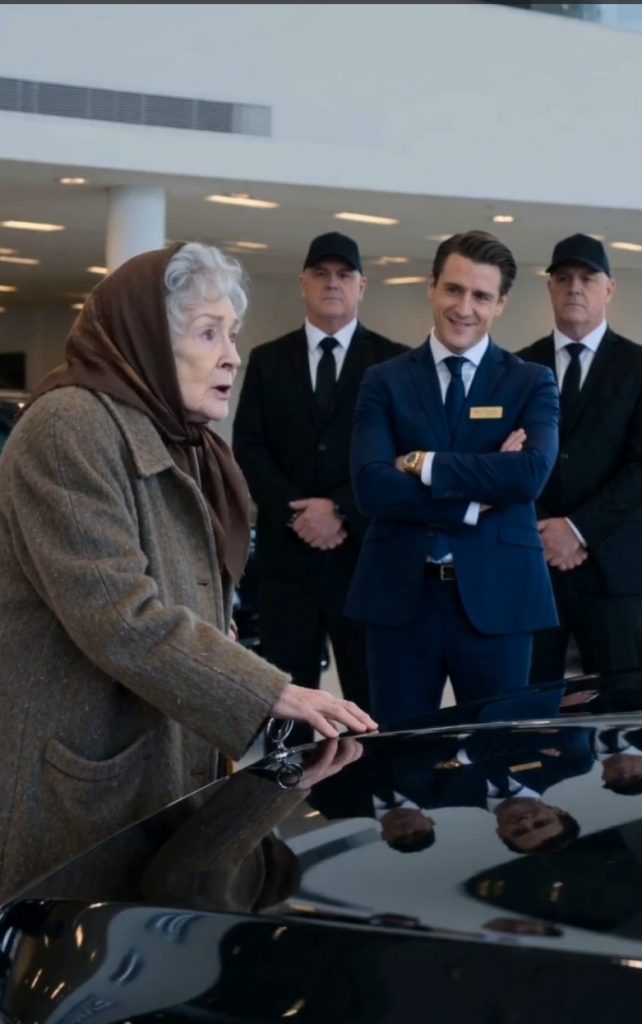
The old woman placed her hand on the hood of the black sedan as if she were touching something alive.
The car sat beneath the showroom lights like a piece of polished midnight, its surface so clean it reflected the marble floor, the ceiling tracks, and the frail curve of her fingers. Around it, the BENNAONG showroom gleamed with the kind of cold beauty that made people lower their voices without knowing why.
She wore a heavy brown wool coat that hung from her shoulders like it had belonged to someone larger. A patterned headscarf framed her lined face, and a wooden cane rested in her other hand. Every few seconds, the cane tapped softly against the marble, a small human sound in a room built to worship money.
The manager watched her as though she had wandered into the wrong universe.
His name tag read BENNAONG in gold letters. His suit was sharp, black, and perfect. His beard was trimmed, his hair carefully styled, and his arms were crossed so tightly over his chest that he looked less like a salesman and more like a gatekeeper.
The woman looked up at him.
“I want to buy this car,” she said.
For one second, nobody moved.
Then the manager laughed.
It was not a surprised laugh. Not even a nervous one. It was loud, open, and cruel, thrown upward toward the ceiling so everyone in the showroom could hear it. Behind him, three security men in dark suits joined in, not because the joke was funny, but because he had decided it was.
The old woman’s hand remained on the car.
Her fingertips trembled slightly, but her face did not collapse. She only blinked, slowly, as if she had been expecting pain but not quite in this shape.
“You?” the manager said, still smiling. “You want to buy this car?”
Several customers turned their heads.
A young couple near the financing desk stopped whispering. Two sales employees froze beside another sedan. A woman in a cream blazer lowered the brochure in her hand and stared.
The manager stepped closer, his shoes clicking across the marble.
“Ma’am,” he said, stretching the word until it became an insult, “this is not a public restroom. This is BENNAONG. Do you understand where you are?”
The old woman looked at the car again.
“I know where I am.”
That irritated him.
People like her were supposed to apologize. They were supposed to bow their heads, mumble about a mistake, and disappear before their poverty stained the shine. But this woman stood there with her cane and her old coat, calm in a place designed to make her feel small.
The manager’s smile sharpened.
“Security,” he called.
The word echoed through the glass showroom.
The three men behind him straightened immediately. One stepped forward. The old woman looked at them, then back at the manager, and something quiet changed in her face.
The hope disappeared.
In its place came a stillness so deep it made one of the younger salesmen look away.
She did not argue. She did not beg. She did not tell him he was wrong.
She simply removed her hand from the hood, adjusted her grip on the cane, and turned toward the exit.
The cane began to tap again.
Tap.
Tap.
Tap.
Every sound landed like a question nobody wanted to answer.
The automatic glass doors slid open as she reached them. Cold daylight spilled across the marble, cutting through the showroom’s artificial glow. Outside, traffic moved along the city street, ordinary and indifferent.
Just before she stepped out, the manager called after her.
“Next time, try the bus station.”
The guards laughed.
A few customers did too, weakly, the way people laugh when they are afraid of standing alone.
The old woman paused with one foot on the threshold.
For the first time, she looked back at the showroom. Not at the manager. Not at the guards. Not at the cars.
At the gold BENNAONG letters above the reception desk.
Then she walked out.
And no one noticed the elderly man across the street lowering his phone after recording every word.
Act II
Her name was Ruth Ainsley, though almost nobody in the city remembered it anymore.
Thirty-eight years earlier, before BENNAONG became a name whispered in private clubs and displayed in glass towers, Ruth had lived in a two-room apartment above a bakery with a man who believed cars could have souls.
His name was Elias Ainsley.
He was not rich. He was not famous. He was an engineer with oil under his nails, invoices in his pockets, and ideas too large for the garage he rented behind a hardware store. He could spend six hours adjusting the sound of a door closing because, as he told Ruth, “A car should make you feel safe before you even start the engine.”
Ruth worked nights at a hospital laundry back then. She came home smelling of bleach, with swollen feet and cracked hands, and still helped him test leather samples, sort screws, and type letters to investors who never replied.
When Elias designed the first BENNAONG sedan, it did not have a name yet.
It was just “the black one.”
Ruth called it that because the prototype was always covered under a black canvas sheet in the garage. Elias would lift the cover like a magician revealing a secret, and Ruth would pretend to gasp every time.
Then one evening, after another investor rejected him, Elias sat on the garage floor and cried.
Not loudly. Elias never cried loudly.
Ruth knelt beside him and took off her wedding ring.
The diamond was small. The band was thin. It had been the only expensive thing she owned.
“Sell it,” she said.
He refused for three days.
On the fourth, he sold it.
That money paid for the final prototype part that made the car run.
Years later, when investors finally came, they did not come because Elias was charming. They came because Ruth had mailed a handwritten letter to a retired industrialist named Conrad Bennaong, a man known for taking risks on impossible machines.
Conrad had money. Elias had the design. Ruth had the stubbornness to make both men sit at the same table until one believed the other.
The company took Conrad’s name because his fortune opened the first factory.
But the car carried Elias’s heart.
And Ruth knew every curve of it.
She knew the hidden line beneath the hood where Elias had once said, “That’s where the light should break.” She knew the seat stitching pattern he copied from the plaid skirt she wore on their first date. She knew the small emblem inside the glove box, a tiny silver sparrow, because Elias used to call her “my sparrow” when she moved too fast through their little kitchen.
BENNAONG sold its first thousand cars in eighteen months.
Then ten thousand.
Then the world changed around them.
Conrad died. Elias became the quiet genius in the background. Executives arrived with expensive watches and soft hands. They loved the story of the humble founder, as long as that story could be polished, packaged, and sold.
They did not love Ruth.
She was too plain. Too blunt. Too unwilling to pretend that greed was vision.
When Elias got sick, the board moved quickly. Contracts appeared. Voting rights shifted. A legal trust was created “for continuity.” Ruth signed some papers at the hospital because a lawyer told her Elias had already approved them.
He had not.
By the time she understood what had happened, Elias was gone, and the company he built no longer returned her calls.
They sent flowers to the funeral.
White lilies. No note.
Ruth buried her husband wearing a plain brass ring from a street market because the real one had become part of the first BENNAONG engine.
After that, she disappeared.
Not because she was defeated.
Because Elias had left her one thing the board never found.
A brown envelope sealed inside an old toolbox, hidden beneath grease-stained manuals and a photograph of the black prototype. In that envelope was a document Conrad Bennaong had signed in the company’s first year.
It granted Ruth Ainsley a founder’s share.
Not symbolic.
Controlling.
Conrad had written one sentence beneath his signature.
For the woman who made us possible.
Ruth spent decades refusing to use it.
Then, three weeks before she walked into the showroom, a letter arrived from a stranger.
It contained only two things.
A photograph of the new BENNAONG flagship sedan.
And a message written in careful black ink.
They are selling his dream to people who would have thrown him out.
Act III
The man who sent the letter was Samuel Price, the elderly stranger standing across the street that morning with his phone in his hand.
Samuel had once been the first mechanic Elias hired.
Back then, he had been twenty-two, broke, and reckless enough to believe he could build anything if someone gave him coffee and a wrench. Elias gave him both. Ruth gave him soup when he forgot to eat.
He never forgot them.
When BENNAONG became powerful, Samuel stayed in the factory as long as he could. But men like him were slowly pushed out. They called it modernization. They called it restructuring. Samuel called it what it was.
Erasure.
He watched the new executives remove Elias’s photograph from the design wing. He watched Ruth’s name vanish from anniversary brochures. He watched salespeople repeat a clean corporate myth about “legacy craftsmanship” without knowing whose hands had created that legacy.
Then he met Adrian Cole.
The showroom manager.
Adrian was not the worst man in the company because he was loud. He was the worst because he believed the company’s cruelty was elegance. He trained his staff to judge customers before greeting them. He told new hires that luxury was “not about access, but exclusion.”
He turned humiliation into policy.
A delivery driver once came in to ask about a used company vehicle for his daughter. Adrian made him wait forty minutes, then told him the service entrance was around back.
A retired teacher brought in her late husband’s BENNAONG for appraisal. Adrian told her the car was “sentimental, not valuable,” then had it quietly purchased through a broker for a fraction of its worth.
A young mechanic applied for a job and mentioned that his grandfather had worked with Elias Ainsley. Adrian laughed and said, “Everyone’s grandfather claims they built this brand.”
Samuel heard the story from the mechanic.
That was when he wrote to Ruth.
But Ruth had not come to the showroom to expose anyone.
Not at first.
She came because the black sedan on display was the anniversary edition. The company had announced it as a tribute to “the founders,” though the brochure mentioned Conrad Bennaong six times and Elias Ainsley only once in a footnote.
Ruth wanted to buy one.
Not for status. Not for revenge.
For Elias.
She wanted to drive it once to the hill outside the city where they used to park after long nights in the garage, eating cold sandwiches and imagining a life big enough to scare them.
She wanted to place her hand on the dashboard and say, “We made it, Eli.”
But when she entered the showroom, nobody saw a founder’s widow.
They saw an old coat.
They saw a cane.
They saw a woman who looked like she had no right to touch polished metal.
So Adrian laughed.
And in that laugh, Ruth heard thirty-eight years of doors closing.
She walked out slowly because her hip hurt, but also because she needed every person in that room to remember the sound of her leaving.
Samuel crossed the street as soon as she stepped onto the sidewalk.
He removed his cap.
“Mrs. Ainsley,” he said.
Ruth looked at him for a long moment. Age had changed his face, but not his eyes.
“Sammy Price,” she whispered.
He smiled sadly. “You always said I’d grow into my ears.”
For the first time that morning, Ruth almost laughed.
Almost.
Then Samuel held up his phone.
“I recorded it,” he said. “All of it.”
Ruth looked through the glass. Inside, Adrian was already smiling again, brushing invisible dust from his suit as if the old woman had been nothing more than a stain removed from the floor.
Samuel’s voice lowered.
“The board is meeting upstairs today.”
Ruth turned back to him.
“They’re here?”
“All of them,” he said. “For the anniversary launch.”
Through the second-floor glass above the showroom, Ruth could see silhouettes moving behind frosted walls. Men and women with power, gathered above the cars, above the customers, above the employees who were trained to obey.
Her fingers tightened around the cane.
Samuel reached into his coat and handed her a folder.
Inside was the founder’s share document, copied, certified, and accompanied by letters Ruth had not seen in years. Conrad’s signature. Elias’s notes. The original trust language. Proof of every quiet theft hidden beneath legal polish.
Ruth stared at the pages.
Then she looked at the showroom doors.
“Sammy,” she said softly, “call the attorney.”
Samuel nodded.
Ruth adjusted her headscarf.
This time, when the glass doors opened, she did not walk in alone.
Act IV
The first thing Adrian noticed was not Ruth.
It was the woman beside her.
She was tall, silver-haired, and dressed in a navy suit that made even the showroom’s best employees stand straighter. Behind her came Samuel Price, two legal assistants, and a man carrying a slim black case.
The conversations died almost instantly.
Adrian’s smile faltered.
Ruth walked at the center of them, cane tapping against the marble, the same slow rhythm as before.
Tap.
Tap.
Tap.
But now it sounded different.
Not like retreat.
Like a verdict approaching.
Adrian stepped forward with irritation already rising in his face.
“I thought I made myself clear,” he said.
The woman in the navy suit looked at his name tag.
“Adrian Cole?”
His chin lifted. “I’m the general manager.”
“Not for long,” she said.
The room went so quiet that somewhere near the windows, a customer’s phone could be heard vibrating against a glass table.
Adrian blinked. “Excuse me?”
The attorney opened her folder.
“My name is Vivienne Hart. I represent Ruth Ainsley, controlling founder shareholder of BENNAONG Automotive Holdings.”
A nervous laugh escaped Adrian before he could stop it.
“That is absurd.”
Ruth said nothing.
Vivienne turned a document toward him.
It bore Conrad Bennaong’s signature, a corporate seal, and Ruth’s name in ink that had survived decades better than the men who tried to bury it.
Adrian looked at the page.
Then at Ruth.
For the first time, he really saw her.
Not the coat. Not the cane. Not the headscarf.
Her.
The woman whose name had been removed from plaques but not from history.
“That can’t be valid,” he said.
“It is,” Vivienne replied. “Confirmed by the company’s own archival counsel this morning.”
Above them, movement flashed behind the glass wall of the second-floor conference room. Board members were looking down now.
Ruth finally spoke.
“I came here to buy a car.”
Her voice was quiet, but it carried across the marble.
Several employees lowered their eyes.
“I came with money,” she continued. “With identification. With no anger in my heart. I came because my husband designed that hood line with a pencil he sharpened using a kitchen knife.”
Her hand lifted toward the black sedan.
“He designed that seat pattern from my skirt. He placed a sparrow in the glove box because he said every machine needs one secret that belongs to love.”
The woman in the cream blazer covered her mouth.
Ruth turned to Adrian.
“You saw an old woman and decided I was not worth basic decency.”
Adrian’s face hardened, but fear had begun to show beneath it.
“Ma’am, there was a misunderstanding.”
“No,” Ruth said. “There was understanding. You understood exactly what you were doing.”
Samuel handed the phone to Vivienne.
The video played.
Adrian’s laughter filled the showroom.
Louder than before. Uglier than before. Without the protection of the moment, it sounded naked and small.
The guards behind him stared at the floor.
The customers watched him watch himself.
Then came his final sentence.
“Next time, try the bus station.”
No one laughed now.
The second-floor elevator opened.
Three board members stepped out, followed by the current CEO, a polished man named Malcolm Voss, whose public face had appeared in magazines above words like innovation and heritage.
He approached Ruth with both hands slightly raised.
“Mrs. Ainsley,” he said carefully. “Perhaps we can discuss this privately.”
Ruth looked at him.
“You had thirty-eight years to speak to me privately.”
The CEO stopped.
The entire showroom seemed to inhale.
Ruth reached into her coat pocket and removed a small object wrapped in a faded cloth. She unfolded it with care.
Inside lay a thin brass ring.
“My real wedding ring paid for your first running prototype,” she said. “This one cost twelve dollars. I wore it to my husband’s funeral while your company sent flowers without a note.”
Malcolm’s expression shifted.
Whether it was shame or calculation, no one could tell.
Ruth turned to Vivienne. “Read it.”
Vivienne opened the second document.
“As controlling founder shareholder, Mrs. Ainsley is exercising emergency authority under the original governance clause. Effective immediately, Adrian Cole is removed from his position pending formal termination. A full ethics review will begin across all BENNAONG retail locations. Any employee punished for reporting discriminatory conduct will be reinstated or compensated.”
Adrian’s mouth fell open.
“You can’t do this.”
Ruth’s eyes did not move from his.
“I already have.”
The security guards did not touch her now.
They did not move at all.
The same men who had formed a wall behind Adrian stood suddenly without a side to stand on.
But Ruth was not finished.
She turned toward the black anniversary sedan.
“I still want to buy the car,” she said.
Malcolm seized the opening. “Of course. Naturally, we would be honored to gift it to you.”
Ruth’s face tightened.
“No.”
The word landed sharply.
“I said buy. Not receive. Not accept. Not pose for a photograph while you pretend you remembered me.”
She reached into her old coat and took out a checkbook.
The room watched as Ruth Ainsley, in her worn shoes and brown wool coat, wrote a check for the full price of the most expensive car in the showroom.
Then she paused before signing.
“There is one condition.”
Malcolm swallowed. “Name it.”
Ruth looked toward the younger sales employees standing frozen by the reception desk.
“The commission goes to the employee who tried to bring me tea before your manager stopped her.”
A young woman in a black blazer went pale.
Her name was Maya.
She had been working there for six weeks.
Earlier that morning, when Ruth first entered, Maya had stepped forward with a warm smile. Adrian had cut her off with two fingers in the air and whispered, “Do not waste time on that.”
Now Ruth looked directly at her.
“You saw me,” Ruth said.
Maya’s eyes filled.
And that was when Adrian lost the last thing he had been clutching.
Not his job.
Not his pride.
His certainty that people like Ruth could be humiliated without consequence.
Act V
The paperwork took twenty-seven minutes.
No one in the showroom forgot a single one of them.
Adrian stood near the side office with a legal assistant beside him, his gold name tag removed and placed face down on a glass desk. The three security men waited separately, silent and stiff, each suddenly remembering that obedience did not erase responsibility.
Customers who had watched Ruth leave now watched her sign her name.
Ruth Ainsley.
The letters were slow but steady.
When Maya received the commission confirmation, she pressed both hands to her mouth and turned away. Later, she would call her mother from the break room and cry so hard she could barely explain what had happened.
Ruth did not smile for cameras because she refused every camera.
A man from corporate communications appeared with frightened enthusiasm and suggested “a healing moment for the brand.” Ruth looked at him once, and he vanished back into the elevator.
She did allow Samuel to stand beside her when the car was brought forward.
The black sedan glided across the showroom floor, silent and shining. Its paint caught the city light. Its hood reflected Ruth’s face, every line of it, every year, every loss, every night she had worked while Elias built a dream other men tried to steal.
Maya opened the driver’s door for her.
Ruth ran her hand along the frame.
Then she leaned inside and opened the glove box.
For a moment, she did not breathe.
There it was.
A tiny silver sparrow.
The company had kept the emblem without remembering why.
Ruth touched it with one finger.
“Hello, Eli,” she whispered.
Samuel looked away.
The showroom no longer felt cold. Not because the marble had warmed or the lights had softened, but because truth had entered the room, and truth has a way of making expensive things look small beside ordinary love.
Before Ruth drove away, she asked Maya to sit in the passenger seat for one minute.
Maya hesitated. “Me?”
“Yes,” Ruth said. “You should know what kindness helped sell.”
Maya slipped inside carefully, as if entering a chapel.
Ruth placed both hands on the steering wheel. Her fingers were bent with age, but they settled there with startling familiarity.
“My husband believed luxury was not supposed to make people feel poor,” she said. “He believed it should make people feel cared for.”
Maya nodded, unable to speak.
Ruth looked through the windshield at the showroom floor, at the employees, the board members, the customers, and the man who had laughed at her.
“Remember that,” she said.
Then she started the car.
The engine turned over with a low, smooth sound.
Ruth closed her eyes.
For one heartbeat, she was not an old woman in a luxury showroom. She was young again, sitting in a cold garage beside Elias while the first prototype coughed, trembled, and finally came alive. She could smell gasoline, rain, and bakery bread from downstairs. She could hear Elias shouting with joy, lifting her off the ground, laughing into her hair.
We made it, Ruthie.
She opened her eyes.
“Yes,” she whispered. “We did.”
The glass doors opened.
This time, nobody ordered her out.
The staff stood aside. Customers watched in silence. Samuel placed a hand over his heart as Ruth guided the black sedan toward the street.
Outside, the city kept moving, unaware that an empire had just been corrected from inside a showroom.
But BENNAONG changed after that day.
Not overnight. Companies never repent as quickly as people pretend. There were investigations, resignations, lawsuits, statements, and meetings that stretched late into the night. The board tried to soften the story. Ruth refused to let them.
The video went public anyway.
Not through her.
Through a customer who had filmed the moment Adrian laughed.
Millions watched the old woman touch the car. Millions heard the manager mock her. Millions saw her leave with quiet dignity, then return with the history he had never bothered to learn.
For days, people argued online about wealth, class, arrogance, and the kind of rooms that decide who belongs before anyone opens their mouth.
But Ruth cared little for the noise.
She drove the black sedan to the hill outside the city.
Samuel followed in his truck, giving her space.
At the top, Ruth parked beneath an old oak tree overlooking the skyline. The city lights flickered below, glass towers rising where factories and workshops had once stood. She sat there for a long time with the engine off and the window cracked open.
Then she took out a sandwich wrapped in paper.
Cold turkey. Mustard. No crust.
Elias’s favorite.
She placed half on the passenger seat.
“You would have hated the showroom,” she said softly. “Too much glass. Not enough coffee.”
The wind moved gently through the car.
Ruth laughed then.
A small laugh.
A real one.
A month later, BENNAONG unveiled a new plaque in the flagship showroom. Ruth refused to attend the ceremony unless every technician, janitor, receptionist, and junior salesperson was invited before the executives.
The plaque did not say “legacy.”
Ruth hated that word.
It said:
ELIAS AND RUTH AINSLEY
WHO BUILT THE FIRST CAR WITH SKILL, SACRIFICE, AND LOVE.
NO ONE WHO ENTERS THIS HOUSE IS BENEATH RESPECT.
Maya became the youngest senior client advisor in the showroom’s history. Samuel was hired as an archival consultant, though he mostly used the position to correct executives when they said something foolish.
As for Adrian Cole, his name disappeared from the building faster than Ruth’s ever had.
But unlike Ruth, he had earned his absence.
Years later, people still told the story of the old woman in the brown coat.
Some told it as revenge.
Some told it as justice.
Ruth never called it either.
When asked what she had felt in the moment the manager laughed, she gave the same answer every time.
“I felt sorry for him,” she said. “He was standing in a palace built by people he would have thrown out.”
Then she would touch the little silver sparrow on her keychain and walk away, cane tapping softly, leaving behind the kind of silence that makes people rethink who they choose to respect.