Act I
The hammer rang through the frozen settlement like a warning bell.
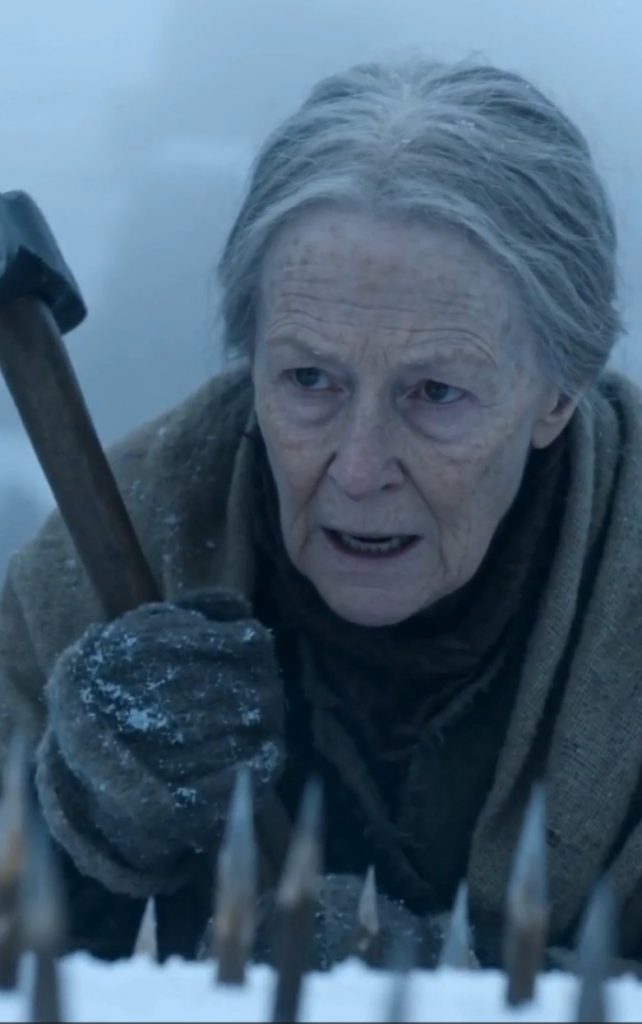
High above the snow, an old woman stood halfway up a crooked wooden ladder, her boots braced against the trembling rungs, her gloved hands wrapped around the handle of an iron hammer. The wind pulled at her dark headscarf. Frost clung to the edges of her coat. Every breath left her mouth in a hard white cloud.
Below her, the men of the village watched in silence.
She did not look down.
She raised the hammer again.
The iron head came down on the sharpened wooden stake with a crack that echoed across the stone huts. Snow jumped from the roof. The stake sank deeper between the dark roof logs, joining hundreds of others already standing upright like a field of frozen thorns.
One of the men crossed himself.
Another whispered, “Why is she doing this?”
No one answered.
No one knew.
Her name was Mara, though most people in the village had stopped using it years ago. They called her the widow. The mad old woman. The one who spoke to her stove at night and stacked firewood like she was preparing for a siege.
Now she had climbed onto her roof in the worst fog of the season and begun driving sharpened stakes into every open space above her home.
Not a few.
Not enough to scare off a wolf.
Hundreds.
The men stood near the firewood pile, their fur-lined caps pulled low, their faces stiff with unease. Behind them, the rest of the village hid inside doorways, watching through cracks in shutters. Children were pulled away from windows by frightened mothers.
Mara swung again.
Crack.
A younger man named Oren took one step forward. “Old mother,” he called, trying to sound respectful. “Come down before you fall.”
She ignored him.
The hammer rose.
Crack.
“You’ll bring the roof down,” another man shouted.
Still nothing.
Only the hammer.
Only the wind.
Only the fog pressing close around the settlement, thick and gray, swallowing the dead trees beyond the last hut.
Mara paused at last. Her shoulders rose and fell. Her hands trembled from age and cold, but her eyes remained fixed on the next stake as if the entire world had narrowed to one point of wood.
The men below stared up at her.
What they saw was a poor widow in rags, too stubborn to admit she had lost her mind.
What they did not see was the memory behind her eyes.
They did not see the night forty winters earlier when another village had laughed at another warning.
They did not see the roofs turning black with shadows.
They did not hear the sound that came from the fog after midnight.
Mara tightened her grip.
One of the villagers muttered, “She’s building a cage for demons.”
At that, Mara finally turned her head.
Her face was lined and weathered, but her stare cut down through the cold with terrible clarity.
“No,” she said.
Her voice was rough from the wind.
“I am building the only door they cannot open.”
Then, far beyond the trees, something answered.
Act II
The sound was faint at first.
Not a howl.
Not thunder.
A low wooden groan, like old carts moving through snow where no road existed.
The men turned toward the fog.
Mara did not.
She went back to hammering.
That frightened them more than the sound.
The village of Greystone had always lived with fear, but fear had rules. Wolves came hungry. Sickness came in spring thaw. Tax collectors came before harvest. Men understood those things. They could lock doors, hide coin, sharpen axes, pray.
But Mara’s fear had no shape.
For three days, she had dragged wood from the forest with a rope around her waist. For three nights, smoke had risen from her chimney as she burned pitch and hardened the points of the stakes over fire. At dawn, she had carried them outside one by one and leaned them against her stone wall.
People laughed then.
“She thinks winter can climb,” a boy had joked.
Mara heard him.
She did not smile.
Before age bent her back, before grief carved her face, Mara had not been a peasant woman. She had been the daughter of a ridge warden, raised in a fortress no longer marked on any map. Her father guarded the northern pass where traders crossed during summer and armies tried to cross when kings grew ambitious.
Mara learned to read tracks before she learned to sew.
She learned where snow breaks under weight, how fog carries sound, how silence can lie.
When she was seventeen, the King’s Road fell.
Not to soldiers marching beneath banners.
To men who came over rooftops.
They called themselves the White Rooks because they struck in winter and vanished before sunrise. They traveled light, wore pale cloaks, and carried hooked ladders that could bite into wood and stone. They did not break gates. They did not waste strength on doors. They climbed where people never thought to look.
Roofs.
Smoke holes.
Storage lofts.
The first village they took had mocked the old ridge wardens for building steep roofs lined with spikes. The villagers said it looked ugly. Primitive. Wasteful.
By dawn, there was no one left laughing.
Mara survived because her father dragged her into a grain cellar and held one hand over her mouth until the sounds above faded into morning.
She remembered the look on his face afterward.
Not fear.
Failure.
He had warned them. They had laughed. And warning did not matter when pride was louder.
Years later, Mara married Tomas, a quiet carpenter with kind eyes and hands that could make even broken wood useful. They came to Greystone together when it was still a young settlement, just a ring of huts around a well.
She told him about the White Rooks once.
Only once.
He believed her.
That was why their roof had always been built differently.
Too steep. Too strong. Too many hidden braces beneath the logs.
The villagers teased them for it. Tomas only shrugged and said, “My wife likes sleeping under a stubborn roof.”
When Tomas died, the roof remained.
So did Mara.
She had no children living in Greystone. No husband. No family close enough to visit when the snow grew cruel. Only a stone hut, a stack of firewood, a cane she refused to use, and memories everyone else dismissed as old woman’s tales.
Until three mornings ago.
Mara had gone to the forest before sunrise to gather fallen branches. Near the frozen stream, she saw marks in the snow.
Not wolf.
Not deer.
Hooks.
Metal teeth dragged in pairs.
She followed the marks with her eyes and saw where pale cloth had snagged on a thorn bush.
White.
Almost invisible against snow.
Mara stood very still.
Then she turned and looked toward Greystone.
Children’s smoke rising.
Goats tied near doors.
Men arguing over firewood.
Women kneading coarse bread.
A village that believed danger always announced itself at the gate.
Mara went home and began sharpening stakes.
She told no one at first because she knew how they would look at her. The same way they looked now. With pity sharpened by annoyance.
But as the day faded and the fog thickened, even the boldest men stopped laughing.
The groan beyond the trees came again.
Closer this time.
Mara lifted the hammer.
And below her, Oren finally saw what was carved into the underside of her roof beams.
Old marks.
Warden marks.
Warnings.
Act III
Oren had been a boy when Tomas died.
He remembered the funeral only because Mara had stood beside the grave without crying. People called her cold for that. Oren’s mother had told him to hush.
“Some grief freezes too deep for tears,” she had said.
Now, staring up at Mara’s roof, he understood something he had never noticed before.
The hut was not ugly.
It was fortified.
The stones were thick and uneven, but they leaned inward at careful angles. The doorframe was narrow enough that only one person could enter at a time. The woodpile beside the ladder was stacked not randomly, but as a barrier. Even the small window near the back had an iron crossbar hidden behind a hanging cloth.
Mara had not spent years living like a strange old widow.
She had spent years waiting for history to remember the path back.
Oren swallowed. “What are those marks?”
Mara did not answer immediately.
She drove another stake into place.
Then she said, “Instructions.”
“For what?”
“For surviving men who come from above.”
A murmur passed through the villagers.
One of the older men, Petyr, scoffed too loudly. “There are no White Rooks. My grandfather said those stories were made to scare children from wandering at night.”
Mara looked down at him.
“Your grandfather locked his roof hatch every winter.”
Petyr went pale.
The others turned toward him.
He opened his mouth, then closed it.
The fog shifted again. For one heartbeat, between the leafless trees, shapes moved.
Human shapes.
Then the gray swallowed them.
The group below the ladder broke apart in panic.
“Inside,” Oren shouted. “Get everyone inside.”
But Mara’s voice cracked through the chaos.
“Not your own huts.”
They stopped.
She pointed with the hammer toward the stone chapel at the center of the settlement. It was the only building with no roof loft, only a low slate covering too smooth for hooks.
“The chapel,” she said. “Women. Children. Elders. Now.”
Petyr shook his head. “You don’t command this village.”
“No,” Mara said. “But fear does. And fear is finally telling the truth.”
Nobody moved for half a second.
Then a child cried from one of the doorways, and that sound broke the men’s pride.
They ran.
Doors opened. Mothers wrapped blankets around children. Goats bleated. Someone dropped a basket of turnips into the snow. Oren and two others began pushing people toward the chapel while Petyr stood frozen, ashamed and furious in equal measure.
Mara climbed down three rungs, reached for another bundle of stakes, then climbed back up.
Her body was failing her. Every movement hurt. Her wrists burned. Her knees shook beneath the weight of cold and age.
But memory held her upright.
She hammered until her hands went numb.
Crack.
Crack.
Crack.
As she worked, a young girl appeared below the ladder.
It was Petyr’s granddaughter, Lina, barely eight years old, wrapped in a red scarf.
“Grandmother Mara,” the girl called.
Mara stiffened at the word.
No one had called her that in years.
“Go to the chapel,” Mara said.
Lina held up a small pouch. “Mother says your fingers will freeze.”
Inside were strips of wool and a little pot of rendered fat to rub into the skin.
Mara stared down at the child.
For a moment, the fog, the roof, the danger, all of it slipped aside, and she saw herself at seventeen, hiding in the cellar while adults above her wished they had listened sooner.
“Run,” Mara whispered.
Lina obeyed.
Mara tied the wool clumsily around her gloves and lifted the hammer again.
Then the first hook landed on the far roof.
Act IV
The sound was unmistakable.
A hard bite of metal into wood.
Then another.
Then another.
Across Greystone, pale ropes shot upward through the fog and caught on roof edges. Hooked ladders rose like ribs from the snow. Men in white cloaks began climbing, silent and fast.
No war cry.
No warning.
Just movement.
The village had never looked so small.
Mara shouted, “Cut the ropes!”
Oren understood first. He grabbed an axe from beside the woodpile and ran to the nearest hut, swinging at the rope hooked over the eaves. Another man followed. Then another.
The first ladder fell backward into the fog with a crash.
A shape dropped away with it, swallowed by snow and gray.
No one stopped to look.
Mara drove the last stake into her roof and turned toward the far side of the settlement. Her own hut stood closest to the tree line. That meant it would be first.
She knew that.
She had always known that.
The first pale figure reached her roof just as she pulled the ladder away.
A gloved hand appeared over the edge.
Then another.
The climber tried to swing himself up, but the field of sharpened stakes blocked every place a knee or palm could land. He hesitated, confused. Another came behind him. Then a third.
They had found many roofs in many villages.
Never one like this.
Mara stood below with the hammer in one hand and the ladder braced under the other arm.
The man above looked down at her through the fog.
For a second, their eyes met.
He was younger than she expected.
That hurt in a way she had no time to understand.
“Go back,” she said.
He did not.
He shifted toward the chimney.
Mara swung the hammer against the roof support peg she had loosened that morning.
The outer rail of stakes snapped forward, not falling, but dropping into an angled barrier that blocked the chimney path completely.
The climber recoiled.
Behind him, the others shouted for the first time.
Not with victory.
With surprise.
Across the village, the chapel bell began ringing.
Not because anyone pulled it in ceremony, but because Lina had climbed onto a bench and thrown her whole small body against the rope again and again. The bell thundered through the fog, calling every hidden soul to wakefulness.
Men poured from doorways.
Not brave men.
Frightened men.
But frightened men can still choose well.
They cut ropes. Dragged ladders down. Blocked doors. Threw sand over icy paths. Every trick Mara had carved into her beams, every warning dismissed as madness, became instruction.
Oren ran to her side. “Your roof held.”
“Not enough,” Mara said.
She pointed toward the grain store.
A hooked ladder had caught there. Two white-cloaked raiders had reached the top and were trying to pry open the loft hatch where winter barley was kept. If they took the grain, Greystone would not need swords to die. Hunger would finish the work.
Oren started toward it, but Petyr grabbed his arm.
“There are too many.”
Mara heard him.
She took one breath.
Then she did something no one expected.
She climbed back up the ladder.
“Mara!” Oren shouted.
She did not stop.
With the hammer tucked into her belt, she pulled herself rung by rung toward the roofline of her own hut. The spikes made the surface impossible to cross for enemies, but Mara knew the hidden path between them. Tomas had built it for her long ago: three safe beams beneath the snow, angled just wide enough for a careful foot.
She stepped onto the roof.
The village froze.
The old woman moved across the field of stakes like a ghost returning to a battlefield she had never truly left.
The raiders saw her.
So did the villagers.
Mara reached the highest point of her roof and lifted a tar-soaked bundle tied to the chimney. With shaking hands, she struck flint once.
Nothing.
Again.
A spark.
The bundle caught.
Orange light burst through the fog.
Not a fire large enough to burn the roof.
A signal.
On the ridge beyond the chapel, another flame answered.
Then another.
Oren stared upward, stunned.
Mara had not only prepared her own hut.
She had warned the ridge wardens.
The old order everyone thought dead had been watching the pass all along.
Horns sounded through the fog.
Deep. Human. Near.
The raiders on the grain store looked toward the ridge.
For the first time, they were the ones afraid.
Act V
The White Rooks left the way cowards leave when darkness no longer belongs to them.
Fast.
The horns grew louder. Torchlight moved between the trees. The raiders dropped from roofs, abandoned hooks, slipped into the fog, and ran for the forest before the ridge wardens reached the village edge.
No grand battle followed.
No heroic charge.
Just the collapse of a plan that had depended entirely on surprise.
By dawn, Greystone still stood.
Smoke rose from every chimney. The chapel doors opened, and the villagers emerged into a morning made silver by frost. Children clung to their mothers. Men moved through the snow collecting abandoned ropes and broken hooks, staring at them as if proof could still be denied if they looked away long enough.
Mara sat on the lowest rung of her ladder.
Her hammer lay beside her.
Her hands were wrapped in wool, swollen from the night’s labor. Her headscarf had come loose. Snow rested on her shoulders. She looked smaller than she had on the roof, and older.
For once, nobody called her mad.
Oren approached first.
He removed his cap.
“I should have listened,” he said.
Mara looked at the ground. “Yes.”
The simple answer struck harder than anger would have.
Petyr came next, shame dragging his face downward.
“My granddaughter said you saved us.”
Mara’s eyes flicked toward the chapel, where Lina stood with her red scarf bright against the snow.
“She rang the bell,” Mara said. “Remember that when men speak of who saved whom.”
Petyr nodded slowly.
Then Samuel, the oldest man in Greystone, stepped from the crowd. He had been silent through all of it, silent in the way people are when memory finally catches up with them.
“My mother used to speak of the roof-thorns,” he said. “I thought they were superstition.”
Mara leaned back against the ladder.
“Most wisdom becomes superstition when the danger stays away long enough.”
No one spoke.
The ridge wardens arrived before full sunrise, six riders in gray cloaks with frost on their beards and old iron badges at their throats. Their captain dismounted in front of Mara’s hut and bowed his head to her.
Not slightly.
Deeply.
The villagers stared.
“Mara of Northpass,” he said.
The name moved through the crowd like wind through dry leaves.
Northpass.
Even the youngest knew that name from winter tales. A fortress swallowed by snow. A road lost to war. A girl who had survived when others had not.
Mara’s jaw tightened.
“I am Mara of Greystone now.”
The captain accepted the correction. “Then Greystone owes you its life.”
She looked toward the roof, toward the hundreds of stakes glittering with ice in the pale morning.
“No,” she said. “It owes itself a memory.”
Over the next days, the village changed.
Not dramatically at first. Villages built of stone and stubborn people do not transform overnight. But men who had once mocked Mara began bringing her firewood without asking. Women came to sit by her stove and listen, not to gossip, but to learn. Children carried small bundles of sharpened sticks and asked where they should be placed.
Mara taught them.
She showed them how to read snow near the tree line. How to listen when fog made sound bend strangely. How to build a roof that did not invite danger down through it. How to keep pride from becoming a locked door.
The chapel stored grain in stone bins instead of roof lofts.
The watch bell was lowered so even a child could reach the rope.
Every hut received roof-thorns before the next snowfall.
Mara supervised from a chair near her doorway, cane across her lap, face unreadable as younger hands did what hers had nearly broken themselves to finish.
One afternoon, Lina brought her a piece of carved wood.
It was a little sparrow, rough and uneven, with one wing slightly larger than the other.
“For your roof,” Lina said.
Mara took it carefully.
“Why a bird?”
“So people remember to look up.”
Mara’s mouth trembled.
That evening, Oren climbed onto her roof and fixed the wooden bird near the chimney, just below the signal post. It faced the forest, small and brave against the winter sky.
Weeks passed.
The fog returned many times, but the White Rooks did not.
Word traveled across the valley that Greystone was no easy village. That its roofs had teeth. That its children knew the bell rope. That its old widow had eyes sharper than winter.
Some people exaggerated the story. They said Mara fought ten men alone. They said the spikes were magic. They said the fog itself obeyed her.
Mara hated all of that.
The truth was better.
She had been afraid.
She had prepared anyway.
At the end of winter, when the first thaw loosened snow from the roof, the villagers gathered outside her hut. Not for a festival. Not for a speech. They came quietly, carrying tools, timber, and iron.
Petyr stepped forward.
“We want to rebuild the watchtower,” he said. “The old one above the ridge.”
Mara studied him for a long time.
Then she nodded once.
“Build it ugly,” she said.
The men blinked.
Mara reached for her cane and stood slowly.
“Pretty things invite admiration,” she said. “Ugly things often keep you alive.”
For the first time anyone could remember, the villagers laughed with her instead of at her.
The sound rose into the cold air, gentle and human, and Mara turned away before they could see her eyes fill.
That night, she sat alone by the fire with the hammer across her knees.
Outside, the wind moved over the roof-thorns and made them hum softly. The sound no longer felt like warning. It felt like a promise.
Greystone slept.
The chapel bell hung ready.
The watch fires waited beneath covered pitch.
And on the roof of the old stone hut, above the stakes everyone had once feared and mocked, a small wooden sparrow faced the fog.