Act I
The first sound was leather tearing.
Not scratching. Not chewing. Tearing.
Ryan Cole came running down the hallway in a gray T-shirt and jeans, heart already hammering before he reached the living room. The noise had been too violent to be a toy, too steady to be an accident. It sounded like something being ripped open by force.
Then he saw Jerry.
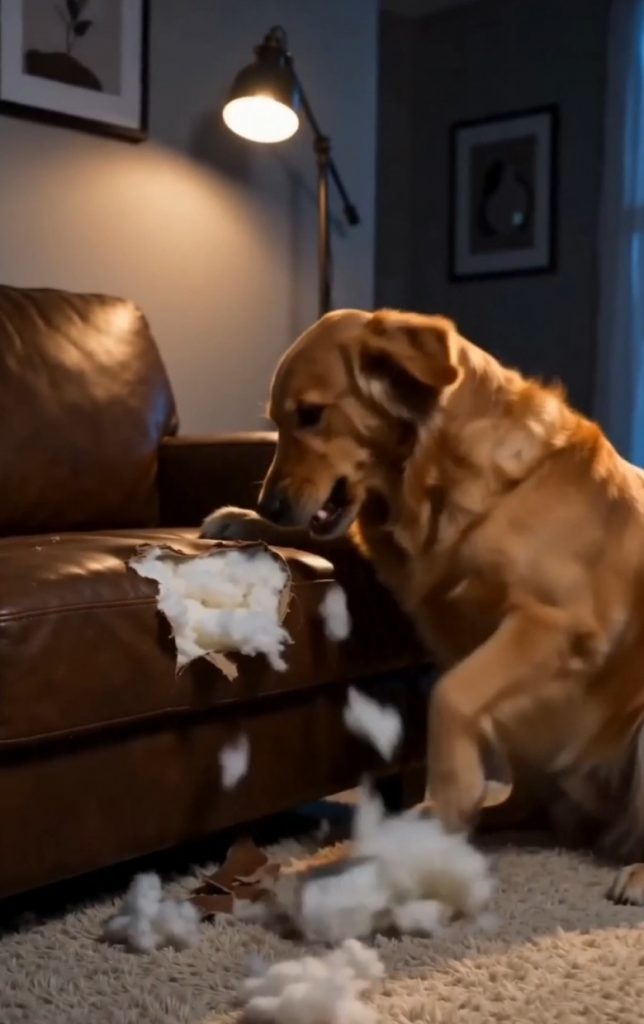
The golden retriever was buried shoulder-deep into the left armrest of the brown leather sofa, his paws digging, his teeth clamped into the torn seam. White stuffing covered the beige rug like dirty snow. Strips of leather hung from the couch in wet, jagged ribbons.
“Jerry!”
Ryan’s voice cracked through the room.
The dog did not stop.
Jerry had always been gentle. Too gentle, sometimes. He greeted delivery drivers like family. He carried socks around the house without puncturing them. He once sat beside a moth for twenty minutes as if guarding something sacred.
But now he looked possessed by a single purpose.
His golden coat bristled under the warm floor lamp. His eyes were wide, not playful, not guilty, not wild.
Focused.
He drove his snout deeper into the ruined sofa and growled.
Ryan froze for half a second, stunned by the sight of the dog he loved destroying the one expensive thing he still owned. That couch had belonged to his mother before she died. It was the last real piece of her house he had kept when everything else had been sold, donated, or packed into storage boxes he couldn’t bear to open.
And Jerry was ripping it apart.
“What are you doing?” Ryan shouted, dropping to his knees. “Jerry, stop!”
He grabbed the dog around the shoulders and pulled.
Jerry resisted with shocking strength.
His paws dug into the rug. His muscles locked. He yanked forward and tore one final mouthful from the armrest, sending foam and cotton into the air.
“Jerry! Stop!”
Ryan pulled harder.
For the first time, Jerry turned his head.
His mouth was full of stuffing. His ears were high. His eyes flashed toward Ryan for one brief second, pleading and urgent, then snapped back to the hole.
Not guilty.
Warning.
Ryan’s anger faltered.
The living room fell into a strange silence. The lamp hummed softly. Outside the windows, the neighborhood was dark and still. The minimalist art on the wall stared down blankly, absurdly calm above the destroyed room.
Jerry sat off to the side, chest rising and falling, but he did not relax.
He stared at the hole in the sofa.
Ryan stared too.
The left armrest had been hollowed open. Inside, beyond torn leather and exposed wood framing, the darkness looked deeper than it should have. Something was in there. Not stuffing. Not a spring. Something small and hard, tucked far back where no dog toy could have reached.
Then Ryan heard it.
A faint sound.
Metal against wood.
Jerry whined once.
Ryan leaned closer, breath caught in his throat.
And from inside the sofa, something blinked red.
Act II
Ryan almost fell backward.
The tiny red light appeared once, disappeared, then appeared again from the shadow inside the armrest. A slow pulse. Steady. Deliberate.
For several seconds, he told himself it was nothing.
A reflection from the lamp. A piece of glass. Some old electronic part that had fallen into the couch years ago.
Then Jerry growled again.
Low. Protective. Certain.
Ryan reached into the hole with two fingers and touched something wrapped in tape.
His stomach tightened.
He pulled carefully, peeling the object free from a nest of dust, torn foam, and old splinters. It came loose with a soft crackle of adhesive.
It was a small black device.
Not a remote. Not a charger. Not anything he recognized from the house.
A camera.
Tiny. Wireless. Its lens was no larger than a shirt button, and the red light on its side continued to blink as it sat in Ryan’s palm.
The room changed around him.
The warm lamp no longer felt cozy. The shadows behind the furniture no longer felt ordinary. The clean walls, the framed art, the familiar rug, the couch his mother had once loved—everything suddenly seemed staged, watched, violated.
Ryan slowly looked toward the hallway.
Then toward the windows.
Jerry moved closer and pressed his body against Ryan’s knee, still staring at the destroyed armrest as if the camera were not the only thing hidden there.
Ryan’s throat went dry.
He had moved into this house six months after his mother’s funeral. Everyone told him it would help, being back in a place that had history. His mother, Marlene, had bought the little modern house after divorcing his father. She called it her quiet place.
Ryan had not remembered it as quiet.
He remembered her locking the door twice at night.
He remembered her lowering her voice on the phone when she thought he was asleep.
He remembered the last year of her life, when she became jumpy and distracted, when she stopped inviting neighbors inside, when she told Ryan not to worry because “some people make noise when they’re losing control.”
At the time, he thought grief and illness had made her paranoid.
The doctors said stress could do that. His aunt said Marlene had always been dramatic. His father, Victor, said she was punishing everyone with silence the way she always had.
Ryan believed them because believing them was easier than believing his mother had been afraid for a reason.
Then she died in a car accident on a rainy Tuesday evening.
The police called it simple.
Bad weather. Sharp curve. No witnesses.
Ryan had accepted that because he was twenty-seven, exhausted, and drowning in paperwork, debt, and condolences that felt more like rehearsed lines than comfort.
The only one who never accepted it was Jerry.
Jerry had been his mother’s dog first.
After the funeral, the golden retriever refused to sleep anywhere except beside the couch. Not on it. Beside it. Always facing the left armrest. Sometimes Ryan woke at three in the morning to find Jerry standing in the dark living room, nose lifted, ears forward, as if listening to someone breathe inside the walls.
Ryan blamed grief.
Dogs missed people too.
But the camera in his hand was not grief.
It was evidence.
His phone buzzed suddenly on the coffee table.
Ryan flinched so hard he nearly dropped the device.
The screen lit up with a name he had not seen in weeks.
Dad.
Ryan stared at it.
Victor Cole had not called since a tense conversation about selling the house. He wanted Ryan to “move on.” He said keeping Marlene’s place was unhealthy. He said the furniture, especially the old couch, was junk with memories stitched into it.
The phone buzzed again.
Jerry began to growl.
Ryan did not answer.
Instead, with trembling hands, he looked back into the armrest.
Behind the torn leather, deeper than the camera had been, something pale was wedged between the wooden supports.
An envelope.
His name was written on it in his mother’s handwriting.
Ryan stopped breathing.
Act III
The envelope had yellowed at the edges.
Ryan pulled it free slowly, afraid the paper might tear, afraid it might not be real, afraid it might say exactly what his heart had already begun to understand.
His name covered the front.
Ryan.
No last name. No explanation.
Just the way his mother had written it on school lunches, birthday cards, and sticky notes left on the fridge when she worked late.
His fingers shook so badly he had to place the camera on the coffee table before opening it.
Inside was a folded letter, a small silver key, and a flash drive taped to the page.
Ryan read the first line and felt the room tilt.
My sweet boy, if Jerry finds this before I can give it to you, trust him before you trust anyone else.
Ryan looked at Jerry.
The dog sat beside him, still panting, eyes fixed on his face now. Waiting.
Ryan unfolded the rest.
His mother’s handwriting was neat, but the pressure changed in places, darker where emotion had pressed harder through the pen.
She wrote that she had discovered something during the divorce. At first, it was money. Accounts Victor had hidden. Loans taken under names that weren’t his. Insurance documents she never remembered signing.
Then it became worse.
Victor had been using her identity to move money through a charity she started for local families. Donations came in. Funds went out. On paper, Marlene had approved everything.
She had not.
When she confronted him, he laughed.
Not because she was wrong.
Because she had no proof.
So Marlene began collecting it.
Bank records. Audio files. Copies of forged signatures. Names of people who helped him. And one recording that terrified her more than anything else: Victor speaking with a man named Daniel Rusk, an insurance investigator Marlene had once trusted.
Ryan read faster, his pulse thudding in his ears.
If something happens to me, do not let them call it an accident.
The words blurred.
Ryan wiped his eyes with the back of his wrist, angry at himself for crying before he even reached the end.
The key opens Box 317 at the Southline Storage Facility. The code is your birthday. The flash drive has copies, but not everything. I hid this in the couch because Jerry would never let anyone near it without me. He knows the scent of the adhesive. I trained him on it, sweetheart. I’m sorry. I know that sounds strange. I didn’t know who else I could trust.
Ryan lowered the letter.
The ruined sofa sat in front of him like a body that had finally given up a secret.
He remembered his father standing in this same living room after the funeral, one hand on the left armrest, asking if Ryan wanted help “clearing out old things.”
Jerry had barked at him until Victor left.
Ryan had been embarrassed.
He had apologized to his father.
A cold wave of shame moved through him.
The phone buzzed again.
Dad.
Then a text appeared.
You home? We need to talk about the house.
Ryan stared at the words.
Another message came before he could move.
Don’t make this harder than it has to be.
Jerry stood.
His body went rigid.
From outside, tires whispered against wet pavement.
Headlights swept across the living room window, then vanished.
Ryan turned off the lamp without thinking.
The room dropped into darkness, broken only by the red blink of the hidden camera on the coffee table.
Jerry moved between Ryan and the front door.
Then the doorknob turned.
Act IV
Ryan had locked it.
He knew he had locked it.
But the knob twisted once, paused, then twisted again with the slow confidence of someone who expected the door to open.
Jerry’s growl deepened.
Ryan grabbed the letter, flash drive, key, and camera, stuffing them into his pocket with clumsy urgency. His eyes darted around the room for a weapon, but all he saw were ordinary things: a lamp, a ceramic bowl, a stack of unread mail, his mother’s old blanket folded over the back of a chair.
The doorknob stopped.
A second later, his phone lit up.
Dad.
Ryan did not answer.
The call ended.
A text arrived.
Open the door.
Ryan’s skin went cold.
Jerry barked once, sharp and thunderous.
Outside, a man sighed.
Not loudly. Not angrily.
Impatiently.
“Ryan,” Victor called through the door. “I know you’re in there.”
Ryan backed toward the hallway.
His father’s voice was calm, almost bored. That frightened him more than shouting would have.
“We need to talk before you do something stupid.”
Jerry barked again.
“Control that dog,” Victor snapped.
There it was.
The mask slipping.
Ryan moved toward the kitchen, keeping one hand on Jerry’s collar. His mother had installed a back door there, one that led to a narrow side yard and then to the neighbor’s fence. But as Ryan reached the kitchen entrance, he saw movement through the glass.
A second man stood outside the back door.
Dark jacket. Baseball cap. Phone in hand.
Ryan froze.
Daniel Rusk.
He knew him from the funeral. The man had hugged Ryan too long and said, “Your mother was troubled, but she loved you.”
At the time, Ryan thought it was kindness.
Now he understood it had been a warning disguised as comfort.
The front door rattled harder.
“Ryan,” Victor said, voice lower now. “You found something that doesn’t belong to you.”
Ryan’s hand closed around the flash drive in his pocket.
Jerry pulled suddenly toward the ruined sofa again.
“No,” Ryan whispered. “Jerry, we have to go.”
But the dog would not move toward the hallway or the kitchen. He lunged back to the torn armrest, shoved his snout inside, and began digging again.
“Not now,” Ryan hissed.
Jerry ignored him.
Outside, the man at the back door tried the handle.
Ryan’s breath came fast. He could call 911, but what would he say? My father planted a camera in my dead mother’s sofa? There are men at both doors? My dog found a letter accusing him of murder?
Then Jerry pulled something out of the couch.
A phone.
Old. Cracked. Wrapped in plastic and tape.
Ryan stared.
His mother’s phone.
Not the one police returned after the accident. That one had been wiped clean, Victor said. Damaged by water, he said. Nothing useful on it, he said.
This was another phone.
Jerry dropped it at Ryan’s feet and barked toward the hallway.
The front doorframe splintered.
Ryan grabbed the phone, turned, and ran upstairs with Jerry at his side.
“Ryan!” Victor shouted as the front door burst open below.
Ryan locked himself in his mother’s old bedroom.
His fingers flew over the dead phone, searching for a power button, a crack, anything. Nothing happened. The battery was dead. Of course it was dead.
Jerry jumped onto the bed and faced the door, barking with his whole body.
Ryan’s eyes landed on the bedside drawer.
He yanked it open.
Inside, beneath a faded scarf, was the old charging cable his mother had kept for everything.
He plugged in the phone.
Downstairs, footsteps moved through the house.
“Check the rooms,” Victor said.
Ryan pressed his back against the bedroom door.
The phone screen stayed black.
Then, faintly, a white battery symbol appeared.
A second later, the device vibrated.
Ryan nearly sobbed.
The lock screen came alive.
Enter passcode.
He tried his birthday.
Wrong.
His mother’s birthday.
Wrong.
Jerry barked as footsteps reached the stairs.
Ryan closed his eyes.
Think.
His mother had always said passwords should be memories no one else respects enough to guess.
He looked around the room.
The framed photo on the dresser showed Marlene younger, laughing on the floor with Jerry as a puppy. On the back, she had written one word years ago.
Sunshine.
That was what she called Jerry when his coat glowed in morning light.
Ryan typed it in.
The phone unlocked.
At the top of the screen was a draft message never sent.
Ryan opened it.
A video file sat attached.
The bedroom door handle moved.
Ryan hit play.
Act V
His mother’s face filled the screen.
Marlene Cole looked tired, older than Ryan wanted to remember, but completely clear-eyed. She sat in the same living room downstairs, the brown leather sofa behind her, Jerry lying at her feet.
“Ryan,” she said softly, “I hope I’m wrong.”
From the hallway, Victor pounded on the bedroom door.
Ryan held the phone with both hands as the video continued.
“If you are watching this, it means I wasn’t wrong. It means Jerry did what I trained him to do. Good boy, Jer.”
Jerry barked at the door as if answering her.
On the screen, Marlene took a shaky breath.
“Your father is not the man you wanted him to be. I am sorry. I tried to protect you from that truth because I thought childhood should last as long as it could. But I also know you. You will blame yourself for not seeing it. Don’t.”
Ryan’s face crumpled.
The door shook again.
“Open it!” Victor shouted.
Marlene’s voice continued, steady and urgent.
“I copied everything to the storage box, but this phone has the recording that matters. The night before I hid this, Victor came here with Daniel Rusk. They didn’t know the living room camera was mine before they replaced it with theirs.”
Ryan’s eyes lifted.
The camera on the coffee table.
His mother had known.
The video changed.
Now it showed the living room from a hidden angle. Victor stood near the sofa, younger by a year, sharper in a black coat. Daniel Rusk paced beside him.
Marlene was not visible, but the audio was clear.
“She won’t stop,” Daniel said.
Victor’s answer came cold.
“Then we make sure no one believes her.”
The conversation unfolded in fragments, but enough was there. The forged documents. The plan to have Marlene declared unstable. The insurance. The car. The curve on Briar Road where the guardrail had been loose for months.
Ryan stopped breathing.
Victor hit the bedroom door so hard the top hinge cracked.
Ryan’s phone, his own phone, suddenly showed one bar of service.
He sent the video to the only person he could think of: his aunt Claire, his mother’s sister, a woman Victor hated because she had never once laughed at his jokes.
Then he sent it to 911 with his location.
Then he began recording live.
“Dad,” Ryan called through the door, voice shaking but loud. “Mom made a video.”
Silence.
The hallway went still.
Ryan kept the camera pointed at the door.
“She recorded you and Daniel.”
For the first time that night, Victor sounded afraid.
“Ryan, listen to me.”
“No.”
The word surprised Ryan with its strength.
“No, you listen. I spent a year thinking she was scared because she was sick. I let people call her paranoid. I let you call her difficult. I let you stand at her funeral.”
Jerry stopped barking and growled instead.
Low. Final.
Victor spoke carefully. “Whatever you think you have, you don’t understand the context.”
Ryan laughed once, broken and bitter.
“That’s what guilty people call the truth when it gets inconvenient.”
Sirens rose in the distance.
Faint at first.
Then closer.
Daniel Rusk swore from downstairs.
Footsteps thundered. A door slammed. Another crash followed as someone tried to run through the back. Jerry leapt off the bed and barked toward the window, then back at Ryan, tail rigid, eyes bright.
Victor did not run.
He stayed outside the bedroom door, breathing hard.
“You’re my son,” he said.
Ryan looked at the phone screen, at his own pale face reflected in the dark glass.
“No,” he said quietly. “I’m hers.”
The police arrived three minutes later.
By then, Aunt Claire had received the video, called two reporters she trusted, and driven through three red lights toward the house in her bathrobe and winter coat.
Daniel Rusk was caught in the side yard.
Victor opened the front door with both hands raised, already wearing the expression of a misunderstood man.
It did not work this time.
Not with the camera. Not with the letter. Not with the flash drive. Not with the storage key. Not with the old phone that had survived because a grieving dog refused to forget what he had been taught to protect.
At dawn, the living room looked worse than it had at midnight.
The sofa was destroyed. The rug was covered in stuffing. The coffee table held evidence bags, photographs, cables, and the tiny black camera that had blinked from the shadows like a buried eye.
Ryan sat on the floor beside Jerry, one hand buried in the dog’s golden fur.
Claire stood near the window, crying without sound.
For a long time, nobody spoke.
Then Jerry rested his head on Ryan’s knee.
Ryan looked at the ruined couch and finally understood.
Jerry had not destroyed the last piece of his mother’s home.
He had opened it.
Weeks later, the storage box revealed everything Marlene promised it would. Bank records. Audio files. Copies of forged signatures. Names. Dates. Enough to reopen her case and expose a network of people who had protected Victor because he paid well and smiled better than he loved.
The official story changed slowly.
It always does.
First, the accident became suspicious. Then the financial crimes became public. Then Daniel Rusk cooperated when he realized Victor would sacrifice him without blinking.
Ryan watched it happen from the same living room, though the couch was gone.
He never replaced it.
Instead, he put a wooden bench against that wall, beneath a framed photo of Marlene and Jerry in the morning sunlight. On the bench sat the old silver key, sealed now in a small glass case.
Not as decoration.
As proof.
People told Ryan he was lucky his dog had found the camera.
Ryan always corrected them.
“Jerry knew,” he said.
And Jerry did.
He had known the scent of the tape. The shape of the secret. The place his first owner had hidden the truth when every human around her had become uncertain ground.
On the first anniversary of Marlene’s death, Ryan took Jerry to Briar Road.
The guardrail had been replaced. Yellow wildflowers grew along the ditch. Cars passed without slowing, their drivers unaware that the curve held a story bigger than weather.
Ryan stood there with Jerry beside him and read the final paragraph of his mother’s letter again.
You do not have to spend your life chasing what happened to me. Live, Ryan. Laugh loudly. Keep good people close. And when Jerry does something that makes no sense, pay attention. That dog has always had better instincts than most men.
Ryan folded the letter carefully.
Jerry leaned against his leg.
For the first time in a year, Ryan smiled without feeling guilty.
The house was still quiet at night.
But it was different now.
Not the silence of secrets.
The silence after truth has finally been allowed to breathe.