Act I
The bucket rattled before the water fell.
That was the first thing Emma heard.
Not the bedroom door opening. Not the footsteps. Not the sharp breath of the people gathering in the hallway.
The bucket.
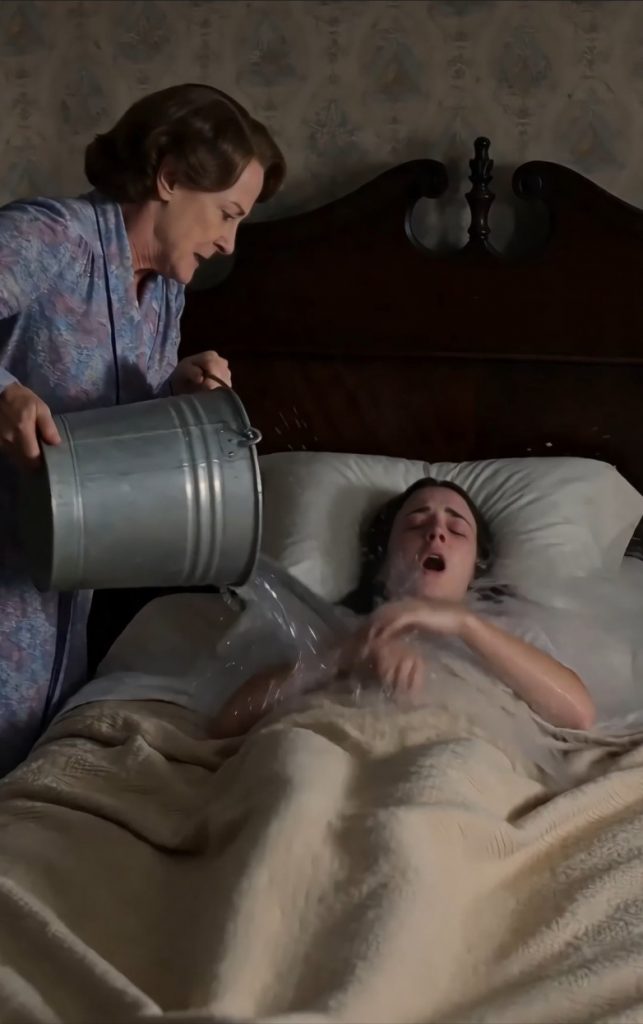
A hard metal clatter cutting through the fever haze as she lay curled beneath the thick beige blanket, her hair damp at the temples, her body shivering so violently the bedframe gave small wooden creaks beneath her.
Then came the voice.
“Get up right now!”
Emma’s eyes fluttered open.
For a second, she did not understand where she was. The wallpaper swam in pale yellow shapes. The white pillow under her cheek felt too hot. Her throat burned when she tried to breathe.
At the side of the bed stood Margaret Whitmore.
Her mother-in-law.
Short styled brown hair. Purple-blue floral housecoat. Mouth pulled tight with the kind of disgust Emma had learned to fear more than shouting.
In her hands was a metal bucket.
Emma blinked, confused. “Margaret?”
The older woman leaned forward. “Do not say my name like we are equals.”
Emma tried to sit up, but her arms shook beneath the blanket. She had been sick for two days, maybe three. Time had become a blur of chills, sweat, water glasses, and unanswered calls to her husband.
“I’m not well,” she whispered.
Margaret’s face hardened. “You’re not well because you’re lazy.”
Behind her, in the doorway, four people stood frozen.
A woman holding a bouquet of pink flowers. Three men in coats, one with his hand still half-raised as if he had meant to knock and then forgotten how.
Emma saw them and felt humiliation flood her before the water did.
“Please,” she said.
Margaret tipped the bucket.
Cold water crashed over Emma’s chest, shoulders, and hair.
She screamed.
The shock stole the air from her lungs. The soaked blanket clung to her. Her white T-shirt turned heavy against her feverish skin. Water ran down her neck, into her ears, across the pillow, over the edge of the mattress, dripping steadily onto the wooden floor.
The bedroom went silent except for Emma’s panicked breathing.
She struggled upright, coughing, trembling so hard her teeth clicked together. Her cheeks were burning, but the rest of her body felt plunged into ice.
Margaret stood over her with the empty bucket hanging from one hand.
No regret.
No softness.
No pause.
Emma looked up through water and tears. “Why did you do that?”
The woman with the flowers covered her mouth.
One of the men looked away.
Margaret’s voice dropped, cold and final.
“Get up right now.”
Emma’s hands clenched around the soaked blanket.
For months, she had swallowed every insult in this house because she believed silence would protect her marriage. She had smiled at dinners while Margaret corrected her. She had apologized for things she did not do. She had let herself become smaller and smaller until even her own voice sounded like it belonged to someone else.
But now the bedroom door was open.
People had seen.
And for the first time, Margaret Whitmore had made one mistake.
She had chosen witnesses.
Act II
Emma had never wanted the Whitmore house.
That was what Margaret never understood.
The old brick home on Sycamore Lane was beautiful in the way expensive things often were: polished floors, framed family portraits, heavy curtains, silver candlesticks that nobody touched except to clean. It was a house built to impress visitors and exhaust the people inside it.
When Emma married Nathan Whitmore, people said she was lucky.
Nathan was handsome, educated, polite in public, and heir to a family name that had been printed on hospital wings and library plaques for three generations. His father had run Whitmore Textiles before the factory closed. His mother still spoke as if the town owed her a curtsy.
Emma came from a rented apartment above her aunt’s bakery.
Margaret never let her forget it.
At first, the insults came dressed as advice.
“You’ll learn which fork is for fish.”
“You mustn’t speak so loudly at the table.”
“Nathan has always needed someone refined beside him.”
Emma tried to laugh them off. She told herself Margaret was old-fashioned, lonely, protective of her son.
But cruelty does not become kindness just because it wears pearls.
After Nathan’s father died, Margaret moved into the guest suite “temporarily.” Then temporarily became indefinitely. She began running the house as if Emma were a boarder who had overstayed.
She checked the laundry.
She rearranged the kitchen.
She opened mail.
She told Nathan, softly and often, that Emma was fragile, dramatic, ungrateful.
Nathan believed whichever woman required less courage from him.
So he asked Emma to be patient.
Patient when Margaret criticized her cooking.
Patient when Margaret invited relatives and introduced Emma as “still adjusting.”
Patient when Margaret said, in front of guests, “Some girls marry into a family and think the work is done.”
Emma had been patient until patience became another word for disappearing.
The fever came after a charity dinner.
Emma had spent six hours on her feet because Margaret insisted the caterers were incompetent. By midnight, she was shaking. By morning, she could barely stand. Nathan was out of town on business, and Emma texted him twice before her hands became too weak to hold the phone.
Margaret read the messages on the kitchen tablet because Nathan’s account was still logged in.
Then she decided Emma was pretending.
That afternoon, Margaret invited three relatives and a church friend to the house. The woman with the flowers was Claire, Nathan’s cousin, who had come to “cheer Emma up,” not knowing she was about to witness something that would change the family forever.
The three men were Uncle Robert, Cousin James, and Mr. Ellis, the family attorney.
Margaret had asked Mr. Ellis to come for paperwork.
That was the real reason.
Not Emma.
Not flowers.
Not family concern.
Paperwork.
Margaret wanted Nathan to sign a petition declaring Emma unfit to manage any household finances while he traveled. She had been preparing it for weeks, collecting little stories and turning them into evidence.
Emma forgot to pay a bill.
Emma cried at dinner.
Emma slept too late.
Emma was unstable.
Emma was not one of them.
What Margaret did not know was that Mr. Ellis had not come only because of her request.
He had come because of a letter.
A letter written by Nathan’s father before he died.
A letter Margaret had tried very hard to keep hidden.
And while Emma sat soaked and trembling in the bed, that letter was folded inside the attorney’s coat pocket.
Act III
Mr. Ellis stepped into the bedroom first.
He was an older man with silver hair and a face that looked carved by years of keeping other people’s secrets. Until that moment, Emma had only seen him at funerals and formal dinners, always quiet, always careful.
Now his carefulness was gone.
“Margaret,” he said, “put the bucket down.”
Margaret turned slowly. “Excuse me?”
“Put it down.”
His voice was not loud.
That made it worse for her.
The empty bucket swung once from Margaret’s hand before she set it on the floor with a hollow clank.
Claire rushed to the bed and pulled the dry throw blanket from the chair. “Emma, sweetheart—”
Margaret snapped, “Do not fuss over her.”
Claire ignored her.
That was the first crack.
She wrapped the dry blanket around Emma’s shoulders, her hands shaking as she touched the young woman’s burning forehead.
“She’s on fire,” Claire whispered.
Emma closed her eyes, too humiliated to cry properly, too cold to stop shaking.
Uncle Robert stood in the doorway, pale and rigid. James looked furious, though whether at Margaret or at himself for waiting so long, Emma could not tell.
Margaret lifted her chin. “You are all being manipulated. She has done this before. Whenever responsibility appears, suddenly she is ill.”
Mr. Ellis reached into his coat.
Margaret’s eyes flicked to his hand.
Something like fear passed over her face.
He unfolded the letter.
“Before we discuss responsibility,” he said, “perhaps we should discuss why Henry Whitmore changed his trust.”
The room seemed to narrow.
Margaret went still.
Emma opened her eyes.
Henry. Nathan’s father.
He had been the only person in the family who treated Emma like she belonged without requiring her to earn it first. In the final months of his illness, Emma had sat with him in the sunroom while Margaret attended luncheons and Nathan avoided the smell of medicine.
Henry told stories.
Emma listened.
That was all.
Or so she thought.
Mr. Ellis looked at her now with unexpected gentleness.
“Henry left instructions that were to be shared one year after his death,” he said. “That year ended yesterday.”
Margaret’s voice sharpened. “This is not the time.”
“No,” Mr. Ellis replied. “This is exactly the time.”
He read.
Henry’s words filled the wet, silent room.
He wrote about the house. About the family name. About how legacy had become a performance instead of a duty.
Then he wrote about Emma.
“My daughter-in-law has shown more loyalty to this family in one year than some have shown in a lifetime. She sat with me when I was afraid. She spoke to me as a man, not an inconvenience. She asked for nothing. That is why I trust her with what must be protected.”
Margaret’s mouth parted.
Emma stared, barely breathing.
Mr. Ellis continued.
Henry had placed the Sycamore Lane house in a protected trust. Not under Margaret’s control. Not Nathan’s.
Emma’s.
Not to sell. Not to profit from. But to preserve as a home, and eventually as a foundation residence for women recovering from medical hardship and family abandonment.
Emma’s hand flew to her mouth.
She had never heard of it.
Margaret had.
That became clear the moment her face twisted.
“You had no right to read that here,” she hissed.
Mr. Ellis folded the letter halfway. “And you had no right to punish the trustee of this house because you feared losing control of it.”
The words landed like a door unlocking.
Emma looked at Margaret.
The water dripped from the bed. The bucket sat on the floor. The flowers trembled in Claire’s hand.
For the first time, Emma understood.
Margaret had not poured water on her because she believed she was lazy.
She had done it because she was afraid Emma mattered.
Act IV
Nathan arrived twenty minutes later.
By then, Emma had been moved to a dry chair near the window and wrapped in two blankets while Claire called a doctor. James had brought warm tea with hands so unsteady the saucer rattled. Uncle Robert stood in the hallway on the phone with Nathan, speaking in a voice Emma had never heard from him before.
“Come home now,” he said. “Your mother has gone too far.”
Margaret waited in the bedroom like a queen whose court had betrayed her.
When Nathan entered, his coat still dusted with rain from the driveway, he looked first at Emma.
Then at the soaked bed.
Then at the bucket.
His face went blank.
“What happened?”
No one answered at first.
That was the cruel thing about families like the Whitmores. They knew how to speak around harm for so long that naming it felt almost rude.
Emma could not do it.
Her throat hurt too badly.
Claire did.
“Your mother dumped a bucket of cold water on your wife while she was sick in bed.”
Nathan turned to Margaret.
Margaret immediately raised a hand, wounded and regal. “Nathan, she refused to get up. Guests were here. She was embarrassing you.”
Emma let out a small broken laugh.
Not because anything was funny.
Because even now, soaked and feverish, she was somehow still being accused of causing the scene.
Nathan’s jaw tightened. “Mom.”
“She is manipulating you,” Margaret said. “She always has.”
Mr. Ellis held up the letter.
Nathan’s eyes moved to it.
“What is that?”
“Your father’s final instruction,” Mr. Ellis said. “The house trust became active yesterday.”
Margaret stepped forward. “Henry was not in his right mind.”
Mr. Ellis looked at her coldly. “I have two physician statements and three witnesses to the signing that say otherwise.”
Nathan took the letter and read.
Emma watched his face shift with every line.
Confusion.
Shock.
Shame.
By the time he reached the part about Emma sitting with Henry, his eyes were wet.
“You never told me,” he said softly.
Emma looked down at her hands. “You weren’t there to tell.”
That hurt him.
It was supposed to.
Margaret tried again. “Nathan, listen to me. This girl has turned your father against his own blood from beyond the grave.”
Nathan looked at his mother for a long moment.
Then he looked at Emma shivering beneath the blanket.
Something in him finally broke in the right direction.
“No,” he said. “You did that.”
The room froze.
Margaret recoiled as if he had slapped her.
Nathan stepped toward the bucket and picked it up. Water still clung to its rim.
“You brought people here to humiliate my wife,” he said. “You wanted them to see her weak so they would believe your story.”
Margaret’s eyes flashed. “I wanted to save you.”
“You wanted control.”
Her face hardened. “After everything I sacrificed for this family—”
“Not everything you call sacrifice was love,” Nathan said.
Emma looked at him then.
For years, she had waited for him to say something brave. She had imagined it happening at dinner, in the hallway, after one of Margaret’s little cuts.
She had stopped expecting it.
Now it arrived late, but it arrived.
Nathan turned to Mr. Ellis. “What happens now?”
“The trust gives Emma legal residence and authority over the house’s future use,” Mr. Ellis said. “Margaret has no ownership claim.”
Margaret’s face drained.
Nathan swallowed. “And my mother?”
Mr. Ellis folded the document. “She is a guest here only as long as the trustee permits.”
Every eye turned to Emma.
The power shifted so quietly that the dripping water sounded loud again.
Margaret stared at her with disbelief.
Emma had spent a year being treated like someone allowed in by mercy.
Now mercy was hers to give.
And everyone in the room knew Margaret did not deserve it.
Act V
Emma did not throw Margaret out that night.
Not because Margaret deserved gentleness.
Because Emma was too sick to turn justice into theater.
The doctor came and confirmed what Claire already knew: a severe fever, dehydration, and risk made worse by the shock of cold water. Nathan stood beside the bedroom door as the doctor spoke, his face pale with guilt.
Margaret waited downstairs.
Alone.
No one sat with her.
By morning, Emma’s fever had begun to lower. The bed had been stripped. The floor dried. The bucket removed from the room and placed in the garage where no one had to look at it.
But the house was different.
Not visibly.
Not yet.
The same wallpaper. The same headboard. The same framed picture near the bed.
But the silence had changed sides.
For once, it was Margaret who moved carefully.
Nathan brought Emma tea and sat in the chair beside her bed.
“I failed you,” he said.
Emma looked at him.
She wanted to forgive him immediately because that would have been easier. It would have wrapped the wound in something clean and quick.
But easy forgiveness often asks the wounded person to carry the weight of everyone else’s comfort.
So she told the truth.
“Yes,” she said.
Nathan lowered his eyes.
“I kept waiting for you to protect me,” Emma continued. “Then I realized you were waiting for me to survive quietly enough that you never had to choose.”
His face crumpled.
“I’m choosing now.”
Emma’s voice stayed soft. “Then keep choosing when it’s not dramatic.”
That was harder than one brave moment in a bedroom.
He knew it.
That afternoon, Margaret entered with no bucket, no command, no audience.
She stood at the foot of the bed in a plain navy dress, her hands clasped tightly.
“I was angry,” she said.
Emma waited.
Margaret swallowed. “I behaved poorly.”
Claire, standing near the window, made a small sound of disbelief.
Emma did not smile.
“Poorly?” she repeated.
Margaret’s jaw tightened, old pride fighting for breath. “I should not have poured water on you.”
“No,” Emma said. “You should not have spent a year trying to convince everyone I was worthless.”
The words filled the room.
Margaret looked away first.
That mattered.
Not enough, but it mattered.
Emma sat up slowly, wrapped in a blanket, still weak but no longer shrinking.
“You will leave this house by the end of the week,” she said.
Margaret’s head snapped back. “Emma—”
“No.”
It was one small word.
It felt like a door closing.
“This was Henry’s home,” Emma continued. “And he wanted it to become a place where women could recover without being shamed for needing rest. I think we should begin by making sure I can recover in it.”
Nathan stood beside the doorway, silent but present.
For once, he did not interrupt to soften the truth for his mother.
Margaret looked at him.
He did not rescue her.
A week later, she left Sycamore Lane.
Not ruined. Not homeless. Not destroyed.
Just removed from the throne she had mistaken for love.
The change that followed was slow.
Emma did not become fearless overnight. She still flinched when footsteps stopped outside her door. She still woke from dreams of cold water and the metal rattle of a bucket handle. She still had days when she heard Margaret’s voice in her own thoughts, calling her weak for needing rest.
But the house began to heal around her.
Claire came often with flowers that no longer looked out of place. James repaired the warped bedroom floorboards himself. Uncle Robert, ashamed of his silence, funded the first renovation of the sunroom.
Nathan began therapy.
Emma did too.
They did not pretend love was enough without change.
Six months later, the first guest arrived at what was now called the Henry Whitmore Recovery House.
She was a young mother recovering from surgery, with nowhere quiet to sleep. Emma met her at the door herself. The house smelled of fresh paint, lavender soap, and soup warming in the kitchen.
The old bedroom had been transformed.
New linens. Soft curtains. A lock on the door that worked from the inside. A small card on the nightstand read:
Rest is not laziness. Healing is not shame. You are safe here.
Emma stood in the hallway after the guest settled in and looked toward the room where she had once sat soaked, shaking, and humiliated in front of witnesses who did not yet know how to be brave.
She could still remember every sound.
The splash.
The gasp.
The dripping water.
Margaret’s command.
Get up right now.
For a long time, those words had been a wound.
Now they meant something else.
Emma had gotten up.
Not because Margaret ordered her to.
Because the truth did.
And when she finally rose, the whole house rose with her.