Act I
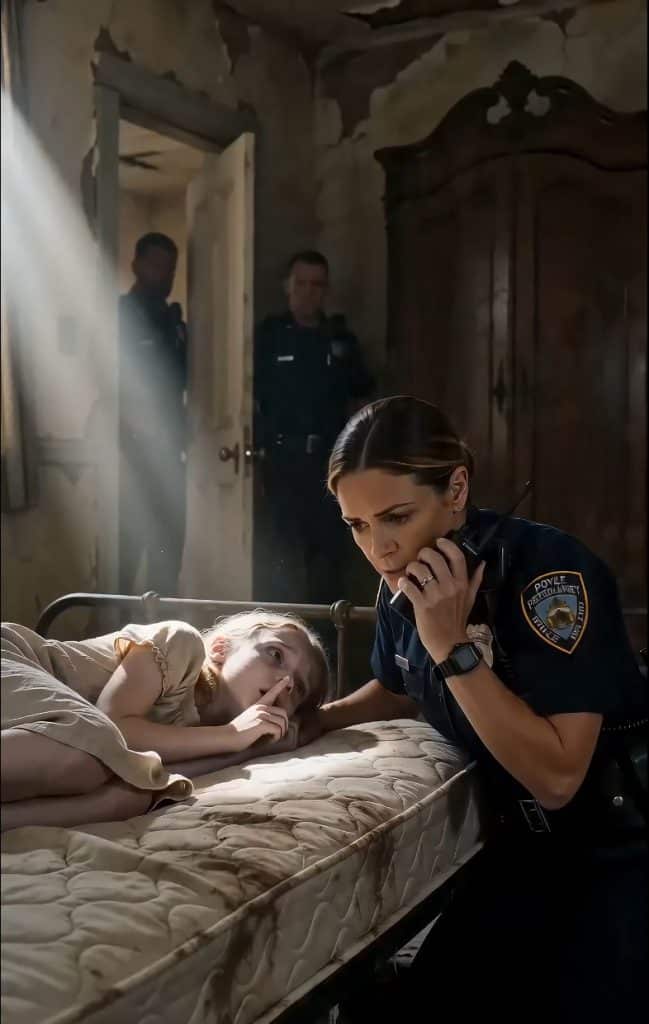
Officer Marissa Pyle found the girl in a room that looked like it had been forgotten by time.
The wallpaper peeled in long yellowed strips. The walls were cracked. Dust floated through a beam of sunlight spilling from the old window, turning the air silver and sickly. An antique wardrobe stood in the darkest corner, its wooden doors closed tight.
On the bed, curled against a stained mattress, was the missing child.
For a moment, Marissa forgot how to breathe.
“Dispatch,” she said into her radio, forcing her voice to stay steady. “I found her.”
The girl’s eyes snapped open.
She was pale, thin, and shaking. Tear tracks ran down both cheeks, cutting clean paths through the dust on her skin. She looked at Marissa’s uniform, then at the doorway where another officer stood guard, then back at the shadows in the room.
Slowly, she raised one trembling finger to her lips.
Don’t.
Marissa froze.
The girl’s message was clear.
Not don’t hurt me.
Not don’t leave.
Be quiet.
Marissa lowered the radio.
Her partner, Officer Brent Cole, stood near the doorway with one hand close to his holster, watching the hall. He had not seen the girl’s gesture. He was still scanning outward, still thinking the danger was somewhere else in the house.
But Marissa had spent twelve years reading fear.
This child was not afraid of being found.
She was afraid of being heard.
Marissa stepped closer to the bed, slowly, carefully, letting the old floorboards take her weight without groaning too loudly.
“You’re safe,” she whispered.
The girl shook her head.
Her eyes slid toward the wardrobe.
Marissa followed the look.
The old wooden cabinet stood silent in the corner. Tall. Dark. Heavy. Its brass handles hung unevenly, one lower than the other, catching a weak flash of sunlight.
Nothing moved.
Still, Marissa felt every nerve in her body tighten.
She set her radio gently on the bed and touched two fingers to the girl’s forehead, checking her temperature, checking if she was fully conscious, checking how badly the child had been left alone.
The girl flinched, then grabbed Marissa’s sleeve with surprising strength.
Her lips barely moved.
“He’s still here.”
Before Marissa could answer, the radio on the bed chirped.
Static cracked through the quiet room.
Then dispatch spoke, urgent and clipped.
“Officer, suspect is nearby.”
The girl squeezed her eyes shut.
Marissa picked up the radio, her gaze already moving toward the wardrobe.
“Copy that.”
A second later, the wardrobe doors burst open with a crash that shook dust from the ceiling.
And what came out of the darkness made Marissa realize the case was not what anyone thought it was.
Act II
The girl’s name was Lily Hart.
For six days, her face had been on every local news station, every gas station screen, every flyer taped to diner windows and telephone poles across three counties.
Eight years old. Brown hair. Blue coat. Last seen outside Franklin Elementary.
The public story was simple.
Lily had been taken by a man named Calvin Rusk, a drifter with a criminal record and no known family. Police had released his photo within hours. Reporters called him dangerous. Neighbors claimed they had seen him near the school. Comment sections sentenced him before anyone found Lily’s backpack.
But Marissa had never liked simple stories.
Especially when they arrived too neatly.
The first problem was the school camera.
It showed Lily walking past the back gate, not running, not struggling. Someone had called her name from a dark SUV parked just beyond the frame. Lily turned toward it like she recognized the voice.
Calvin Rusk did not own an SUV.
The second problem was Lily’s mother.
Rachel Hart cried on television, but something about the interviews made Marissa uneasy. Not because grief had rules. It didn’t. People broke in strange ways. Some screamed. Some went silent. Some smiled because their bodies had forgotten what faces were for.
But Rachel did not look broken.
She looked managed.
Her husband, Greg Hart, stood beside her in every interview with one hand on her shoulder, speaking for both of them.
“We just want our daughter home,” he said.
Always daughter.
Never Lily.
Marissa noticed that too.
Then came the anonymous tip.
An old house off County Road 9. Abandoned for years. Kids dared each other to go near it, but no one stayed long. The place had cracked windows, sagging gutters, and a smell of rot that seemed to come from the walls themselves.
The caller said a child had been seen in an upstairs window.
By the time Marissa and Cole arrived, the house was silent.
No car outside. No fresh tire marks in the dirt. No sign of anyone moving through the weeds except one narrow path near the back porch.
They entered carefully.
The first floor was empty. Dusty rooms. Broken chairs. A kitchen with cabinets hanging open. A dead refrigerator humming with nothing inside.
Then they heard the softest sound above them.
Not a scream.
A sob.
Marissa found Lily in the back bedroom, curled on that stained mattress beneath sunlight full of dust, too terrified to make a sound.
And when the girl raised her finger to her mouth, Marissa understood.
Someone had told Lily that silence was survival.
That kind of fear does not appear in one day.
It is taught.
The wardrobe crash changed everything.
Marissa turned so fast the radio slipped in her palm.
Cole shouted from the doorway, “Pyle!”
A figure tumbled out of the wardrobe and hit the floor hard.
Not Calvin Rusk.
Not a grown man.
A teenage boy.
He was maybe fifteen, dirty and shaking, with a split lip and wrists marked from rough rope. His hands flew up when he saw Marissa’s weapon.
“Don’t shoot!” he cried. “Please!”
Lily screamed his name.
“Evan!”
Marissa lowered her gun halfway but did not relax.
The boy crawled toward the bed, then stopped when he saw her uniform.
“I’m not him,” he said breathlessly. “I’m not the suspect.”
“Hands where I can see them,” Marissa ordered.
He obeyed instantly.
Lily tried to sit up, trembling with panic.
“He helped me,” she sobbed. “He hid me when the man came back.”
Marissa’s eyes moved from Lily to Evan, then to the empty wardrobe behind him.
There were scratches on the inside of the wooden doors.
Not old scratches.
Fresh ones.
Someone had been hiding in there for hours.
Maybe longer.
Cole stepped into the room, confused. “Dispatch said suspect nearby.”
Evan looked toward the hallway, his face draining of color.
“He is,” he whispered.
Marissa’s radio crackled again.
“Unit 12, be advised. New information from county records. Possible second victim connected to Hart residence.”
Marissa stared at the teenage boy.
Evan swallowed hard.
Then he said the sentence that tore the case wide open.
“Lily’s stepfather took both of us.”
Act III
Greg Hart was not supposed to be a suspect.
That was the point.
He had a steady job, a clean smile, and a house with white trim where neighbors said the lawn was always cut before Saturday morning. He coached youth baseball. He donated to school fundraisers. He shook hands with officers during search parties and said things like, “Anything you need.”
Men like Greg did not look like monsters in photographs.
They looked like the man standing beside the victim’s mother.
That was why people missed them.
Evan Miller had lived two houses down from the Harts until the previous winter. His mother worked nights at a distribution center. He used to mow lawns in the neighborhood for extra cash, including Greg’s.
That was how he noticed things.
A cracked window on the back door.
Lily sitting alone on the porch in cold weather.
Rachel flinching when Greg’s truck pulled into the driveway.
Evan told his mother once that something was wrong in the Hart house. His mother told him to stay out of other people’s business, not because she did not care, but because poor families learn early that trouble with respectable people can cost more than they can pay.
Then Evan disappeared.
His case never made the news.
Fifteen-year-old boys from rental houses did not get the same headlines as missing little girls from quiet neighborhoods. Police took a report. A social worker noted he had “possible runaway tendencies.” The file sat.
But Evan had not run.
Greg caught him one evening behind the garage after Evan saw him loading Lily into the dark SUV.
“I thought he was taking her somewhere,” Evan said, sitting on the floor with his back against the wardrobe, his voice shaking. “I followed him on my bike. I thought if I got a picture, someone would listen.”
He did get a picture.
That was why Greg took him too.
Lily curled closer to Marissa, clutching the officer’s sleeve with both hands.
“He told me if I made noise, Evan would get hurt,” she whispered.
Marissa’s jaw tightened.
Greg had used one child to silence another.
The room seemed darker after that.
Cole radioed for additional units, but Marissa kept her eyes on the hallway. The house had too many blind corners. Too many shadows. Too many places for a man who knew the layout to hide.
“Where is Greg now?” she asked.
Evan pointed shakily toward the floor.
“There’s a cellar door behind the kitchen. He comes up from there. He heard the sirens and went down.”
Cole cursed under his breath.
The search team had cleared the first floor but not the cellar. The back entrance had been hidden behind a collapsed pantry shelf.
Greg had not fled.
He had gone underground.
Marissa looked at Lily. “Can you walk?”
The girl nodded, but when she tried to stand, her knees buckled.
Marissa caught her.
Evan pushed himself up too quickly and nearly fell.
Cole moved toward the doorway. “We need to get them out now.”
The radio chirped again.
This time the dispatcher’s voice was tighter.
“Officer Pyle, units are two minutes out. Possible suspect vehicle located behind property. Proceed with caution.”
Two minutes.
In a quiet office, two minutes was nothing.
In an old house with a hidden cellar and two frightened children, two minutes was a lifetime.
A noise came from below.
Wood scraping.
A door opening.
Lily went rigid.
Evan whispered, “He’s coming.”
Marissa positioned herself between the children and the hallway.
Cole raised his weapon toward the stairs.
The house held its breath.
Then Greg Hart’s voice floated up from below, calm and wounded, the voice America had seen on television.
“Lily? Sweetheart? Come to Dad.”
The girl began to shake so hard Marissa felt it through her uniform.
And that was when Marissa knew Greg did not think he had lost.
He still believed the room would obey him.
Act IV
Greg Hart appeared at the top of the stairs with both hands raised.
He looked exactly like he did on the news.
Clean jacket. Neatly combed hair. Tired eyes arranged into the shape of concern.
If Marissa had not already seen Lily’s terror, Evan’s bruised wrists, the scratches inside the wardrobe, she might have understood why people believed him.
He was very good at looking harmless.
“Officers,” Greg said, breathing hard. “Thank God. You found them.”
Cole did not lower his weapon.
“Stop right there.”
Greg stopped.
His eyes slid past Marissa to Lily.
The little girl hid behind her.
Something dark moved across Greg’s face and vanished.
“She’s confused,” he said softly. “They both are. That man Rusk took her. I tracked him here.”
Marissa’s voice stayed flat.
“Where is Calvin Rusk?”
Greg swallowed.
“Gone. I think he ran out the back.”
Evan snapped, “Liar.”
Greg looked at him then.
Only for a second.
But the mask slipped again.
“You’ve caused enough trouble,” he said.
Marissa saw Lily flinch.
Not from the words.
From the tone.
That tone had history.
Cole stepped forward. “On your knees.”
Greg looked offended, almost amused. “You’re making a mistake.”
“On your knees.”
Greg lowered himself slowly.
Outside, sirens grew louder.
For the first time, Greg looked toward the window.
He had counted on minutes. Privacy. Confusion. A frightened child who would not speak.
He had not counted on Evan.
He had not counted on Marissa believing fear before reputation.
Then Lily spoke.
Her voice was barely audible.
“He put the phone in my backpack.”
Everyone went still.
Marissa turned slightly.
“What phone?”
Lily pointed toward the bedframe. “The one he used to text my mom. He said if she thought I was alive, she would do whatever he wanted.”
Greg’s jaw tightened.
Marissa looked at Cole.
Cole moved to the bed, checked beneath it, and pulled out a cracked prepaid phone wrapped in a plastic bag.
Greg’s face changed completely.
No smile now.
No grief.
Just rage.
He lunged.
Cole intercepted him before he reached Lily. The struggle lasted only seconds, but it shattered the silence of the house. Boots scraped. Wood creaked. Greg shouted once before Cole forced him against the wall and cuffed him.
Lily buried her face against Marissa’s side.
Evan stood frozen, fists clenched, as if part of him still expected no one to stop Greg.
But someone had.
Additional officers stormed into the room moments later. Greg was pulled upright, breathing hard, his perfect television face twisted with disbelief.
As they led him past Lily, he tried one final time.
“Sweetheart,” he said gently, “tell them you know I love you.”
Lily lifted her head.
Her face was pale. Tears still shone on her cheeks. But when she spoke, the room heard her clearly.
“You told me love means staying quiet.”
Greg stopped.
Lily’s voice trembled, but did not break.
“Officer Pyle told me I could speak.”
Marissa felt those words land somewhere deep.
Greg looked away first.
That was the moment the power left him.
Not when the cuffs locked.
Not when the sirens arrived.
When the child he had trained into silence chose to be heard.
Act V
The world changed its story by morning.
Calvin Rusk was found in another county, confused and terrified, hiding because he had seen his own face on the news and knew no one would believe him. Greg had used him perfectly: a man with a record, no money, no clean reputation, and no one powerful enough to defend him.
The prepaid phone told the truth.
So did the SUV’s navigation records, the hidden cellar, Evan’s photograph, and the messages Greg sent to Rachel from Lily’s backpack.
But the strongest evidence came from Lily herself.
Not all at once.
Not under bright lights.
Not in front of strangers demanding bravery.
She spoke to a child specialist in a room with soft chairs and a box of crayons. Marissa waited outside the door because Lily asked her to stay close.
Evan told his story too.
For the first time, people listened.
His disappearance file was reopened. So were two older reports connected to Greg’s neighborhood, reports that had been dismissed as runaway cases or family disputes. Greg Hart had spent years hiding behind other people’s assumptions.
Poor boys ran.
Scared wives exaggerated.
Quiet children imagined things.
Respectable men deserved the benefit of the doubt.
That belief had protected him better than any locked door.
It did not protect him anymore.
Rachel Hart broke down when she learned the truth. Not because she had never suspected danger, but because fear had taught her to doubt herself before doubting Greg. In the hospital hallway, she dropped to her knees in front of Lily and whispered, “I’m sorry,” over and over until Lily reached for her.
Marissa did not interrupt.
Some apologies belonged only to the people who had survived them.
Weeks passed before Lily slept through the night.
Months passed before Evan stopped waking at every creak of wood.
Recovery did not arrive like a movie ending. It came in small, stubborn pieces.
Lily eating pancakes shaped like stars.
Evan returning to school with a counselor waiting near the office.
Rachel moving them into a small apartment with bright windows and no wardrobes in the bedrooms.
Marissa visiting once a week at first, then less often, because the goal was never for Lily to need her forever.
Still, Lily kept a photograph from the day the rescue team returned to the old house after the investigation.
In it, Officer Pyle stood in front of the property with sunlight behind her, one hand resting on the open patrol car door. She looked stern, tired, and protective.
Lily taped the photo inside a notebook.
On the first page, she wrote one sentence in purple marker.
She listened when I couldn’t talk.
The old house was demolished before winter.
Lily watched from across the street, holding Rachel’s hand on one side and Evan’s on the other. Marissa stood a few feet away, not in uniform that day, just a woman in a dark coat with coffee in one hand and her eyes on the house.
When the machines tore through the upstairs bedroom, the antique wardrobe cracked apart in a burst of old wood and dust.
Lily flinched.
Evan squeezed her hand.
The wardrobe collapsed into pieces.
For a long moment, Lily said nothing.
Then she whispered, “It’s just wood now.”
Marissa looked at her.
“Yes,” she said. “It is.”
Lily nodded slowly, as if filing that away.
Just wood.
Not a monster.
Not a secret.
Not a place where fear could hide and wait.
Months later, during Greg Hart’s trial, Lily did not have to face him directly. Her recorded testimony was enough. Evan testified with an advocate beside him and Marissa sitting in the back row where he could see her.
Greg’s attorney tried to twist the story.
Children get confused.
Teenagers seek attention.
Police rushed to judgment.
But the evidence did not bend.
Neither did the children.
When the guilty verdict came, Rachel cried silently. Evan stared at the floor. Lily held Marissa’s hand for exactly three seconds, then let go as if proving to herself she could stand alone.
Afterward, outside the courthouse, reporters shouted questions.
Lily hid behind her mother.
Marissa stepped between the cameras and the child without saying a word.
That was the thing about protection, Lily learned.
Real protection did not demand silence.
It made room for truth.
Years later, Marissa would still remember that room.
The dusty sunlight.
The stained mattress.
The radio chirping on the bed.
The girl’s finger pressed to trembling lips.
And the wardrobe doors exploding open like the house itself could no longer hold its secret.
People would call her brave for finding Lily.
Marissa never accepted that version.
The brave ones were the children.
Evan, hiding in the dark so he could warn someone.
Lily, terrified and still pointing with her eyes toward the truth.
All Marissa had done was listen.
But sometimes, in the thin space between danger and rescue, listening is the thing that saves a life.
And sometimes the quietest child in the room is not silent because she has nothing to say.
She is waiting for one safe person to hear her.