Act I
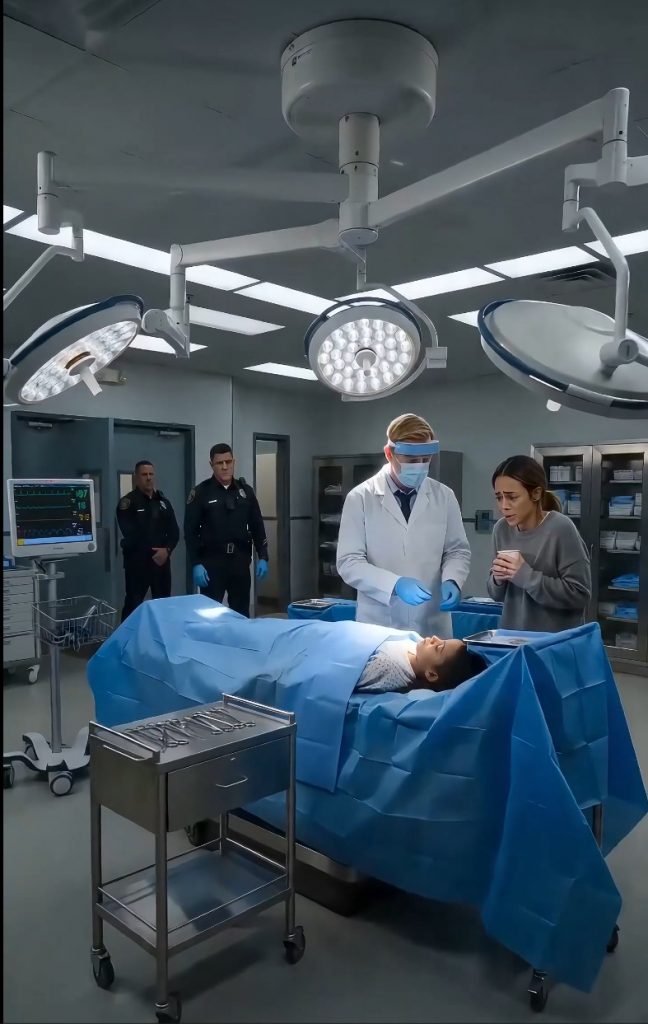
The mother was still holding the paper cup when the doctor lifted the evidence bag.
Her fingers had crushed the rim without realizing it.
“Is my boy going to be okay?” she asked.
Her voice shook under the steady beep of the monitor.
The operating room was too bright for night. Surgical lights glared over the blue drapes. Metal trays reflected pale flashes of white and silver. Rain tapped against the high window, soft and relentless, as if the storm had followed them all the way into the hospital.
Lena Carter stood beside the operating table in a gray sweater, brown hair pulled back badly, eyes swollen from crying.
Her son, Noah, lay still beneath the drape.
He was eight years old.
That morning, he had asked for pancakes.
By midnight, two police officers were standing near the operating room door.
Dr. Celia Hart, blonde hair tucked under a surgical cap, face shield catching the harsh lights, held up a clear plastic evidence bag with blue-gloved fingers.
Inside it was a dark, heart-shaped object.
Small. Rough. Black as river stone.
Lena gasped.
The paper cup crumpled in her hands.
The doctor’s voice was calm, but nobody in the room mistook calm for comfort.
“We found this during the procedure,” Dr. Hart said. “This shouldn’t have been there.”
The officer by the door straightened.
Lena stared at the bag like it had come from a nightmare she had seen before.
“No,” she whispered.
Dr. Hart looked at her sharply.
“You recognize it?”
Lena tried to speak.
Nothing came out.
The dark heart turned slowly inside the plastic as the doctor lowered it to chest height. It looked too heavy for something so small. Too deliberate. Not like a toy. Not like a piece of candy. Not like anything a child should ever have carried inside his body.
Officer Miles Dane stepped forward.
His badge caught the surgical light.
“Ma’am,” he said, steady and serious, “we need to ask a few questions.”
Lena looked at her son.
The monitor kept beeping.
The rain kept falling.
And in the silence that followed, every adult in the room wondered the same terrible thing.
Who had put the black heart inside Noah Carter?
Act II
Lena had spent two years being treated like a suspicious mother.
Not openly.
That would have been easier to fight.
The suspicion came dressed as concern.
Teachers asking whether Noah was eating enough. Nurses asking why he seemed anxious before visits with his father’s family. Social workers writing careful notes about Lena’s “heightened emotional response” whenever she pushed back against people who spoke over her.
It began after Noah’s father died.
Evan Carter had been a quiet man from a loud family. The Carters owned property, restaurants, a private school wing, and half the people who sat on charitable boards in the county. Evan had left that world behind when he married Lena, a woman who worked in a library and bought secondhand furniture because she liked things with history.
His mother, Margaret Carter, never forgave him.
“She’s temporary,” Margaret once said at a Thanksgiving dinner, smiling as she cut pie.
Lena heard it.
Evan did too.
He took Lena’s hand under the table and never let go.
Then Evan died in a construction accident during a winter storm, and Margaret returned with lawyers.
Noah was Evan’s only child.
That meant inheritance.
Trust funds.
Property shares.
A future Margaret believed belonged under Carter control.
At first, she asked for more visits.
Then weekend custody.
Then medical authority, claiming Lena was overwhelmed by grief and “not objective” about Noah’s care.
The court did not grant Margaret full control, but it opened a door. Supervised transitions. Shared access to records. Evaluations. Questions.
Lena learned that wealth does not need to shout when it can file motions.
Noah changed after the visits.
He stopped asking to sleep with the lights off. He hid food in his backpack. He flinched when Margaret’s driver pulled up outside the school.
When Lena asked what happened at the Carter house, he said, “Grandma says you make everything worse.”
Lena documented everything.
No one seemed interested.
Then, three weeks before the hospital, Noah came home with a dark heart-shaped stone in his pocket.
Lena found it while doing laundry.
It was smooth on one side, rough on the other, almost like a charm broken off something larger. When she asked him about it, Noah grabbed it from her hand and shoved it back into his pocket.
“Don’t tell,” he whispered.
“Don’t tell who?”
He looked at the window, as if the Carter house could see through walls.
“Grandma.”
That night, Lena took a picture of the stone while Noah slept.
The next morning, it was gone.
When she asked, Noah cried and said he had lost it.
Now Dr. Hart was holding a black heart in an evidence bag inside an operating room.
And Lena knew it was not lost anymore.
Act III
Officer Dane questioned Lena in the scrub room while the second officer stayed near the door.
The space was narrow and bright, smelling faintly of soap and metal. Lena sat on a stool, still clutching the ruined paper cup because nobody had thought to take it from her and she had forgotten how to let go.
“When did Noah first complain of pain?” Officer Dane asked.
“At dinner,” Lena said. “He said his throat felt strange. Then his stomach. Then he started crying.”
“What had he eaten?”
“Soup. Crackers. Apple slices.”
“Prepared by you?”
“Yes.”
The officer wrote it down.
Lena saw the pen move and felt the world tilting.
“You think I did this.”
“I’m asking questions.”
“That’s what people say when they already have the shape of an answer.”
Officer Dane paused.
His expression changed, but not enough to become soft.
“Mrs. Carter, your son had a foreign object removed during an emergency procedure. You were the adult with him tonight.”
“He was with Margaret yesterday.”
“The grandmother?”
Lena nodded quickly.
“She had him from school until seven. Her driver dropped him off. He was quiet. Too quiet.”
“Did he mention the object?”
Lena swallowed.
“He had one before.”
The officer looked up.
Lena pulled out her phone with shaking hands and opened the photo from the laundry room. The image was blurry, taken under yellow bedroom light, but it showed the same shape.
A black heart.
Officer Dane took the phone carefully.
“Why didn’t you report this?”
“I tried to tell the caseworker he was coming home scared. I tried to tell his pediatrician Margaret was giving him things and telling him to keep secrets. They said children from grieving families attach fear to objects.”
Her voice broke.
“He’s eight. They kept making him sound like a symptom.”
Through the small window, Lena saw Dr. Hart speaking with another doctor beside the operating table. Noah was still monitored. Still alive. Still far too still.
Officer Dane looked at the photo again.
“There’s a marking on this one.”
Lena leaned forward.
In the corner of the blurry photo, barely visible on the stone’s lower curve, was a tiny gold line.
Not random.
A letter.
C.
The evidence bag on the counter had the same tiny mark.
Carter.
Lena whispered, “It came from her house.”
Officer Dane’s face hardened, but he did not speak yet.
A nurse entered with a sealed personal-effects bag from Noah’s clothing.
Inside were his socks, shirt, and a folded scrap of paper found in his jacket pocket.
Officer Dane opened it with gloves.
The message was written in a child’s uneven handwriting.
I did not swallow it. She said I had to hide the proof.
Lena covered her mouth.
The room went silent except for the rain and the machines beyond the wall.
Act IV
Margaret Carter arrived at the hospital at 2:17 a.m. wearing pearls.
She did not ask where Noah was first.
She asked who called the police.
That was the detail Officer Dane later said changed the tone of the entire investigation.
Margaret swept into the surgical waiting area with her attorney on speakerphone and a wool coat over her shoulders, looking less like a grandmother terrified for a child and more like a woman arriving to correct staff.
“This is outrageous,” she said. “Lena has been unstable for months.”
Lena stood near the hallway wall, pale and shaking.
Dr. Hart stepped between them before Margaret could move closer.
“Noah is recovering,” the doctor said. “You may not see him right now.”
Margaret’s face tightened.
“I am his grandmother.”
“And this is a hospital,” Dr. Hart said. “Not your living room.”
Officer Dane approached with the evidence bag sealed inside a second container.
“Mrs. Carter, do you recognize this object?”
Margaret barely glanced at it.
“No.”
“Take your time.”
“I said no.”
Lena watched her eyes.
Margaret did recognize it.
Not with shock.
With irritation.
Like the object had failed her.
Officer Dane nodded to the second officer, who stepped into the hall and returned with a tablet. On it was a photo taken from the Carter estate website years earlier, during a fundraiser for the Carter Children’s Foundation.
Margaret stood in the center of the image beside a glass bowl filled with small black heart-shaped stones.
The caption read:
A Heart for Every Child.
Each donor received a custom stone engraved with the Carter family mark.
Margaret’s attorney shouted from the phone. Officer Dane ended the call.
Margaret’s voice went cold.
“You have no right.”
“I have a child in recovery,” he said. “I have an object from your foundation found during a medical emergency. I have a note from Noah saying he was told to hide proof. And I have a mother who photographed the same object weeks ago after a visit to your home.”
Margaret turned to Lena.
“You foolish girl.”
Lena flinched, but she did not look down.
Not this time.
Officer Dane noticed.
“What proof was he hiding?” he asked.
Margaret said nothing.
The answer came from Noah’s school bag.
A hospital social worker, following chain of custody, found a small audio recorder tucked inside the lining. It had been purchased by Evan years before for Noah to record bird sounds in the park. Noah had kept it because it still had his father’s voice on old files.
The newest recording was from Margaret’s study.
Her voice came through clearly.
“You will tell the doctor your mother gave it to you.”
Noah’s small voice answered, trembling.
“But she didn’t.”
“Then she will lose you, and that will be her fault.”
Lena made a sound so broken that Dr. Hart reached for her shoulder, then stopped and asked first.
“May I?”
Lena nodded.
The recording continued.
Margaret’s plan had been cruel because it was simple.
Create a medical emergency. Make it look like negligence. Blame Lena. Petition for immediate custody and control of Noah’s trust while the mother was investigated.
What Margaret did not understand was that Noah, frightened as he was, had learned from his father to record birds, rain, songs, and secrets.
He had not swallowed the black heart to obey her.
He had swallowed it because he was terrified she would take the recorder and destroy the one thing that proved his mother had not hurt him.
That truth nearly destroyed Lena.
Her son had tried to protect her while she was trying to protect him.
No child should have to do that.
Act V
Noah woke the next morning to his mother’s voice.
Not loud.
Not dramatic.
Just there.
She sat beside the bed with one hand resting where he could see it, close enough for him to reach but not forcing him to. Dr. Hart had explained that he might be confused, frightened, or ashamed when he woke.
Lena was ready for all of it.
His eyes opened slowly.
The first word he said was not Mom.
It was, “Sorry.”
Lena broke.
She bent over the bed, careful of every tube and wire, and touched his hair with trembling fingers.
“No,” she whispered. “No, baby. You saved yourself. You told the truth. You did nothing wrong.”
His eyes filled.
“She said they’d take you.”
“They won’t.”
“You promise?”
Lena looked toward the glass wall.
Officer Dane stood outside speaking with the hospital social worker. Dr. Hart was reviewing the chart. The evidence bag was gone now, locked away where lies could not touch it.
“I promise,” Lena said.
This time, she knew the promise had weight.
Margaret Carter was arrested before noon.
The Carter family released a statement calling the matter private and painful. By evening, the recording was in police custody, the hospital report was complete, and an emergency judge suspended Margaret’s access to Noah and froze any attempt to alter custody or trust control.
The case did not end quickly.
People like Margaret do not spend years building power just to surrender it at the first locked door.
Her lawyers challenged the recording. Challenged the hospital’s handling of evidence. Challenged Lena’s fitness. Challenged Dr. Hart’s conclusions. Challenged Officer Dane’s authority.
But paper could not unmake the object.
The black heart had a Carter mark.
Noah’s note was real.
The recording was clear.
And for once, the adults in the room listened before the powerful person finished explaining why they should not.
Weeks later, Noah came home.
Not to the Carter estate.
To the small yellow house with the library books stacked on the side table, the pancake pan shaped badly from years of use, and the window seat where Evan used to read aloud during thunderstorms.
Lena placed a new lock on the door.
Not because the lock could stop every danger.
Because Noah asked for it.
That mattered.
He returned to school slowly. He met with a counselor. He slept with the hallway light on. He kept the audio recorder on his bedside table, though Lena told him he did not have to be the one collecting proof anymore.
“You’re the kid,” she said. “That’s your job.”
“What does the kid do?”
“Pancakes. Cartoons. Homework. Complains about vegetables.”
Noah thought about it.
“I can do that.”
Lena laughed and cried at the same time.
Dr. Hart visited once after discharge, not as a doctor on duty, but as the woman who had held up the evidence and refused to soften the truth. She brought Noah a small model ambulance, which he immediately inspected for accuracy.
“The doors don’t open right,” he said.
Dr. Hart smiled.
“I’ll file a complaint.”
Officer Dane came by another day with paperwork for Lena and a sticker badge for Noah. Noah accepted it solemnly.
“Are you going to arrest Grandma forever?”
The officer sat carefully at the kitchen table.
“That’s up to the court,” he said. “My job is to tell the truth about what happened.”
Noah nodded.
“My dad said truth is like a flashlight.”
Officer Dane smiled faintly.
“What did he mean?”
Noah looked toward the rain-streaked window.
“That dark places don’t like it.”
Months later, during the custody hearing, Lena wore the same gray sweater she had worn at the hospital. She had considered throwing it away, but Noah asked her not to.
“That’s the sweater from when you didn’t leave,” he said.
So she wore it.
The judge granted Lena full custody, permanent protection orders, and independent control over Noah’s medical care. The Carter trust was moved under neutral supervision until Noah came of age. Margaret’s polished friends stopped calling. Her foundation quietly removed the black heart fundraiser from its website.
But the county remembered.
Not because of scandal.
Because of the question the case forced everyone to ask.
How many times had a frightened child told the truth and been mistaken for trouble?
On the first anniversary of the hospital night, Noah and Lena walked past the children’s wing after a routine checkup. The operating suite doors were closed. The hallway smelled like antiseptic and raincoats.
Noah paused.
Lena looked down.
“You okay?”
He nodded, then hesitated.
“Can we go get pancakes?”
She smiled.
“Absolutely.”
As they stepped into the elevator, Noah reached for her hand.
He did not have to.
He wanted to.
The doors closed on the hospital lights, the monitors, the memory of the evidence bag, and the dark heart that had once made a room turn suspiciously toward a mother who had been fighting alone for too long.
The black heart had been meant to destroy her.
Instead, it exposed the person who believed children were tools, grief was leverage, and motherhood could be buried under accusation.
But Noah had left a note.
He had kept a recording.
He had survived long enough for the truth to reach the right hands.
And when the doctor lifted that strange object under the surgical lights, it did not become proof against his mother.
It became proof that the smallest voice in the room had been telling the truth all along.