Act I
The phone screen glowed like the last living thing in the room.
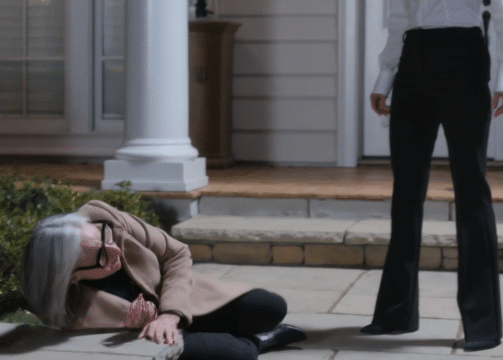
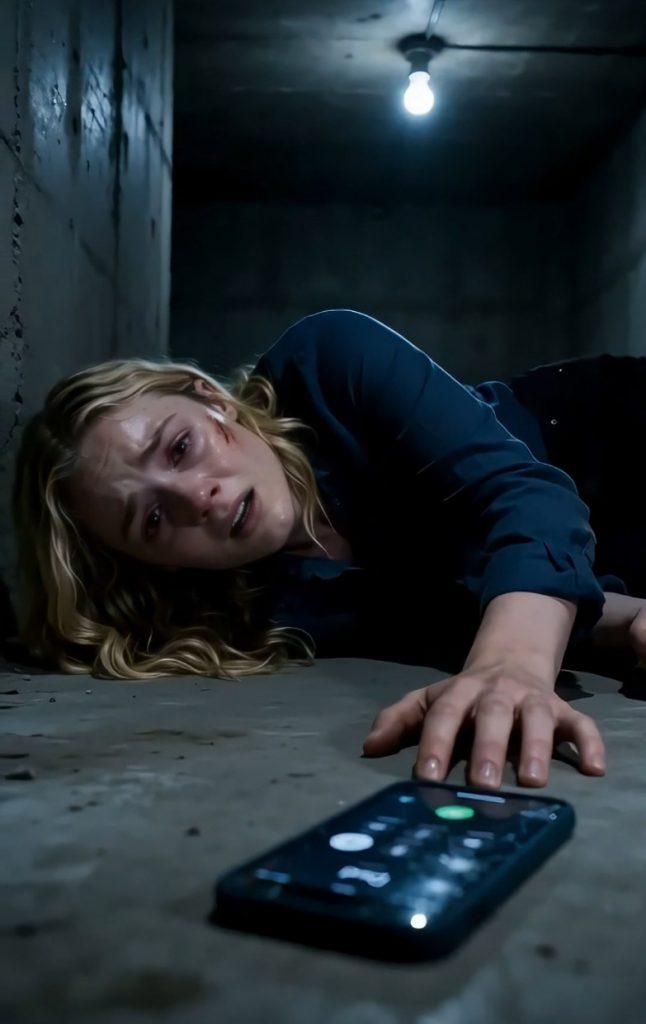
Ava Hart lay on her side on the concrete floor, one cheek pressed against the dust, one trembling hand stretched toward the cracked smartphone just beyond her fingertips. Her blonde hair clung to her damp face. A thin red scratch marked her cheek. Her breathing came fast and broken, too loud in the cold basement silence.
Above her, a single bulb flickered.
Beyond the heavy wooden door, there was only darkness and the pale line of light beneath the frame.
Ava dragged herself another inch.
Her fingers touched the phone.
The screen was spiderwebbed with cracks, but the name was still visible.
Dad.
She tapped the green button with a shaking finger and pulled the phone close to her mouth.
The call connected with a hiss of static.
“Ava?” her father said. “Honey?”
She closed her eyes, and for one second, the sound of his voice almost broke her.
“He locked me in,” she whispered.
There was no pause.
No confusion.
No useless question.
Her father’s voice changed instantly into something firm, controlled, and terrifyingly awake.
“Stay with me. Stay awake. I’m coming.”
Ava pressed the phone to her chest and tried not to sob.
Then she heard footsteps.
Heavy.
Slow.
Crossing the floor above her.
Her eyes snapped toward the door.
The footsteps stopped on the other side.
The latch rattled once.
Then a man’s fist slammed into the wood.
Ava flinched so hard the phone nearly slipped from her hand.
“Open the door right now!” her husband shouted from the other side. “I know you’re in there!”
Ava curled around the phone as the door shook in its frame.
Her father’s voice crackled through the speaker.
“Ava, listen to me. Do not answer him.”
Another blow hit the door.
The iron latch jumped.
Dust fell from the frame.
And Ava realized the only thing between her and the man outside was a lock he had installed himself.
Act II
When Ava married Grant Hart, people called her lucky.
He was handsome in a polished way, with careful hair, clean shirts, and the ability to make strangers feel like he had chosen them personally from a crowd. He opened doors. Remembered birthdays. Sent flowers to her office after their third date.
Her mother had been gone for years by then, and Ava’s father, David, was the only person who did not fall for Grant immediately.
“He smiles without his eyes,” David said once.
Ava got angry.
She told him he was overprotective. Told him she was twenty-eight, not sixteen. Told him Grant made her feel safe.
David had looked at her for a long moment.
Then he said, “Then I hope I’m wrong.”
For a while, Grant was careful enough to make everyone believe he was.
He helped renovate the old house Ava had inherited from her mother. He painted the kitchen cabinets blue because Ava liked color. He replaced the basement door, fixed the deadbolt, and joked that the place was now “Grant-proof.”
Back then, Ava laughed.
Later, she would remember that joke differently.
The changes came slowly.
Grant started correcting her in front of friends. Then canceling plans because he said she looked tired. Then keeping track of what she spent. Then telling her that her father came around too often, called too much, worried too loudly.
“He doesn’t respect our marriage,” Grant said.
David noticed the distance growing.
Ava noticed too, but by then she had learned to explain things away before anyone else could ask.
Grant was stressed.
Grant was worried.
Grant loved her.
That was the most dangerous excuse of all.
The night everything broke open, Ava had found a folder hidden behind the furnace.
At first, she thought it was old house paperwork. Insurance forms. Deed copies. Contractor receipts.
Then she saw her signature on documents she had never signed.
A home equity loan.
A transfer request.
A medical authorization giving Grant decision-making power if she was ever declared unable to manage her affairs.
Her name appeared again and again, written in a version of her handwriting that looked close enough to fool someone who did not love her.
Ava had taken pictures with her phone.
Grant found her before she reached the stairs.
The argument moved too fast for her memory to hold cleanly. His voice. Her backing away. The folder falling. Her shoulder hitting the wall. His hand closing around her phone before she twisted free.
Then the basement door slammed.
The lock turned.
Ava heard him breathing on the other side.
“You need to calm down,” he said.
That was when she knew.
He was not losing control.
He was taking it.
But Grant had made one mistake.
The phone he thought he had shattered still worked.
And David Hart had taught his daughter, when she was little and afraid of storms, that if she ever needed him, she only had to call once.
Act III
David was already in his truck when Ava whispered those four words.
He locked me in.
He had been driving toward the house because she had sent him a photo ten minutes earlier.
No message.
Just one blurry image of a forged signature and the corner of Grant’s shoe in the frame.
David had called immediately.
No answer.
Then again.
No answer.
By the third call, he was running red lights with emergency dispatch on speaker and a retired fire captain’s calm hiding a father’s fear.
Now he heard the pounding through Ava’s phone.
He heard Grant shouting.
He heard his daughter’s small, broken breathing.
“Sir,” the dispatcher said, “officers are en route.”
“They need to move faster,” David said.
His voice was steady, but his hands were white on the steering wheel.
Through the phone, Grant’s fist hit the door again.
Ava sobbed.
David forced his tone softer.
“Ava, sweetheart, listen. Is the old workbench still against the east wall?”
She looked through the dim basement, disoriented.
“Yes.”
“Can you get behind it?”
“I don’t know.”
“You can. Crawl if you have to. Put something between you and the door.”
The latch rattled violently.
Grant’s voice dropped into something colder.
“I’m going to catch you.”
Ava’s breath vanished.
David heard it.
“Ava,” he said sharply. “Look at the phone. Look at me through my voice.”
She squeezed her eyes shut.
“I’m scared.”
“I know. Move anyway.”
That sentence reached her.
Move anyway.
Ava dragged herself backward across the concrete, one elbow at a time, the phone clutched against her chest. The old workbench stood in shadow, covered in paint cans and broken tools from the renovation Grant had never finished.
She slid behind it just as the door shook again.
The deadbolt held.
Barely.
On the other side, Grant stopped shouting.
Silence spread.
For one terrible second, Ava thought he had left.
Then she heard a different sound.
Metal scraping.
Grant had gone for tools.
David heard it too.
“What is that?” he asked.
Ava’s voice trembled. “He’s trying to open it.”
“No,” David said. “He’s trying to scare you.”
But he knew that was not true.
Ava pressed the phone closer.
“Dad?”
“I’m here.”
“If he gets in—”
“He won’t.”
“You don’t know that.”
David’s voice broke for the first time.
“Yes, I do.”
Outside, sirens began to rise faintly through the phone.
Ava heard them.
So did Grant.
The scraping stopped.
Then the pounding became frantic.
Act IV
Grant broke the outer panel of the basement door just as the first cruiser pulled into the driveway.
The sound was sharp and splintering, but the iron latch still held. The door bent inward, cracked near the hinge, and Ava screamed behind the workbench.
Grant heard the sirens and cursed.
Then he did what men like him often do when consequences finally arrive.
He changed his voice.
“Ava!” he shouted, suddenly frantic in a different way. “Open the door! I’m trying to help you!”
Ava stared at the door through tears.
Her father’s voice came through the phone.
“Don’t say a word.”
Boots thundered across the floor upstairs.
A police officer shouted Grant’s name.
Grant answered immediately, breathless and false.
“She’s locked herself in the basement! She’s unstable! I’m trying to get to her!”
Ava’s stomach turned.
Even now.
Even now, he was building a story.
The officer ordered him away from the door.
Grant protested.
Then David arrived.
Ava heard his voice before she saw him.
Not through the phone.
Above her.
In the house.
“Where is my daughter?”
Grant snapped, “You shouldn’t be here.”
David’s answer was low.
“You should pray I remember I’m not twenty years younger.”
The officer moved between them before either man could step closer.
A second officer came down the basement stairs outside the door, flashlight cutting through the cracks.
“Ma’am?” she called. “Ava Hart? This is Officer Lewis. Are you able to speak?”
Ava tried, but only a sob came out.
David’s voice came again, closer now.
“Ava, tell them you’re there.”
She forced air into her lungs.
“I’m here,” she cried. “I’m here.”
The officer’s tone sharpened instantly.
“We need entry tools.”
Grant shouted from above, “She’s lying! She’s confused!”
Then the phone on the basement floor played his own voice back through the speaker.
Open the door right now. I know you’re in there.
I’m going to catch you.
The room above went silent.
Ava looked down.
Her thumb had hit the recording app when she crawled.
Or maybe the cracked phone had done one last impossible thing for her.
Either way, the lie had nowhere to stand.
The officers forced Grant back.
The fire crew arrived two minutes later.
David insisted on going down with them until the officer blocked him with one arm.
“Sir, let us open it.”
David stood at the top of the stairs, shaking, listening to metal tools bite into the frame he had warned Ava not to trust.
The latch finally gave.
The basement door swung inward.
Light flooded the concrete floor.
Ava crouched behind the workbench, phone clutched in both hands, eyes wide, face wet with tears.
For one heartbeat, no one moved.
Then David pushed past everyone and dropped to his knees in front of her.
Ava reached for him like she was five years old again.
He gathered her into his arms, holding her carefully, fiercely, as if the world had nearly taken her and he meant to make it apologize.
“I came,” he whispered.
Ava broke against his shoulder.
“I knew you would.”
Act V
Grant was arrested in the kitchen.
He did not go quietly.
Men like him rarely do when the audience changes.
He demanded a lawyer. Accused Ava of hysteria. Told the officers she had always been dramatic, always unstable, always too influenced by her father. He tried to sound reasonable, but the recording had stripped the polish from his voice.
The folder behind the furnace did the rest.
Forgery. Financial fraud. Coercive control. Threats. A pattern that had been building behind closed doors while the world complimented Grant’s manners.
By morning, the house was full of evidence markers.
Ava sat wrapped in a blanket on the front porch while paramedics checked her. Dawn came slowly over the yard, turning the windows gold. The basement door stood open behind her, broken at the frame, no longer a secret.
David sat beside her.
He did not say I told you so.
That was one of the reasons she cried again.
“I thought you’d be angry,” she whispered.
He looked at her, stunned.
“At you?”
She nodded.
His face crumpled.
“Oh, Ava.”
He took her hand carefully.
“I was angry every day I saw you shrinking and didn’t know how to reach you. I was angry at him. At myself. At the silence. Never at you.”
Ava looked toward the police cars.
“He made me feel stupid.”
David’s jaw tightened.
“That’s how people like him build cages. Not all at once. One doubt at a time.”
The trial took months.
Grant’s attorney tried to frame the basement as a misunderstanding. The recording ended that. The forged documents ended more. A neighbor came forward after hearing the sirens and admitted she had heard shouting before but had convinced herself it was not her business.
She cried on the stand.
Ava did not comfort her.
She was learning that kindness did not require making other people feel better about failing you.
Grant was convicted.
The financial damage took longer to untangle, but the house remained Ava’s. Her mother’s house. The place that had almost become a prison and then became proof.
At first, Ava could not go near the basement.
David changed the door anyway.
Not because she planned to use it.
Because broken things should not be left as monuments to fear unless the person who suffered chooses that.
He removed the heavy wooden slab and the iron latch. In its place, he installed a plain white door with a simple handle and no lock.
Ava watched from the hallway.
When he finished, he handed her the old latch.
“What do you want to do with it?”
She stared at the black iron in her hands.
It was heavier than she expected.
“Throw it away,” she said.
Then she paused.
“No. Wait.”
Weeks later, she took it to the courthouse on the day Grant was sentenced. Afterward, she placed it in a donation bin for a local art program that worked with survivors. The latch became part of a sculpture months later.
Bent metal. Broken locks. Open frames.
The title was simple.
Exit.
Ava stood in front of it at the gallery opening with David beside her and cried, but not because she was afraid.
Because someone had turned the thing that trapped her into proof that doors could open.
She rebuilt slowly.
Not dramatically.
No sudden transformation. No perfect sunrise. Some nights she still woke at small sounds. Some days she checked doors twice. Some mornings she saw her reflection and barely recognized the woman who had crawled across concrete toward a cracked phone because hope was still glowing through the damage.
But she did rebuild.
She went back to work.
She repainted the kitchen yellow.
She replaced Grant’s stiff furniture with secondhand pieces that did not match and made the house feel alive again. She hosted dinner for her father every Sunday. The first time he fell asleep in the armchair after dessert, Ava covered him with a blanket and stood there smiling through tears.
A year after the basement, she stood at the top of those stairs and turned on the light.
The room below was still concrete.
Still cold.
But no longer terrifying in the same way.
Shelves lined one wall now. Boxes labeled in her handwriting. Holiday decorations. Paint cans. Her mother’s old garden tools. Ordinary things.
Ava walked down alone.
One step.
Then another.
At the bottom, she stood where she had once lain on the floor reaching for the phone.
Her chest tightened.
Then loosened.
From upstairs, David called, “You okay?”
Ava looked at the door.
Open.
Bright hallway beyond it.
No latch.
No deadbolt.
No voice on the other side.
“Yes,” she called back.
And she meant it.
Not because the fear had never happened.
Because it had.
Because she remembered the concrete, the pounding, the cracked phone, the voice telling her to stay awake.
Because she had heard the door shake and survived long enough to hear it open.
Ava placed one hand against the wall and breathed.
The basement did not own her anymore.
The house did not belong to him.
The story did not end with the lock.
It ended with a daughter calling for help, a father coming through the dark, and a woman learning that survival is not the moment fear disappears.
Sometimes survival is a shaking hand reaching for a broken phone.
Sometimes it is a whisper.
He locked me in.
And sometimes, on the other end of the line, love answers without hesitation.
Stay awake.
I’m coming.