Act I
The man on the sidewalk did not ask for help.
That was what Officer Aaron Miles remembered most.
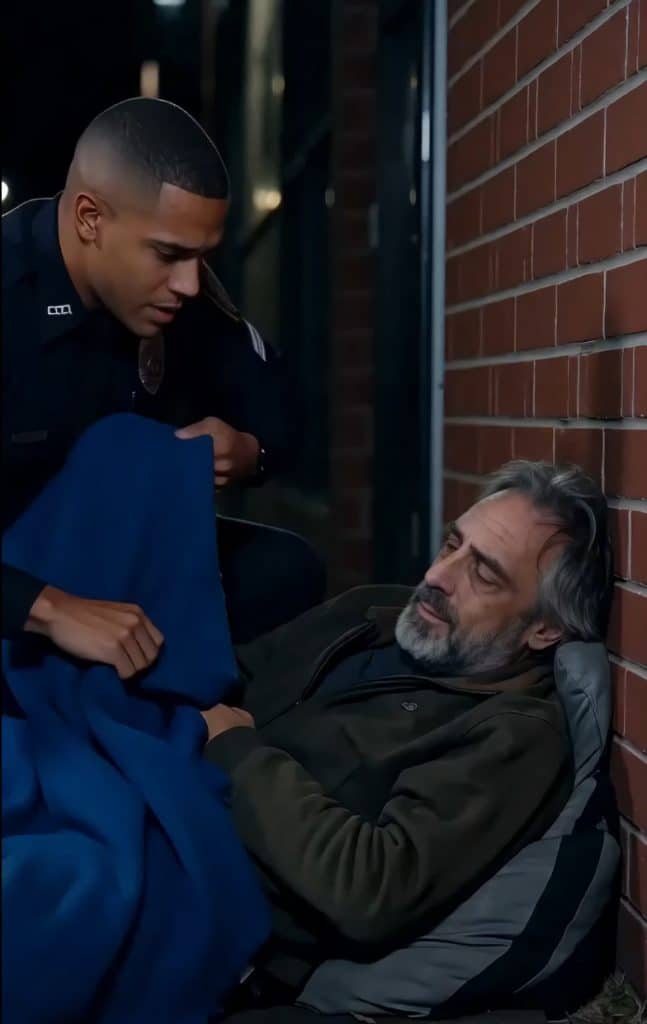
He was lying against the red brick wall behind the old bus station, knees pulled toward his chest, one arm tucked beneath his head as if he had simply grown too tired to stay standing. His coat was thin. His shoes were soaked. His beard was streaked with gray, and his breath trembled in the cold night air.
Most people walked past him.
Some stepped wider, as if hardship might stain their shoes.
Aaron stopped.
He was twenty-six, six months into the force, still new enough to believe the uniform meant he could fix something if he tried hard enough. He had been sent to clear the alley after a shop owner complained about “loitering.” The order was simple.
Move him along.
But the man could barely lift his head.
Aaron looked down the empty street. Snow had not started yet, but the temperature had dropped hard after sunset. The man’s hands were shaking too badly to close around the paper cup beside him.
Aaron crouched.
“Sir,” he said gently. “Can you hear me?”
The man opened his eyes.
They were sharp.
Not drunk. Not vacant.
Just exhausted beyond dignity.
Aaron took the thick blue blanket from the back of his cruiser. It was supposed to be for accident victims. He unfolded it slowly and tucked it around the man’s shoulders, careful not to startle him.
The man stared at him like kindness had become a language he no longer understood.
“Stay warm, brother,” Aaron said.
The man’s lips parted, but no words came.
Aaron sat with him until an outreach van arrived. He bought him coffee from the all-night deli and left twenty dollars in the paper bag with a sandwich because the man had refused cash when offered directly.
Before Aaron left, the man touched the blue blanket with one trembling hand.
“What’s your name?” he rasped.
“Miles,” Aaron said. “Aaron Miles.”
The man nodded once.
Like he was writing it somewhere inside himself.
Then the outreach van doors closed, and the blue blanket disappeared into the winter dark with him.
Aaron thought that was the end of it.
He was wrong.
Because eight months later, on the worst morning of his life, a legal envelope appeared on his kitchen table.
Act II
By the time the envelope arrived, Aaron no longer wore the uniform.
Not because he stopped believing in it.
Because believing in it had cost him.
Three months after the night with the blue blanket, Aaron reported two senior officers for stealing cash during a raid. He thought the evidence would protect him. Body camera timestamps. Missing inventory. A witness brave enough to speak if someone in authority promised to listen.
Instead, the witness vanished.
The report was buried.
And Aaron became a problem.
At first, it was small things. Bad shifts. Mocking comments. Paperwork “lost” from his file. Then came the accusation that he had violated procedure during a welfare check. No one cared that the complaint came from a man connected to one of the officers he had reported.
Aaron was suspended pending review.
The department called it administrative.
His landlord called it unpaid rent.
His younger sister, Maya, tried to pretend she was not scared when he came home early every day and sat at their kitchen table with job applications spread around cold coffee.
Their mother had died when Aaron was nineteen. Their father was gone before that. Maya was seventeen now, smart, stubborn, and two months from graduating high school. Aaron had promised her he would keep them steady.
But promises did not pay electric bills.
The morning the envelope arrived, Aaron almost threw it away with the collection notices.
It was legal-sized, cream-colored, heavier than the others. His name was typed cleanly across the front.
Aaron Miles.
No return address he recognized.
Maya stood at the stove making eggs they could barely afford, watching him turn the envelope over in his hands.
“Another bad one?” she asked.
“I don’t know.”
“Open it.”
Aaron gave her a tired look.
She shrugged. “Could be someone sending you a million dollars.”
He almost smiled.
Then he tore open the edge.
Inside was a folded document on thick paper, along with a smaller handwritten note.
Aaron pulled it out.
At first, he understood none of it.
Trust agreement.
Appointment.
Grant.
Board approval.
The words looked like they belonged to someone else’s life. Someone with suits, lawyers, offices, and bank accounts that did not dip below twelve dollars before payday.
Then he saw the number.
His breath stopped.
Maya turned from the stove. “Aaron?”
His hand began to shake.
“What the…” he whispered. “This can’t be real.”
Maya hurried to his side.
“What is it?”
Aaron read the note first because it was the only part that felt human.
Officer Miles,
You gave me a blanket on the night I had decided no one in this city could still see me.
You were wrong about one thing.
That was not the end of your duty.
It was the beginning of mine.
Come to Whitaker House, 41st floor, Thursday at 10 a.m. Bring the letter. Bring the truth. And bring the same heart you had that night.
—Nathaniel Whitaker
Maya went still.
“The Nathaniel Whitaker?”
Aaron did not answer.
Everyone in the city knew the name.
Whitaker Transit. Whitaker Medical. Whitaker Foundation. Buildings. Scholarships. Hospitals. Donations large enough to make headlines. A man so rich most people forgot he was real.
Aaron looked back at the document.
The blue blanket had not covered a forgotten man.
It had covered one of the most powerful men in the state.
And somehow, Nathaniel Whitaker had remembered his name.
Act III
Aaron almost did not go.
He owned one suit, black and slightly too tight at the shoulders, bought years earlier for his mother’s funeral. Maya ironed it twice and slapped his hand when he tried to adjust the tie too many times.
“You’re going,” she said.
“What if it’s a mistake?”
“What if it isn’t?”
That was the problem.
Hope felt dangerous now.
Aaron had learned that systems could smile while they crushed you. He had learned that truth without power often got buried under paperwork. He had learned that good intentions looked foolish when rent was due.
But on Thursday morning, he took the bus downtown.
Whitaker House rose from the financial district like a slab of polished black glass. Aaron stood outside for a full minute before entering, feeling ridiculous in his old suit and scuffed shoes.
The lobby smelled like marble, money, and fresh flowers.
A receptionist looked up.
“Mr. Miles?”
He froze. “Yes.”
“Mr. Whitaker is expecting you.”
The elevator ride felt endless.
Forty-one floors.
Each number lit up like a countdown.
When the doors opened, Aaron stepped into a warm office suite lined with dark wood, framed city maps, and old photographs of buses, shelters, and public hospitals from decades before the skyline became glass.
At the far end of the conference room stood a man in a navy suit.
Salt-and-pepper hair.
Trimmed beard.
Strong posture.
But Aaron recognized the eyes first.
The man from the sidewalk.
The man from the brick wall.
The man from the blue blanket.
Nathaniel Whitaker held that same blanket against his chest.
It had been cleaned, folded, and preserved like something sacred.
Aaron stopped in the doorway.
Mr. Whitaker smiled, but his eyes shone.
“I wondered if you’d recognize me.”
Aaron swallowed. “I wasn’t sure I was supposed to.”
“No one was,” Whitaker said.
He laid the blanket carefully on the dark wood table between them.
For a moment, neither man spoke.
Then Whitaker looked at the blanket and said, “I was not homeless that night. But I was lost.”
Aaron stayed silent.
Whitaker’s voice lowered.
“My wife had died six months earlier. My son was trying to have me declared mentally incompetent so he could force control of the company. My board thought I was unstable. My doctors called it grief. My son called it opportunity.”
He touched the edge of the blue fabric.
“I left my apartment that night without my phone, without my wallet, without any plan to return.”
Aaron’s chest tightened.
Whitaker looked up.
“You did not ask who I was. You did not ask what I could give you. You did not lecture me. You did not move me along because someone with a storefront found me inconvenient.”
His voice broke slightly.
“You called me brother.”
Aaron looked down.
“I was just doing my job.”
“No,” Whitaker said. “I know the difference. I’ve employed enough men who only do their jobs.”
He slid a folder across the table.
Aaron did not touch it.
“What is this?”
“An offer. And evidence.”
Aaron looked up sharply.
Whitaker’s expression changed.
“The officers who destroyed your career were connected to my son’s private security contractor. The same contractor used to intimidate me, falsify medical reports, and pressure witnesses.”
Aaron felt the room tilt.
Whitaker nodded once.
“Yes,” he said. “Your fight and mine were the same fight. We just did not know it yet.”
Act IV
The folder held everything Aaron had lost.
Copies of his original report. Internal emails discussing how to discredit him. Bank transfers from a security firm to one of the officers he had accused. A memo marked confidential that named Aaron a “liability.”
He read until the words blurred.
“They knew,” Aaron whispered.
Whitaker’s jaw tightened. “They knew.”
Aaron sat down slowly.
For months, he had wondered if he had imagined it. If he had made some mistake. If he had ruined his own life trying to be righteous in a world that rewarded silence.
Now the proof sat in front of him.
Clean.
Documented.
Undeniable.
Whitaker waited.
He did not rush him.
Finally, Aaron looked at the first document again. “What is the appointment?”
Whitaker leaned back.
“The Whitaker Foundation is launching an independent crisis response program. Legal aid. emergency housing, medical transport, whistleblower protection, and outreach teams that work without treating people like problems to be removed.”
Aaron blinked.
“I don’t understand what that has to do with me.”
“I want you to run field operations.”
Aaron stared at him. “I’m not qualified for that.”
Whitaker smiled faintly. “That is what people say when they have been trained to confuse credentials with character.”
“I’m twenty-six.”
“You saw a man on the ground and treated him like a human being while everyone else looked away.”
“That doesn’t mean I can run a foundation program.”
“No,” Whitaker said. “But it means I can trust what you will build if the right people are placed around you.”
Aaron shook his head, overwhelmed.
“There are people with degrees for this.”
“I hired them too.”
Despite himself, Aaron almost laughed.
Whitaker opened the folder to the final page.
“The grant includes salary, housing support, legal assistance for your case, and a scholarship fund for your sister. She has already been accepted to Northbridge University, correct?”
Aaron’s head snapped up.
“How do you know that?”
“She wrote a very good essay.”
Aaron’s throat closed.
Maya had not told him she had submitted the application because the tuition was impossible. She had kept the acceptance letter hidden in her drawer rather than add one more burden to his shoulders.
Whitaker’s voice softened.
“No young woman should give up her future because her brother told the truth.”
Aaron pressed both hands over his face.
For a few seconds, he could not breathe around the emotion in his chest.
Whitaker stood and walked around the table.
He did not touch Aaron’s shoulder.
He simply stood near him, close enough to be present without demanding a performance of gratitude.
“When I was on that sidewalk,” Whitaker said quietly, “I believed my life had become a mistake no one cared enough to correct. You corrected it with a blanket.”
Aaron lowered his hands.
Whitaker extended his.
“You saved my life that night.”
Aaron rose slowly and took it.
The handshake was firm.
Not charity.
Not pity.
Recognition.
Across the table, the blue blanket rested between them like a witness.
Act V
The story broke two weeks later.
Not the blanket part.
That stayed private at first.
What broke publicly was the corruption.
Two senior officers suspended. One arrested. A security contractor under investigation. Nathaniel Whitaker’s son removed from the company board after evidence showed he had tried to force his father out through forged medical claims and intimidation.
Aaron’s name appeared in the articles.
Former officer vindicated.
He hated that word.
Vindicated sounded clean. It did not include the months of shame, the unpaid bills, the way Maya had pretended not to skip lunch, the nights he sat awake wondering if doing the right thing had been selfish.
But the truth was public now.
And public truth has a weight private truth does not.
The department offered reinstatement.
Aaron declined.
Not angrily. Not dramatically.
He sent a short letter thanking them for reviewing the matter and explaining that he had accepted another position.
Maya read it over his shoulder and grinned.
“You sound so professional.”
“I am professional.”
“You used to eat cereal out of a saucepan.”
“That was efficient.”
She left for Northbridge that fall with two suitcases, a scholarship, and the blue scarf Aaron bought her because he said college students needed scarves.
She said no one needed scarves.
She wore it anyway.
The Whitaker Foundation’s first field office opened in the old bus station district, three blocks from the brick wall where Aaron had found Nathaniel. They called the program The Blue Blanket Initiative, though Aaron resisted the name until Whitaker told him resistance was not a management strategy.
The office offered temporary shelter placement, legal support, addiction recovery referrals, emergency medical rides, and a quiet room where people could make phone calls without being treated like criminals for needing help.
Aaron hired carefully.
A former nurse. A public defender. Two outreach workers who had once lived on the streets themselves. A retired dispatcher who remembered every voice. A chef who made soup so good people came in pretending they only wanted directions.
On the wall near the entrance, framed behind glass, was the original blue blanket.
Beneath it, a small brass plaque read:
STAY WARM, BROTHER.
Aaron thought it was too much.
Everyone else thought it was exactly enough.
Nathaniel visited often.
At first, staff stiffened when the billionaire walked in. Then they realized he washed coffee mugs without being asked and sat with clients longer than anyone expected. He never told people his story unless it helped them tell theirs.
One winter night, almost exactly a year after the sidewalk, Aaron found him standing alone in front of the blanket.
“You okay?” Aaron asked.
Whitaker smiled without looking away. “Better than I was.”
Outside, snow had begun to fall.
The first snow of the season.
Aaron stood beside him.
For a while, they watched through the window as flakes drifted past the streetlights and softened the city’s hard edges.
“I used to think power meant being able to change everything,” Whitaker said.
Aaron glanced at him. “And now?”
“Now I think it means being responsible for what you notice.”
Aaron thought of that night. The brick wall. The cold sidewalk. The order to move a man along. The choice not to.
He looked at the people inside the office.
A mother warming her hands around a paper cup. A teenager filling out an intake form. An old veteran laughing softly with the chef near the soup counter. Small salvations. Imperfect. Human. Real.
“I almost didn’t stop,” Aaron admitted.
Whitaker turned to him.
Aaron kept his eyes on the snow. “I was tired. It was cold. I had orders. I told myself someone else would handle it.”
“But you stopped.”
“Yeah.”
“That is the only part that matters.”
Years later, people would tell the story as if it were simple.
A young officer helped a stranger.
The stranger turned out to be rich.
A letter changed the officer’s life.
But Aaron knew the truth was deeper than that.
The letter had not changed his life.
The kindness had.
The letter only revealed what the kindness had already set in motion.
Because compassion is rarely as small as it looks in the moment. It travels. It waits. It enters rooms before you do. It becomes evidence, memory, obligation, mercy.
Sometimes it is a cup of coffee.
Sometimes it is a sandwich left in a paper bag.
Sometimes it is a blue blanket tucked around a man who has forgotten his own worth.
And sometimes, months later, it returns as a hand across a dark wood table, a life rebuilt, and the impossible proof that one decent act can survive the cold long enough to find its way home.