Act I
The first sound was not a scream.
It was a tiny voice pressed against glass.
“Mommy?”
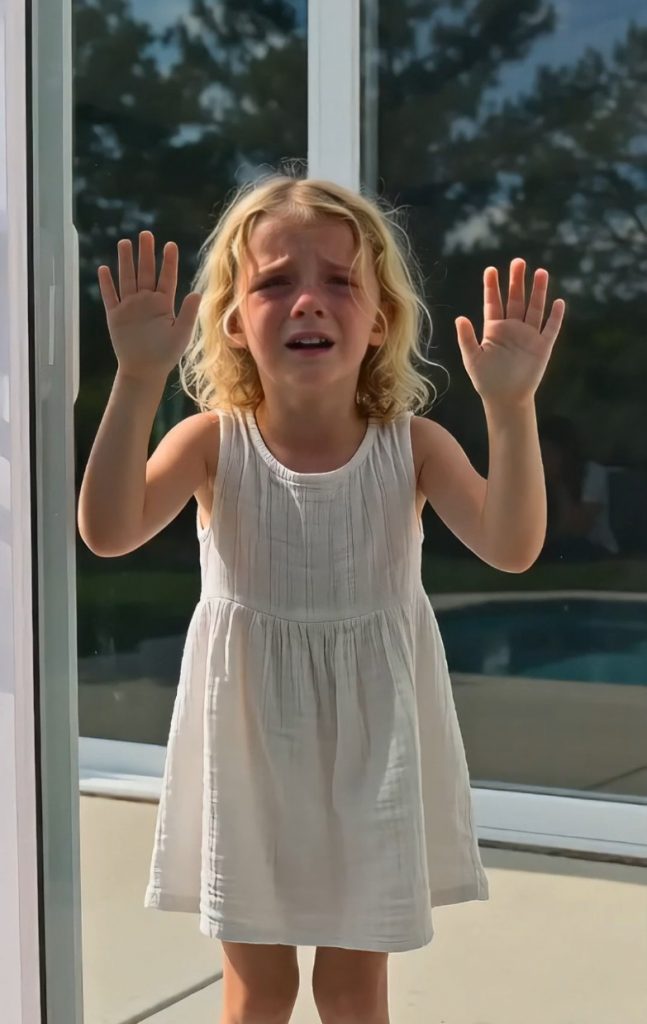
Mia Carter stood barefoot on the concrete patio, both small palms flattened against the sliding door. Sunlight glared so hard off the glass that her reflection looked broken, a pale little shape swallowed by tree shadows and white heat.
Inside the house, everything was still.
The gray sectional sofa sat in the living room beneath dark wooden beams. The kitchen island was clean. The barstools were lined up neatly. It looked like the kind of home people posted online to prove they were holding life together.
But no one inside was listening.
Mia tapped the glass again.
Her curly blonde hair stuck to her forehead. Her white cotton dress clung damply to her back. Her cheeks were red and wet with tears.
“Mommy?”
The door did not move.
The lock was turned.
She tried the handle with both hands, pulling until her little fingers slipped. The white frame rattled once, then settled back into silence. The sound barely reached the living room, muffled by thick glass and the heavy quiet inside.
On the sofa, Grace Carter sat with her head buried in her hands.
She had been sitting like that for almost twenty minutes.
Or an hour.
She did not know anymore.
Time had become strange lately. Some mornings disappeared before she remembered breakfast. Some afternoons stretched so wide she felt trapped inside them. Grief had made the house too bright, too quiet, too full of things she could not finish.
Mia banged harder.
This time, her tiny fists thudded against the glass.
Grace did not lift her head.
Outside, the patio burned under the afternoon sun. The yard beyond it shimmered with heat. Mia pressed her forehead to the door and tried to see through the reflections.
Her mother was right there.
So close.
Too far.
“It’s too hot,” Mia cried.
The words came out weak and muffled.
She slid one hand down the glass, leaving a streak behind. Her knees trembled. She looked once toward the yard, but there was no shade close enough, no person near enough, no way back inside.
Then her legs folded.
Mia sank down onto the concrete beside the door, one cheek turning toward the glass, her hand falling open near the frame.
For one terrible second, the whole world went quiet.
Then something moved in the yard.
A dog came sprinting out of the sunlight.
He was big, fast, golden-brown in the glare, paws slapping against the patio as he skidded beside Mia. His name was Ranger, and until that moment, Grace had thought of him as one more problem she did not have strength to handle.
Ranger lowered his head and licked Mia’s cheek.
She did not wake.
He whined once.
Then he turned to the glass, rose onto his hind legs, and began clawing at the door with everything he had.
And the one who finally heard Mia was not her mother.
Act II
Ranger had been Grace’s husband’s dog.
That was the simplest way people described him.
Not the family dog. Not Mia’s dog. Not Grace’s dog.
Evan’s dog.
Evan had brought him home three years earlier as a muddy, long-legged rescue puppy with ears too big for his head and eyes full of apology. Grace had laughed when she saw him sitting in the laundry basket, wrapped in one of Evan’s old towels.
“We do not need a dog,” she had said.
Evan had smiled like he already knew he had won.
“No,” he said. “But maybe he needs us.”
That was Evan’s way. He had a talent for finding broken things and calling them unfinished. Old furniture. abandoned bicycles. stray dogs. tired people. Grace used to tease him that he collected lost causes because he did not know how to leave anything behind.
Ranger adored him from the first night.
He followed Evan through the house, slept outside his office door, and waited by the garage every evening ten minutes before Evan’s truck pulled in.
Mia was two then.
She learned to walk by holding one hand on the coffee table and the other in Ranger’s fur. The dog moved slowly for her, patient and proud, as if he understood he had been promoted from pet to guardian.
Then Evan died.
One rainy morning. One driver who ran a red light. One phone call Grace could still hear in her sleep.
After the funeral, Ranger changed.
He stopped sleeping in the laundry room. He slept outside Mia’s door instead. He barked whenever a delivery truck pulled too close. He followed Grace around the house with anxious eyes, as if waiting for a command she did not know how to give.
Grace loved him.
She also resented him.
That truth made her feel monstrous.
Ranger was a living piece of Evan. His collar still had the tag Evan had ordered. His food bin had Evan’s handwriting on the label. His leash hung beside the back door where Evan used to grab it every morning.
Every time Ranger looked at her, Grace felt asked for something she could not provide.
Energy.
Patience.
Love without breaking.
So she had started keeping him outside more.
Not all day. Not cruelly. But often enough that Mia noticed.
“Ranger wants to come in,” Mia would say.
“He has shade,” Grace answered.
“He misses Daddy too.”
That sentence always ended the conversation.
Grace tried therapy. Tried meal trains. Tried smiling at neighbors who asked if she was “doing better” like grief was the flu. She tried to be the mother Mia needed, the widow people admired, the woman who could rebuild a life from casseroles and sympathy cards.
But some days she simply sat down and vanished into herself.
That afternoon had begun with something small.
A broken mug.
Evan’s favorite.
It slipped from Grace’s hand while she was unloading the dishwasher and shattered across the kitchen floor. Blue ceramic pieces scattered under the island, and Grace stood above them, unable to breathe.
Mia came running.
“Mommy?”
Grace told her to stay back because of the sharp pieces. She opened the sliding door and asked Mia to play on the patio for “just a minute” while she cleaned.
Ranger was in the yard.
Mia had her sidewalk chalk.
The door was supposed to stay unlocked.
Grace swept the mug into the trash. Then she saw the handle, still intact, with the tiny chip Evan used to rub his thumb over while drinking coffee.
She sat down on the sofa holding it.
That was all.
She just sat down.
And the house swallowed her.
She did not remember the automatic child lock clicking into place when the door slid shut behind Mia. Evan had installed it after Mia learned to open the patio door by herself. A clever safety feature, he had called it.
A safety feature that now trapped their daughter outside.
Mia had called once.
Then again.
Then banged.
Grace heard something, maybe. A distant tapping. A sound her numb mind folded into the house settling, the air conditioner turning on, a branch brushing the glass.
Then the tapping stopped.
That should have been the warning.
But it was Ranger who understood silence first.
He had been near the fence, lying in the thin shade under the maple tree. The moment Mia collapsed, he lifted his head. He ran to her before Grace even raised her eyes.
He licked her face.
Whined.
Nudged her shoulder.
When she did not respond, Ranger turned from the child to the door.
And began to fight the only barrier he could see.
Act III
The barking broke through Grace like a hand reaching into deep water.
At first, she flinched.
Ranger barked often. At squirrels. At trucks. At the neighbor’s leaf blower. At empty air when the house felt too quiet. Lately, the sound had made Grace angry before she even knew why.
But this bark was different.
It was sharp.
Repeated.
Panicked.
Glass rattled behind her.
Grace lifted her head from her hands.
Ranger was standing upright against the sliding door, front paws clawing furiously down the glass. His mouth opened in another desperate bark. His eyes were fixed on her.
Not asking.
Commanding.
Grace stood halfway, irritated and confused.
“Ranger, stop.”
He did not stop.
He struck the glass again.
Behind his legs, low on the patio, Grace saw a white shape.
For half a second, her brain refused to understand it.
Then the shape became a dress.
A small bare foot.
A limp hand.
Grace’s heart stopped.
“Mia!”
She ran so hard into the coffee table that pain shot through her thigh, but she did not slow down. She reached the door and grabbed the handle.
Locked.
“No, no, no.”
Her fingers slipped. She fumbled with the latch. Ranger dropped down and backed away just enough to give the door space, still whining, still looking from Grace to Mia.
The lock stuck.
It had always stuck when the frame got hot.
Grace yanked again, sobbing now, her whole body shaking.
“Open. Please open.”
The latch snapped loose.
She dragged the door open and fell to her knees on the patio.
The heat hit her like a wall.
“Mia. Baby. Mia, wake up.”
Mia’s skin was hot. Her lashes fluttered. She made a tiny sound, barely there, and Grace nearly collapsed from relief and terror at once.
Ranger pressed his nose against Mia’s shoulder, then looked at Grace as if begging her to do something faster.
Grace lifted Mia carefully, shielding her from the concrete, and carried her inside. Ranger followed so close his body brushed against Grace’s legs.
The cool air of the living room felt obscene.
How had it been so calm in here?
How had the sofa sat untouched, the island clean, the floors polished, while her child had been crying outside the glass?
Grace laid Mia on the rug and grabbed her phone with shaking hands.
Her fingers almost could not press the numbers.
“Emergency services,” the operator said.
Grace’s voice broke.
“My daughter was locked outside. She’s overheated. She collapsed. Please, please send someone.”
The operator stayed calm. Grace clung to that calm like a rope.
She answered questions. She followed instructions. She cried through half of them and apologized through the rest.
Ranger lay beside Mia, whining softly, his head close to her hand.
Mia stirred.
“Mommy?” she whispered.
Grace let out a sound that was almost a sob and almost a prayer.
“I’m here,” she said. “I’m right here. I’m so sorry.”
Mia’s fingers moved weakly.
They touched Ranger’s ear.
“Ranger got you,” she murmured.
Grace looked at the dog.
There were claw marks smeared down the glass. Streaks from his paws. Fur stuck to the frame. His chest heaved from barking, running, pleading in the only language he had.
Grace reached for him with one trembling hand.
Ranger leaned into her touch without hesitation.
That forgiveness nearly broke her.
Because the dog she had been pushing outside had just brought her daughter back in.
Act IV
The ambulance arrived in six minutes.
Grace counted every one.
By then, Mia was awake but dazed, curled against her mother with Ranger pressed protectively at their feet. The paramedics moved quickly, calmly, asking questions Grace hated answering.
How long was she outside?
Was she crying before she collapsed?
Did she lose consciousness?
Grace told the truth every time.
“I don’t know.”
Those four words became a punishment.
She did not know because she had not looked.
A neighbor, Mrs. Alvarez, stood in the doorway with both hands over her mouth. She had heard the barking from across the fence and come running just as the ambulance pulled up.
“What happened?” she whispered.
Grace looked at the glass door.
At the lock.
At the patio.
At the dog.
“She was outside,” Grace said. “I didn’t hear her.”
Mrs. Alvarez’s face softened, but Grace could not bear softness.
Softness felt like being excused.
And she did not want to be excused.
At the hospital, Mia was treated and monitored. Nurses spoke gently. A doctor told Grace that Mia had been brought in quickly. That mattered. Ranger’s alarm had mattered.
Grace nodded, but the words moved around her without settling.
Quickly.
As if speed could erase the moment Mia’s hands slid down the glass.
A hospital social worker came in later.
Grace expected judgment.
She almost wanted it.
Instead, the woman pulled up a chair and asked about support. About sleep. About grief. About whether Grace had been feeling disconnected, overwhelmed, unable to respond to ordinary things.
Grace stared at the floor.
“I love my daughter,” she said.
“I know,” the woman replied.
Grace looked up sharply.
The woman’s voice stayed gentle.
“Loving her doesn’t mean you aren’t drowning.”
That was the first sentence all day that made Grace cry without trying to stop.
She cried for Mia. For Evan. For the mug. For the locked door. For the months she had mistaken survival for healing. For the dog waiting in the hospital parking lot with Mrs. Alvarez because he refused to leave the car.
When Mia was finally cleared to go home that evening, she was tired but smiling faintly.
“Where’s Ranger?” she asked.
Grace brushed hair from her forehead.
“Waiting for you.”
Mia’s eyes filled. “Can he sleep in my room?”
Grace swallowed.
“Yes.”
“And not outside?”
Grace closed her eyes.
“Not outside.”
When they pulled into the driveway, Ranger barked once from Mrs. Alvarez’s porch, then tore across the lawn the second she released him. He reached Mia as Grace lifted her from the car and immediately lowered his head, careful and gentle.
Mia wrapped both arms around his neck.
“My good boy,” she whispered.
Grace stood beside them, one hand on the car door.
Across the yard, Mrs. Alvarez watched quietly.
“You know,” the older woman said, “I heard him before I heard anything else.”
Grace looked at Ranger.
“He knew,” she said.
Mrs. Alvarez nodded.
“Dogs often do.”
But Grace knew it was more than that.
Ranger had not only known Mia was in danger.
He had known Grace was lost somewhere inside the house.
And he had dragged her back.
Act V
The sliding door came off its track the next morning.
Grace did not wait for someone else to fix it. She called a contractor, then called her brother, then stood in the living room while both men removed the faulty lock and replaced it with a safer system that could not trap a child outside.
She watched every screw go in.
She tested the handle twenty times.
Then she placed a small bell on the door at Mia’s height.
Not because she trusted objects more now.
Because she understood that love needed systems when grief made memory unreliable.
The house changed after that.
Not all at once.
Real change rarely arrives dramatically. It comes in small humiliating appointments and calendars taped to refrigerators. It comes in admitting to a therapist that you sat on a sofa while your child called for you. It comes in letting neighbors help even when help feels like proof you failed.
Grace went to counseling twice a week.
Mrs. Alvarez picked Mia up from preschool on Thursdays.
Grace’s brother installed shade over the patio and a camera near the door.
And Ranger came back inside.
Fully.
His bed returned to the hallway outside Mia’s room. His bowl moved back to the kitchen. His leash hung beside the back door again, right where Evan used to keep it.
The first night home, Grace found Mia asleep with one hand dangling from the bed, fingers buried in Ranger’s fur. The dog lay motionless, as if he understood that being still was now his most important job.
Grace sat on the floor beside them.
For a long time, she said nothing.
Then she whispered, “I’m sorry.”
Ranger opened one eye.
His tail tapped once against the carpet.
Grace laughed through tears.
“You make forgiveness look easy,” she said.
It was not easy for her.
Forgiving herself would take longer.
Some nights, she still woke hearing Mia’s muffled voice through glass. Sometimes she walked to the patio door at midnight just to touch the lock. Sometimes she stood over Mia’s bed and counted the rise and fall of her breathing until Ranger huffed, annoyed, like he was telling her he had the watch.
But the house no longer felt silent in the same way.
It had footsteps again. Dog nails clicking on hardwood. Mia singing to stuffed animals. Grace making coffee in Evan’s chipped replacement mug and opening the curtains before the morning could close in around her.
One afternoon, several weeks later, Mia drew a picture at the kitchen island.
Grace was paying bills nearby, forcing herself to stay present, one envelope at a time.
“What are you making?” she asked.
Mia held up the paper.
It showed a house with a giant glass door. A little girl in a white dress. A brown dog with enormous paws. A mother with long hair running from a gray couch.
At the top, in crooked letters, Mia had written:
Ranger woke Mommy up.
Grace stared at it.
Her throat tightened.
“Do you want to put it on the fridge?” she asked.
Mia shook her head.
“By the door,” she said. “So Ranger can see.”
So they taped it beside the patio door, just above the new latch.
Ranger sniffed it, wagged once, then sat beneath it like a guard accepting his post.
That evening, Grace opened the sliding door and stepped outside with Mia and Ranger together. The patio was cooler now, shaded and safe, the concrete no longer blazing under direct sun.
Mia chalked flowers across the ground.
Ranger lay beside her, ears twitching at birds.
Grace sat in a chair near the door, watching them both.
Not from far away.
Not from behind glass.
There would always be people who would hear the story and judge Grace by the worst fifteen minutes of her life. Grace understood that. Some days, she judged herself the same way.
But Mia did not remember it like that.
Mia remembered the dog.
The paws on the glass. The barking. The warm fur against her hand. The moment her mother came running.
And Grace remembered something else too.
She remembered that love is not proven by never failing.
Sometimes it is proven by what you do after the failure opens its mouth and shows you exactly what it could have taken.
The glass still held faint scratches where Ranger had clawed it.
Grace refused to polish them away.
They stayed there in the afternoon light, thin white marks against the pane, a permanent record of the moment a loyal dog refused to let silence win.
Mia had been trapped outside.
Grace had been trapped inside herself.
And Ranger, wild with love and fear, had stood between both dangers and barked until the whole house came back to life.