Act I
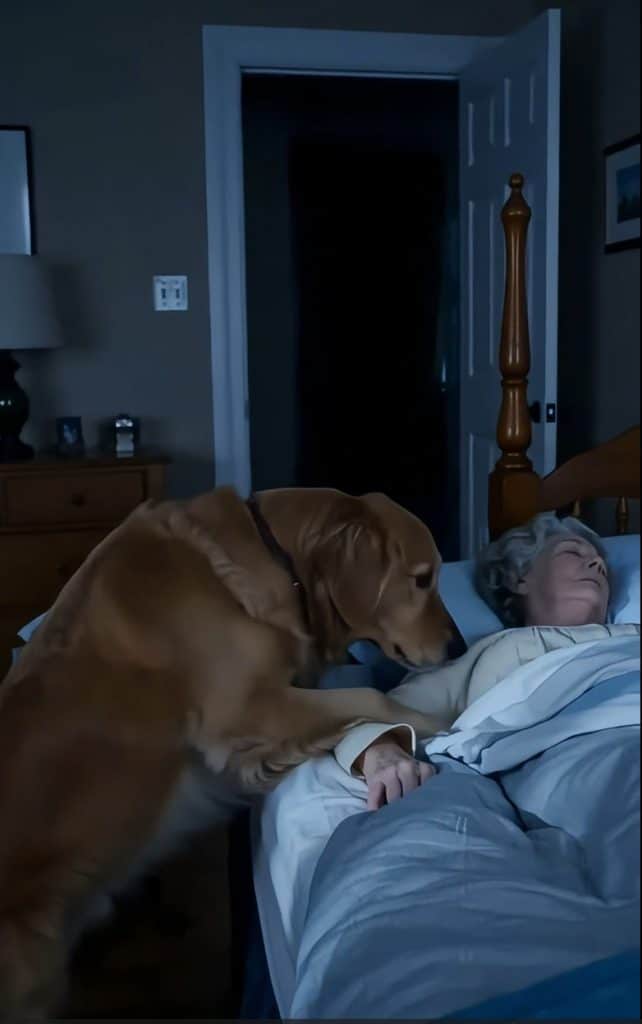
The bedroom was quiet enough to hear the curtains breathe.
Moonlight slipped through the white fabric and spilled across the wooden floor, pale and thin. The bedside lamp was off. A tissue box sat untouched on the side table. On the dresser, a framed photograph faced the bed: a younger woman in a blue dress, a tall man with one arm around her, and a golden dog sitting proudly at their feet.
Eleanor Whitaker slept beneath white and blue blankets, one hand resting near the edge of the mattress.
She did not hear the first creak.
But Bailey did.
The Golden Retriever stood beside the bed, half-lit by moonlight, his soft brown eyes fixed on the partially open door. Beyond it, the hallway was black. Not dim. Not shadowed.
Black.
Bailey’s ears lifted.
He did not bark.
That was the strange part.
Bailey barked at delivery trucks. At crows on the fence. At the neighbor’s sprinkler when it clicked on too suddenly. But now, with something moving outside Eleanor’s bedroom, he kept his mouth closed.
He placed both front paws gently on the mattress and nudged Eleanor’s hand with his nose.
She did not wake.
Another faint sound came from the hallway.
A slow board creak.
Bailey froze.
His breathing stopped for one second. His eyes moved from the door to Eleanor, then back again.
He tapped her forearm with one paw.
Softly.
Carefully.
Eleanor’s fingers twitched, but her eyes stayed closed.
Bailey leaned closer and pressed his nose against her wrist. When that failed, he raised himself higher on the bed and pushed carefully against her shoulder.
The dog was urgent now, but still silent.
The hallway creaked again.
Closer.
Eleanor’s brow tightened in sleep.
Bailey lowered his muzzle to her cheek and gave one tiny whine, so small it almost vanished into the room. Then he turned his body toward the door, placing himself between Eleanor and the darkness beyond it.
At last, Eleanor’s eyes fluttered.
She woke to Bailey inches from her face.
For a moment, she was only confused. Then she saw the dog’s posture. His rigid back. His closed mouth. The way he stared past her instead of at her.
Eleanor followed his gaze.
The bedroom door stood open.
The hallway beyond it was dark.
And in that darkness, something moved.
Only then did Eleanor understand that Bailey had not been trying to wake her loudly.
He had been trying not to let whoever was outside know she was awake.
Act II
Bailey had been Harold’s dog first.
That was how Eleanor always introduced him, even after Harold was gone.
“My husband’s shadow,” she would say, smiling when people asked about the old Golden Retriever who followed her through the grocery store parking lot, waited beside her garden chair, and slept outside her bedroom door.
Harold had brought Bailey home six years earlier, when the dog was still young enough to trip over his own paws. Eleanor had pretended to be annoyed. She said they were too old for muddy footprints. Too settled for chewed slippers. Too practical for a dog with more enthusiasm than sense.
Harold only laughed.
“We are exactly old enough,” he said. “We need someone in this house who still believes every morning is a miracle.”
Bailey gave them that.
He sat with Harold during his treatments. He learned to bring Eleanor her slippers when her arthritis made cold floors painful. He walked slowly when Harold’s strength faded. He rested his head on the old man’s knee during long nights when neither of them could sleep.
After Harold died, Bailey stopped sleeping by the fireplace.
He moved to Eleanor’s door.
Every night.
At first, Eleanor found it comforting. Then necessary. Then, in a quiet way she rarely admitted, lifesaving.
Her son, David, worried about her living alone.
He called every evening from Chicago. He asked whether she had locked the doors, whether she had taken her medication, whether she had remembered to turn off the stove. Eleanor heard the fear beneath his questions, and it irritated her because it sounded too much like doubt.
“I am old,” she told him once. “I am not helpless.”
David had gone silent.
“I know, Mom,” he said. “But Dad isn’t there anymore.”
That was the part neither of them could argue with.
Still, Eleanor stayed in the house.
She stayed because Harold had built the back porch himself. Because the lilac bush near the fence had survived twenty winters. Because every hallway held a memory, and leaving felt like losing him a second time.
But the house had begun to feel different over the last month.
Small things moved.
A drawer left slightly open.
A photograph turned face down.
A missing envelope from Harold’s desk that Eleanor later found tucked beneath old newspapers.
She told herself she was forgetting.
That was the cruelest explanation, and somehow the easiest to believe.
She was seventy-eight. Her hands shook sometimes. Names took longer to reach her mouth. Last week, she found her reading glasses in the refrigerator and laughed until she cried.
Maybe she was slipping.
Maybe David was right to worry.
Then Bailey started standing at the hallway each evening, staring toward the front door.
Not barking.
Watching.
Eleanor thought he missed Harold.
So did she.
Two days before the night Bailey woke her, Eleanor’s home aide, Marcy, had come by for the last time.
Marcy was kind in the way tired people are often kind: efficient, patient, but always watching the clock. She helped Eleanor with groceries and laundry twice a week. Her adult son, Travis, sometimes drove her, waiting in the car with the engine running.
Eleanor had only met him once.
He had smiled too much.
That day, he carried a box from the porch into the foyer.
“Nice place,” he said, looking around.
Eleanor thanked him and thought nothing of it.
Bailey had stood between them the entire time.
Low.
Silent.
Unmoving.
Travis had laughed.
“Dog doesn’t like me.”
“Bailey is particular,” Eleanor said.
“No kidding.”
The next morning, Marcy called to say she had taken another job. Sudden. Better pay. Nothing personal.
Eleanor wished her well.
That evening, David called again and asked about the legal papers Harold had kept in the house. The deed. The insurance documents. The old safe deposit key.
Eleanor told him they were in Harold’s desk.
“Are you sure?” David asked.
The question annoyed her.
“Yes,” she said sharply. “I am sure.”
After they hung up, she checked.
The papers were there.
But the desk drawer had been unlocked.
Eleanor stared at it for a long time.
Then Bailey came to the doorway, looked down the hall, and gave one quiet breath through his nose.
That night, Eleanor went to bed with the uneasy feeling that her house had learned to keep secrets.
And Bailey was the only one listening.
Act III
Eleanor did not scream.
She wanted to.
Her throat tightened around the sound, but Bailey’s stillness stopped her. He was not acting like a dog who wanted noise. He was acting like a dog who wanted time.
So Eleanor stayed frozen in bed, eyes wide, following the shape in the hallway.
There was a shadow near Harold’s study.
Not tall enough to be clear. Not close enough to see a face. Only a figure shifting slowly, careful not to let the floorboards complain too loudly.
A thin line of light appeared.
Someone had opened the study door.
Bailey lowered his head.
Eleanor reached slowly under her pillow.
Harold had insisted she keep an old emergency phone there after his first hospital stay. It was simple, prepaid, and usually forgotten. David teased her about it. Eleanor had rolled her eyes and kept it there anyway because Harold had asked.
Her fingers found it.
The figure in the hallway moved again.
A drawer opened.
Paper rustled.
Eleanor’s heart pounded so hard she was afraid it would give her away.
Bailey shifted one paw forward.
Not into the hallway.
Just enough to block more of the doorway.
Eleanor pressed the phone’s side button and lowered the brightness with shaking fingers. Her hands were clumsy. Her thumb missed once. Twice.
The hallway went quiet.
Bailey’s ears lifted.
Eleanor stopped breathing.
The figure stepped toward the bedroom.
The floor creaked.
Bailey made the smallest sound then.
Not a bark.
A warning rumble so low Eleanor felt it more than heard it.
The figure stopped.
“Quiet,” a man whispered from the hallway.
Eleanor knew that voice.
Not well.
But enough.
Travis.
Marcy’s son.
The realization moved through her coldly. He had been in her foyer. He had seen the layout. He had seen she was old. He had seen Harold’s study door. Maybe he had seen where Marcy kept the spare key when she returned it.
Or maybe Marcy had never returned it at all.
Eleanor’s fear changed shape.
It became anger.
Not loud anger. Not reckless anger.
The kind that sits upright inside an old woman who suddenly understands that someone mistook her loneliness for weakness.
Travis took another step.
Bailey moved.
He placed himself fully in front of the bedroom door now, shoulders squared, head low, eyes fixed on the darkness.
The man whispered something Eleanor could not catch.
Bailey did not move.
Eleanor’s thumb finally found the emergency call button.
She pressed.
The phone vibrated once in her hand.
Too loud.
Travis heard it.
His silhouette sharpened in the hallway.
“Mrs. Whitaker?”
The fake softness in his voice chilled her more than a shout would have.
Bailey’s growl deepened.
Eleanor sat up slowly, phone hidden beneath the blanket.
“I know you’re there,” Travis said.
Eleanor’s voice surprised her.
It came out steady.
“So does my dog.”
Silence.
Then Travis laughed under his breath.
“That old thing?”
Bailey stepped forward once.
The laughter stopped.
Eleanor heard a dispatcher’s voice, faint and tiny, through the phone beneath the blanket.
“Emergency services. What is your emergency?”
Eleanor did not dare lift the phone to her mouth.
So she spoke to the hallway instead.
“Bailey,” she said clearly, “stay.”
The dispatcher went silent, listening.
Eleanor raised her voice just enough.
“There is a man in my house.”
Travis cursed under his breath.
Then the hallway erupted into motion.
Act IV
Bailey lunged, but only to the doorway.
He did not chase recklessly into the dark hall. He held the entrance like a living barrier, barking now with a force that shook the bedroom walls.
Eleanor swung her legs over the side of the bed and grabbed the lamp from the bedside table.
Her knees nearly failed her, but fury kept her upright.
Travis moved fast down the hall.
A drawer slammed. Something fell in Harold’s study. The front door rattled as he tried to leave the way he had come.
Bailey took one step into the hallway, then looked back at Eleanor.
Even in panic, he checked her.
That nearly broke her heart.
“Go,” she whispered. “I’m safe.”
Bailey ran.
His paws hammered down the hall. There was a sharp shout from Travis, then the sound of a body hitting the wall. Not hard enough to injure, but enough to stop him. Enough to make him afraid.
Eleanor followed slowly, one hand on the wall, the emergency phone still connected.
“I am at 418 Willow Lane,” she said to the dispatcher, voice shaking now. “My name is Eleanor Whitaker. Someone broke into my house.”
“Police are on the way,” the dispatcher said. “Are you safe?”
Eleanor looked toward the hall.
Bailey stood near the front door, barking with his body angled between Travis and the rest of the house.
Travis had dropped a folder.
Harold’s folder.
The one with the deed, insurance papers, and the safe deposit records.
Eleanor saw it on the floor beneath the moonlight from the foyer window.
Something inside her steadied.
“Yes,” she said. “My dog is with me.”
The police arrived six minutes later.
To Eleanor, it felt like an hour.
By then, Travis had backed himself against the entryway bench, pale and furious, one hand raised as if Bailey were a loaded weapon. Bailey had not bitten him. Had not needed to. He had simply refused to let him move.
When officers entered, Eleanor sat in Harold’s old chair with the blanket around her shoulders.
She looked smaller than she wanted to.
That bothered her.
But when one officer asked if she was hurt, she lifted her chin.
“No,” she said. “He did not get that privilege.”
The officer blinked, then nodded respectfully.
Travis tried to talk.
He said Marcy knew nothing. Then said Eleanor had given permission. Then said he only came to check on her because the door was open.
Bailey growled at that.
Eleanor almost smiled.
The officers found the spare key in Travis’s pocket.
They found Harold’s documents in the folder by the door.
They found two pieces of Eleanor’s jewelry tucked in his jacket, wrapped in one of her handkerchiefs.
Marcy arrived twenty minutes later, crying before she reached the porch. She said she did not know. She said Travis must have taken the key from her bag. She said she was sorry again and again until Eleanor finally raised one hand.
“I believe you,” Eleanor said.
Marcy broke down harder.
Eleanor believed her because shame looked different from lying.
She had seen both that night.
David arrived just after sunrise.
He drove four hours after the police called him, arriving with uncombed hair, a wrinkled sweater, and fear all over his face.
“Mom.”
He crossed the living room in three strides and knelt in front of her chair.
For one second, Eleanor was annoyed by the way he looked at her, as if checking whether she had cracked.
Then she saw the boy inside the man.
The same boy who once ran into her bedroom during thunderstorms and climbed under her quilt without asking.
She touched his cheek.
“I’m all right.”
David’s eyes filled.
Then he looked at Bailey, who lay at Eleanor’s feet with his head on his paws.
David swallowed.
“I wanted you to move out of this house,” he said.
“I know.”
“I thought he was just keeping you attached to Dad.”
Eleanor looked down at the dog.
“He is,” she said softly. “But not only that.”
Bailey lifted his eyes toward her.
The scratches on the bedroom doorframe, the muddy paw prints from officers coming in, the open drawers in Harold’s study — all of it remained as evidence of the night.
But so did Bailey.
Golden, tired, watchful.
The one who heard danger before anyone else did.
The one who knew not to bark until Eleanor was awake.
The one who stood between an old woman and the darkness.
And before the morning ended, the whole family would learn Harold had left one more instruction behind.
Act V
David found the envelope in Harold’s desk while helping Eleanor put the papers back.
It was sealed, yellowed slightly at the edges, with Eleanor’s name written in Harold’s careful handwriting.
She sat at the kitchen table when David brought it to her.
For a long moment, she only stared.
“I don’t remember this,” she whispered.
David placed it gently in front of her. “It was tucked behind the deed.”
Eleanor opened it with trembling fingers.
Inside was a single page.
Ellie,
If you are reading this, it means you went looking through my desk, which means I was right to label everything and you were wrong to say I was dramatic.
Eleanor laughed once, suddenly and painfully.
David looked away, giving her privacy she did not ask for but appreciated.
She kept reading.
I know you will try to be brave after I am gone. You always were. But brave does not mean alone.
Bailey knows this house. He knows your routines. He knows when something is wrong. Trust him when he worries. I trained him for more than fetching slippers, though he remains terrible at giving them up.
Her eyes blurred.
One more thing. If David ever tries to convince you that Bailey is only a dog, remind him that I said Bailey is family. And if Bailey ever wakes you in the night, listen.
Eleanor pressed the page to her chest.
David wiped his face with one hand.
“I’m sorry,” he said.
“For what?”
“For thinking keeping him here was about grief.”
Eleanor looked at Bailey, who was asleep now beside the kitchen doorway, finally letting exhaustion win.
“It was about grief,” she said. “But grief isn’t always a chain. Sometimes it’s a guardrail.”
The house changed after that night.
Not because Eleanor left it.
Because people stopped treating her staying as stubbornness.
David installed better locks. Motion lights. A camera by the porch. A new alarm system with a silent emergency button near Eleanor’s bed and another in the kitchen.
Eleanor allowed all of it.
Not because she had become afraid of her home.
Because she had remembered that independence did not mean refusing help. It meant choosing the kind of help that let her remain herself.
Marcy wrote a letter a week later, apologizing again. Eleanor answered it with three sentences.
I believe you. I hope you find peace. I will not be needing your services again.
That was mercy.
And a boundary.
Travis was charged for the break-in and theft. Eleanor did not attend every hearing, but she gave a statement. She wore Harold’s favorite blue scarf, walked in beside David, and kept her voice steady as she told the court that old age was not an invitation.
Bailey waited outside the courthouse with David’s wife.
When Eleanor came out, the dog stood so quickly his leash tangled around a bench.
Eleanor laughed for the first time in days.
“My brave boy,” she said.
Bailey leaned against her legs.
Months passed.
The scratches stayed on the bedroom doorframe.
David offered to sand them down, but Eleanor refused.
“They remind me,” she said.
“Of the break-in?”
“No,” she said. “Of the warning.”
At night, Bailey returned to his place beside the bed. Sometimes Eleanor woke and found him watching the doorway. Sometimes she whispered Harold’s name into the dark and felt the old ache move through her, softer now, less like a wound and more like a hand resting lightly on her shoulder.
One evening, David called as usual.
“Doors locked?” he asked.
“Yes.”
“Alarm set?”
“Yes.”
“Bailey on duty?”
Eleanor glanced down.
Bailey was already asleep with one ear tilted toward the hallway.
“Always.”
David paused.
“Good.”
After they hung up, Eleanor turned off the lamp and settled beneath the blue-and-white blankets. Moonlight slipped through the curtains. The hallway beyond the bedroom door was no longer black; a small motion light glowed softly near the floor.
Bailey breathed quietly beside her.
Eleanor reached down and rested her hand on his head.
Harold had been right.
Brave did not mean alone.
And sometimes love stayed behind in unexpected forms: in a letter tucked behind legal papers, in a dog who remembered his training, in the soft press of a cold nose against an old woman’s hand when danger walked quietly down the hall.
That night, Bailey had not barked.
Not at first.
He had known noise could give them away.
So he woke her gently, silently, urgently, with moonlight on his fur and fear in his eyes, until Eleanor opened her own and saw what waited beyond the door.
The darkness had entered her house thinking she was alone.
It had been wrong.