Act I
The frost had not melted yet when the golden retriever pushed through the little iron gate.
For one strange second, nobody moved.
Not Marissa, standing barefoot inside the open front door with a dish towel still in her hand. Not Lily and Nora, frozen behind her in their navy winter coats. Not the man in camouflage who had just stepped out of the rental car after eleven months overseas, still carrying the weight of a war zone in his shoulders.
Then the dog made a sound.
It was small, broken, and unmistakably his.
Ethan Keller dropped his duffel bag onto the white grass.
“Cooper?”
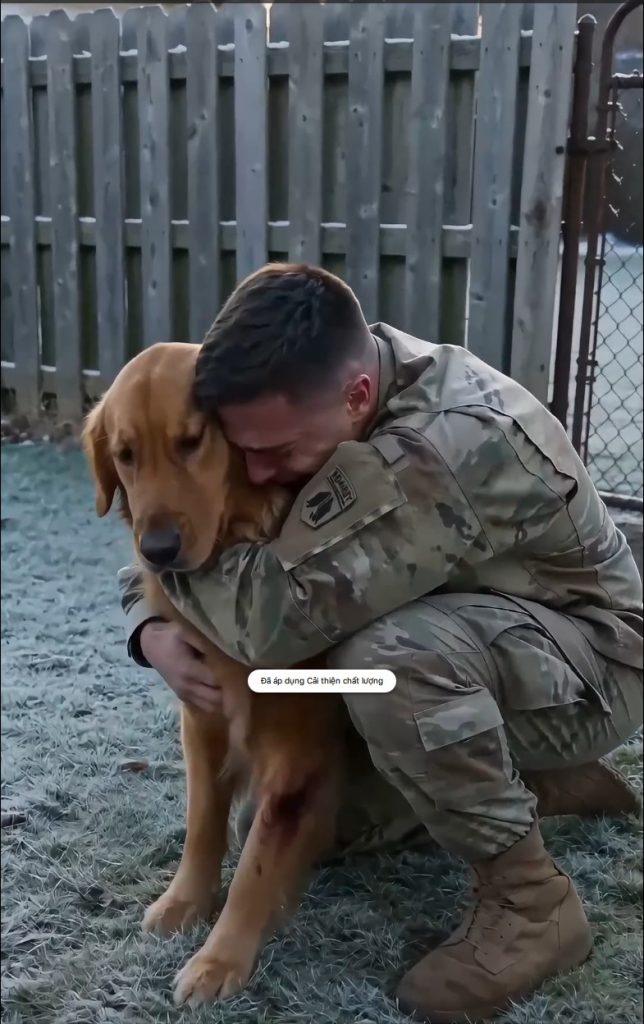
The dog limped once across the yard, then again, his golden coat dull from travel, his eyes locked on the soldier as if the world had narrowed to one person. Ethan took one step forward. Then his knees gave out before Cooper even reached him.
The dog pressed into his chest with such force that Ethan nearly fell backward.
He grabbed Cooper around the neck and buried his face into the thick fur. His fingers dug into the dog’s shoulders, trembling, desperate, like he was holding on to something that had already vanished once and might vanish again if he loosened his grip.
Behind them, Marissa made a sound that was half sob, half prayer.
The girls started crying harder.
For months, they had learned how not to say Cooper’s name at the dinner table. They had learned how to walk past his empty bed by the fireplace. They had learned how to pretend their father’s voice did not crack whenever he called from overseas and asked, “Any news?”
There had never been news.
Not good news, anyway.
There had been flyers stapled to telephone poles until the rain ruined them. There had been posts in neighborhood groups, grainy doorbell-camera clips, calls to shelters, false sightings, and strangers who said cruel things behind screens.
There had been Marissa crying in the laundry room because everyone thought she had failed.
There had been Lily whispering goodnight to an empty dog bed for 336 nights.
And now Cooper was here, standing in the frosty grass, leaning his whole body into the soldier who had raised him from a clumsy golden puppy.
Ethan pulled back just enough to look at him.
His face changed.
He had been crying from relief a moment ago. Now something colder moved behind his eyes.
Cooper’s left hind leg was held slightly off the ground, the fur around it darkened from an old wound reopened by the long journey. His collar was not the same one he had worn when he disappeared. This one was leather, cracked and mud-stiff, with a small metal capsule tied beneath the tag.
Ethan touched it with shaking fingers.
Cooper licked his cheek, soft and frantic, as if trying to tell him something before anyone else could.
Ethan closed his eyes and hugged him again.
“Forty-eight weeks,” he whispered through a broken sob. “How did you make it back?”
Then Ethan noticed the one thing no one else had seen.
Act II
Forty-eight weeks earlier, Cooper had disappeared on a Tuesday morning.
It had been the kind of morning that left no room for mystery at first. Marissa was late getting the girls to school. Ethan’s deployment orders had come sooner than expected. The house was half-packed with winter gear, military paperwork, and the quiet panic that always filled their home before goodbye.
Cooper had been restless all week.
He knew before the girls knew. Before Marissa admitted it to herself. Before Ethan sat on the edge of the bed in the dark and stared at his boots because putting them on meant leaving again.
The dog had followed him from room to room, pressing his head under Ethan’s hand every time the soldier paused.
“You take care of them,” Ethan had told him the night before he left.
Cooper had thumped his tail once, solemn as an oath.
The next morning, while Marissa loaded Nora’s lunchbox and Lily searched for a missing glove, a delivery truck stopped in front of the house. The gate blew open in a sharp gust of wind. Cooper bolted.
At least, that was the story everyone believed.
Marissa chased him down the sidewalk in socks. Lily screamed from the porch. Nora stood by the open door with tears already running down her cheeks.
By the time Marissa reached the corner, Cooper was gone.
Neighbors came out with coffee mugs and tight faces. Some helped. Some only watched. By noon, flyers were printed. By evening, Ethan had been told over a shaky video call from a base two states away, his face blank from shock.
“It was my fault,” Marissa sobbed.
“No,” he said immediately.
But the word came too fast. Too clean. The kind of word people say when they need it to be true.
Over the next few weeks, grief settled into the Keller house like another person.
Marissa searched every shelter within a hundred miles. Ethan called when he could, always asking gently, always ending the call quieter than he began. The girls stopped sleeping alone, both of them piling into Marissa’s bed with Cooper’s blanket tucked between them.
Then the town began doing what towns do when sadness lingers too long.
People made a story out of it.
At the grocery store, Marissa heard two women whisper that military wives were always overwhelmed. At school pickup, another mother asked whether Cooper had been “too much dog” for the girls. Someone online accused the family of making the whole thing up for attention after the reward money climbed to five thousand dollars.
The cruelest part came from Ethan’s own older brother, Dale.
Dale had never liked Marissa. He thought she had softened Ethan. He thought the little house with the white door, the picket fence, and the two daughters had made his brother ordinary.
At Thanksgiving, while Ethan was overseas and Marissa had brought the girls to the Keller family table out of duty, Dale raised his glass and said, “Some people lose things because they don’t watch what matters.”
The room went silent.
Lily understood enough to put down her fork.
Marissa did not cry there. She thanked Ethan’s mother for dinner, gathered the girls’ coats, and drove home with both daughters asleep in the back seat.
That night, she sat on the kitchen floor beside Cooper’s empty water bowl and pressed both hands over her mouth.
The humiliation was not loud anymore.
It had become daily.
A missing dog bed. A silent yard. A husband calling from another continent, trying not to sound broken. Two little girls who still checked the window every time a dog barked outside.
By Christmas, most people stopped searching.
By spring, the flyers came down.
By summer, Cooper’s name became something the family spoke carefully, like a match near dry paper.
Ethan changed too.
He did his job. He led his men. He answered messages when the connection allowed. But there was a distance in him Marissa had never heard before, a thin wall built from helplessness and guilt.
He had survived danger before.
But he had never learned how to protect his family from thousands of miles away.
And somewhere deep inside him, where he would not let anyone see, he believed Cooper had died trying to find him.
That belief followed him home.
When Ethan stepped onto his own street that winter morning, he expected tears, hugs, little arms around his waist, Marissa’s face against his chest.
He did not expect the gate to creak.
He did not expect Cooper to appear from the white edge of the world.
He did not expect the past to come limping back with proof hanging under its collar.
But the truth was not in the fence, the storm, or the mistake they all blamed Marissa for.
Act III
The metal capsule beneath Cooper’s collar was no bigger than Ethan’s thumb.
At first, he could not open it. His fingers were too cold, too unsteady. Cooper kept nudging his wrist, whining softly each time Ethan paused.
Marissa came down from the porch, one hand still pressed to her mouth.
“Ethan,” she whispered. “His leg.”
“I know.”
His voice was barely there.
The girls hovered behind their mother, afraid to rush Cooper even though every part of them wanted to. Lily was crying silently now, her eyes fixed on the dog like blinking might take him away. Nora held Cooper’s old blue leash in one hand. She had kept it hanging by the door for almost a year.
Ethan finally twisted the capsule open.
Inside was a strip of paper, folded so tightly it had to be coaxed out with the edge of his dog tag.
The handwriting hit him before the words did.
His father’s handwriting.
Ethan stopped breathing.
Marissa saw the color leave his face. “What is it?”
He did not answer.
He unfolded the paper with the care of someone handling a ghost.
Ethan,
If Cooper made it home, it means he did what I could not.
The yard seemed to tilt beneath him.
His father, Robert Keller, had been gone from Ethan’s life for eleven years.
Not dead. Not officially. Just gone.
He had left after one too many fights, one too many slammed doors, one too many promises made with shaking hands and broken by morning. Ethan had been twenty-one the last time they spoke. Robert had arrived at Ethan’s graduation from basic training smelling like old whiskey and regret, and Ethan had told him not to come near him again until he could be the man he kept pretending to be.
Robert never came near him again.
Not for Ethan’s wedding.
Not when Lily was born.
Not when Nora came two years later.
Not when Ethan deployed the first time, or the second, or the third.
Ethan told himself he had made peace with it. He told himself absence was easier than disappointment.
But now his father’s handwriting was in his hand, tied to the collar of a dog who had been missing for forty-eight weeks.
He read the next lines aloud, his voice cracking.
I found him three towns over after the storm. No collar. No tag. Hurt, scared, and stubborn as you. I took him in because I recognized him from the pictures your mother keeps hidden in the hallway drawer.
Marissa covered her mouth again, but this time no sound came out.
Ethan kept reading.
I should have called. I know that. I picked up the phone a hundred times. Then I’d hear your voice in my head telling me I had no right, and I’d put it down.
The paper shook in Ethan’s hand.
Cooper leaned against his side.
I told myself I was helping until he was strong enough to travel. Then I told myself one more week. Then another. Truth is, son, that dog was the first living thing in years that looked at me like I wasn’t already ruined.
Ethan closed his eyes.
The anger came first.
It came hot and sharp, because anger was easier than grief. His father had known. For almost a year, Robert had known Cooper was alive while Ethan’s wife blamed herself, while his daughters cried, while the whole town whispered.
He had known.
And he had stayed silent.
Marissa reached for the letter, but Ethan held it tighter. He needed to finish.
I got sick in August. Worse in October. By November, I knew I wasn’t going to make it to Christmas. I tried to bring him myself, but I couldn’t drive anymore. A woman from the clinic promised she’d help when the roads cleared. Then Cooper got out two nights ago during the freeze.
Two nights ago.
Ethan looked down at the dog.
Cooper had crossed miles in winter to come home.
He had not wandered back by chance.
He had escaped a dying man’s house and followed whatever memory, scent, instinct, and love still burned inside him until he reached the white door.
The letter continued.
He always slept by my boots. Not because he loved me best. Because I think he was waiting for yours.
That line broke Ethan in a way the reunion had not.
His knees pressed deeper into the frozen grass. He folded forward over Cooper’s neck, and the dog stood still under the weight of him, steady as a promise kept too late.
Marissa knelt beside them now. Her tears fell quietly.
For forty-eight weeks, she had carried the blame for a disappearance that had never been her fault.
For forty-eight weeks, Ethan had carried a grief that had been built on silence.
And for forty-eight weeks, Cooper had been keeping two broken men alive, one near the end of his road and one half a world away.
Then Ethan reached the final line.
There’s one more thing you need to know about the morning he vanished.
Act IV
Ethan read the last paragraph three times before he understood it.
The delivery truck didn’t open your gate. Dale did.
The cold moved through the yard like a shadow.
Marissa’s face changed first. Not with surprise, but with the awful recognition of a wound finally given a name.
Dale.
Ethan’s brother.
The man who had toasted to Marissa’s failure at Thanksgiving. The man who had looked Lily in the eye while making her mother feel small. The man who had told half the town that some people lost things because they did not watch what mattered.
Ethan kept reading, each word heavier than the last.
He came to see me two weeks after Cooper disappeared. Said it was better this way. Said you were getting too soft, too attached to that house and that family. Said losing the dog might remind you what Keller men were supposed to be.
Ethan stared at the paper.
For a moment, all sound vanished.
The girls crying. Marissa breathing. Cooper whining at his knee. The wind pushing through the leafless shrubs.
Gone.
There was only the memory of Dale’s voice, smug and familiar, wrapping cruelty in the language of toughness.
Dale had always hated gentleness because he had never known what to do with it.
He had called Ethan weak for kissing his daughters on the forehead. He had called Marissa controlling for asking Ethan to come home whole instead of harder. He had laughed when Cooper climbed onto Ethan’s lap like a puppy, even at eighty pounds, and said, “That dog has made you pathetic.”
Ethan had ignored him.
He had been wrong to.
Robert’s letter said Dale opened the gate after watching Marissa load the car. He had not meant for Cooper to vanish forever. He had only meant to scare them, to create a lesson, to prove some ugly point about discipline and loss.
But Cooper ran farther than Dale expected.
And when Robert found him days later, hurt and without his tag, Dale was the one who begged their father not to call Ethan.
Let him learn, Dale had said.
Let her learn.
Ethan folded the letter slowly.
His face was no longer shattered. It was still.
That stillness frightened Marissa more than his sobbing had.
“Ethan,” she said softly.
He looked at her.
In that look was an apology he did not yet know how to speak. Not because he had blamed her out loud. He never had. But some part of him had left her alone under the weight of it, and he knew that now.
Marissa shook her head before he could say anything.
“Not here,” she whispered. “Not in front of them.”
Ethan looked back at Lily and Nora.
Their faces were wet and pale, their world rearranging too quickly for their hearts to follow.
So he did the only thing that mattered first.
He opened his arms.
The girls ran.
Lily reached Cooper first, falling to her knees beside him, pressing her face against his shoulder. Nora threw both arms around his neck and sobbed into his fur. Cooper, exhausted and trembling, kissed their cheeks one after the other as if checking them off a list he had carried inside him for miles.
Marissa joined them last.
For a while, the family stayed that way in the frozen yard, wrapped around the dog they had mourned before they should have, while Ethan held the letter in one fist.
By noon, Cooper was at the veterinary clinic.
His injury was treated. He was tired, underweight beneath all that golden fur, but alive in the stubborn, miraculous way loyal animals sometimes are. The veterinarian scanned his microchip and confirmed what everyone in that little room already knew.
Cooper Keller had come home.
By evening, Ethan stood outside Dale’s house.
He did not go alone.
Marissa stood beside him, wearing the same dark coat from the morning, her face pale but steady. Ethan’s mother, Helen, stood on the other side, clutching Robert’s letter with both hands. She had cried when she saw the handwriting. Then she had read Dale’s name and stopped crying completely.
Dale opened the door with a beer in one hand and irritation already on his face.
That irritation lasted until he saw the letter.
Then it became fear.
Ethan did not shout.
That was what Dale expected. A fight. A scene. Something he could twist later into proof that Ethan had lost control.
Instead, Ethan handed him a copy of the letter and said, “You’re going to tell my wife what you did.”
Dale laughed once, but it died quickly.
Behind Ethan, Helen stepped forward.
“Your father wrote another letter,” she said. “To me.”
Dale’s eyes flicked toward her.
Helen’s voice shook, but it did not break.
“He told me everything. He told me about the gate. About the calls you told him not to make. About the way you let those little girls cry for almost a year because you wanted to punish their mother.”
Dale looked past them, toward the street, as if searching for someone who might rescue him from the truth.
No one came.
The neighborhood that had whispered about Marissa was watching now from windows and porches, drawn by the sight of Ethan Keller in uniform standing motionless in the winter dusk.
Marissa stepped forward.
Dale could not meet her eyes.
“You let my daughters think their dog was dead,” she said.
Her voice was quiet, and somehow that made it worse.
“You let my husband grieve from a war zone. You sat at a table with my children and humiliated me for something you caused.”
Dale swallowed.
“I didn’t know he’d be gone that long.”
“No,” Ethan said. “You just hoped the damage would last.”
The words landed with more force than a fist ever could.
Dale’s shoulders sagged.
For the first time in Ethan’s life, his brother looked small.
But the real reckoning was still waiting inside Robert’s final letter.
Act V
Robert Keller died three days after Cooper came home.
He died in a small rented house outside Millstone, forty-two miles from Ethan’s front yard, with a picture of his son taped to the wall beside his bed and Cooper’s old sleeping blanket folded in the corner.
Ethan went there after the funeral.
Not because forgiveness had come easily. It had not.
He went because the letter had ended with a request.
Don’t let my worst years be the only version of me your girls inherit.
The house was plain, almost empty. A kettle on the stove. Work boots by the door. A stack of unpaid bills clipped together with military precision. On the kitchen table sat a shoebox with Ethan’s name written across the lid.
Inside were photographs.
Ethan as a boy on a bicycle. Ethan in his first uniform. A newspaper clipping from his wedding announcement. Pictures of Lily and Nora printed from social media, their edges worn from being handled too often.
At the bottom was a small envelope addressed to Marissa.
She opened it in the car, with Ethan sitting beside her in silence.
Robert had written only one page.
He told her she had deserved better from the Keller family. He told her Ethan had chosen well. He told her that every time Cooper heard a truck outside, he ran to the window, waiting for someone he loved to come back.
Then he wrote the line that made Marissa finally cry.
You did not lose him. We did.
At Robert’s funeral, Dale did not speak.
He stood at the edge of the small gathering with his hands in his coat pockets, looking like a man who had spent his whole life mistaking cruelty for strength and had finally seen the bill come due.
The town changed its story after that.
People who had whispered at school pickup started bringing casseroles. The women from the grocery store sent cards. The same neighborhood page that had accused Marissa of attention-seeking filled with apologies so polished they almost sounded like announcements.
Marissa read none of them twice.
She did not need public forgiveness from people who had never had the courage to ask for the truth.
But one afternoon, Lily found the old flyers in a box in the garage. She carried them to the kitchen table, where Cooper was sleeping beneath Ethan’s chair, his bandaged leg stretched out carefully.
“Can we keep one?” she asked.
Ethan looked at the flyer.
MISSING GOLDEN RETRIEVER. ANSWERS TO COOPER. FAMILY HEARTBROKEN.
For months, that paper had been a symbol of failure.
Now it felt different.
A record. A witness. Proof that love had kept calling long after hope became embarrassing.
“Yeah,” Ethan said. “We’ll keep one.”
They framed it.
Not in the hallway where guests would see it, but in the little mudroom by the back door, above Cooper’s leash. Beneath it, Marissa tucked a copy of Robert’s first letter into the frame.
The truth belonged there too.
Winter softened into spring.
Cooper healed slowly. He never moved as fast as he used to, but he moved with purpose. Every morning, he followed Ethan to the porch while the soldier drank coffee in the pale light. Every afternoon, he waited at the gate for the girls’ school bus.
And every night, he slept at the foot of Ethan and Marissa’s bed, close enough that Ethan could reach down in the dark and feel the rise and fall of him.
Some nights, Ethan still woke suddenly.
Not from danger. Not from noise.
From the old fear that something precious had disappeared while he was too far away to stop it.
When that happened, Cooper lifted his head before Ethan even moved.
He would rise with a tired sigh, walk to Ethan’s side of the bed, and rest his chin on the mattress until Ethan’s breathing slowed.
No command.
No training.
Just love.
One evening, months after the frost melted, Ethan opened the little iron gate and fixed the latch with a new steel lock. Lily watched him from the steps.
“Do you think Cooper remembers the whole way home?” she asked.
Ethan looked across the yard.
Cooper was lying in the grass beside Nora, letting her place dandelions gently around his collar.
“I think he remembered us,” Ethan said.
Lily considered that.
“Is that enough?”
Ethan’s throat tightened.
He thought of Robert alone in that rented house, trying too late to become better. He thought of Marissa standing through humiliation without letting bitterness harden her. He thought of his daughters keeping a leash by the door long after adults had decided hope was foolish.
Then he looked at Cooper.
The dog lifted his head, saw Ethan watching, and thumped his tail once against the grass.
Solemn as an oath.
“Yeah,” Ethan said quietly. “Sometimes that’s everything.”
That winter morning in the yard would become the story people told for years.
They would talk about the soldier who fell to his knees. The dog who limped home after forty-eight weeks. The wife who had been blamed until the truth walked back through the gate on four tired paws.
But inside the Keller house, the story was simpler.
A family had been broken by silence.
A dog had carried the truth home.
And when Ethan Keller finally held Cooper in the frost and whispered, “How did you make it back?” the answer had been there all along.
Love had remembered the way.