Act I
Emily Carter thought the man was gone until the officers came to her apartment.
The hallway outside her door was too quiet.
No neighbor’s television through the wall. No elevator hum. No footsteps from the floor above. Just three uniformed men standing beneath the flat white light, their polished shoes planted on the carpet like they had been waiting for her long enough to make the air heavy.
The man in front wore a dark formal uniform with medals on his chest and a peaked cap tucked under one arm.
He held an envelope.
“Are you Emily?” he asked.
Emily froze with one hand still on the doorknob.
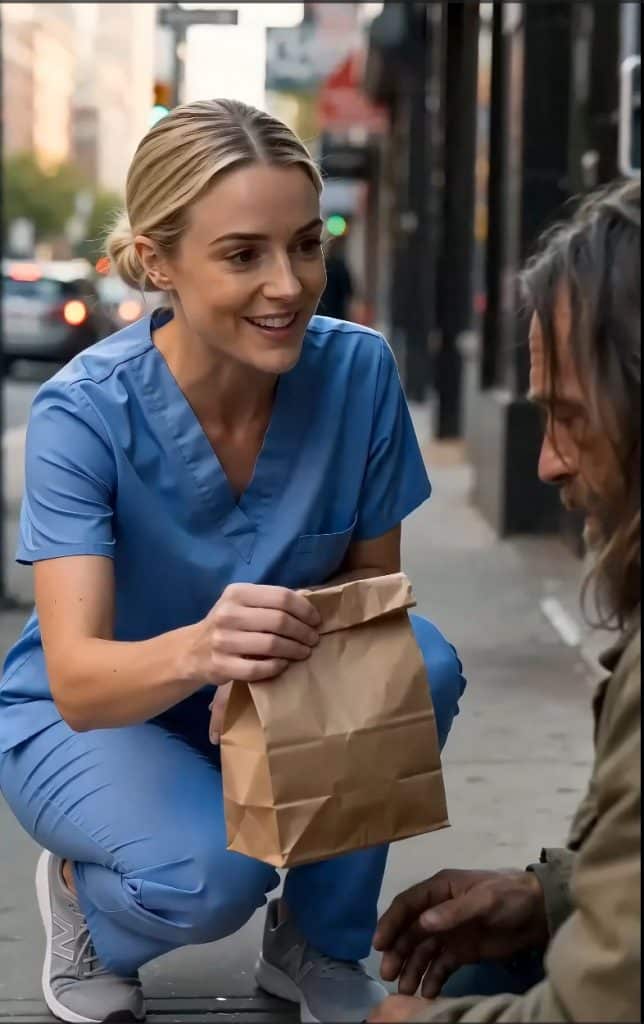
She was still in her blue scrubs from the clinic, hair pulled into a bun, gray sneakers damp from the city sidewalk. In her mind, she was still outside the storefront near the bus stop, staring at the empty piece of cardboard where the man had been sitting an hour earlier.
“Yes,” she said carefully. “I’m Emily.”
The officer’s face did not soften.
“We are here to talk about the man you fed.”
Her stomach dropped.
That morning, he had looked like dozens of men she passed on her walk to work.
Long unkempt hair. Beard streaked with gray. Olive green jacket. Cardboard under him like the city had reduced his life to one square of sidewalk.
But his eyes had been different.
Tired, yes.
Hungry, yes.
Still, when Emily crouched beside him and held out a brown paper bag, he looked up at her like he was not used to being seen.
“I brought you breakfast,” she had said. “Enjoy.”
He took the bag with both hands.
“Thank you so much,” he said, voice gravelly and careful.
“You’re welcome.”
It should have ended there.
A small kindness.
A quiet exchange.
The kind of thing Emily did because being a nurse had taught her that people could survive terrible things and still be undone by being treated as invisible.
But when she came out of the store later and tossed her wrapper into the public trash bin, the cardboard was empty.
The man was gone.
No bag. No jacket. No trace except a single folded napkin left on the pavement.
Now three officers stood in her hallway.
The lead officer lifted the envelope.
“He asked for you by name,” he said.
Emily’s breath caught.
“I never told him my name.”
The officer looked down at the envelope, then back at her.
“That is why we came.”
Act II
Emily Carter had a habit of feeding strangers.
Her coworkers teased her for it gently, the way people tease someone for being too kind because admitting they admire it feels too vulnerable. She kept protein bars in her locker, extra socks in her car, and grocery store gift cards tucked into the side pocket of her backpack.
The clinic where she worked sat three blocks from a bus stop that became a shelter when the weather turned. People drifted through with blankets, shopping bags, cardboard signs, and stories nobody asked to hear.
Emily asked sometimes.
Not too much.
Not the questions people ask to satisfy curiosity.
She asked names. Allergies. Whether someone had a place to sleep. Whether they wanted coffee with sugar or black.
The man in the olive jacket had appeared two weeks earlier.
At first, he did not speak.
He sat near the storefront with his back against brick, watching traffic as if waiting for something that was always late. He never held a sign. Never shook a cup. Never reached out.
Emily noticed the way he folded his hands.
Not casually.
Precisely.
Thumbs aligned. Shoulders squared. Even sitting on cardboard, he looked as if his body remembered discipline his life no longer did.
On the third day, she brought him breakfast.
Egg sandwich. Apple. Coffee.
He thanked her, but did not give his name.
On the fifth day, she asked.
He stared at the coffee lid for a long time.
“Matthew,” he said.
“Nice to meet you, Matthew.”
He flinched a little when she said it.
Emily pretended not to see.
People carried pain differently. Some wore it loudly. Others tucked it behind borrowed names and old coats.
Emily understood that better than most.
Her own father had disappeared before she was old enough to remember him. Her mother, Lorraine, never called it abandonment. She always used softer words.
He got lost.
He was sick.
He loved you in the ways he could.
Emily hated those sentences as a child.
Love that vanished did not feel like love. It felt like a locked door. It felt like Father’s Day crafts left unfinished. It felt like medical forms with one blank line that made teachers lower their voices.
Her mother died when Emily was nineteen, leaving behind one shoebox of photographs, hospital bracelets, and a letter she had never mailed.
The letter was addressed to Captain Matthew Alden.
Emily had read it once.
Then again.
Then so many times the folds began to tear.
You don’t know about her, Lorraine had written. I tried to find you. They said you were gone. If there is any part of you still alive, her name is Emily.
Emily spent years telling herself it did not matter.
She became practical. Finished nursing school. Paid rent. Worked double shifts. Built a life around helping people whose names were not mysteries.
Still, whenever she passed a man in an old military jacket, she looked twice.
That morning, when Matthew took the paper bag from her hands, his fingers brushed hers.
He looked at the name stitched on her scrub badge.
Emily C.
His face changed.
Only for a second.
Like a door opening inside him and slamming shut before the light could escape.
She should have noticed.
She should have asked.
But the clinic called twice. Her shift was starting. The city was moving.
So she smiled, said, “You’re welcome,” and walked away.
By the time she turned back, the sidewalk had swallowed him.
And now the men in uniform knew her name.
Act III
Emily stepped aside and let the officers into her apartment.
It was small, clean, and too bright under the kitchen light. A folded blanket lay on the couch. A mug sat in the sink. Her mother’s old shoebox was still on the bookshelf, though Emily rarely touched it now.
The lead officer introduced himself as Major David Ellis.
The two men behind him remained near the door, silent and formal.
Major Ellis placed the envelope on the kitchen table but did not open it.
“Before we say anything else,” he said, “the man you helped is alive.”
Emily’s knees weakened.
She had not realized until then that she had been afraid they were there to tell her he was dead.
She gripped the back of a chair.
“What happened to him?”
“He walked into the Veterans Affairs administrative office on West Thirty-Fourth Street this morning,” Ellis said. “He was disoriented. Hungry. But he knew one thing clearly.”
Emily stared at him.
“He asked us to find Emily Carter.”
A strange sound escaped her.
“That’s impossible.”
Major Ellis opened the envelope.
Inside was a photograph.
Old. Faded. Creased at the corners.
A young woman stood outside a laundromat, laughing at whoever held the camera. She had brown hair, tired eyes, and one hand resting on her stomach.
Lorraine.
Emily’s mother.
Emily sat down before she fell.
Major Ellis placed another photograph beside it.
A younger version of the man from the sidewalk stood in uniform, clean-shaven, proud, one arm around Lorraine’s shoulders. On the back, in careful handwriting, was written:
Lorraine and Matt, 1994.
Emily could not breathe.
“No.”
The word came out small.
Major Ellis lowered his voice.
“His full name is Captain Matthew Alden.”
Emily pressed both hands to her mouth.
The apartment tilted around her.
Matthew.
The name from the letter.
The name her mother had written on an envelope and hidden in a shoebox because hope had become too painful to mail.
Major Ellis continued gently.
“Captain Alden was injured during his final deployment. When he returned, there were complications. Memory loss. Psychological trauma. Administrative failures. He was transferred between facilities, then misidentified after leaving treatment. For years, he lived under incomplete records.”
Emily’s eyes filled.
“You lost him?”
Ellis did not defend the system.
“Yes,” he said. “We did.”
That honesty hurt more than an excuse would have.
Emily looked at the photograph again.
“My mother thought he left.”
“He did not know about you,” Ellis said.
Emily’s whole body went still.
“He didn’t know?”
“We believe your mother tried to reach him after he disappeared from treatment, but the letters never found him. Some records were sealed incorrectly. Some were lost. Some were ignored by people who should have done better.”
Emily closed her eyes.
All those years of silence.
Not a choice.
A failure.
A chain of missing files, wrong rooms, forgotten names, and a man sitting on cardboard while his daughter walked past him in blue scrubs.
Major Ellis took a folded napkin from the envelope.
It was the one Emily had seen on the sidewalk.
On it, written in shaky ink, were four words.
She looks like Lorraine.
Emily broke then.
Not loudly.
Not completely.
Just enough for the first tear to fall onto the table between the photographs.
Major Ellis waited.
Then he said, “He wants to see you.”
Act IV
Emily did not answer right away.
For most of her life, she had imagined meeting her father in anger.
She imagined him polished and guilty. A man with excuses. A man who would have to explain birthdays missed, hospital forms blank, a mother crying over letters that never left the kitchen drawer.
She had not imagined him hungry on a sidewalk.
She had not imagined him taking breakfast from her hands.
She had not imagined that the first kind thing she ever did for her father would happen before she knew who he was.
“Does he remember me?” she asked.
Major Ellis looked down.
“He remembers your mother. Pieces. Not all at once. Your name came after he saw your badge.”
Emily gave a broken laugh.
“My badge only says Emily C.”
“He said your mother wanted that name.”
Emily went very still.
Lorraine had told her that once.
Emily means rival.
Her mother hated that meaning, but loved the sound.
“I chose it because it sounded like someone who would fight for herself,” Lorraine used to say.
Emily looked toward the bookshelf.
The shoebox.
She stood, walked to it, and lifted the lid with shaking hands. Inside were photographs, folded papers, an old hospital bracelet, and the letter addressed to Captain Matthew Alden.
She brought it to the table and placed it in front of Major Ellis.
“My mother wrote this.”
He did not touch it without asking.
Emily nodded.
He read silently.
By the time he finished, his expression had changed.
“This needs to go in his file.”
Emily’s jaw tightened.
“No.”
Major Ellis looked up.
“It belongs to him.”
“It belongs to her too,” Emily said. “And she spent her whole life being told silence meant something it didn’t.”
The room went quiet.
The officer behind Ellis shifted slightly.
Emily wiped her face.
“I’ll bring it myself.”
Major Ellis studied her for a moment, then nodded.
“Of course.”
The drive to the medical center felt unreal.
Emily sat in the back of the official car with the shoebox on her lap, watching storefronts blur past the window. The same city that had ignored Matthew on cardboard now looked sharp and accusing.
When they arrived, a nurse led them to a private room.
Matthew sat on the edge of the bed in clean clothes someone had found for him. His hair had been brushed back. His beard trimmed slightly. Without the sidewalk around him, he looked less like a stranger and more like a man paused between two lives.
He stood when Emily entered.
Too quickly.
The nurse reached to steady him, but he waved her off.
His eyes locked on Emily.
“Lorraine?” he whispered.
Emily’s heart cracked.
“No,” she said. “I’m Emily.”
He stared at her.
The name moved through him visibly.
Emily opened the shoebox and took out the photograph of her mother. Then the letter.
“She wrote to you,” Emily said.
Matthew looked at the envelope as if it might vanish.
His hands trembled when he took it.
“I didn’t leave her,” he whispered.
Emily closed her eyes.
“I know.”
He looked up, desperate now.
“I didn’t know. I swear to God, I didn’t know.”
The anger Emily had carried for years rose inside her.
It deserved a place.
It deserved to be heard.
But when she looked at the man in front of her, she saw the sidewalk, the cardboard, the way his tired eyes had brightened over a paper bag breakfast from a daughter he could not yet name.
“I believe you,” she said.
Matthew covered his face with both hands.
And for the first time in Emily’s life, her father cried in front of her.
Act V
They did not become family in one afternoon.
That was the truth people wanted softened later.
Reporters wanted a miracle reunion. The VA wanted a corrected record. The officers wanted closure. Neighbors wanted the version where a nurse fed a homeless man and discovered he was her long-lost father, as if blood alone could repair the years between them.
Emily refused to lie.
Matthew was a stranger.
A stranger with her mother’s photograph in his pocket.
A stranger whose voice shook when he said her name.
A stranger who knew the lullaby Lorraine used to hum, but not the fact that Emily hated peas, became a nurse, broke her wrist at thirteen, and cried in the bathroom after passing her licensing exam because her mother was not there to see it.
He had missed everything.
Not by choice.
But absence still leaves a shape.
They started slowly.
Emily visited twice a week.
At first, she brought breakfast because that was the only language they shared. Brown paper bags. Coffee. Apples. Egg sandwiches wrapped in foil.
Matthew apologized too often.
Emily told him to stop.
Then told him to keep going.
Then told him she did not know what she wanted, and he said, “That’s all right,” which helped more than any promise could have.
His memory returned in fragments.
Lorraine dancing barefoot in a kitchen.
Rain against a motel window.
A blue dress she wore to a cheap wedding reception.
The way she laughed when she was trying not to forgive him.
Some days, he remembered too much and went silent.
Other days, he remembered nothing new and looked ashamed.
Emily learned grief could move backward. She had grieved a father who abandoned her, then had to grieve the father who had been lost, then the mother who died believing the wrong story.
When the official inquiry opened into Matthew’s missing records, Emily attended every meeting.
She wore scrubs to the first one because she had come straight from work, and because she wanted the room to remember who had found him.
Not a database.
Not a task force.
A daughter with a breakfast bag.
Major Ellis testified that Matthew Alden had been failed by overlapping systems that treated damaged men as paperwork. The clinic director apologized. The VA administrator apologized. Someone used the phrase “administrative oversight,” and Emily nearly stood up.
Instead, she opened her mother’s letter and read one line aloud.
If there is any part of you still alive, her name is Emily.
No one in the room said “oversight” after that.
Months later, Matthew moved into a supported veterans’ residence six blocks from Emily’s apartment. It was not perfect, but it was clean, staffed, and warm. He had a window overlooking a small courtyard where sparrows fought over crumbs.
Emily brought him a framed photograph for the wall.
Lorraine and Matt, 1994.
Beside it, she placed a newer photo: Emily standing between Matthew and Major Ellis outside the residence, all three squinting in sunlight.
Matthew stared at it for a long time.
“I look old,” he said.
Emily smiled.
“You are old.”
He laughed.
It startled them both.
Then it softened the room.
On the anniversary of the morning she fed him, Emily took Matthew back to the sidewalk near the bus stop.
He was nervous.
So was she.
The storefront was the same. The trash bin was the same. Cars moved past as if the city had no memory. The piece of cardboard was gone.
Emily stood where she had crouched that day.
Matthew looked at the pavement.
“I was so hungry,” he said quietly. “But when you handed me that bag, I wasn’t thinking about food.”
Emily looked at him.
“What were you thinking?”
He touched his chest, over the pocket where he once kept Lorraine’s photograph.
“I thought I had seen a ghost.”
Emily swallowed.
“I thought you were just a man who needed breakfast.”
“I was.”
He looked at her.
“And I was more.”
Emily nodded through tears.
That was the whole lesson, maybe.
Everyone was more.
More than cardboard. More than uniforms. More than missing files. More than old stories told incorrectly because nobody bothered to find the truth.
Emily took a brown paper bag from her tote and handed it to him.
He frowned.
“What’s this?”
“Breakfast.”
His eyes filled.
“You already fed me.”
“I know.”
This time, he smiled before taking it.
“Thank you so much.”
Emily laughed softly, crying now.
“You’re welcome.”
The city moved around them, loud and indifferent, but Emily no longer felt swallowed by it.
A year earlier, she had given food to a stranger and walked away.
The stranger vanished.
Then officers came to her door with an envelope, a photograph, and a truth her mother had deserved to hear.
Emily could not get back the years.
Neither could Matthew.
But sometimes life returns what was lost in a form too fragile to recognize at first. A tired man on cardboard. A paper bag breakfast. A name stitched on blue scrubs.
And sometimes the smallest kindness is not small at all.
Sometimes it is the thread that pulls a buried life back into the light.