Act I
The dollar bill landed faceup on the diner floor.
It fluttered once, soft and pathetic, before settling beside the waitress’s white shoe. Around it, the tiles were scuffed from years of spilled coffee, hurried breakfast rushes, and late-night truckers dragging their boots toward the counter.
Maya Doyle stared at it.
For one second, she forgot the man still gripping her wrist.
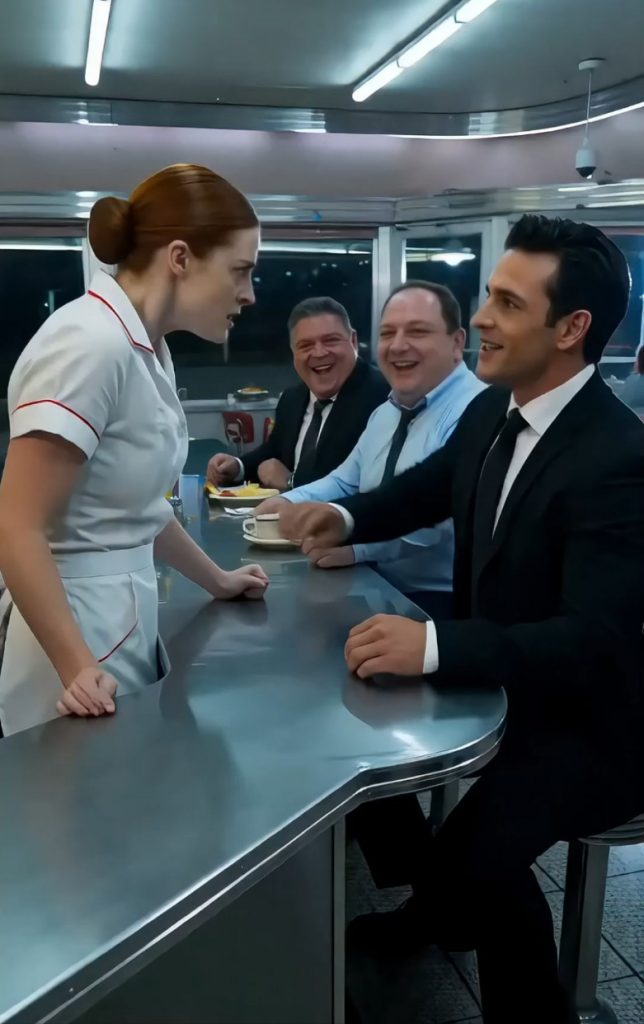
She forgot the packed lunch crowd, the fluorescent lights humming overhead, the metallic stools lined along the counter, and the smell of frying onions coming from the kitchen window.
All she saw was that dollar.
One dollar.
Thrown at her like she was less than human.
“Pick it up if you want it,” Preston Vale said.
His friends laughed.
Not loudly at first. Just enough to make sure she heard it. Just enough to make sure everyone heard it.
Maya’s left wrist burned where Preston’s fingers dug into her skin. She tried to pull back, but he yanked her toward the table again, forcing her shoulder down until the edge of the table pressed against her waist.
Ketchup bottles rattled.
A fork slid off a plate.
At the counter, a man stopped stirring his coffee. In the corner booth, a mother pulled her young son closer. Near the jukebox, a teenage boy in a gray sweatshirt raised his phone with both hands, his face serious as he recorded.
Nobody stepped in.
Preston leaned over Maya with the lazy confidence of a man who had never been told no by someone he could not punish.
“Come on, sweetheart,” he said. “Don’t act proud. Girls like you live off tips.”
Maya’s face burned.
She wore the same white waitress uniform her mother had worn twenty years earlier, with red trim at the collar and sleeves. She had pressed it herself that morning before sunrise. She had pinned her reddish-brown hair neatly, tied her apron, and told herself she could survive another shift with a smile.
Now her cheek was inches from a dirty table, and a man in a black suit was turning her work into a public joke.
His older friend, thick-necked and red-faced in a gray suit, slapped the table once.
“That’s generous, Preston,” he said. “I wouldn’t have given her anything.”
The younger one in the blue shirt laughed harder.
Maya swallowed the words rising in her throat. She had been trained all her life to stay calm in front of customers. Smile through insults. Apologize for mistakes that were not hers. Never give rich men a reason to call the manager.
But this was not a customer complaint.
This was cruelty.
Preston tightened his grip.
“Sit with me,” he murmured. “Smile for my friends. Maybe I’ll make it five.”
Maya looked up at him, and the humiliation inside her sharpened into something hotter.
“No,” she said.
The word was quiet.
But it changed the air.
Preston’s smile faded.
His friends stopped laughing for half a beat.
Then Preston bent closer, his voice dropping low enough that only she and the nearest tables could hear.
“You don’t know who you’re talking to.”
Maya’s eyes flicked to the window.
Outside, across the parking lot, a black motorcycle sat near the curb.
She had noticed it when it pulled in twenty minutes earlier. Big. Old. Beautiful in a dangerous way. The rider had taken the back booth without removing his gloves, ordering only black coffee and a slice of cherry pie.
Maya had not seen his face clearly.
Only the leather vest. The patches. The black spiked wristband around one thick wrist.
Now the diner went quieter.
Preston felt it too late.
A shadow fell over his shoulder.
Leather creaked.
A large hand came into frame, caught the back of Preston’s shirt collar, and lifted him off Maya like he weighed nothing.
Preston gasped.
His grip opened.
Maya snatched her wrist to her chest and stumbled back.
The biker said nothing.
He did not need to.
With one controlled shove, he sent Preston backward. Preston’s polished shoes slipped on the tile, his arms flailed, and he hit the floor beside the dollar bill he had thrown at Maya seconds earlier.
The laughter died instantly.
And then the biker finally spoke.
Act II
“Keep your hands off my daughter.”
The words were not shouted.
That made them worse.
They rolled through the diner with the weight of a verdict, low and steady, cutting through the hum of the fluorescent lights and the hiss of the grill behind the counter.
Maya froze.
Her breath caught so sharply it hurt.
Daughter.
Preston, still on the floor, blinked up at the man towering over him. The biker’s face was visible now beneath the harsh diner lights: weathered skin, iron-gray beard, eyes like storm clouds over asphalt.
Maya knew those eyes.
She had spent fourteen years trying not to remember them.
“Dad?” she whispered.
The diner seemed to shrink around that single word.
The biker turned toward her.
For the first time since he had walked in, his hard expression cracked. Not much. Just enough for grief to show through.
“Maya,” he said.
Her heart hammered against her ribs.
Ray Doyle had been a ghost in her life longer than he had been a father.
When Maya was twelve, he left town on his motorcycle after one final fight with her mother. He did not pack properly. He did not say goodbye properly. He only kissed Maya’s forehead while she pretended to sleep and disappeared before sunrise.
For years, her mother said he was dangerous.
For years, Maya believed her.
Ray sent postcards from places that sounded made up when she was young enough to hope. Tulsa. Reno. Baton Rouge. Flagstaff. Then the postcards stopped. Her mother threw away the old ones, but Maya kept three hidden inside a cookbook behind the counter.
When her mother died, Ray did not come to the funeral.
That was the wound Maya never forgave.
He had missed the day she stood beside a closed casket with coffee stains on her uniform because she had opened the diner that morning anyway. He had missed the day the lawyer explained the bills were worse than anyone knew. He had missed the months when Maya slept in the office because she could not afford an apartment and keep the diner alive at the same time.
And now he was standing in front of her, broad-shouldered and silent, acting like he still had the right to call her his daughter.
Preston groaned and pushed himself up on one elbow.
“You assaulted me,” he snapped, though his voice shook. “Do you have any idea who I am?”
Ray looked down at him.
“Yes.”
That single word took the color from Preston’s face.
Maya noticed it.
So did everyone else.
The older man in the suit shifted uneasily. The younger friend looked toward the door as if calculating how quickly he could leave without seeming afraid.
Preston straightened his tie with trembling fingers.
“I’ll have this place shut down by morning.”
Maya laughed once.
It came out broken.
“You’ve been trying for six months.”
The diner went still again.
Preston’s eyes flashed toward her.
Maya had not meant to say it. Not here. Not in front of everyone. But humiliation had burned away her fear, and all that remained was the truth.
Preston Vale was not just some arrogant customer.
He was the son of Daniel Vale, owner of Vale Development, the company buying up half the block.
The laundromat had sold first. Then the flower shop. Then the old hardware store, its windows now covered with brown paper and demolition notices.
Only Doyle’s Diner remained.
A squat, chrome-edged relic of another century, squeezed between two empty buildings and sitting on a corner lot that Preston’s father needed for his luxury apartment project.
They had made offers.
Maya refused.
Then came the health inspection complaints.
The late-night vandalism.
The supplier who suddenly canceled after twenty years.
The bank calling about the loan.
And finally, Preston himself, walking in twice a week with friends, ordering coffee he never drank, leaving coins in puddles of ketchup, and calling her “honey” like it was a punishment.
Today was supposed to break her.
Maya understood that now.
The suit. The friends. The laughter. The dollar on the floor.
It was not random cruelty.
It was pressure.
Ray bent, picked up the dollar bill between two fingers, and placed it on Preston’s chest.
“You dropped something,” he said.
A few customers made small sounds under their breath.
Not laughter.
Something closer to justice trying to start quietly.
Preston stood, face red.
“This isn’t over.”
Ray stepped closer.
“It wasn’t over when you grabbed her.”
Preston’s confidence wavered again.
Maya held her wrist against her chest, looking between the two men. Her father had not come to her mother’s funeral. He had not answered the letters she never sent. He had not been there when the diner nearly collapsed under debt.
But somehow, he knew Preston.
And somehow, Preston was afraid of him.
That was when Maya realized her father had not walked into the diner by accident.
Act III
Ray had been sitting in the back booth for forty-seven minutes before Preston touched Maya.
He had watched the door. The counter. The exits. The teenage boy with the phone. The two men pretending not to wait for something to happen.
Most of all, he had watched his daughter move through the diner like a person carrying a building on her shoulders.
Maya had not recognized him at first.
That hurt more than he expected.
But he deserved it.
He knew he did.
The last time he saw her, she had been a girl with scraped knees and a loose front tooth, asleep under a faded quilt while rain hit the roof of their apartment. He had told himself he was leaving to protect her. Men like him were good at dressing cowardice in noble words.
The truth was uglier.
Ray Doyle had owed money to people who did not forgive debts.
He had been young, angry, and stupid enough to think he could make extra cash running packages for a motorcycle crew outside the law. By the time he understood what he had stepped into, his wife had already found the cash hidden in the garage.
She gave him one choice.
Leave before trouble followed him home.
So he left.
At first, he planned to come back clean. Then one year became three. Shame became habit. Silence became easier than explaining why he had failed at the only job that mattered.
He did not know Patricia was sick until after she was gone.
A retired mechanic from the old neighborhood found him in Arizona and handed him a newspaper clipping with her obituary folded inside.
Ray had carried that clipping in his vest ever since.
He came back two weeks ago, expecting Maya to slam the diner door in his face.
Instead, he found her fighting alone against a family with money, lawyers, and a plan to erase everything Patricia had built.
Ray did not go to her.
Not yet.
He followed the money first.
That was something his years on the road had taught him: men like Preston Vale always left tracks because they believed nobody beneath them knew how to read.
Ray found the contractor who had been paid to break the diner’s front window. He found the inspector whose “anonymous complaints” came from Vale Development’s office line. He found the bank officer who had lunch with Daniel Vale two days before Maya’s loan terms suddenly changed.
And then he found the old deed.
That was the part nobody expected.
Not Preston.
Not Daniel Vale.
Not even Maya.
Doyle’s Diner did not sit on ordinary commercial property. The land had been purchased in 1968 by Maya’s grandfather, who had slipped one strange clause into the original sale agreement with the city.
The corner lot could not be transferred to a private developer without written consent from the operating owner of the diner.
Not the bank.
Not the creditor.
Not the city.
The operating owner.
Maya.
Ray had the document in his saddlebag outside.
He had come to show it to her after the lunch rush. He had imagined sitting at the counter, ordering coffee, and telling her the truth in pieces. He had imagined apologizing badly. He had imagined her throwing him out.
He had not imagined Preston grabbing her wrist.
The teenage boy in the gray sweatshirt stepped forward now, phone still in hand.
“I recorded the whole thing,” he said.
His voice cracked slightly, but he did not lower the phone.
Maya turned to him.
The boy looked nervous, then determined.
“He grabbed her first,” he said. “Everyone saw it.”
Several customers shifted.
One by one, people began nodding.
A truck driver at the counter stood up.
“He’s been bothering her for weeks,” he said.
The mother in the corner booth lifted her hand.
“I heard what he said to her.”
Maya’s throat tightened.
For months, the diner had been full of witnesses who looked down at their plates.
Now, finally, they were looking up.
Preston pointed at the room.
“You people don’t know what you’re getting involved in.”
Ray smiled faintly.
That smile did not reach his eyes.
“I do.”
The bell above the diner door jingled.
A man in a navy overcoat stepped inside, holding a leather folder and wearing the tired expression of someone who had spent too many years cleaning up rich men’s messes.
Maya recognized him from the bank.
“Mr. Larkin?” she said.
The man nodded once, then looked at Preston.
“Good. You’re still here.”
Preston’s face changed.
That was the moment Maya understood there was more in the leather folder than an old deed.
Act IV
Mr. Larkin walked to the nearest table and laid the folder down beside an untouched plate of fries.
“I was asked to review the loan irregularities connected to Doyle’s Diner,” he said.
Preston recovered just enough to sneer.
“By him?”
He jerked his chin toward Ray.
Mr. Larkin did not blink.
“By the bank’s legal department. Mr. Doyle brought documents that made ignoring the issue impossible.”
Maya looked at her father.
Ray kept his eyes on Preston, but his jaw tightened.
He had not come back empty-handed.
That fact pressed against Maya’s anger in a way she was not ready to forgive.
Mr. Larkin opened the folder.
“The diner’s loan was not in default. The notice sent to Ms. Doyle last month contained revised terms that were never approved through proper channels.”
Preston’s older friend stood abruptly.
“I should go.”
Ray glanced at him.
“Sit down.”
The man sat.
Mr. Larkin continued.
“There are also signed statements from two contractors regarding damage done to the property, along with payment records tied to a shell company used by Vale Development.”
The diner erupted into whispers.
Preston’s face went pale, then red, then pale again.
Maya felt as if the floor had shifted beneath her. Not like when Preston dragged her down. This was different. This was the ground finally moving back into place.
For six months, she had believed she was failing.
Every broken window, every late bill, every canceled delivery had felt like proof that she was too young, too tired, too alone to keep the diner alive.
But she had not been failing.
She had been attacked.
Ray reached into his vest and pulled out a folded paper sealed in a plastic sleeve.
“This is the original property covenant,” he said. “Your grandfather kept a copy. Patricia hid it behind the office wall clock.”
Maya stared at him.
“My mother knew?”
“She suspected,” Ray said softly. “She didn’t trust the Vales. Never did.”
He handed her the sleeve.
Their fingers brushed.
For a moment, they were not in a crowded diner. They were in a kitchen from a lifetime ago, Patricia humming while wiping down the counter, Ray flipping pancakes badly, Maya laughing with syrup on her chin.
Then the memory broke.
Preston lunged for the paper.
Ray caught his wrist midair.
Not violently.
Easily.
Preston froze.
Ray leaned in.
“You made the mistake every bully makes,” he said. “You thought quiet meant weak.”
Preston’s mouth opened, but no words came.
Outside, a police siren gave one short chirp.
Everyone turned toward the window.
Two officers stepped out of a patrol car.
Preston looked at Mr. Larkin.
“You called the police?”
The teenage boy lifted his phone.
“I did.”
The room turned toward him.
He swallowed, suddenly aware of every eye.
“My mom works doubles here when Maya needs help,” he said. “I’m sick of watching people treat her like she’s nothing.”
Maya’s eyes filled before she could stop them.
The boy’s name was Evan. His mother, Denise, covered weekend nights when Maya could not afford a full staff. Evan usually did homework in the corner booth, eating fries Maya pretended not to charge for.
He had seen more than she realized.
The officers entered.
Preston began talking immediately, loud and polished, explaining how he had been assaulted by a stranger in a biker vest while a waitress overreacted to harmless teasing.
Then Evan played the video.
Preston’s voice filled the diner.
Come sit with me, sweetheart.
Pick it up if you want it.
The screen showed his hand gripping Maya’s wrist. It showed her trying to pull away. It showed the dollar falling. It showed the laughter.
By the time the video ended, Preston was no longer speaking.
One officer looked at Maya.
“Do you want to make a statement?”
Maya glanced at Ray.
Then at the customers.
Then at the dollar bill still lying near Preston’s shoe.
For the first time all day, she did not feel small.
“Yes,” she said. “I do.”
Preston was escorted out through the same door he had entered with his perfect suit and perfect smirk. His friends followed separately, avoiding the eyes of the room.
Nobody laughed now.
But when the door closed behind him, Maya still had one more person to face.
Act V
The diner did not return to normal after Preston left.
Normal was too small a word for what remained.
The lunch orders went cold. Coffee sat untouched in mugs. The fluorescent lights still hummed overhead, and the menu boards still glowed above the counter, but something in the room had changed so completely that everyone seemed afraid to disturb it.
Maya stood near the table where she had been humiliated, holding the old property covenant in one hand.
Her wrist ached.
Her pride ached worse.
Ray stood a few feet away, suddenly less like the terrifying man who had thrown Preston to the floor and more like what he really was: an aging father with too much regret and no right to demand forgiveness.
“Maya,” he said.
She looked at him.
The room pretended not to listen.
Ray swallowed.
“I should have come back sooner.”
Maya let out a sharp, humorless breath.
“That’s not an apology.”
“No,” he said. “It’s not.”
He removed a small packet from the inside of his leather vest and placed it on the table.
Postcards.
Old ones.
New ones.
Dozens of them, bound with a rubber band.
Maya’s hand trembled.
“I wrote them,” Ray said. “Most I never sent. Some came back. Some I was too ashamed to mail.”
“You missed her funeral.”
His face tightened.
“I know.”
“She waited for you.”
“I know.”
“I waited too.”
That broke him.
Not dramatically. Not loudly. His shoulders simply dropped, and the hard mask he had worn since entering the diner seemed to fall away.
“I thought staying gone made you safer,” he said. “Then I told myself you were better without me. After a while, that lie was all I had.”
Maya’s eyes burned.
“I was a kid.”
“I know.”
“You don’t get to walk in, shove one bad man, and be my father again.”
Ray nodded.
“No. I don’t.”
The honesty of that answer hurt more than any excuse would have.
Ray reached into the packet and pulled out a key.
It was old and brass, worn smooth at the teeth.
“Your mother kept a storage unit on Route 9,” he said. “I found the payment records. There are boxes there. Her papers. Your grandfather’s things. Maybe answers you should’ve had a long time ago.”
He placed the key beside the postcards.
“I’ll leave after I give my statement.”
Maya stared at the key.
A part of her wanted him gone. Another part, smaller and more dangerous, wanted to ask him to stay long enough to explain everything. Why he had left. Why he had survived all these years while her mother got tired and sick and still opened the diner every morning.
But forgiveness was not a tip thrown on the floor.
No one could demand she pick it up.
So she said the only true thing she had.
“I don’t know what I want from you.”
Ray nodded again.
“That’s fair.”
Behind the counter, Denise arrived early for her shift after Evan called her. She hugged Maya so tightly the property document crinkled between them. Then she kissed Evan on the head and told him he had done the right thing.
By evening, the video had spread through town.
By the next morning, Vale Development released a statement full of polished regret and careful distance. By noon, Daniel Vale’s office claimed Preston was acting alone. By dinner, two more business owners came forward with stories about pressure, threats, and suspicious fines.
The corner block did not fall quietly.
It fought back.
And Doyle’s Diner became the center of that fight.
Not because it was fancy.
It was not.
The chrome was dented. The stools squeaked. The pie case fogged up whenever the kitchen got too hot. The menu still listed a meatloaf special that nobody had ordered since 1998.
But it belonged to them.
To Maya.
To Patricia.
To the customers who had finally remembered they had voices.
And, in some complicated, unfinished way, to Ray too.
He did not leave town after his statement.
He rented a room above the auto shop and came to the diner every morning at six. He did not ask for free coffee. He did not sit at the counter like he owned a place in her life. He took the back booth, ordered black coffee, and waited until Maya decided whether to speak.
For two weeks, she barely did.
Then one morning, the front door stuck in the cold.
Ray stood to fix it.
Maya stopped him.
“The hinge is stripped,” she said. “You’ll need the box wrench from under the sink.”
He looked at her carefully.
“That an invitation?”
“It’s a broken door.”
A faint smile touched his face.
“Yes, ma’am.”
He fixed the door.
Then a shelf.
Then the flickering sign above the counter.
Trust did not return like lightning. It returned like repairs. Small. Practical. Easy to miss unless you knew how broken everything had been.
A month later, Maya opened the storage unit on Route 9.
Ray went with her, but he waited outside until she asked him in.
Inside were boxes of old photographs, ledgers, diner menus, her grandfather’s framed business license, and a letter Patricia had written but never mailed.
Maya read it sitting on an overturned crate.
Her mother’s words filled the cold little unit with a voice she had missed so badly it almost hurt to breathe.
Patricia wrote that she had been angry at Ray for leaving, but never for loving Maya. She wrote that fear had made both of them cruel in different ways. She wrote that the diner would one day feel too heavy, but Maya should remember this:
A place is not worth saving because of its walls. It is worth saving because of who refuses to let cruelty have the final word inside it.
Maya cried then.
Ray turned away to give her privacy, but she reached for his hand.
Not forgiveness.
Not yet.
But a beginning.
Spring came slowly that year.
The corner lot stayed standing. The city opened an investigation into Vale Development’s tactics. Preston’s friends stopped coming to the diner, and nobody missed them.
Evan’s video became local proof that silence helped bullies more than anyone wanted to admit.
Maya framed the old property covenant and hung it near the register. Beneath it, she taped the dollar bill Preston had thrown at her.
People asked why she kept it.
She always gave the same answer.
“So I remember what it cost him to underestimate me.”
One Friday night, the diner filled until every stool was taken.
Truckers, nurses, mechanics, teachers, teenagers, and old regulars crowded beneath the fluorescent lights. Ray sat in the back booth, wearing the same leather vest, drinking coffee that had gone cold because he kept watching Maya move through the room.
This time, no one grabbed her wrist.
No one called her sweetheart like an insult.
No one laughed when she passed.
At closing, Maya flipped the sign on the door and found Ray outside beside his motorcycle. The chrome reflected the diner lights, old and scarred and still shining.
“You heading out?” she asked.
He looked at the road, then back at her.
“Only if you want me to.”
Maya folded her arms.
The night air smelled like rain and fryer oil.
“You can come by tomorrow,” she said. “The freezer’s making a weird sound.”
Ray smiled.
It was small, careful, and full of gratitude he knew better than to speak too loudly.
“I’ll bring my tools.”
Maya nodded and went back inside.
Before locking the door, she looked once at the spot where Preston had fallen. The tiles had been mopped a hundred times since then. No mark remained.
But Maya remembered.
She remembered the dollar.
The laughter.
The hand on her wrist.
And then the sound of leather creaking behind a man who thought power meant making someone smaller.
People would tell the story as if the biker saved the waitress.
Maya knew the truth was bigger than that.
He had stopped Preston.
But she had stood up.
She had made the statement. She had kept the diner. She had faced the father who abandoned her and decided that healing did not mean pretending the hurt never happened.
That was the real reversal.
Not the bully on the floor.
Not the dollar under glass.
The real reversal was Maya Doyle walking through her own diner the next morning with her head high, pouring coffee beneath the same harsh lights, knowing every person in the room understood what Preston Vale had learned too late.
She was not there to be bought.
She was not there to be broken.
And no man would ever make her pick her dignity up from the floor again.