Act I
The room was too beautiful for cruelty.
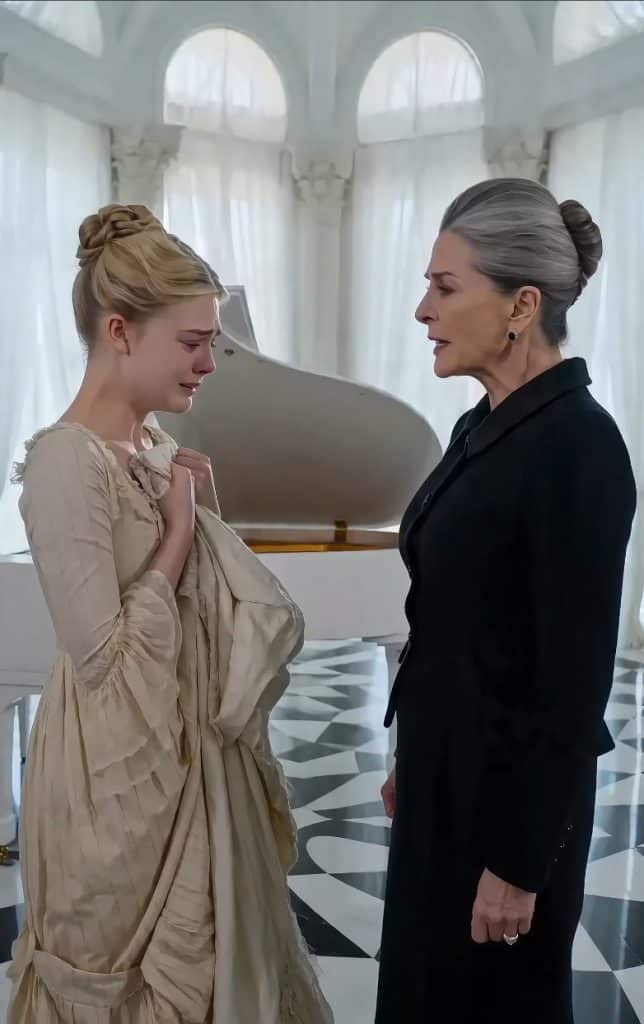
Sunlight poured through the tall windows of the Whitmore mansion, washing the marble floor in pale gold. A white grand piano gleamed near the curtains, untouched and perfect, like everything else in that house.
Then Eleanor Whitmore looked at the young woman standing before her and cut her apart with one sentence.
“Do you really think you can join our family in that dress?”
Amelia Lane’s fingers tightened around the ivory lace at her chest.
The gown was old. Anyone could see that. The pleated layers had softened with time, and the delicate lace at the sleeves had been carefully repaired by hand. It did not sparkle like the designer gowns hanging upstairs for the engagement dinner. It did not announce wealth.
But to Amelia, it was the only beautiful thing her mother had left behind.
She stood near the piano with tears already sliding down her cheeks, blonde hair pinned into a careful bun because she had wanted to look worthy. She had practiced walking into this room without shaking. She had practiced smiling at the woman who had the power to decide whether the Whitmore family would accept her.
But nothing could have prepared her for Eleanor’s eyes.
Cold. Assessing. Disappointed.
Eleanor wore black from throat to ankle, tailored so sharply she looked carved from shadow. Her gray-streaked hair was twisted into a severe bun. Her rings flashed as she folded her hands in front of her, as if Amelia were an unfortunate stain on the marble.
Amelia swallowed.
“It was my mother’s,” she whispered.
For the first time, Eleanor’s expression shifted.
Not softened.
Sharpened.
Her gaze dropped to the dress.
“What did you say?”
Amelia took a trembling breath. “My mother wore it before I was born. She told me if I ever came here, I should wear it.”
The words seemed to offend Eleanor more than the gown itself.
“Your mother,” she said, stepping closer, “had no business sending you into this house dressed like a ghost.”
Amelia flinched.
She had expected judgment. She had expected questions about her family, her education, her accent, her lack of money. She had expected the Whitmores to look at her and wonder what Adrian saw in a girl who had grown up above a closed laundromat in a town no one in that room would ever visit.
But she had not expected Eleanor to reach out.
The older woman suddenly seized the fabric near Amelia’s waist and pulled it toward the light.
Amelia gasped, but she did not step back.
Because under all the humiliation, under the fear, under the years of unanswered questions, a small part of her had been waiting for this moment.
Eleanor turned the inner lining of the gown between her ringed fingers.
Then she saw it.
A blue embroidered letter, hidden against the ivory silk.
S.
The color drained from Eleanor’s face.
“Who gave you this dress?” she demanded.
Amelia’s lips trembled.
“My mother.”
Eleanor’s grip tightened.
“Who was your mother?”
The piano behind them stood silent, but the whole room seemed to hold its breath.
And then Amelia said the name that had been buried for twenty-four years.
Act II
“Sarah Lane,” Amelia whispered. “But she said that wasn’t the name she was born with.”
Eleanor’s hand went slack.
The fabric slipped from her fingers, but her eyes stayed fixed on the hidden monogram as if it had opened a door she had spent half her life trying to keep sealed.
Amelia reached carefully into the small satin purse hanging from her wrist. Her fingers shook as she pulled out a folded letter, worn soft at the creases.
“My mother died six months ago,” she said. “Before she passed, she gave me this. She told me not to open it until Adrian brought me here.”
Eleanor stared at the letter.
Amelia had imagined this moment so many times. Sometimes Eleanor would recognize the dress and embrace her. Sometimes she would call her a liar. Sometimes she would know the truth immediately and finally explain why Amelia’s mother used to wake from nightmares calling a name she refused to discuss.
But in every version, Amelia had imagined herself stronger.
Now she felt like a child again, standing in the hallway of a tiny apartment while her mother sat at the kitchen table under a single yellow lamp, repairing the same ivory gown with careful, grieving hands.
“This dress belonged to another life,” Sarah had once told her.
“What life?”
Sarah smiled sadly. “One that ended before you were born.”
Sarah Lane had never spoken much about her past. She worked as a seamstress, then a hotel cleaner, then a piano teacher for children whose parents paid in cash when they could. She had gentle hands and a beautiful voice, but there was always a silence around her.
She never kept photographs.
She never celebrated her birthday.
She never allowed Amelia to search her maiden name.
When Amelia was fifteen, she found a silver hairpin hidden in a box beneath her mother’s bed. On the back, engraved so finely she almost missed it, were the words: To S, always. E.
Sarah took it from her and cried for an hour.
That was the first time Amelia heard the name Eleanor.
Not a friend.
Not exactly.
A sister.
Years later, when Amelia met Adrian Whitmore at a charity recital, she did not know his connection to the house her mother feared. Adrian was warm where his family was polished. He had been adopted into the Whitmore household after his parents died, raised under Eleanor’s strict eye but never quite shaped by her coldness.
He heard Amelia play an old upright piano in a community center and stayed after everyone else left.
“You play like someone taught you to listen before touching the keys,” he told her.
“My mother taught me,” Amelia said.
It was the first honest thing between them.
By the time Adrian brought her into the Whitmore world, Amelia already knew the name. Whitmore. The same name her mother had whispered once in a fever and denied remembering after.
Then, one week before the engagement dinner, Amelia opened the letter.
Her mother’s handwriting filled the page in thin, slanted lines.
Wear the ivory dress. Stand in the music room. Show Eleanor the blue S. If she remembers me, she will know you are not a stranger.
Amelia had read that sentence until the ink blurred.
Now Eleanor stood in front of her, breathing as if every inhale hurt.
“Open it,” Eleanor said.
Amelia hesitated.
Eleanor’s voice broke. “Please.”
So Amelia unfolded the letter.
And the first line nearly brought the older woman to her knees.
Act III
My name was Seraphina Whitmore.
Eleanor made a sound so small Amelia almost missed it.
The grand piano behind them seemed suddenly less like decoration and more like a witness. Its white surface reflected the two women in fragments: the matriarch in black, the young woman in ivory, and between them, a letter written by a dead woman who had refused to disappear completely.
Amelia continued reading.
If you are holding this, then I am gone. And if Eleanor is standing before you, then my daughter has found her way home.
Eleanor covered her mouth with one trembling hand.
Amelia’s voice shook harder.
I did not die in the accident.
The sentence landed like a crack through marble.
Eleanor staggered back.
For twenty-four years, the Whitmore family had told one story. Seraphina, the youngest daughter, had run away with a poor musician named Thomas Lane. Their car had gone off the coastal road during a storm. The vehicle was found damaged near the water. Thomas’s body was recovered days later. Seraphina’s never was.
Everyone said the sea had taken her.
Eleanor had believed it because grief gives people terrible things to accept when there is no body to hold.
She had been thirty-five then, already hardened by family duty. Seraphina had been twenty-two, bright and reckless, always barefoot in the music room, always playing the piano too loudly, always laughing when their father said no.
The night Seraphina disappeared, she had been wearing the ivory gown.
Not a wedding dress. Not exactly.
It had been their mother’s old recital gown, altered by Eleanor herself. She had sewn the blue S into the lining as a private joke because Seraphina kept losing things.
“You can lose your gloves, your sheet music, and your temper,” Eleanor had told her. “But you cannot lose yourself.”
Seraphina had laughed and kissed her cheek.
That was the last memory Eleanor trusted.
Now Amelia stood in that same gown, holding proof that the last memory had not been the end.
“What happened to her?” Eleanor whispered.
Amelia read on.
I survived because someone pulled me from the wreck before the authorities arrived. I was pregnant. Hurt. Confused. I remembered Thomas. I remembered the storm. I remembered a voice telling me that if I went home, my child would never be safe.
Eleanor’s eyes lifted slowly.
“A voice?” she said.
Amelia kept reading, but dread had begun to gather in the room.
Your father’s attorney came to the clinic before you did. Mr. Bellamy. He told me Thomas was dead, that Father had disowned me, and that Eleanor had signed papers declaring me unstable. He said if I returned, my child would be taken and raised as a Whitmore without me.
“No,” Eleanor whispered.
The letter trembled in Amelia’s hands.
So I ran. I became Sarah Lane. I raised my daughter with the only name that still felt safe. I thought I was protecting her from you.
Eleanor shook her head, tears spilling freely now.
“I never signed anything,” she said. “I searched for her. I searched for months.”
Amelia looked up.
For the first time since she entered the mansion, she saw something in Eleanor’s face that was not judgment.
It was grief.
Raw. Old. Unfinished.
Eleanor reached for the letter, then stopped herself, as if afraid to touch the truth too roughly.
“My sister was alive,” she said. “All those years, she was alive.”
Amelia’s voice broke.
“She thought you hated her.”
Eleanor closed her eyes.
The elegant mansion, the marble floor, the white piano, the polished silver frames on the walls — all of it seemed suddenly obscene against the size of what had been stolen.
Then a voice spoke from the doorway.
“She was supposed to stay gone.”
Act IV
Amelia turned.
An old man stood beneath the archway, one hand resting on a polished cane.
Walter Bellamy had served the Whitmore family for more than forty years. He was not family, but he moved through the mansion like its shadow, present at every funeral, every contract signing, every scandal quietly buried before it reached daylight.
Eleanor stared at him as if she no longer recognized the man.
“What did you say?”
Bellamy’s face did not change.
At eighty-one, he had the calm of someone who had outlived most accusations. His silver hair was neatly combed, his suit immaculate, his expression almost bored.
“I said,” he replied, “she was supposed to stay gone.”
Amelia stepped backward, clutching the letter to her chest.
Eleanor’s grief turned slowly into something colder.
“You knew.”
Bellamy looked at the dress, then at Amelia. “I suspected.”
“You knew my sister survived.”
“I knew your father wanted the matter contained.”
The words were clean. Legal. Cowardly.
Eleanor walked toward him with the terrible quiet of a woman whose heart had just been broken twice.
“My father died believing Seraphina was dead.”
Bellamy’s mouth tightened. “Your father died believing what was necessary.”
“For whom?”
“For the family.”
The answer echoed through the music room.
Amelia suddenly understood why her mother had spent her life afraid of polished men with soft voices. Why she changed streets when a black car slowed near their apartment. Why she kept the ivory gown wrapped in paper but never threw it away.
Because the gown was proof.
Bellamy’s eyes moved to the letter. “That document belongs to the Whitmore estate.”
“No,” Amelia said, surprising herself with the firmness in her voice. “It belongs to me.”
He gave her a faint smile. “Young woman, you have no idea what you have walked into.”
Eleanor turned sharply. “She has walked into her own family.”
The sentence shook Amelia more than the insult had.
Bellamy’s calm flickered.
“Eleanor, be careful. Recognition of this girl opens questions about inheritance, property, voting rights in the foundation—”
“My sister was alive,” Eleanor said. “And you let her die alone.”
Bellamy’s face hardened. “Your sister chose disgrace. Your father chose preservation. I chose order.”
“No,” Eleanor said. “You chose power.”
The old man’s fingers tightened around his cane.
For years, Bellamy had controlled the Whitmore estate from behind signatures and sealed files. Eleanor had run the public face of the family, but Bellamy knew where every secret slept. He knew which accounts had been moved after Seraphina disappeared. He knew which trust had dissolved when she was declared dead. He knew how much money had flowed into his private holdings while the family mourned.
Amelia knew none of that yet.
But Eleanor did.
She had seen odd papers over the years. Missing pages. Delayed filings. Her father’s will altered after Seraphina’s disappearance in ways Bellamy had explained with perfect patience.
Now all those small doubts returned with teeth.
Eleanor crossed to the piano and lifted the bench lid.
Inside, beneath old sheet music tied with ribbon, was a locked compartment Amelia would never have noticed. Eleanor pulled a small brass key from the chain around her neck and opened it with shaking hands.
From inside, she removed a faded envelope.
Bellamy went still.
“Eleanor,” he said quietly.
She looked at him. “You told me this was sentimental nonsense.”
His jaw tightened.
Eleanor opened the envelope and pulled out a photograph.
Two young women sat at the white grand piano, laughing. One had Eleanor’s proud eyes. The other had Amelia’s smile.
On the back, written in blue ink, were four words.
Seraphina. Come home soon.
Eleanor pressed the photo into Amelia’s hands.
“She was my baby sister,” she whispered. “And you are hers.”
The room could never go back to what it had been.
Act V
By the time Adrian reached the music room, Eleanor Whitmore was no longer the woman who had mocked Amelia’s dress.
She was kneeling on the marble floor with the ivory gown gathered carefully in her hands, sobbing into the fabric as if an apology could travel backward through twenty-four years.
Amelia stood frozen, overwhelmed by the speed of it all.
An hour ago, she had been a poor girl in an old dress, waiting to be judged by a family that saw her as an inconvenience.
Now she was Seraphina Whitmore’s daughter.
The lost child of a woman the mansion had mourned incorrectly.
Adrian entered breathless, stopped at the sight of them, then looked at Amelia with quiet alarm.
“What happened?”
Amelia could not answer.
Eleanor did.
“She’s family,” she said.
Adrian’s expression shifted. Not with shock exactly, but with understanding. As if some part of him had always known Amelia belonged in rooms that tried to reject her.
Bellamy attempted to leave before the police arrived.
He did not get far.
Eleanor had spent her life commanding servants, donors, lawyers, and board members with the icy elegance of someone born to be obeyed. That evening, for the first time, she used that power for the truth.
She called the family’s current attorney. Then the foundation board. Then the authorities.
By midnight, sealed records were being requested. By morning, old estate transfers were under review. Within a week, the false statements surrounding Seraphina’s disappearance began to unravel.
But none of that healed the wound immediately.
The real reckoning happened in smaller moments.
It happened when Eleanor sat alone in Seraphina’s old bedroom and found the wallpaper still faintly marked where two sisters had measured their height as children.
It happened when Amelia opened her mother’s sewing box and found tiny scraps of blue thread matching the monogram in the gown.
It happened when Eleanor listened to an old cassette recording of Seraphina playing piano and broke down before the first minute ended.
For days, Amelia did not know what to feel.
Part of her wanted to be angry. Her mother had died believing she was unwanted. She had raised Amelia in rented rooms while the mansion that should have known her name stood bright and untouched on the hill.
But grief is rarely clean.
Eleanor had lost a sister too.
Not once, but twice.
The first time to a lie.
The second time to the truth arriving too late.
On the night of the engagement dinner, Eleanor canceled the entire event.
The caterers were sent home. The flowers were removed from the ballroom. The guests, who had arrived expecting champagne and polished announcements, left whispering about police cars, old scandals, and the young woman in the vintage ivory dress.
Amelia thought she would never want to step inside that music room again.
But one week later, she returned.
This time, the house was quiet. No guests. No judgment. No glittering audience waiting to decide whether she was enough.
Only Eleanor sat at the white piano, hands resting motionless above the keys.
“I don’t know how to ask forgiveness for what I said to you,” Eleanor admitted.
Amelia stood by the window, watching sunlight spill across the black-and-white marble.
“Then don’t ask yet,” she said softly. “Just tell me about her.”
Eleanor nodded.
And for the next three hours, she did.
She told Amelia how Seraphina used to sneak strawberries from the kitchen and blame the gardener. How she hated formal dinners but loved thunderstorms. How she played piano with too much feeling and never enough discipline. How she wanted a daughter one day and said she would teach her to choose kindness without becoming weak.
Amelia cried then.
Not because the story hurt.
Because it sounded like her mother.
Near sunset, Eleanor opened the piano bench and handed Amelia the old photograph.
“You should have this.”
Amelia stared at the two sisters laughing at the keys.
Then she shook her head.
“No,” she said. “We should keep it here.”
Eleanor looked at her carefully.
Amelia touched the piano’s white surface. “This is where she belonged before they made her disappear.”
Eleanor’s lips trembled.
Together, they placed the photograph on the piano.
Months later, the Whitmore Foundation announced the Seraphina Lane Fund, created to support women rebuilding their lives after coercion, fraud, and family abandonment. Eleanor insisted on using both names: the one her sister was born with, and the one she survived under.
At the announcement, Amelia wore the ivory gown again.
Not because she needed approval.
Not because anyone demanded tradition.
Because the dress had carried her mother’s truth when no one else had.
As she stood beside Eleanor in the music room, reporters asked about the blue S hidden in the lining.
Amelia smiled through tears.
“My aunt sewed it there,” she said. “So my mother would never lose herself.”
Eleanor reached for her hand.
This time, Amelia let her take it.
The white grand piano gleamed behind them, no longer a symbol of everything the mansion had kept polished and silent. It had become something else.
A witness.
A grave marker.
A beginning.
And in the room where Amelia had once been told she did not belong, her mother’s name was finally spoken without shame.