Act I
The mud swallowed Adrian Cole’s shoes with every step.
He hated that.
He hated the gray sky, the cold rain still clinging to the rubble, the workers standing in a loose circle instead of moving, and the yellow excavator sitting silent behind them like an expensive machine waiting for permission.
Most of all, he hated the dog.
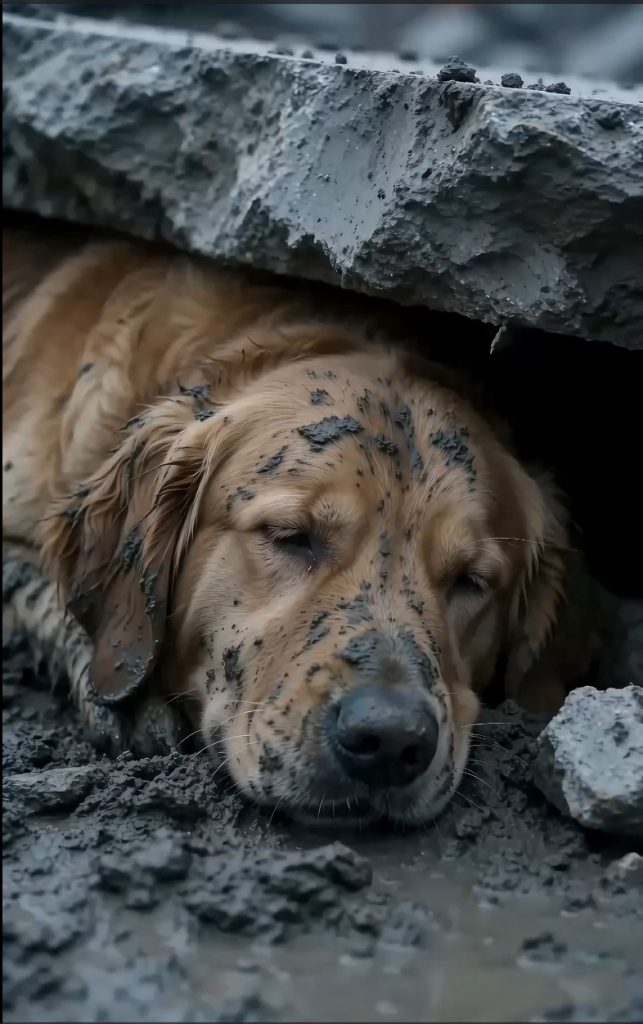
The Golden Retriever lay half-trapped beneath the edge of a broken concrete slab, wet fur pressed into the mud, chest moving in faint, uneven breaths. Around him, six construction workers stood frozen, their neon safety vests bright against the dead color of the demolition site.
Nobody spoke.
The only sounds were the distant hum of the excavator, the slow drip of rain off metal, and the shallow whimper coming from under the slab.
Adrian stopped beside the animal and looked down with disgust.
“This is why we’re behind schedule?”
No one answered.
One of the younger workers lowered his eyes. Another gripped the handle of a sledgehammer so tightly his gloves creaked.
The older worker near the back stood perfectly still.
His name was Ray Dempsey. Weathered face. White stubble. A hard hat scratched from thirty years of work. He stared at the dog like his whole life had narrowed to that patch of mud.
Adrian noticed none of it.
He checked his black wristwatch, then glanced toward the half-demolished shell of the old factory. The city inspector was due by noon. Investors were arriving tomorrow. Every delay cost money, and money was the only language Adrian believed was real.
The dog gave another weak sound.
Adrian’s jaw tightened.
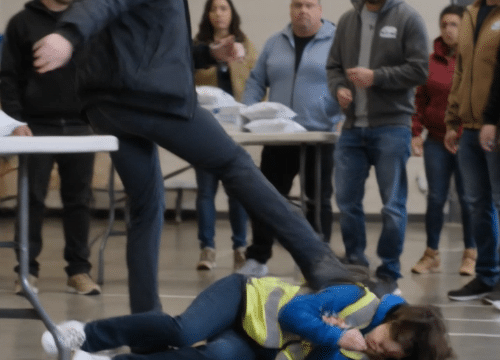
Then he lifted one mud-covered dress shoe and kicked the dog aside as if moving debris.
The sound was small.
That made it worse.
The Golden Retriever jerked once, then went still beneath the concrete edge.
The entire site froze.
The worker with the sledgehammer took half a step forward. Someone behind him whispered, “No…”
Adrian turned sharply.
“What?” he barked. “It’s just a dog!”
His blue suit was splattered with mud, his white shirt damp at the collar, but he still stood like the site belonged to him, like the men in work boots were only tools with names.
“Get back to work!”
No one moved.
Adrian adjusted his muddy cuff, furious that silence had answered him instead of obedience.
“I’m the boss here,” he shouted, pointing at the crew. “You do what I say!”
Ray Dempsey stepped forward.
The movement was slow, but something about it made every man turn.
His eyes were locked on the Golden Retriever.
His mouth trembled once before he found his voice.
Then the whole site heard him scream.
“That was my dog!”
And suddenly, Adrian Cole understood too late that he had not kicked an obstacle.
He had kicked the one thing every man on that site was willing to stop working for.
Act II
The dog’s name was Murphy.
Every worker on the site knew him.
He arrived every morning in the passenger seat of Ray Dempsey’s old pickup, head out the window if the weather was kind, red collar shining beneath his golden fur. He had a habit of stealing gloves, dropping them at men’s feet, and waiting until someone laughed before giving them back.
On cold mornings, Murphy sat near the break trailer while Ray poured coffee from a dented thermos.
On hot afternoons, he slept in the shade beneath a stack of plywood, one ear lifted whenever the excavator started.
The crew joked that Murphy had more seniority than half the men.
But Ray never laughed too loudly at that.
Because Murphy had not started as a job-site dog.
He had belonged to Ray’s son, Caleb.
Caleb Dempsey had been twenty-eight when he died on a construction site across town. A rushed foundation pour. A missing support. A report that said “unforeseeable failure” even though every worker there knew the truth.
Someone had pushed the schedule.
Someone had ignored warnings.
Someone had decided a delay was more expensive than danger.
That someone had been Adrian Cole.
Back then, Adrian was not yet the executive with the tailored suits and polished presentations. He was a rising project manager, ambitious and sharp, the kind of man who smiled in meetings and punished hesitation afterward.
Ray had tried to speak up after Caleb died.
He had photographs. Notes. A voicemail from his son saying the site was unsafe.
But the company buried everything under paperwork and sympathy. Caleb’s death became a tragic accident. Adrian received a promotion six months later.
Ray received a folded flag from the union, a settlement he did not want, and Murphy sitting by the front door every evening waiting for a man who would never come home.
For two years, Ray refused to work for Cole Development again.
Then the old factory contract came through.
He signed on for one reason.
Not money.
Not pride.
Proof.
Ray had heard rumors that Adrian had hidden unsafe demolition records inside the old company archive before the building changed ownership. The factory had once belonged to Whitcomb Steel, the company Adrian used to work for before he built his own empire from its bones.
The same company that had signed off on Caleb’s accident report.
The old archive wing was supposed to be cleared last.
But Adrian wanted it gone first.
Fast.
Quiet.
Before anyone had time to look too closely.
So Ray came back to the mud, the machines, and the man he hated. He kept his head down. He brought Murphy every day because the dog panicked when left alone and because, deep down, Ray could not bear to leave the last piece of Caleb behind.
That morning, Murphy had been restless from the start.
He barked at the south wall before the crew even powered the excavator. He scratched near a cracked concrete trench, pacing in circles, nose down, tail stiff.
“Something’s under there,” one of the younger workers said.
Adrian dismissed it without looking.
“Then dig faster.”
Ray knew Murphy’s signals. Caleb had trained him for search-and-rescue volunteer work on weekends. The dog was not barking at shadows.
He was warning them.
Ray ordered the crew to stop.
Adrian arrived twenty minutes later in his blue suit and fury.
By then, the slab had shifted. Murphy had lunged toward the trench just as concrete slid from the broken wall. He got pinned before anyone could reach him.
The crew stopped everything.
The excavator went silent.
Ray dropped to his knees in the mud, calling Murphy’s name, his hands shaking as he tried to see how badly the dog was trapped.
Then Adrian walked in.
Not asking what happened.
Not asking if anyone was hurt.
Only asking why the work had stopped.
And now Murphy lay silent beneath the slab while Ray stood in front of the man who had taken his son, his justice, and nearly the last living piece of his grief.
Adrian stared at Ray, stunned for only a second before arrogance rushed back to cover the crack.
“Control yourself,” he said. “This is a worksite, not a kennel.”
The crew shifted behind Ray.
The sledgehammer stayed lowered.
But the silence changed.
It no longer belonged to shock.
It belonged to men deciding what kind of line could not be crossed.
Ray looked at Adrian through the mist and mud.
“You don’t remember him, do you?”
Adrian frowned.
“Remember who?”
Ray pointed toward Murphy.
“His owner.”
Adrian’s face tightened.
For the first time all day, he looked unsure.
Ray took one step closer.
“Caleb Dempsey.”
The name hit the site like thunder.
And Adrian Cole’s muddy hand slowly dropped from the air.
Act III
Adrian recovered fast.
Men like him always did.
“I’m not doing this,” he snapped. “Your personal tragedy has nothing to do with today’s schedule.”
Ray’s eyes darkened.
“That’s what you called it back then too.”
A few workers looked at each other.
Most of them had heard pieces of the story, but never from Ray directly. He was not a man who shared pain easily. He carried it like a tool belt: heavy, familiar, always there.
Adrian pointed toward the excavator.
“Start the machine.”
Nobody moved.
His voice rose.
“I said start the machine.”
The operator, a broad man named Luis, stared back from beside the cab.
“No.”
One word.
Flat.
Final.
Adrian’s face flushed.
“You want to lose your job over a dog?”
Ray turned toward Murphy.
“No,” he said. “We’re stopping because Murphy found something.”
Adrian’s eyes narrowed.
“What did you say?”
Ray crouched in the mud, ignoring the sharp ache in his knees. He reached carefully near the edge of the slab, not touching the dog, not risking more weight shifting. His fingers closed around something half-buried in gray sludge.
A strip of orange utility tape.
Old.
Torn.
Marked with black lettering.
Luis stepped forward.
“That’s not on the map.”
Another worker whispered, “There’s a gas line?”
Adrian’s voice cut in too fast.
“It’s abandoned.”
Everyone looked at him.
Ray stood slowly.
“How do you know?”
Adrian went still.
The rain began again, light but steady, tapping on hard hats and broken concrete.
Ray held up the muddy tape.
“The current survey didn’t show this trench. None of the permit drawings show it. We asked you yesterday why the archive wing was locked, and you told us it was empty.”
Adrian’s expression hardened.
“Because it is.”
Murphy gave the faintest sound.
Ray’s face broke, then hardened again.
“Get the rescue braces,” he told the crew.
Adrian stepped into his path.
“If anyone touches that slab before I give clearance, you’re fired.”
The worker with the sledgehammer finally spoke.
“Then fire all of us.”
One by one, the men moved.
Not wildly. Not violently. They moved like a crew. The way trained workers move when the job is no longer about concrete but survival.
Luis grabbed stabilizing blocks.
Another worker brought a jack.
Two others guided Ray back before grief made him reckless.
Adrian shouted over them, but his voice no longer filled the site. It bounced off men who had stopped hearing him as authority.
“Do you have any idea who owns this project?” he yelled.
Ray looked over his shoulder.
“Not you.”
Adrian laughed, sharp and ugly.
“You think because your dog got hurt, the law changes?”
“No,” Ray said. “I think because your hidden gas line nearly killed my crew, the law finally arrives.”
That was when the youngest worker, Ben, lifted his phone.
He had been recording.
Adrian saw the red dot on the screen.
His face changed.
Ben’s hand shook, but he did not lower it.
“I got everything,” he said. “The kick. The threats. The utility tape. Everything.”
Adrian lunged toward him.
Luis stepped between them.
No one touched Adrian.
They did not need to.
The circle had already closed.
Then a new sound rolled across the site.
Not thunder.
A siren.
Ray looked toward the muddy access road.
Two city vehicles pulled in first. Then a white truck marked with municipal inspection decals. Behind it came an animal rescue van, its tires throwing mud as it stopped near the rubble.
Adrian stared as if the road itself had betrayed him.
Ray wiped rain from his face.
“I called before you got here,” he said. “When Murphy started barking at the trench.”
The first inspector stepped out, boots sinking into the mud, clipboard sealed under a plastic cover.
“Who is in charge here?”
Adrian opened his mouth.
Ray answered first.
“He is.”
Then he pointed at Adrian Cole.
“And he ordered us to keep working over an unmarked line.”
The inspector looked from the tape, to the slab, to the silent excavator, to Murphy trapped beneath the concrete.
Finally, he looked at Adrian’s mud-splattered suit.
“Shut the site down.”
Adrian’s mouth fell open.
The words were not loud.
They did not need to be.
For the first time in years, someone had given an order Adrian Cole could not overrule.
Act IV
The rescue team moved quickly.
They spoke in calm, precise voices, sliding supports beneath the slab before lifting anything. One worker checked the soil. Another monitored the trench. The crew helped without being asked, passing tools, clearing loose debris, holding tarps against the rain.
Ray stood close enough to see Murphy’s muddy fur, far enough not to interfere.
His hands kept opening and closing.
“Come on, boy,” he whispered. “Stay with me.”
Adrian stood near the excavator, surrounded by mud and men who no longer looked at him with fear.
The inspector approached him.
“I need the full utility survey.”
Adrian adjusted his tie.
“It’s in the office.”
“Then have it sent.”
“It may take time.”
The inspector studied him.
“You had time to threaten your crew. Find time.”
Ben was still recording.
Adrian noticed and looked away.
A second inspector entered the half-demolished factory with Luis and two workers. They returned fifteen minutes later carrying a dented metal filing box coated in dust and concrete powder.
Adrian’s face went pale.
Ray saw it.
So did everyone else.
The inspector set the box on the hood of the city truck and opened it.
Inside were old permits, folded maps, and a set of safety complaints from years ago.
The top page had Caleb Dempsey’s name on it.
Ray stopped breathing.
The inspector lifted the page carefully.
It was not a final report.
It was Caleb’s original warning.
Filed two days before he died.
Ray stepped closer, eyes fixed on the paper.
“He wrote one?”
The inspector looked at him with quiet sympathy.
“Yes.”
Ray’s voice broke.
“They told me there was no written complaint.”
Adrian said nothing.
The rain slid down his face like sweat.
The inspector continued sorting.
There were photographs of the old foundation site. Emails printed and signed. A memo with Adrian Cole’s initials beside a line that made Luis swear under his breath.
Proceed without delay. Risk acceptable pending review.
Ray stared at the words.
Risk acceptable.
His son’s life had been reduced to two words in a margin.
Adrian finally spoke.
“You don’t understand the context.”
Ray turned toward him.
No shouting now.
Just devastation sharpened into truth.
“My son called me that night,” he said. “He said the ground was wrong. He said you were pushing them too fast.”
Adrian’s jaw tightened.
“That accident was investigated.”
“It was buried.”
The crew stood behind Ray, not as spectators anymore, but witnesses.
The inspector took photos of each document. Another official called for police. The site, once a place Adrian controlled with paychecks and threats, became a crime scene in slow motion.
Then one of the rescuers called out.
“We’ve got him.”
Ray turned.
Murphy was lifted from beneath the slab, wrapped carefully in a heavy blanket. His head rested low, but when Ray said his name, one ear twitched.
Ray covered his mouth.
The rescue worker carried Murphy toward the van.
“He’s alive,” she said. “Critical, but alive.”
Ray almost collapsed.
Luis caught his arm.
The crew exhaled together, a sound that was half relief, half grief.
Adrian watched from across the mud, isolated now, his polished suit ruined, his authority stripped down to a man standing beside the consequences he had tried to bury.
A police cruiser arrived at the gate.
Adrian stepped backward.
Ben’s phone followed him.
The inspector closed the metal box.
“Mr. Cole,” he said, “you’ll need to answer some questions.”
Adrian looked at Ray, then at the crew, searching for weakness, fear, anything familiar.
He found none.
Only men in muddy boots standing where they should have stood years ago.
Together.
Act V
Murphy survived the night.
Ray did not leave the animal clinic.
He sat in a plastic chair under fluorescent lights, still wearing mud-caked work pants, hard hat on the floor beside him, hands clasped so tightly his knuckles ached.
Every time the door opened, he looked up.
Near dawn, the vet came out and told him Murphy was stable.
Not fine. Not healed. Not safe yet.
But alive.
Ray bowed his head and cried without making a sound.
By noon, the video had spread through the city.
Ben had not posted the worst part for shock. He had sent it to the union, the inspector, and the local reporter who had covered Caleb’s death years earlier. By evening, everyone knew the story.
The executive who kicked a trapped dog.
The crew that refused to keep working.
The buried documents.
The dead worker whose warning had been hidden.
The Golden Retriever who had stopped a demolition and uncovered the truth.
Adrian Cole’s company released a statement before sunset.
It called the incident “deeply regrettable.”
No one believed it.
By the end of the week, the city suspended every active Cole Development permit. Investigators reopened Caleb’s case. Former employees came forward with old emails, photographs, and stories they had been too afraid to tell.
Men who had been silent for years suddenly realized they were not alone.
Ray visited Murphy every day.
The dog healed slowly. There were bandages, careful lifts, soft food, and long hours where Ray simply sat beside him with one hand resting gently against his neck.
“You always were smarter than us,” Ray whispered one afternoon.
Murphy blinked up at him, tired but present.
That was enough.
Three months later, the old factory site looked different.
The rubble had been cleared safely. The unmarked gas line had been exposed and capped. The archive wing was preserved long enough for investigators to remove every box, every report, every page Adrian had believed time would swallow.
A temporary fence surrounded the place now.
On it hung a sign the crew had made themselves.
Caleb Dempsey Memorial Safety Fund.
Beneath the words was a small painted paw print.
Ray stood in front of it on the day the crew returned, not to work under Adrian, but to break ground under new management. Luis was the site supervisor now. Ben handled documentation. Every worker had stop-work authority written directly into the contract.
No one could be punished for saying something was unsafe.
Not again.
Murphy arrived in Ray’s truck just after eight.
He moved slower now, with a slight stiffness in one leg, but the moment his paws touched the ground, every man on the site stopped.
Then someone began clapping.
Ray shook his head, embarrassed, but Murphy lifted his head like he had been expecting applause all his life.
The crew laughed through wet eyes.
For the first time in years, Ray felt something inside him loosen.
Not heal completely.
Grief did not work that way.
But loosen.
Later that morning, a black sedan stopped near the gate.
Adrian Cole stepped out.
He no longer wore a tailored blue suit. Just a dark coat, no tie, his face drawn and older than it had been in the mud that day. His lawyers had advised him not to come. His board had removed him. Prosecutors had not finished with him.
Still, he stood outside the fence.
Ray walked over slowly.
Murphy stayed at his side.
Adrian looked at the dog first.
Then at Ray.
“I didn’t know it was Caleb’s dog,” he said.
Ray studied him for a long moment.
“That’s what you still don’t understand.”
Adrian swallowed.
Ray’s voice stayed quiet.
“It shouldn’t have mattered.”
The words hit harder than shouting.
Adrian looked down.
For once, there was no answer ready. No command. No excuse polished enough to survive daylight.
Ray turned away.
Behind him, the excavator started with a low, steady rumble.
Not rushed.
Not reckless.
Just work beginning the right way.
Murphy leaned against Ray’s leg, warm and alive.
Ray rested a hand on his head.
The old factory would come down piece by piece. The buried truth had already come up. Caleb’s warning would finally be entered into the record, not as a footnote, not as an inconvenience, but as the proof of a man who had tried to save lives before powerful people decided he was easier to ignore.
And Murphy, the dog Adrian Cole had called “just a dog,” became the reason the entire city learned what had been hidden under concrete, contracts, and years of silence.
Some creatures cannot speak.
But sometimes, they still tell the truth louder than anyone else.