Act I
The cigarette smoke curled through the luxury mall like an insult.
Everyone saw it.
The glowing GUCCI storefront. The polished marble floor. The curved glass railing reflecting the bright overhead lights. The shoppers standing in clusters with phones already raised, waiting for something ugly to happen.
At the center of it all stood Lucas Varrick.
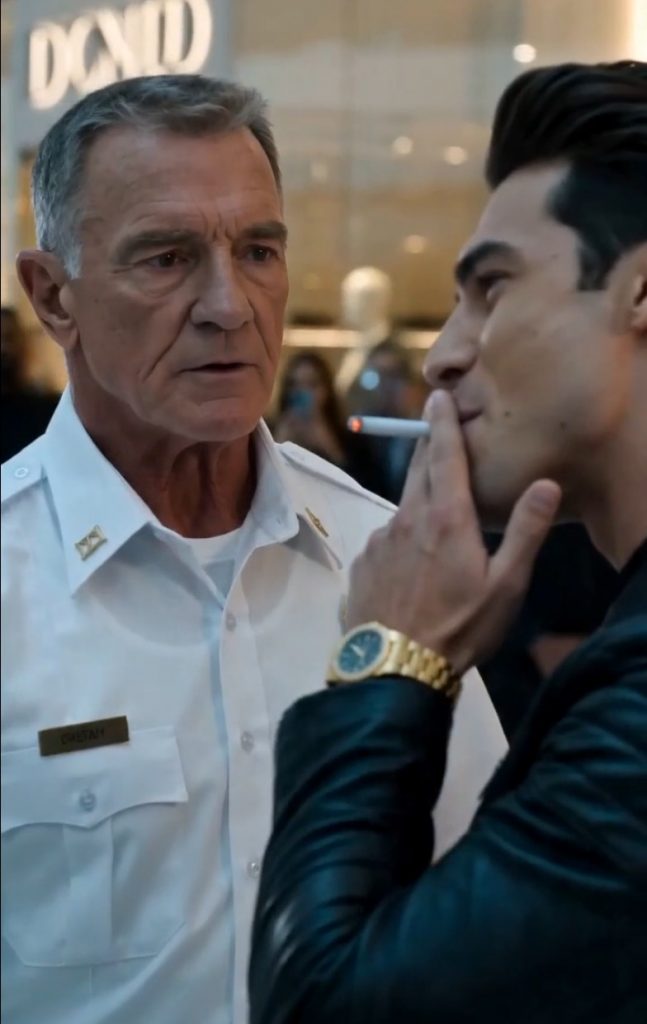
Black leather jacket. Gold watch. Dark hair styled like he had never once heard the word no and believed it. Behind him, four bodyguards in black suits stood like a wall.
Lucas took another slow drag from his cigarette and exhaled toward the ceiling.
Then the old security officer approached.
He wore a white uniform shirt, dark trousers, and a gold name tag that caught the mall light. His gray hair was neatly combed. His face was dignified, tired, and calm.
His right sleeve was pinned up at the shoulder.
He had only one arm.
“Sir,” the officer said, stopping at a respectful distance. “Smoking is not allowed inside. Please put it out.”
Lucas turned slowly.
For a moment, he just stared.
Then he smiled.
Not with amusement.
With cruelty.
He stepped closer and blew a thick cloud of smoke straight into the officer’s face.
The crowd murmured.
The officer did not cough. He did not step back. He only waited, his left hand relaxed at his side, his eyes steady.
Lucas laughed and looked over his shoulder at his friends.
“You see this?” he said. “A one-armed guard giving orders.”
A few of the bodyguards chuckled.
The officer’s expression did not change.
“I’m asking respectfully.”
That seemed to anger Lucas more than defiance would have.
His smile vanished.
The cigarette hung between his fingers as he stepped into the old man’s space.
Then he slapped him.
The sound cracked through the corridor.
A woman gasped. Someone cursed under their breath. Several phones lifted higher.
The officer’s head turned slightly from the impact, but his feet did not move.
Lucas pointed at the marble floor.
“Kneel,” he said. “Now.”
The old man slowly looked back at him.
No fear.
No humiliation.
Only restraint.
That was when one of the large bodyguards stepped forward.
He lunged with the confidence of a man who thought size was the same thing as power.
The security officer moved once.
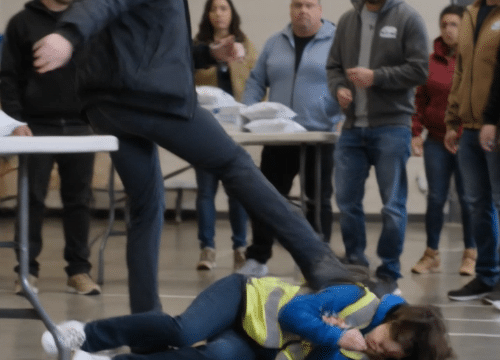
His left hand caught the man’s wrist. His shoulder turned. His hips shifted. The bodyguard’s feet left the floor, and a second later his back hit the marble with a heavy thud that silenced the entire mall.
Lucas stopped breathing.
Across the corridor, a middle-aged man in a gray suit with a small American flag pin stared at the officer like he had just seen a ghost.
“No way,” he whispered. “It can’t be him.”
The remaining bodyguards rushed in together.
They slammed into the old officer, driving him backward into the glass railing. His white uniform twisted under their hands. The glass behind him cracked in a sharp, branching pattern.
The crowd screamed.
Lucas stood frozen, cigarette forgotten in his hand.
And the man with the flag pin pushed through the crowd, his face pale.
“Get off him,” he said. “Do you have any idea who that is?”
Act II
Twenty-seven years earlier, the man now wearing a mall security uniform had been known by another name.
Captain Samuel Rourke.
Back then, nobody called him old.
He was a decorated Marine, quiet under pressure, the kind of man who made chaos feel ashamed of itself. He had led rescue operations in places most people only saw on maps and had survived situations men twice as loud never would have walked out of.
His right arm was lost during an embassy evacuation.
The official report said he was injured while assisting civilians.
That was the clean version.
The real version was that Samuel had gone back into a burning service corridor after hearing a child crying behind a locked emergency door. He carried the child out with one arm already wounded, then collapsed only after placing her in the arms of a medic.
That child grew up.
So did the story.
It became a medal ceremony, a newspaper photo, a speech in Washington, then a framed article on the wall of a veterans’ center where people stopped and stared for a few seconds before moving on with their lives.
Samuel hated the attention.
He accepted the medal because the men who did not come home deserved to be remembered through him. But after the cameras left, he disappeared from public life as much as a man with his face in old history books could.
Years later, he took a job at Varrick Plaza Mall.
Not because he needed pity.
Because the mall’s security director ran a program hiring disabled veterans, and Samuel believed work was dignity when the world tried to turn a person into a symbol. He liked routine. He liked walking the marble floors before opening. He liked helping lost children find parents and old shoppers find elevators.
He did not tell people who he had been.
To most of the staff, he was just Mr. Rourke.
The one-armed guard.
Calm. Polite. Always early.
Lucas Varrick knew none of that.
Lucas knew only that his father owned the mall.
Or, more accurately, his father’s company owned enough of it for Lucas to treat the building like a private playground.
He smoked where he wanted. Parked where he wanted. Walked past staff entrances with his bodyguards trailing behind him. If anyone complained, he made a phone call. If anyone resisted, that person’s shift changed, contract ended, or reputation suffered.
He called it influence.
Everyone else called it surviving Lucas.
That night, he had arrived after a party with his friends, bored and restless, looking for an audience. He lit the cigarette inside not because he needed it, but because rules meant nothing unless someone tried to enforce them.
Samuel enforced them.
That was all.
He did not know Lucas was the owner’s son until a cashier whispered it behind a pillar.
He did not care after he knew.
A rule was a rule.
A public space was a public space.
And dignity did not become optional because a young man had money.
But Samuel also knew something the crowd did not.
Lucas was not only arrogant.
He was afraid of being ordinary.
That was why he needed the bodyguards. The leather jacket. The gold watch. The laughter of weaker men. He needed every stranger in the corridor to know he could make someone smaller.
So when Samuel did not shrink, Lucas escalated.
The smoke.
The insult.
The slap.
The command to kneel.
Every step had been a performance.
But performances can turn dangerous when the wrong person refuses to play along.
Act III
The glass cracked again.
A thin line spread from behind Samuel’s shoulder, spiderwebbing outward beneath the pressure of the bodyguards forcing him into the railing.
“Stop!” someone shouted.
But no one moved in.
Fear held the crowd back.
Phones kept recording. Children cried near the storefront. A security guard from another wing radioed for backup with a shaking voice.
Samuel’s face tightened, but he did not panic. He braced with his left arm and shifted his weight so the glass took less pressure. Even pinned, he was still calculating. Still protecting people from the worst possible outcome.
The bodyguards did not understand that.
They thought they had him.
Lucas finally found his voice.
“Hold him there,” he snapped, trying to sound powerful again.
The man with the flag pin pushed between two shoppers.
His name was Thomas Bell, and he was not just another witness.
He was a retired State Department officer, now serving as a federal security consultant. He had been invited to inspect Varrick Plaza’s emergency systems after a recent series of threats against high-end retail centers.
He had also been in the embassy twenty-seven years ago.
He had watched Captain Samuel Rourke carry a child through smoke with one arm nearly useless and his uniform torn. He had watched men twice his rank step aside when Samuel walked past because courage like that did not need announcement.
Now Thomas saw that same man pinned against mall glass by hired muscle while a rich boy held a cigarette and smiled too late.
His voice rose.
“Hands off Captain Rourke!”
The name hit the corridor like a second slap.
Samuel’s eyes flicked toward him.
A warning.
Not now.
But it was already too late.
Thomas stepped closer, holding up his government identification.
“You are assaulting a decorated veteran and uniformed security officer in front of fifty witnesses. Release him now.”
One bodyguard hesitated.
Samuel used that hesitation.
He dropped his weight suddenly, pivoted under the nearest man’s grip, and drove his shoulder just enough to break the pressure without throwing anyone through the glass. The bodyguards stumbled into each other. Samuel moved out from the railing, breathing hard but upright.
The cracked glass remained behind him like proof.
Lucas stared.
“Captain?” he said, almost laughing. “What, this old guy?”
Thomas turned on him.
“This old guy saved seventeen civilians in an embassy attack before you were born.”
The crowd changed.
Not loudly.
It was something quieter.
Phones turned from gossip devices into evidence. The murmurs shifted from shock to anger. People who had been watching a confrontation now understood they were witnessing a humiliation attempt against a man who had already given more than Lucas could imagine.
Samuel adjusted his uniform collar with his single hand.
His cheek still held the red mark from the slap.
He looked at Lucas.
“Put out the cigarette.”
The absurdity of it stunned everyone.
After the smoke, the insult, the slap, the attack, the cracked glass, he returned to the first rule. The simple rule. The one Lucas had broken before everything else revealed who he was.
Lucas’s face twisted.
“You think this changes anything?”
Then another voice answered from behind the crowd.
“It changes everything.”
The shoppers turned.
A tall man in a charcoal suit stood near the GUCCI entrance, flanked by mall executives and two police officers.
Victor Varrick.
Lucas’s father.
And for the first time that night, Lucas looked truly scared.
Act IV
Victor Varrick did not rush toward his son.
He walked slowly, his face unreadable, his polished shoes clicking across the marble.
Lucas tried to recover.
“Dad, this got out of hand. He attacked my guard.”
Victor looked at the fallen bodyguard still sitting on the floor.
Then at the cracked glass.
Then at Samuel Rourke’s marked cheek.
Finally, he looked at the cigarette in Lucas’s hand.
“Put it out.”
Lucas blinked.
“What?”
Victor’s voice dropped.
“Now.”
Lucas crushed the cigarette under his shoe.
Too late.
Far too late.
Victor turned to Samuel.
“Captain Rourke.”
Samuel’s jaw tightened.
“Mr. Varrick.”
The crowd heard the recognition in both voices.
Lucas heard it too.
“You know him?” he asked.
Victor did not answer immediately.
His eyes moved to Samuel’s pinned sleeve.
Then to his face.
“I owe him my life,” Victor said.
Lucas went still.
The mall seemed to fall silent around the sentence.
Victor looked at his son, and something in his expression broke open—not sadness exactly, but the terrible disappointment of a father seeing the cost of everything he had excused.
“Twenty-seven years ago,” Victor said, “I was a junior trade attaché trapped in an embassy corridor overseas. Captain Rourke got me and others out when he had every right to save himself.”
Lucas’s face drained.
Thomas Bell added quietly, “Your father was one of the seventeen.”
Samuel looked uncomfortable now, more than he had under attack. He had never liked being turned into a monument, especially not in front of strangers.
But Victor was not finished.
“You slapped him,” Victor said to Lucas.
Lucas swallowed.
“I didn’t know—”
Victor cut him off.
“That is not a defense. That is the problem.”
The words landed harder than shouting.
“You didn’t know who he was, so you thought he was safe to humiliate. You saw a uniform you considered beneath you. You saw one arm and mistook restraint for weakness.”
Lucas had no answer.
His bodyguards looked at the floor.
Victor turned to the police officers.
“Take statements from everyone. Preserve every video. The bodyguards who touched him are terminated and banned from this property. Lucas will cooperate fully.”
“Dad—”
Victor finally looked at his son with open fury.
“You are done speaking.”
Lucas closed his mouth.
Samuel stepped forward. “Mr. Varrick, I don’t want this turned into a spectacle.”
Victor’s face softened when he looked at him.
“With respect, Captain, it became a spectacle when my son assaulted you in public.”
The crowd shifted again.
Some people lowered their phones. Others kept recording, but differently now, less hungry for drama and more aware of responsibility.
Samuel glanced at the cracked glass.
“There are families nearby. Clear the area before that panel gives.”
Even then, he was thinking of everyone else first.
Victor looked at the mall staff. “You heard him. Move people back.”
The order snapped them into motion.
The corridor finally became what it should have been from the start: a public space protected by rules, not wealth.
Lucas stood near the railing, stripped of his performance piece by piece. The cigarette was gone. The smile was gone. His bodyguards no longer formed a wall behind him.
He looked smaller without them.
Samuel walked past him toward the damaged glass, checking the distance between the crack and the crowd.
Lucas whispered, barely audible, “I’m sorry.”
Samuel paused.
He did not turn around.
“No,” he said. “You’re embarrassed.”
Lucas flinched.
Samuel looked back then.
“Try becoming sorry after that.”
Act V
The video went everywhere by morning.
At first, people shared the slap.
Then they shared the throw.
Then they shared the moment Thomas Bell said the name Captain Rourke and the whole story changed.
By noon, news stations were outside Varrick Plaza.
By evening, old footage resurfaced from a medal ceremony twenty-seven years earlier. Samuel Rourke, younger and broad-shouldered, standing stiffly while officials praised him. Samuel Rourke refusing to give a long speech. Samuel Rourke saying only, “The people who didn’t come home deserve the applause more than I do.”
The public loved him immediately.
Samuel hated that part.
He did not want interviews. He did not want charity. He did not want people looking at his pinned sleeve with wet eyes and calling him inspiring while ignoring the man beneath the story.
But something happened that he did not expect.
Other workers began speaking.
A cashier said Lucas had threatened her job after she asked him not to smoke near the entrance.
A janitor said the bodyguards had shoved him into a service door.
A young assistant manager admitted complaints about Lucas had been buried because staff were afraid of his last name.
The slap had not created the scandal.
It had revealed the pattern.
Victor Varrick responded publicly three days later.
He stood in the same mall corridor, the cracked glass already replaced behind him. Lucas was not beside him. Neither were the bodyguards.
Samuel stood off camera by choice.
Victor announced a new staff protection policy, independent reporting channels, and a permanent ban on private security teams using force inside the mall without coordination with mall security. He also announced that Lucas Varrick had been removed from all company roles.
Reporters shouted questions about whether that was enough.
Victor did not pretend it was.
“No policy can undo what happened,” he said. “But consequences can begin where excuses end.”
Samuel watched from the second level.
Thomas Bell stood beside him.
“You should have let them interview you,” Thomas said.
Samuel gave him a dry look.
“I’d rather fight four bodyguards again.”
Thomas laughed softly.
Below them, Victor continued speaking.
“He means it,” Thomas said after a moment.
“Maybe.”
“You don’t think so?”
Samuel looked over the railing at the marble floor where the bodyguard had fallen, where Lucas had pointed and demanded that he kneel, where dozens of strangers had filmed instead of stepping forward.
“I think people mean things when everyone is watching,” he said. “The test comes later.”
Thomas nodded.
That was the kind of answer only men who had seen the world fail people could give.
A week later, Samuel returned to work.
The security office had prepared a small celebration. A cake. A card. A banner that said Welcome Back, Mr. Rourke. He endured it with the stiff patience of a man surviving an ambush made of frosting.
But when he returned to the corridor, something had changed.
People greeted him by name.
Not Captain.
Not hero.
Mr. Rourke.
The barista near the north entrance handed him coffee and said, “On the house.”
He paid anyway.
A little boy near the fountain saluted him, and Samuel crouched to eye level.
“You don’t have to do that,” he said kindly.
The boy’s mother looked embarrassed.
Samuel smiled at the child.
“But you can help your mom carry that bag.”
The boy did.
That made Samuel happier than the salute.
Then, near the GUCCI storefront, he saw Lucas.
The young man stood alone.
No leather jacket. No bodyguards. No cigarette. He wore a plain dark sweater and looked as if he had slept badly for days.
Samuel stopped several feet away.
Mall police watched from the corner.
Lucas lifted his hands slightly. “I’m not here to start anything.”
Samuel waited.
Lucas looked at the floor.
“My father said I had to apologize in person.”
Samuel said nothing.
Lucas swallowed.
“But that’s not why I came.”
For the first time, his voice did not sound rehearsed.
“I watched the video,” he said. “Not the one online. The security footage. The whole thing.”
His face tightened.
“I kept waiting for myself to stop.”
Samuel’s expression remained guarded.
Lucas continued.
“I didn’t.”
No excuse followed.
That was the first decent thing he had done.
Samuel looked at him for a long moment.
“Apology accepted,” he said.
Lucas’s head lifted in surprise.
Samuel’s eyes hardened.
“Forgiveness is different. Don’t confuse the two.”
Lucas nodded slowly.
“I won’t.”
“Good.”
Samuel started to walk away.
Then Lucas spoke again.
“Captain Rourke?”
Samuel stopped.
Lucas hesitated.
“Why didn’t you hit me back?”
The question was honest enough to deserve an answer.
Samuel turned.
“Because I’ve spent my whole life learning the difference between power and control,” he said. “You had one that night. I had the other.”
Lucas looked down, and this time he had the sense not to reply.
Months passed.
The mall returned to its glossy normal. Shoppers came and went. The GUCCI windows changed displays. The marble floors kept reflecting light as if nothing dark had ever happened there.
But staff remembered.
They remembered the smoke.
The slap.
The cracked glass.
The old guard standing upright when wealth ordered him to kneel.
And they remembered what happened after.
Complaints were heard. Schedules stopped being used as punishment. Security staff received authority in writing that no private entourage could override them. Workers who had spent years feeling replaceable began to understand that rules could protect them too, if someone powerful decided to enforce them honestly.
Samuel kept doing his job.
He asked teenagers not to run near the escalators. He helped lost children. He walked the corridor with the same calm pace, his pinned sleeve visible, his left hand steady, his name tag shining under the luxury lights.
Sometimes people recognized him.
He preferred when they didn’t.
One evening, Thomas Bell visited again and found Samuel near the railing, looking down at the lower level.
“Still here?” Thomas asked.
Samuel nodded.
“Still walking.”
Thomas smiled. “After everything, you could retire properly.”
Samuel watched a young cleaner pushing a cart past the storefronts, shoulders tired but head held high.
“Not yet,” he said.
“Why?”
Samuel looked at the place where Lucas had once pointed to the floor.
“Because someone has to remind men like him that uniforms are not costumes,” he said. “And people they overlook are still people.”
Down below, the mall lights gleamed.
Glass shone. Marble reflected. Luxury signs glowed warm and gold.
But the story people told about that corridor was never really about luxury.
It was about a cigarette smoked where it should not have been.
A slap thrown at a man presumed powerless.
A crowd that learned the difference between watching and witnessing.
And an old security officer with one arm who refused to kneel—not because the world knew who he was, but because he had never needed the world’s permission to stand.