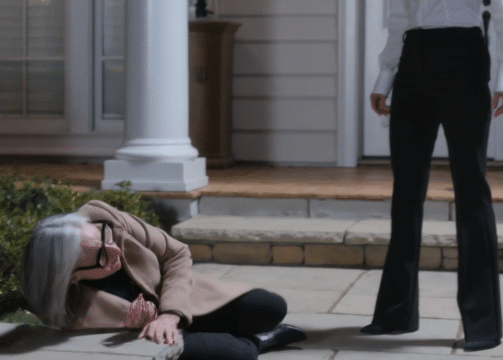
Act I
The phone rang in the dark.
Arthur Bell sat alone at the edge of his bed, staring at the glowing screen like it had found him hiding. The rest of the room was nearly black. Only the cold light from the phone touched his lined face, his trembling mouth, and the gold wedding band he had not removed since the day Margaret died.
Outside the bedroom, the house was silent.
Too silent.
Arthur let the phone ring twice more before answering.
“Hello?”
For a moment, there was only static.
Then a woman’s voice came through, low and urgent.
“Mr. Bell, listen carefully. Turn everything off. Go to the attic, lock the door, and don’t tell your son-in-law.”
Arthur’s breath caught.
“You’re scaring me.”
“You should be scared,” the caller said. “He’s in the house.”
Arthur looked toward the hallway.
The door was open just enough to show a strip of black beyond it. He had left the downstairs lamp on. He was sure he had. But now the hallway looked swallowed.
“Who is this?” he whispered.
“No time. Turn off the lights. Do not call his name. Do not let him hear you.”
Arthur’s hand tightened around the phone.
His son-in-law, Daniel, was supposed to be away on business. That was what he had told Arthur at dinner two nights ago, smiling that polished smile over a plate of food Arthur had barely eaten.
“You worry too much,” Daniel had said. “That’s what happens when old men live alone.”
But Arthur had not always lived alone.
Before Margaret’s stroke, before the hospital bed, before the funeral where Daniel stood a little too dry-eyed beside Arthur’s daughter, this house had been warm. It had smelled like cinnamon toast and furniture polish. It had held birthday parties, music, arguments, and the ordinary mess of being loved.
Now it held locked doors Arthur did not remember locking.
Pills he did not remember taking.
Bills signed in his name.
And Daniel.
Always Daniel.
The caller’s voice snapped back through the phone.
“Just do it.”
Arthur rose.
His knees ached. His fingers shook. He pressed the switch by the bedroom door and watched the last weak lamp in the room die.
Darkness rushed in.
He moved through it by memory, one hand sliding along the wall, the phone clutched against his ear. The floor creaked beneath him. Somewhere downstairs, something clicked.
Not the house settling.
A lock.
Arthur stopped breathing.
Then he heard it.
A footstep.
Slow.
Measured.
Inside his home.
He turned toward the narrow wooden stairs that led to the attic and climbed as fast as his old legs allowed.
Act II
Arthur Bell had not trusted Daniel Pierce from the first handshake.
He could never explain it in a way that sounded fair. Daniel was handsome, educated, well-spoken, the kind of man who opened doors for women and remembered waiters’ names when other people were watching. He had a finance job, a clean car, and a way of making Arthur’s daughter laugh that seemed real enough.
But Margaret had felt it too.
“Something about him is polished too smooth,” she once whispered after Claire brought him to Sunday dinner.
Arthur had laughed then.
“What does that mean?”
“It means nothing sticks unless he wants it to.”
Margaret was right about people more often than Arthur liked to admit.
Still, Claire married him.
Arthur walked her down the aisle while Daniel stood at the altar with perfect eyes and a perfect smile. Margaret cried into a handkerchief. Arthur cried too, though he blamed allergies because fathers were allowed their foolish pride.
For a while, everyone pretended happiness had won.
Then Daniel began managing things.
First Claire’s schedule. Then her bank accounts. Then her phone, because she was “too overwhelmed” after the pregnancy loss she never fully recovered from. She stopped visiting as often. When she did come, Daniel came with her, one hand resting lightly on the back of her chair.
Arthur noticed how she looked at him before answering questions.
Margaret noticed more.
She started writing things down.
Daniel’s business trips that were not real.
Claire’s bruised silences.
Medication bottles that changed labels.
Checks from Arthur’s account he did not remember signing.
Margaret kept the notebook in the sewing room, tucked behind a box of old patterns. Arthur found it only after she died.
At first, the doctors said Margaret’s stroke had been sudden.
Tragic.
Unpreventable.
Daniel helped with arrangements. Daniel handled insurance calls. Daniel told Arthur not to worry, that grief made paperwork confusing. Daniel moved into the guest room “just for a few weeks” to help him adjust.
The weeks became months.
Arthur began forgetting things.
Not big things at first. A kettle left boiling. A missing appointment. A signature he did not recognize but Daniel insisted was his.
“You’re tired,” Daniel said. “Your mind is slipping. It happens.”
Arthur wanted to argue.
But fear is a quiet thief. It does not always burst through the door. Sometimes it sits beside you at breakfast and tells you that you cannot trust yourself.
Then Claire vanished.
Daniel said she had checked herself into a private wellness retreat after a breakdown. No phones allowed. No visitors. Rest was best.
Arthur asked for the facility name.
Daniel smiled.
“When she’s ready, she’ll tell you herself.”
That was three weeks ago.
Since then, Arthur had been alone in the house with Daniel’s cameras, Daniel’s pills, Daniel’s calm voice, Daniel’s hand on his shoulder guiding him away from the locked basement door.
Until the phone rang.
Until the caller told him to hide.
Now Arthur reached the attic landing, breath burning in his chest. The old wooden door stood at the top of the stairs, narrow and warped. He had not opened it since Margaret’s Christmas decorations were stored there.
A floorboard creaked below.
Arthur’s blood went cold.
“Mr. Bell,” the caller whispered. “Are you inside?”
Arthur pushed through the attic door, stepped into the cramped darkness, and pulled it shut behind him.
His fingers fumbled with the latch.
The lock clicked.
A second later, a voice came from downstairs.
“Arthur?”
Daniel.
Soft.
Patient.
Too close.
Act III
Arthur clapped one hand over his mouth.
The phone was still pressed against his ear.
The caller spoke again, quieter now.
“Do not answer him.”
Arthur nodded before realizing she could not see him.
The attic smelled of dust, old wood, and cardboard boxes gone soft with age. Thin lines of light cut through gaps in the planks. Somewhere in the wall, a pipe knocked once, then went still.
Daniel’s footsteps reached the second floor.
“Arthur?” he called again. “Why are all the lights off?”
The voice was almost gentle.
That made it worse.
Arthur moved backward until his shoulder touched a stack of boxes. Something inside shifted with a dry whisper. He froze.
Daniel stopped outside the bedroom below.
A door opened.
Then another.
Arthur could picture him standing there, tall and calm in his dark coat, checking rooms like a man who owned them.
The caller’s voice returned.
“My name is Nora Vale. I’m a private investigator hired by your daughter.”
Arthur’s eyes filled instantly.
“Claire?”
“Quiet,” Nora warned. “She’s alive.”
Arthur almost made a sound.
He bit down on his knuckle instead.
“She escaped three hours ago,” Nora said. “She came to me with Margaret’s notebook and a copy of your medication records. Daniel has been isolating you, altering your prescriptions, and moving assets out of your accounts.”
Arthur’s knees weakened.
He sank onto an old trunk.
The darkness swayed.
“Where is she?” he breathed.
“Safe. But Daniel knows she got out. We think he came to remove documents from the house before police arrive.”
Arthur’s eyes drifted toward the far wall.
Margaret’s sewing boxes.
Her old cedar chest.
The notebook.
He had hidden it after finding it, not knowing what to do, not knowing if his own mind could be trusted. He had slipped it into the attic behind a loose plank because Margaret used to joke the attic was the only room Daniel was too clean to enter.
But Daniel had entered everything else.
Downstairs, a drawer slammed.
Arthur flinched.
Daniel’s voice rose slightly.
“Arthur, I need you to answer me.”
The caller said, “He’s checking whether you’re still compliant.”
Arthur closed his eyes.
That word hurt.
Compliant.
He remembered the pills placed beside his orange juice. The reminders. The little sighs Daniel made when Arthur asked the same question twice. The way shame had made him easier to manage.
A floorboard creaked outside the attic stairs.
Daniel was coming up.
Arthur looked toward the door.
Through the thin crack between the door and frame, darkness moved.
Then came a red glow.
Small.
Round.
Steady.
Arthur leaned closer despite every instinct telling him not to.
At first, he thought it was an eye.
That was when terror opened inside him.
The glow hovered near the doorframe, just beyond the crack, watching. His mouth fell open in a silent gasp. The phone slipped slightly against his cheek.
Then the glow shifted.
A camera lens.
Not a creature.
A hidden camera.
Mounted on the hallway beam outside the attic.
Daniel had been watching more than Arthur knew.
The realization was almost worse than a monster.
Because monsters belonged to nightmares.
This belonged to his house.
Act IV
Arthur jerked back from the crack.
The phone nearly fell from his hand.
“He has a camera,” he whispered.
“We know,” Nora said. “That’s why I told you to turn everything off. He’s been using the house system to monitor you.”
Arthur stared at the attic door.
All those nights he thought he was alone.
All those mornings Daniel knew exactly when he woke, when he ate, when he opened drawers, when he stood too long near Margaret’s sewing room.
The house had not been silent.
It had been listening.
Daniel’s footsteps reached the attic landing.
The door handle moved.
Once.
Then again.
Locked.
A pause.
“Arthur,” Daniel said softly from the other side. “Open the door.”
Arthur did not answer.
Daniel sighed.
The familiar sound made Arthur’s stomach twist. That gentle disappointment. That practiced patience. The voice of a man who had turned control into concern.
“You’re confused,” Daniel said. “Whoever called you is upsetting you.”
Arthur looked toward the loose plank behind the cedar chest.
Margaret’s notebook was there.
So were copies of the bank statements he had hidden after finding his signature on documents he had never seen. So was the medical printout Claire had mailed to him secretly before she vanished, the one Daniel had found missing from the kitchen drawer.
Arthur finally understood why Daniel was in the house.
Not for him.
For the evidence.
Nora’s voice came through the phone.
“Mr. Bell, police are seven minutes out. Stay locked in. Keep him talking if you can, but do not open the door.”
Arthur swallowed.
His voice barely worked.
“Daniel?”
Silence.
Then, warmer, “Yes. I’m here.”
Arthur felt the old fear rise.
The fear that Daniel would explain everything so smoothly that Arthur would doubt what he had seen with his own eyes.
But Margaret’s notebook was behind him.
Claire was alive.
The red camera glow burned through the crack.
Arthur took one shaking breath.
“Where is my daughter?”
Daniel went quiet.
Too quiet.
“She’s resting,” he said at last.
“No.”
The word surprised Arthur.
It came out small, but it stood.
Daniel’s tone changed by a fraction.
“Arthur, unlock the door.”
“Where is Claire?”
“I said open the door.”
There he was.
The polished surface cracking.
Arthur gripped the phone tighter.
“You told me she didn’t want visitors.”
“She doesn’t.”
“She escaped you.”
The silence after that was sharp enough to cut.
Then Daniel laughed once.
Low.
Disappointed.
“Oh, Arthur.”
A soft scraping sound came from the door.
Not the handle this time.
Metal against old wood.
Arthur backed away.
Nora heard his breathing change.
“What is he doing?”
“I don’t know.”
The scraping continued.
Daniel was working something into the lock.
Arthur looked around the attic, frantic. Boxes. Old lamps. Christmas garlands. Margaret’s sewing chest. A stack of wooden chairs. Nothing that made him feel strong.
Then his eyes fell on Margaret’s cedar chest.
He pulled at it with both hands, dragging it across the floorboards toward the door. It was heavy, but fear gave him enough. The chest scraped loudly, blocking the bottom of the door just as the lock clicked from the other side.
Daniel stopped.
Arthur’s breath thundered in his ears.
From beyond the door, Daniel’s voice came flat now.
“No more games.”
The door pushed.
The cedar chest held.
Daniel pushed harder.
Old hinges groaned.
Arthur stumbled backward, then turned and yanked the loose plank from the wall. The notebook was there, wrapped in a plastic grocery bag. He grabbed it with shaking hands and pressed it against his chest.
A red light flashed again through the crack.
The camera had shifted.
Daniel was watching him from another angle.
Arthur looked straight at it.
For years, he had been made to feel fragile. Forgetful. Manageable.
But now he lifted the phone.
Nora was still on the line.
“Tell Claire,” he said, voice breaking, “her mother was right.”
Daniel struck the door hard enough to rattle the frame.
And downstairs, sirens began to rise.
Act V
Daniel tried to run.
That was what people like him did when the room finally stopped obeying.
The moment the sirens reached the driveway, the pressure against the attic door disappeared. Arthur heard footsteps pounding down the stairs, then a crash from the hallway below, then voices shouting from outside.
He stayed where he was.
Nora told him to stay locked in until an officer reached the door.
Arthur obeyed.
Not because he was compliant now.
Because this time, the instruction came from someone trying to save him.
When the attic door finally opened, a uniformed officer stood on the landing with one hand raised gently.
“Mr. Bell? You’re safe.”
Arthur looked past him.
The red camera light was still glowing above the beam.
The officer followed his gaze.
His expression hardened.
Daniel Pierce was taken from the back porch before he reached the fence.
He was not dramatic when they caught him. No confession screamed into the night. No mask torn away. Just a man in an expensive coat, mud on his shoes, jaw tight with rage as officers led him through the kitchen he had once controlled with a soft voice and a pill organizer.
Arthur saw him only briefly.
Daniel looked up.
For one second, all the politeness was gone.
Arthur saw the real thing underneath.
Not a monster from the dark.
Something worse.
A man who had practiced being trusted.
Claire arrived before dawn.
She ran into the house wrapped in a borrowed coat, thinner than Arthur remembered, her face pale and exhausted. For a moment, she stopped at the bottom of the stairs like she was afraid he might not be real.
Then Arthur came down slowly with the officer’s help.
“Dad,” she whispered.
He opened his arms.
She crossed the hallway and collapsed against him.
Arthur held his daughter as tightly as his old body allowed. She shook like a child, though she was nearly forty. He cried into her hair and kept saying her name because for three weeks he had been told she was unreachable, unstable, gone somewhere for her own good.
She was alive.
She was home.
And Margaret had left them a trail.
The notebook became the center of everything.
Inside were dates, observations, names, medication changes, bank transfers, and one final page written in Margaret’s firm handwriting two days before her stroke.
If anything happens to me, Daniel will make Arthur doubt himself first. Believe Arthur. Believe Claire. Follow the money.
Arthur read that page alone in the kitchen while morning light turned the windows blue.
For a long time, he could not move.
Margaret had known.
She had tried to protect them even while her own body was failing her.
The investigation took months.
Daniel had not worked alone. He had hidden assets through false accounts, pressured Claire into signing documents, and used Arthur’s age as a disguise for theft. The cameras in the house were presented as “safety monitoring.” The altered medications were explained as “care coordination.” The private facility where Claire had supposedly checked in did not exist.
But the evidence did.
The cameras.
The bank records.
Claire’s statement.
Margaret’s notebook.
And Arthur’s call log from the night he locked himself in the attic.
Nora Vale testified too. She had been hired by Claire after Claire found one of Margaret’s copied pages hidden inside an old recipe book. Claire had escaped Daniel long enough to contact her, and Nora had traced Daniel’s movement back to Arthur’s house just before making the call.
“Why didn’t you call the police first?” the defense attorney asked her.
“I did,” Nora said. “Then I called the man he was going to reach before they got there.”
Arthur sat in the courtroom with Claire beside him, his wedding band warm against his finger.
When Daniel finally looked back at them, Arthur did not lower his eyes.
That was its own kind of victory.
The house changed after that.
The cameras came down first.
Arthur watched each one removed and placed into evidence bags. Tiny black lenses from corners, shelves, hallway beams, even the attic landing. The red glow that had terrified him became plastic and wire on a table.
Still frightening.
But no longer invisible.
Claire moved back in for a while.
Not as a prisoner. Not as someone broken.
As a daughter who needed time and a father who needed to remember the house could be warm again.
They opened curtains Daniel had kept closed. Changed locks. Replaced the pill bottles. Burned no memories, though Arthur wanted to at first. Claire convinced him not to let Daniel take the past too.
One afternoon, they carried Margaret’s cedar chest down from the attic.
Inside were quilts, letters, Christmas ribbons, and a small envelope addressed to Arthur in handwriting he would have known in a blackout.
He opened it with shaking hands.
My darling Arthur,
If you are reading this, it means I was right to worry, and I am so sorry for that. But I need you to remember something. You are not weak because someone made you afraid. You are not foolish because someone lied well. You are still the man who built this house with patient hands and loved me through every hard season.
Trust yourself.
Trust Claire.
And for heaven’s sake, fix the attic stair. It always creaks on the fourth step.
Arthur laughed.
Then he cried.
Then Claire laughed too, and for the first time in months, the sound did not feel stolen.
The attic door stayed open after that.
Not always.
But often enough.
Arthur replaced the broken lock, repaired the stair, and installed a warm yellow light that filled the old wooden room without shadows. He and Claire turned the attic into a reading space with Margaret’s quilts folded over a chair.
The room that had once held terror became the room that held proof.
Sometimes, late at night, Arthur still woke to silence and reached for his phone too quickly. Sometimes a floorboard creaked and his heart jumped before reason caught up. Fear did not vanish just because the danger was gone.
But one evening, when the phone rang in the dark, Arthur answered without trembling.
It was Claire calling from the grocery store.
“Dad,” she said, “do we need cinnamon?”
Arthur looked toward Margaret’s photo on the bedside table.
“Yes,” he said softly. “Your mother would say we always need cinnamon.”
The house settled around him.
No hidden glow.
No watching eye.
No voice in the hall pretending control was care.
Just the ordinary creak of old wood, the warm lamp beside his bed, and a man who had once locked himself in an attic to survive.
The caller had told him not to tell his son-in-law.
She had been right.
But what saved Arthur was not only the warning.
It was the moment he finally believed that the fear inside his own home was not madness.
It was evidence.
And once he trusted himself enough to hide, he survived long enough for the truth to come upstairs.