Act I
The keyboard stopped clicking.
That was when everyone in the emergency room finally looked up.
Before that, the young woman at the reception desk had been just another midnight problem under fluorescent lights. Another patient leaning too hard against the gray counter. Another trembling hand near a stack of intake forms. Another person waiting for the hospital to notice that pain did not always arrive politely.
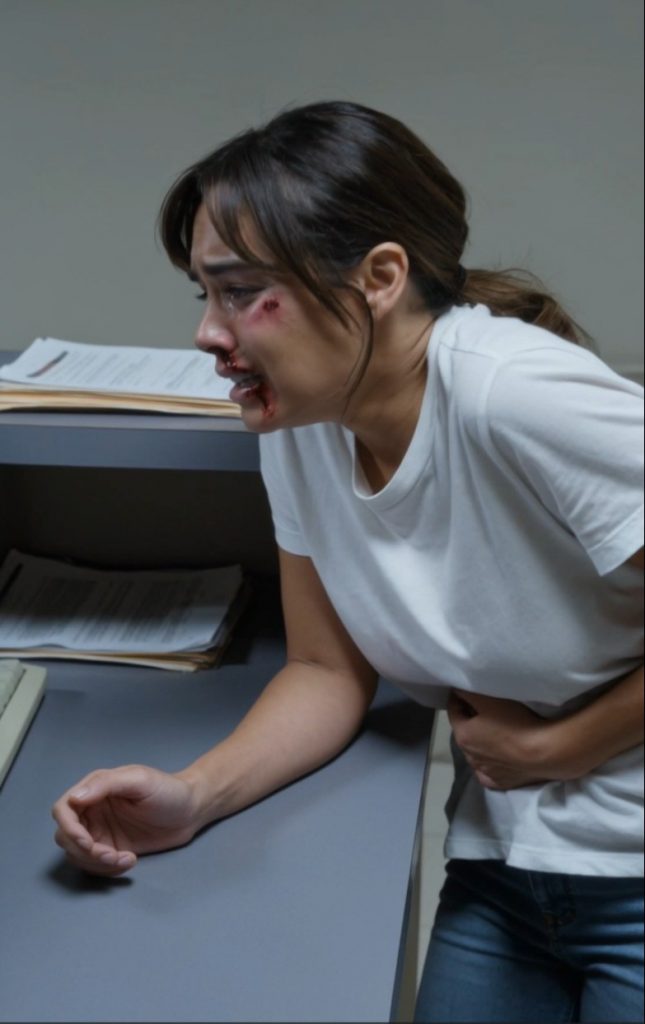
She wore a white T-shirt and jeans.
Both were stained enough to make the nurse behind the desk freeze.
The left side of her face was swollen and darkened. Her mouth trembled as she tried to breathe through the shock. One hand clutched her abdomen. The other rested weakly near the vintage beige keyboard, fingers shaking like she had forgotten what hands were supposed to do.
The nurse, Carla Simmons, had been typing.
Name.
Date of birth.
Insurance.
Emergency contact.
The old CRT monitor hummed beside her, greenish light flickering against her glasses. Procedure had carried her for the first few seconds, because emergency rooms trained people to turn chaos into forms.
Then the woman lifted her eyes.
Carla saw the fear first.
Not the injuries.
The fear.
The woman was not only hurt. She was afraid someone had followed her.
Carla’s fingers froze above the keys.
The clicking died.
The waiting room seemed to inhale.
“Who did this to you?” Carla asked.
The young woman opened her mouth, but nothing came out.
Her knees bent slightly.
Carla pushed back from the desk.
“Ma’am?”
Across the waiting area, a newspaper dropped to the floor with a sharp slap.
A large bald man rose from a chair near the far wall.
He wore a dark olive jacket over a gray shirt and jeans, shoulders broad enough to make the waiting room look smaller. His jaw tightened as his eyes locked on the injured woman at the desk.
For a second, everyone thought the same thing.
He knew her.
The woman heard the paper hit the floor.
She turned.
When she saw him, her face collapsed.
Not in fear.
In recognition so painful it looked like grief.
“Luke,” she whispered.
The man took one step forward.
Then another.
His heavy boots struck the tile with slow, controlled force.
Carla moved around the reception counter, already calling for a trauma nurse.
The bald man stopped five feet from the woman, fists clenched at his sides as if he were fighting himself harder than anyone else in the room.
His voice, when it came, was low and broken.
“Mara,” he said. “Who touched you?”
Mara tried to answer.
Instead, she fell.
And Luke caught her before she hit the floor.
Act II
Mara Bell used to call her brother when the world became too loud.
When she was nine and their father forgot to pick them up from school, Luke walked two miles in the rain with her backpack over one shoulder and his hand wrapped around hers. When she was thirteen and a group of girls locked her in a bathroom during a dance, Luke sat outside the door until she stopped crying. When she was seventeen and their mother died, Luke stood in the kitchen at dawn, making burned toast because neither of them knew what else to do.
He had always been big.
Not just in body.
In presence.
Luke Bell filled doorways, silenced rooms, and made dangerous people reconsider their plans. But with Mara, he had been gentle. He brushed snow off her coat. Fixed her bike. Put money in her glove compartment when she moved out and pretended not to.
Then she met Adrian Vale.
Adrian was everything Luke was not.
Smooth. Educated. Soft-spoken. A real estate attorney with clean nails and expensive patience. He remembered birthdays. He sent flowers. He knew how to make concern sound like love.
Luke disliked him immediately.
Mara hated that.
“You don’t trust anyone,” she told her brother.
“I trust people who don’t need to perform kindness,” Luke said.
That was the beginning of the distance.
Adrian never insulted Luke directly. He was smarter than that. He made little comments instead.
Your brother seems intense.
Does he always hover like that?
You know, Mara, some men use protection as control.
Slowly, Mara stopped calling as much.
Then she stopped visiting.
Then Luke’s calls went unanswered.
The last time they spoke, it ended badly. Luke had shown up at Mara’s apartment after a neighbor called him about shouting. Adrian opened the door in a pressed shirt and said Mara was resting. Luke pushed past him anyway.
Mara came out furious.
Embarrassed.
Afraid, though Luke did not understand that part until later.
“You can’t keep storming into my life like I’m still a child,” she said.
Luke pointed at Adrian.
“He is hurting you.”
Mara’s eyes filled.
“You don’t know anything.”
Adrian stood behind her, silent, one hand at the small of her back.
Luke saw that hand.
Saw how Mara went still under it.
But rage made him clumsy.
He shouted. Adrian called the police. Mara begged Luke to leave. He did, but not before saying the sentence he regretted for two years.
“When you’re ready to stop lying for him, you know where to find me.”
Mara’s face closed.
After that, nothing.
No calls.
No holidays.
No birthday messages except the ones Luke sent into silence.
He came to the emergency room that night for himself, though he would never have said it that way. Chest tightness. Dizziness. A nurse told him he was probably exhausted and needed to stop ignoring his blood pressure.
So he waited with a newspaper he was not reading.
Then Mara walked in.
And every day of silence between them fell apart on the hospital floor.
The doctors rushed her behind double doors. Carla took his name, his relationship, his phone number, his trembling statement. Luke answered like a man under oath.
“She’s my sister.”
“Does she have a spouse?”
“No.”
“Partner?”
His jaw hardened.
“Yes.”
“Name?”
“Adrian Vale.”
Carla stopped writing for half a second.
Luke saw it.
“You know him?”
Carla’s expression became carefully professional.
“I know the name.”
That was all she said.
But Luke understood enough.
Adrian was known here.
And whatever had happened to Mara, this was not the first shadow he had cast across a hospital.
Act III
Mara woke to white lights and Luke’s voice in the hallway.
Not shouting.
That surprised her.
Luke had always been a storm when afraid. He got loud because loud had worked when they were children. Loud made bullies run. Loud made landlords open doors. Loud made their father back away when he came home drunk and mean.
But now Luke’s voice was low.
Controlled.
“I’m not leaving unless she asks me to.”
Another voice answered, professional and firm.
“No one is asking you to leave, Mr. Bell. But we need her statement when she’s ready.”
Mara turned her head.
Pain moved through her in a dull wave. She closed her eyes until it passed.
Carla appeared beside the bed.
“Hey,” the nurse said softly. “You’re safe. You’re in the ER.”
Mara tried to speak.
Her throat felt dry.
Carla helped her sip water through a straw.
“Luke?” Mara whispered.
“He’s right outside.”
Mara’s eyes filled.
“Is he mad?”
Carla’s face softened in a way that almost made Mara cry harder.
“He’s scared.”
That was worse.
Mara looked toward the door.
“I didn’t want him to see me like this.”
“Honey,” Carla said, “someone should have seen sooner.”
Mara turned her face away.
There it was.
The shame.
It arrived before anger, before relief, before even fear. Shame sat on the edge of the hospital bed and whispered that she had stayed too long, lied too well, protected the wrong person, ignored every warning.
Carla seemed to know.
She did not say, Why didn’t you leave?
She did not say, How could you let this happen?
She said, “You don’t have to explain everything at once.”
Mara closed her eyes.
But the story came anyway, broken and quiet.
Adrian had lost control after finding the packed bag in the closet.
The bag had been small. Jeans. Medication. A charger. Her birth certificate. A photograph of her and Luke as children sitting on the hood of their mother’s old car.
She had planned to leave after Adrian went to court the next morning.
He came home early.
He found the bag.
Then he found the note.
Carla listened without interrupting.
The note had not been for Adrian.
It was for Luke.
I’m sorry. I’m scared. I think I need help.
Mara had written it three nights earlier and hidden it in her coat pocket, unable to send it, unable to throw it away.
Adrian read it aloud.
Then he laughed.
Not loudly.
That was what Mara remembered most.
He said, “Your brother? After all this time? You think that man is still waiting to rescue you?”
Mara had run when he went to lock the back door.
She made it to the street.
A woman in a passing car saw her stumble and drove her to the hospital without asking questions. Mara did not know her name. She remembered only the woman saying, “Stay awake, sweetheart. We’re close.”
Carla wrote that down too.
Then she asked gently, “Where is Adrian now?”
Mara’s body went cold.
Her eyes moved to the doorway.
“He knows I came here.”
“How?”
“My phone,” she whispered. “He tracks it.”
Carla’s face changed.
At that moment, Luke stepped into the room.
He had heard enough.
Mara looked at him and started crying.
“I’m sorry,” she said.
Luke crossed the room slowly, like approaching a frightened animal.
Then he sat beside the bed.
“No,” he said. “I am.”
Act IV
Adrian Vale arrived twenty-three minutes later.
He did not run.
Men like Adrian rarely ran when they wanted to appear innocent.
He walked into the ER wearing a navy coat over a white dress shirt, his hair neat, his expression drawn with practiced concern. He went straight to the reception counter.
“My fiancée is here,” he told Carla. “Mara Bell. She’s confused and injured. I need to see her.”
Carla looked at him through her glasses.
“Are you listed as her emergency contact?”
“I’m her partner.”
“That wasn’t my question.”
His smile tightened.
Behind Carla, the security guard shifted closer.
Adrian lowered his voice.
“She has a history of emotional instability. I’m sure she told some dramatic story, but she fell during an argument and panicked.”
Carla did not blink.
“You can have a seat.”
“I need to see her.”
“No.”
The word was clean.
Adrian’s mask slipped by a fraction.
Then Luke stepped out from the hallway.
The waiting room changed instantly.
Adrian saw him and stopped.
For one second, the smooth attorney vanished, and the man underneath looked genuinely afraid.
Luke did not move toward him.
That was the miracle.
Every part of his body wanted to. Mara knew that from the bed behind him. She knew the weight of Luke’s anger, the old protective violence in his shoulders, the way his hands closed when someone he loved was threatened.
But he stayed by the doorway.
Because this time, protection could not mean giving Adrian a new way to call him dangerous.
Adrian recovered first.
“Luke,” he said. “Of course. This explains the performance.”
Luke’s voice was flat.
“She doesn’t want to see you.”
“You don’t speak for her.”
“No,” Luke said. “That’s the difference between us.”
The security guard stepped between them.
Carla picked up the phone and called the hospital administrator, then the police officer assigned to the ER, then a domestic violence advocate on call.
Adrian watched each call with growing irritation.
“You people are making a legal mistake.”
Carla replied without looking up.
“We document those.”
The officer arrived before Adrian could push farther. So did the advocate, a calm woman named Elise who entered Mara’s room and asked one question first.
“Do you feel safe with him here?”
Mara stared at her hands.
For years, the answer had been too complicated to speak.
Not because she did not know.
Because speaking made it real.
Luke stood near the wall, silent.
Carla stayed by the door.
No one answered for her.
Mara lifted her head.
“No.”
The word shook.
But it stood.
Elise nodded.
“That’s enough for now.”
The next hour unfolded with terrible clarity.
Mara gave a statement. The hospital photographed her injuries for medical documentation. Her packed bag, recovered later from Adrian’s apartment, held the hidden note to Luke. The woman who drove Mara to the ER came forward after seeing police outside the hospital and gave her account.
Then came the larger reveal.
Carla had recognized Adrian’s name because another woman had come to the same emergency room eighteen months earlier. Different injuries. Same explanation from Adrian when he arrived afterward.
She fell.
She panicked.
She’s unstable.
That woman had left before making a report.
But Carla remembered.
Nurses remember.
The officer did too, once he searched the name.
Complaints had been filed and withdrawn. A restraining order had been requested and canceled. A former client from Adrian’s firm had reported intimidation and then refused to testify.
Adrian Vale was not a man losing control for the first time.
He was a man whose control was finally being recorded by people who would not be charmed out of writing it down.
When the officer told him he needed to remain available for questioning, Adrian looked past him toward Mara’s room.
His eyes met hers through the narrow gap in the door.
For the first time, Mara did not look away.
Act V
Luke stayed in the hospital chair all night.
Not beside the bed at first.
Mara asked for space, and he gave it.
That might have been the first proof that things could be different. He did not hover. Did not demand details. Did not curse Adrian’s name until the room shook. He sat near the window with his elbows on his knees and waited for Mara to decide when she wanted him closer.
Just before dawn, she whispered, “Luke?”
He stood immediately.
“Yeah?”
“Can you sit here?”
He moved to the chair beside her bed.
She looked smaller than he remembered, though she was thirty-two years old and had survived more than he knew how to hold in his head.
“I thought you hated me,” she said.
Luke’s face broke.
“Never.”
“I stopped calling.”
“I know.”
“I said terrible things.”
“You were trying to survive.”
Mara closed her eyes.
The tears slid into her hair.
“I believed him when he said you’d given up.”
Luke leaned forward, hands clasped tight.
“I was angry. I was hurt. I was stupid. But I never gave up.”
She opened her eyes.
“He said no one would come.”
Luke looked toward the waiting room where the newspaper still lay folded under a chair.
“I was already here.”
It was the first time Mara laughed.
It hurt, so she stopped quickly, but the sound still changed the room.
By morning, temporary protection was in place. Elise arranged a safe address. Carla brought Mara clothes from a donation closet and pretended not to notice when Mara cried over the simple dignity of clean sleeves. The officer took Luke’s statement and reminded him twice not to confront Adrian.
Luke listened.
That mattered.
Outside the hospital, Adrian’s influence began to shrink.
Not all at once.
Men like him built their power carefully, and careful things take time to dismantle. But the hospital record gave the case weight. Mara’s statement gave it direction. The other woman, contacted through an advocate, finally agreed to speak after learning she was not the only one.
Adrian’s firm suspended him pending investigation.
His polished public image cracked.
Then split.
Then became what it always had been beneath the shine.
A cover.
Mara moved into a secure apartment arranged through the advocacy center. Luke helped carry boxes but never opened drawers. He asked before touching anything that belonged to her. He learned, slowly and awkwardly, that being protective was not the same thing as taking over.
Mara learned too.
She learned to answer unknown numbers without shaking. Learned to sleep with a lamp off. Learned that missing someone who hurt you did not mean you wanted to go back. Learned that shame was loudest when it was losing.
Some days she felt free.
Some days she felt foolish.
Elise told her both were normal.
Carla checked on her twice after discharge, though she insisted it was unofficial. The first time, she brought soup. The second time, she brought the name of a therapist who specialized in trauma recovery.
“You don’t have to be brave all at once,” Carla said.
Mara held the card in both hands.
“I don’t feel brave.”
“Good,” Carla said. “That means you’re not performing it for anyone.”
Months later, Mara returned to the hospital.
Not as a patient.
She came through the same automatic doors wearing a blue sweater, her hair cut shorter now, her steps steady though her heart hammered the moment she saw the reception desk. The CRT monitor had finally been replaced. The beige keyboard was gone. The fluorescent lights were still too cold.
Carla looked up from the counter.
For a moment, neither woman spoke.
Then Carla came around the desk and hugged her.
Mara held on.
“I wanted to say thank you,” Mara whispered.
Carla pulled back, eyes wet behind her glasses.
“You walked in,” she said. “That was the hard part.”
Mara looked toward the waiting chairs.
Luke sat there again, this time not with a newspaper but with two coffees and a paper bag of muffins. He raised one hand in a small wave.
Mara smiled.
“He still worries.”
“He’s a brother,” Carla said. “That may be chronic.”
Mara laughed softly.
Then her expression turned serious.
“I used to think the worst part was what Adrian did,” she said. “But sometimes I think the worst part was how normal he made it sound.”
Carla nodded.
“That’s why we ask the question.”
“What question?”
Carla looked toward the counter where Mara had once leaned, barely standing.
“Who did this to you?”
Mara swallowed.
That question had broken the spell.
Not because it solved everything. Not because justice arrived in one clean moment. But because it named what Adrian had tried to blur. Someone did this. Something happened. Pain was not clumsiness. Fear was not instability. Survival was not drama.
A year later, Mara spoke at the hospital’s training session for new emergency staff.
Luke sat in the back row, arms folded, looking uncomfortable in a room full of nurses but proud enough to glow. Carla introduced Mara simply as “someone who wants you to understand why listening matters.”
Mara stood at the front with notes she barely used.
“When I came here,” she said, “I was sure I looked like a mistake. Like someone who had failed at leaving, failed at hiding, failed at being believed.”
The room stayed quiet.
“The nurse stopped typing,” Mara continued. “That was the first thing. She stopped treating me like paperwork and looked at me like a person. Then she asked who hurt me. Not what happened. Not why I was upset. Who.”
Carla looked down.
Mara’s voice strengthened.
“That question gave me back the truth.”
She glanced at Luke.
“And my brother dropping a newspaper so loudly it scared half the ER probably helped too.”
The room laughed gently.
Luke covered his face with one hand.
Mara smiled.
The smile did not erase what happened. Nothing did. But it belonged to her now, and that mattered.
Afterward, Luke walked her to the parking lot.
The evening air was cool. Ambulance lights flashed silently near the bay. Somewhere behind them, the emergency room doors opened and closed for someone else at the beginning of a terrible night.
Luke handed Mara her keys.
“You okay?”
She looked at the hospital entrance.
Then at him.
“I think I am.”
He nodded.
For once, he did not ask twice.
Mara got into her car, started the engine, and waited until Luke stepped back.
Before driving away, she looked once more at the bright hospital doors.
The night she arrived there, she thought her life had narrowed to one counter, one nurse, one question, and one man rising from a waiting-room chair.
She had been wrong.
That was only the doorway.
The nurse’s question opened it.
Her brother’s restraint kept it open.
And Mara walked through on her own.