Act I
The little hand came out from beneath the tablecloth and grabbed Denise Holloway’s ankle.
She almost dropped the tray.
Two wineglasses rattled against each other, catching the warm amber light from the chandeliers above. Around her, the dining room of Maison Verre continued as if nothing had happened. Forks touched porcelain. Patrons murmured over white linen. A sommelier laughed quietly near the wall of wine racks.
But Denise stopped moving.
Because the hand gripping her leg was small.
Too small to belong under a table in a restaurant where dinner reservations cost more than some families spent on groceries for a week.
Denise looked down.
The long white tablecloth at Table 12 shifted.
A faint breath came from underneath it.
Denise lowered the tray to the nearest service stand and bent slowly, blocking the view with her body. She lifted the edge of the linen just enough to see into the shadowed space beneath the table.
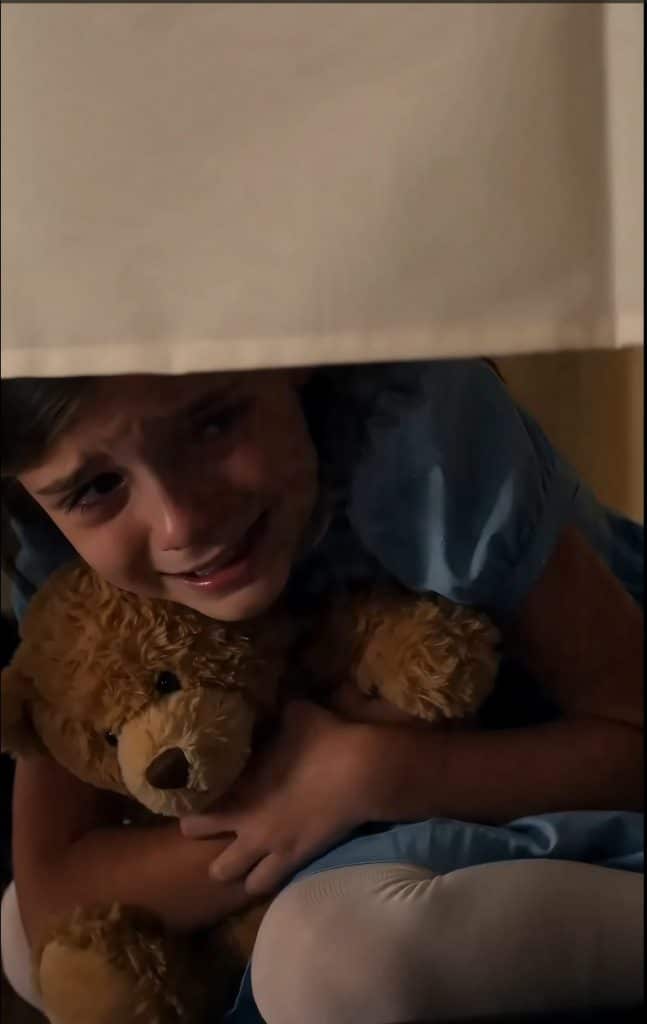
A little girl stared back at her.
Brown hair. Blue dress. White tights. Tear-streaked cheeks.
She clutched a brown teddy bear so tightly its worn ear bent under her fingers.
“Please help me,” the girl whispered.
Denise’s heart changed rhythm.
Not stopped.
Changed.
Into something older, sharper, and ready.
She crouched lower, keeping her voice gentle.
“Are you hiding from someone?”
The child nodded so quickly her hair fell across her face.
“Who?”
The girl’s eyes moved past Denise toward the dining room.
“The woman in black.”
Denise did not turn her head.
She did not need to.
She felt the woman arrive before she saw her.
The air behind her cooled. Conversation nearby thinned. A shadow fell across the white tablecloth.
When Denise stood, the woman was already there.
Tall. Pale. Long black hair. Black coat. Black gloves. Dark makeup shaped into a face that had learned how to frighten people without raising her voice.
She smiled at Denise.
“I believe you found my daughter.”
Beneath the table, the child made a tiny broken sound.
Denise stepped fully in front of the table opening.
The woman’s eyes narrowed.
Denise held her ground.
“I found a terrified child.”
The woman’s smile did not move.
“We were just playing. We’re leaving now.”
“No,” Denise said.
The dining room seemed to hear that word.
A man at the next table stopped cutting his steak. A woman with pearls lowered her glass. Somewhere behind the wine racks, a waiter froze with a corkscrew in his hand.
The woman in black tilted her head.
“Excuse me?”
Denise reached behind her apron without looking away and pressed the emergency button clipped inside the waistband, the one management gave staff for unruly guests and medical incidents.
Then she said the words that changed the entire evening.
“Not until the police get here.”
The woman leaned forward, her perfect calm cracking at the edges.
“You’re done.”
Denise did not step back.
And under Table 12, the girl held her teddy bear against her mouth to stop herself from screaming.
Act II
Denise Holloway had been a waitress for seventeen years.
That was what people saw.
The black-and-white uniform. The white apron. The tray balanced on one hand. The polite smile that appeared on command no matter how badly her feet hurt or how rudely someone snapped for more water.
But Denise had been other things before Maison Verre.
A mother.
A night-shift nurse’s aide.
A woman who once spent six months volunteering at a children’s crisis shelter because she could not save her own sister from the man she had married, and grief needed somewhere to go.
At the shelter, Denise learned the difference between a child misbehaving and a child surviving.
Children hiding for fun giggled.
Children hiding from danger listened.
They listened to footsteps. To changes in tone. To the weight of silence.
The little girl under Table 12 had not crawled beneath the linen because she was playing.
She had hidden like she knew what happened when adults found her.
That was enough for Denise.
The restaurant manager, Julian, hurried toward her from the host stand with panic already tightening his face. He was young, ambitious, and terrified of bad reviews. Maison Verre had a reputation built on discretion. Celebrities came there because nobody took photos. Politicians came there because nobody repeated conversations.
Children hiding under tables did not fit the brand.
“Denise,” Julian whispered, “what is going on?”
The woman in black answered before Denise could.
“This employee is preventing me from retrieving my daughter.”
Denise kept her body between the woman and the table.
“She hasn’t told me her name.”
The woman’s smile sharpened.
“Because she is frightened. Obviously.”
“Of you.”
A low murmur moved through nearby tables.
The woman looked at Julian. “I want her fired immediately.”
Julian hesitated.
Denise saw the conflict in his eyes. Not because he doubted the danger, but because the woman in black knew how to stand like money. In rooms like that, expensive clothes often spoke before truth did.
Then the teddy bear fell halfway out from under the tablecloth.
A small brown bear, worn at the paws, with a red ribbon around its neck.
Denise glanced down.
There was a stitched name on the ribbon.
MILA.
The woman in black saw it too.
Her eyes flickered.
Just once.
Denise noticed.
“What’s your daughter’s name?” she asked.
The woman’s face barely changed.
“Amelia.”
Under the table, the child whispered, “No.”
It was so quiet most people missed it.
Denise did not.
She bent slightly, still blocking the opening.
“Sweetheart, is your name Amelia?”
A pause.
Then the girl whispered, “Mila.”
The restaurant seemed to contract around them.
The woman laughed softly.
“She uses nicknames. Children do that.”
Denise straightened.
“Then you won’t mind waiting.”
The woman’s gloved hand tightened around the strap of her black handbag.
Julian took a step back and spoke into his headset.
“Security to the main dining room.”
The woman’s eyes flashed toward him.
That was when Denise knew she had been right.
Real mothers in panic beg people to help.
This woman wanted witnesses removed.
Act III
The police arrived seven minutes later.
Seven minutes can be a lifetime when a child is hiding beneath a restaurant table and a dangerous adult is standing three feet away pretending to be calm.
Denise spent every second talking softly over her shoulder.
“You’re doing good, Mila.”
The child did not answer.
“That bear got a name?”
A tiny sniffle.
“Button.”
Denise nodded like that was the most important information in the room.
“Button is doing good too.”
The woman in black watched with open hatred now. The mask had not fallen completely, but the painted smile was gone. She stood stiffly beside the table while diners pretended not to stare and failed.
When two officers entered through the front, the woman changed instantly.
Her shoulders softened. Her eyes filled with fake distress. She pressed one gloved hand to her chest.
“Thank God,” she said. “My daughter is having an episode, and this waitress has made everything worse.”
Denise said nothing.
One officer, a tall woman named Ruiz, looked from the woman to Denise to the tablecloth.
“Ma’am, step away from the table.”
“I am her mother.”
“Step away from the table.”
The woman’s jaw tightened, but she moved back two steps.
Officer Ruiz crouched where Denise had crouched before.
“Hi there,” she said gently. “My name is Officer Elena. Are you hurt?”
Mila shook her head.
“Can you come out for me?”
The girl’s eyes darted toward the woman in black.
Denise spoke before anyone else could.
“She can come out behind me.”
Officer Ruiz understood immediately.
Denise knelt, lifted the tablecloth, and opened her arms just enough to create a shield from the dining room. Mila crawled out slowly, teddy bear first, then knees, then trembling shoulders.
She was younger than Denise first thought.
Maybe six.
Maybe seven.
Her blue dress was wrinkled. One white tight had a faint gray mark at the knee. Her little fingers locked around the bear’s neck as if it were the only witness she trusted.
The woman in black took one step forward.
Mila recoiled so sharply she nearly fell.
Officer Ruiz’s partner moved between them.
“No closer.”
The woman’s voice went cold.
“This is outrageous.”
Officer Ruiz looked down at Mila.
“Is this your mother?”
Mila shook her head.
The woman snapped, “She’s confused.”
Denise felt the child press against her apron.
Officer Ruiz asked, “What is her name?”
The woman answered too quickly.
“Amelia Rose Blackwell.”
Mila whispered, “Mila Grace Hart.”
The officer’s expression changed.
Not dramatically.
Professionally.
That was worse for the woman in black.
Ruiz stood and radioed in the name.
Within seconds, the air around the officers shifted.
They had heard something back.
The partner looked at the woman in black.
“Ma’am, what is your name?”
“Vivian Blackwell.”
The officer’s hand moved closer to his radio.
“Do you have identification proving custody of this child?”
Vivian smiled again, but the smile was thinner now.
“My attorney has all necessary documentation.”
“That wasn’t my question.”
Mila tugged Denise’s apron.
Denise bent.
The girl lifted the teddy bear and turned it around.
There was a zipper in the back.
Inside, folded tightly into the stuffing, was a small laminated card.
Denise took it carefully and handed it to Officer Ruiz.
The officer read it.
Her face went still.
On the card was Mila’s photo, her full name, and two words printed in bold red letters.
Amber Alert.
Vivian Blackwell stopped smiling.
Act IV
The restaurant doors were locked from the inside.
Not loudly. Not theatrically.
Just a quiet instruction from Officer Ruiz to Julian, followed by the click of the main entrance bolt and a ripple of fear across the dining room.
Vivian saw it.
Her calm finally cracked.
“You have no authority to detain me.”
Officer Ruiz looked at her. “Actually, I do.”
Mila clung to Denise’s hand.
The officer knelt again, lowering her voice.
“Mila, can you tell me where your parents are?”
The child’s mouth trembled.
“My dad was at the hotel. She said he was sick.”
Vivian cut in. “Do not interrogate her without counsel.”
Officer Ruiz stood.
“Quiet.”
That one word landed with more force than shouting.
Denise felt Mila shaking and lowered herself beside the child.
“You don’t have to say anything you’re not ready to say.”
Mila looked at the teddy bear.
“Daddy put the card in Button,” she whispered. “He said if I got scared, show a helper.”
Denise closed her eyes for half a second.
A father had prepared for this.
That meant the danger had not begun in the restaurant.
It had only arrived there.
More officers came. Then a detective in a gray coat. Then a hotel security manager from three blocks away, breathless and pale, carrying a tablet with surveillance footage.
The footage told enough.
Vivian Blackwell entering a luxury hotel lobby with Mila and her father, a real estate developer named Aaron Hart. Vivian was not Mila’s mother. She was Aaron’s former business partner and ex-fiancée, a woman currently fighting a civil case over money she claimed he owed her.
The footage showed Aaron arguing with Vivian near the elevators.
Then Mila being led away.
Then Aaron searching the lobby minutes later with visible panic.
By the time he alerted hotel security, Vivian had already taken Mila through the service exit and into the city crowd.
Mila had escaped inside Maison Verre when Vivian stopped to make a call near the host stand.
She ran to the first hiding place she saw.
Table 12.
Denise listened as the detective quietly explained this to Officer Ruiz.
Not every word.
Enough.
Vivian had not been playing.
She had been cornered.
And when cornered people with money lose control, they often reach for the oldest weapon they have.
Threats.
Vivian turned toward Denise.
“You have no idea what you’ve done.”
Denise looked at her evenly.
“I helped a child.”
“You cost me everything.”
“No,” Denise said. “You brought everything with you.”
Vivian’s face twisted.
For one second, she lunged—not far, not enough to reach Mila, but enough that the officers moved instantly. Her wrist was caught. Her handbag fell. Her black gloves flashed under the restaurant lights as she fought the grip and lost.
Mila buried her face in Denise’s apron.
Denise wrapped both arms around her without thinking.
“You’re safe,” she whispered. “She can’t take you now.”
Vivian was led out past the wine racks, past the white linens, past the patrons who had finally stopped pretending this was not their business.
As she passed Denise, she hissed one final line.
“You’re just a waitress.”
Denise held Mila closer.
“That was enough.”
The dining room heard it.
This time, no one looked away.
Act V
Aaron Hart arrived twelve minutes later.
He came through the restaurant doors with two officers beside him, tie loosened, face gray with panic. The moment Mila saw him, she broke free from Denise and ran.
“Daddy!”
Aaron dropped to his knees before she reached him.
He caught her with a sound that was not quite a sob and not quite a prayer. Mila wrapped her arms around his neck, teddy bear crushed between them, and clung to him so tightly Denise had to turn away.
Some reunions were too private for a public room.
Even when they happened in the middle of one.
Aaron held Mila for a long time.
No one rushed him.
Not the officers. Not Julian. Not the diners whose meals had gone cold. Not Denise, who stood beside Table 12 with her hands folded in front of her apron so no one would see them shaking.
Finally, Aaron looked up.
“Who found her?”
Mila pointed.
“The lady.”
Aaron rose slowly, still holding his daughter. He approached Denise with tears in his eyes.
“Thank you,” he said.
Denise nodded once.
But Aaron shook his head.
“No. I need you to hear me. Thank you for not handing her over.”
That was when Denise almost cried.
Because that was the truth of it.
Finding Mila mattered.
But refusing to surrender her mattered more.
The restaurant gave refunds that night, though most patrons did not ask for them. Some stayed long after police cleared the scene, speaking in hushed voices, leaving tips large enough to embarrass the staff. A woman from Table 9 pressed Denise’s hand and whispered, “I should have stood up sooner.”
Denise did not know how to answer.
So she said, “Next time.”
The words followed the woman out.
Maybe that was enough.
Vivian Blackwell was charged. The case moved quickly because money could not erase cameras, witnesses, an alert card hidden in a teddy bear, and a child’s own fear. Her attorneys tried to frame it as a custody misunderstanding, but custody misunderstandings do not involve service exits, false names, and threats to waitresses in public dining rooms.
Mila testified only through protected channels.
Aaron made sure of that.
The story made the news, but Denise avoided interviews at first. She did not want to become a slogan. She did not want people calling her a hero while still treating service workers like furniture the next time they ate out.
Then Mila sent her a drawing.
It showed a restaurant table with a long white cloth, a teddy bear, and a woman in an apron standing like a wall. Above the woman, Mila had written in purple marker:
Miss Denise was the door.
Denise read it three times before sitting down.
A week later, she agreed to one interview.
The reporter asked why she had refused Vivian’s claim.
Denise looked into the camera.
“Because frightened children don’t owe adults the benefit of the doubt,” she said. “Adults owe children protection first. Questions can come after.”
That sentence traveled farther than the story itself.
It appeared in staff training videos. School newsletters. Safety seminars. Parent groups. A framed copy eventually hung in the employee hall at Maison Verre, though Denise pretended not to notice it.
Life returned to normal, mostly.
The wine racks glowed. Glasses clinked. Patrons murmured under amber light. Denise carried trays between tables, refilled water, remembered allergies, and corrected men who called her “sweetheart” with the calm deadliness of a woman who had once stared down worse.
But Table 12 changed.
Julian stopped seating families there for a while. Not because it was cursed, but because staff kept looking at the tablecloth and remembering a small hand reaching out from underneath.
Eventually, Aaron and Mila came back.
Not for dinner.
Just dessert.
Mila wore a yellow dress that time. Button the bear sat in the chair beside her with a napkin tucked around its neck. Aaron asked for Denise specifically, and when she came to the table, Mila smiled shyly.
“I’m not under it today,” she said.
Denise laughed softly.
“No, ma’am. I see that.”
Mila looked at the tablecloth.
“I still don’t like long ones.”
“Then we’ll fold it up.”
Denise did exactly that.
She tucked the linen higher so Mila could see every corner beneath the table. No shadows. No hiding place. No fear.
Aaron watched with gratitude he no longer had words for.
Before leaving, Mila handed Denise something small.
A red ribbon.
Button’s old ribbon, the one with her name stitched on it.
“I got him a new one,” Mila said. “You can keep this.”
Denise took it carefully.
“Thank you, baby.”
Mila hugged her waist.
It was quick, fierce, and gone before Denise could prepare herself.
After they left, Denise stood in the service hallway holding the ribbon in her palm.
Julian walked by, saw her face, and wisely said nothing.
Denise kept the ribbon in her apron pocket after that.
Not as a trophy.
As a reminder.
That danger does not always announce itself with shouting. Sometimes it wears gloves, smiles politely, and says my daughter in a voice smooth enough to fool a room full of people who do not want trouble with dinner.
And rescue does not always look dramatic.
Sometimes it is a waitress lowering a tray.
Lifting a tablecloth.
Listening when a trembling child whispers the truth.
Then standing in front of the whole world and saying no.