Act I
The broom struck the dog before Emily Hart understood the truth.
Rain poured across the backyard in hard silver lines, flattening the grass and filling the low places with muddy water. The white porch behind her was slick beneath her bare feet, but she did not feel the cold. She did not feel the rain. She barely felt the broom handle biting into her palms.
All she saw was her son on the ground.
Three-year-old Noah lay in the wet grass near the back fence, blue shirt soaked, black rain boots kicking as he cried. Standing over him was Ranger, the family’s German Shepherd mix, his wet coat dark against the storm.
He was growling.
Low.
Steady.
To Emily, it sounded like a threat.
“Get off, you vicious mutt!”
She ran from the porch with the broom raised. Her heart had already decided the story before her eyes could finish reading it. Big dog. Small child. Growl. Rain. Panic.
Ranger turned his head toward her.
He did not run.
He did not bare his teeth at Noah.
He stayed planted between the toddler and the far side of the yard, body tense, paws sunk into the mud, eyes locked on something Emily could not see.
Emily swung anyway.
The broom hit Ranger across the back with a dull crack.
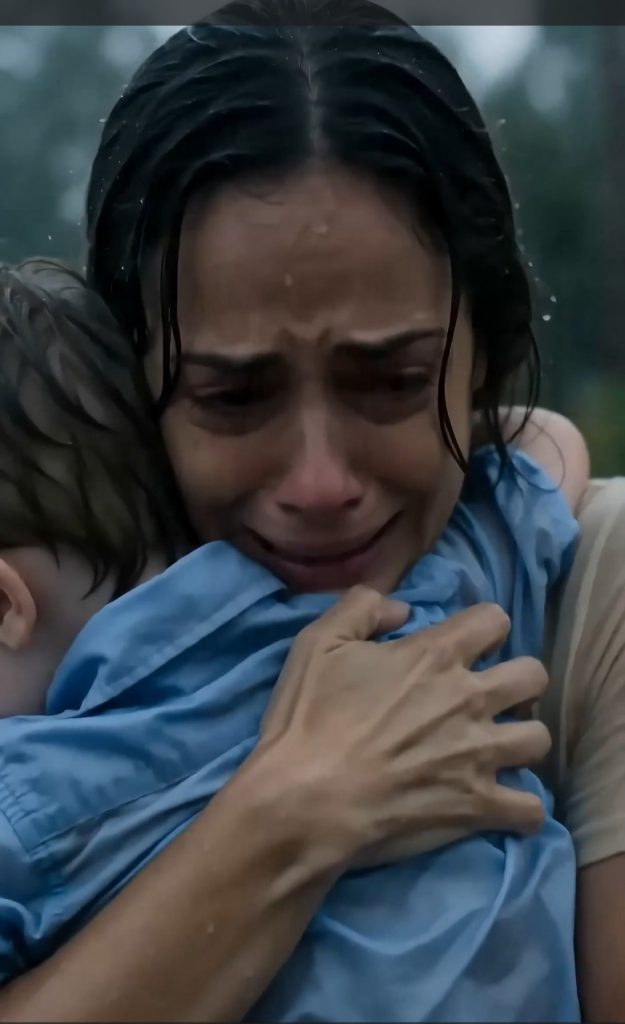
The dog flinched and gave one startled whine, backing away from Noah. Emily dropped to her knees, scooped her son into her arms, and pressed his trembling body against her chest.
“I’ve got you,” she gasped. “I’ve got you, baby.”
Noah sobbed into her shoulder.
Ranger stood several feet away, rain streaming from his ears, staring past them.
Emily clutched Noah tighter and looked at the dog with shaking fury.
Then she heard it.
Not thunder.
Not rain.
A sharp electrical crackle.
Her eyes dropped to the ground.
A black wire lay in the wet grass near the puddle where Noah had been crawling seconds earlier. It snapped and sparked against the water, sending tiny flashes through the muddy edge of the lawn.
Emily stopped breathing.
The broom slipped from her hand.
“Oh God,” she whispered.
Ranger had not been attacking Noah.
He had been keeping him from the puddle.
And Emily had struck the only thing standing between her child and death.
Act II
Ranger had been in the Hart family long before Noah could say his name.
He arrived on a winter afternoon four years earlier, limping up the gravel road during a power outage, ribs showing under muddy fur and one ear bent from an old injury. Emily’s husband, Lucas, found him near the mailbox and spent half an hour coaxing him with leftover chicken while Emily stood on the porch insisting they could not keep a stray dog.
By nightfall, Ranger was asleep on an old towel in the laundry room.
By morning, Lucas was calling him “buddy.”
By the end of the week, Emily had bought him a blue collar.
Lucas said Ranger was not a pet.
“He’s a guardian,” he told her. “Look at him. He knows things.”
Emily laughed then.
That was before the accident.
Before Lucas was gone.
Before the house became too quiet and every sound in the yard made Emily turn her head, expecting boots on the porch that would never come.
After Lucas died, Ranger changed.
He stopped sleeping in the laundry room and began sleeping outside Noah’s door. He followed the boy everywhere, from the kitchen to the porch steps to the edge of the garden. If Noah toddled too close to the gravel driveway, Ranger blocked him with his body. If a delivery truck came up the road, Ranger stood between it and the porch until Emily told him it was all right.
At first, Emily was grateful.
Then she got tired.
Grief had made everything sharp. The bills. The silence. The leaking roof Lucas had promised to fix in spring. The way Noah asked for Daddy at bedtime and then cried himself to sleep holding one of Lucas’s old flannel shirts.
Ranger’s protectiveness became one more thing to manage.
He barked too much.
He shed everywhere.
He growled at the neighbor’s teenage son when the boy ran toward Noah too quickly.
Emily began wondering if the dog was becoming unsafe.
Her mother said it gently over the phone.
“Sweetheart, maybe he’s too much for you right now.”
Emily hated that she had already thought the same thing.
That morning, the storm came in fast.
The rain started before breakfast, tapping softly at first, then hammering the roof by noon. Wind pushed against the windows. The lights flickered twice. Emily checked the weather alert on her phone and saw warnings about downed trees and power interruptions across the county.
She meant to keep Noah inside.
She really did.
But the dryer buzzed. The phone rang. A pot boiled over. For one minute, maybe less, the back door did not latch all the way.
Noah saw puddles.
Noah loved puddles.
By the time Emily realized the house had gone too quiet, Ranger was already barking from the yard.
Not normal barking.
Not the deep warning bark he used for trucks.
This was raw. Urgent. Terrified.
Emily ran to the porch and saw every nightmare at once.
Noah in the grass.
Ranger over him.
A growl in the rain.
And because fear is faster than understanding, she grabbed the nearest thing beside the porch door.
A broom.
She did not see the downed wire.
Ranger did.
Act III
The wire snapped again, spitting white sparks into the puddle.
Emily stumbled backward with Noah in her arms.
Rainwater streamed down her face, but the cold suddenly reached her. She looked at the place where her son’s rain boot had been moments earlier, then at the burned edge of grass around the puddle.
Her knees weakened.
“He saved you,” she whispered against Noah’s wet hair. “He saved you, baby.”
Noah cried harder, too young to understand the sentence but old enough to feel his mother shaking.
Ranger turned away.
That movement broke her heart.
He did not come to her for praise. He did not wag. He did not bark as if demanding she finally understand.
He simply lowered his head and walked toward the fence.
Slowly.
Unevenly.
Emily saw the slight dip in his back where the broom had landed. Saw his wet fur twitch with each step. Saw the small dark mark spreading through the rain on his coat, not severe, but enough to show she had hurt him.
“Ranger,” she called.
The dog did not stop.
Her voice cracked. “Ranger, please.”
He reached the fence near the road and lowered himself into the wet grass. Beyond him, the train tracks ran gray and silent through the rain. The storm had knocked a branch across the utility line near the old pole, and the wire had dropped into the yard sometime while Emily was inside making lunch.
Noah had walked straight toward it.
Ranger had reached him first.
Emily backed away from the puddle, still holding Noah, and fumbled for her phone with one hand. Her fingers were slick. She almost dropped it twice.
When the dispatcher answered, Emily’s voice came out in pieces.
“There’s a downed power line in my backyard. My toddler was near it. My dog pulled him away. Please, I need help.”
The dispatcher’s tone became firm and calm.
“Do not approach the wire. Stay away from all standing water. Are you and the child safe?”
Emily looked at Ranger lying near the fence.
“My son is. My dog is hurt.”
“Ma’am, emergency services are on the way. Do not touch the dog if he is near the wire.”
“He’s not near it,” Emily said quickly. “He’s by the fence.”
But she still hesitated.
That hesitation cut her.
Minutes ago, she had run at him with a broom.
Now she was afraid to run to him too late.
The sirens were still far away when Noah lifted his head from her shoulder and looked at Ranger.
“Doggy,” he sobbed.
Emily kissed his forehead.
“Yes,” she whispered. “Our doggy.”
Then Ranger let out a soft, tired breath and lowered his head onto the wet grass.
Emily knew she could not undo the blow.
But she could still choose what came next.
Act IV
The firefighters arrived first.
They came through the side gate in rain gear, boots sinking into the muddy lawn, voices loud and controlled over the storm. One moved Emily and Noah to the porch. Another marked the danger area with cones and shouted for everyone to keep back until the power company confirmed the line was dead.
A paramedic checked Noah on the porch steps.
“He looks shaken, but I don’t see signs of injury,” the woman said.
Emily almost collapsed with relief.
Then she looked toward the fence.
“What about Ranger?”
A firefighter crouched near the dog, careful and gentle. Ranger lifted his eyes but did not move.
“He’s conscious,” the firefighter called. “Looks like he took a hit to the back. Maybe bruising, maybe a cut. We’ll need a vet.”
Emily flinched.
A hit.
Not from the storm.
From her.
“I did that,” she said.
The paramedic glanced at her.
“I thought he was attacking my son.”
No one answered right away.
That silence was not judgment.
It was worse.
It allowed her own guilt to speak clearly.
Emily pressed Noah closer as tears mixed with rain on her face. “He was saving him, and I hit him.”
The paramedic’s voice softened. “You were afraid.”
“That doesn’t fix it.”
“No,” the woman said. “But it explains why you’re standing here holding your child.”
Emily looked at Ranger.
The dog had not taken his eyes off Noah.
Even hurt, even soaked, even after the broom, he was still watching the boy.
The power company arrived twenty minutes later. To Emily, it felt like hours. They shut off the line, secured the yard, and confirmed what everyone already knew: if Noah had crawled into that puddle, the storm would have ended very differently.
One of the utility workers looked at Ranger and shook his head.
“Dog knew.”
Emily swallowed.
“Yes.”
The vet came in a pickup truck with a portable kit because the roads were flooding too badly for Emily to drive safely. Dr. Lin was practical and kind, the type of woman who spoke to animals as if they were elderly relatives.
She examined Ranger under the porch awning while Emily stood nearby with Noah on her hip.
Ranger did not resist.
He only sighed when Dr. Lin touched the sore place on his back.
Emily covered her mouth.
Dr. Lin cleaned the spot, checked his movement, and finally looked up.
“He’ll be sore. He’ll need rest. But I don’t think anything is broken.”
Emily let out a sound that was almost a sob.
“Can I touch him?”
The vet looked at Ranger, then at Emily.
“Slowly.”
Emily knelt in front of the dog.
For a moment, she could not speak.
Ranger’s eyes were tired and calm.
That made it worse.
“I’m sorry,” she whispered. “I’m so sorry.”
She reached out with trembling fingers and touched the side of his face.
Ranger blinked.
Then, gently, he pressed his wet muzzle into her palm.
Emily broke.
Not loudly.
Not dramatically.
She simply folded forward and cried into the fur of the dog she had nearly sent away, the dog who had just saved the life she could not survive losing.
Noah reached one small hand down.
“Good doggy,” he said.
Ranger’s tail moved once against the porch boards.
That was all.
One small thump.
Forgiveness, in its simplest form.
Act V
The storm passed before midnight.
By morning, the backyard looked innocent again.
The sky cleared to a pale blue. Sunlight touched the wet grass. Birds returned to the fence. The puddle near the downed wire had drained into a dark patch of mud, marked now by yellow utility tape and deep boot prints from the men who repaired the line.
Emily stood at the kitchen window holding a cup of coffee she had not tasted.
Ranger slept on a blanket in the living room, bandaged lightly, Noah curled beside him with one hand resting on the dog’s front paw.
She had tried to move Noah to the couch twice.
Both times, Ranger lifted his head.
Both times, Noah mumbled, “Stay.”
So Emily let them stay.
News traveled fast in rural places.
By noon, her neighbor Mrs. Bell had brought soup and shamefaced gossip.
“I saw the trucks,” she said. “Heard what happened.”
Emily braced herself.
Mrs. Bell looked into the living room at Ranger.
“That dog deserves a steak.”
Emily laughed through a throat still raw from crying.
“He deserves more than that.”
The story spread because stories like that always do. The local fire department mentioned the incident as a storm safety warning. The power company used it to remind families to stay away from downed wires. Someone called Ranger a hero in a comment online.
Emily hated the word at first.
Not because it was wrong.
Because every time someone said it, she remembered the broom.
But guilt, Dr. Lin told her during Ranger’s follow-up visit, is only useful if it becomes care.
So Emily made it care.
She built a new latch for the back door, higher than Noah could reach. She put emergency numbers on the fridge. She walked the yard every morning after storms. She apologized to Ranger every day, not because he needed the words, but because she needed to become the kind of person who remembered them.
And she stopped calling his protectiveness a problem.
When Ranger blocked Noah from running toward the road, Emily thanked him before correcting Noah. When he barked at the loose fence board, she checked it and found the nail had pulled free. When he growled at the old outlet on the porch during another rainstorm, she called an electrician instead of telling him to stop.
Sometimes he was wrong.
Often, he was simply a dog startled by thunder or raccoons.
But Emily had learned the cost of assuming she understood danger better than love did.
Two months later, the town held a small safety fair outside the volunteer fire station. Emily almost did not go, but Noah saw the fire trucks from the road and began shouting with joy from his car seat.
Ranger came too, moving slower but proud in a new blue collar.
The firefighters recognized him immediately.
“There he is,” one called. “The backyard hero.”
Ranger accepted a biscuit with quiet dignity.
Noah clapped.
Emily stood behind them, smiling until a firefighter handed her the broom.
Not the same one.
A child-sized toy broom from a safety display about household hazards.
“Figured this one can be for sweeping only,” he joked gently.
Emily stared at it.
For one second, the rain came back.
The crackle.
The cry.
The swing.
Then Ranger leaned against her leg.
Warm.
Alive.
Still there.
Emily took a breath and smiled.
“Only sweeping,” she said.
That evening, after the fair, she and Noah sat on the porch while Ranger lay at their feet. The repaired utility line stretched safely above the yard. The train moved in the distance, its low rumble soft under the pink evening sky.
Noah leaned against Emily’s side.
“Ranger saved me?”
Emily looked down at him.
He had asked before. He would ask again. Toddlers circle truth until it becomes part of the world they understand.
“Yes,” she said. “Ranger saved you.”
“Mommy mad?”
Emily closed her eyes for a moment.
“Mommy was scared.”
Noah thought about that.
Then he reached down and patted Ranger’s head.
“Ranger good.”
Emily smiled through sudden tears.
“Yes, baby. Ranger good.”
The dog sighed and closed his eyes.
The scar beneath his fur would fade. The yard would grow over. The muddy place near the fence would become grass again by summer.
But Emily knew she would always remember the sight of Ranger standing in the rain, refusing to move, letting himself be misunderstood because Noah had no time for explanations.
That was the part that stayed.
Not the danger.
Not the wire.
Not even the guilt.
The devotion.
Ranger had seen what Emily could not. He had put his body between a child and a hidden current. He had accepted the blow meant for a villain because saving Noah mattered more than being understood.
And sometimes, Emily learned, love does not arrive gently.
Sometimes it growls.
Sometimes it blocks your path.
Sometimes it looks, for one terrible second, like the thing you should fear.
But real love stays long enough for the truth to spark in the rain.
And when it does, you spend the rest of your life remembering the one who stood between your child and the danger you never saw.