Act I
The woman with the tattoos did not look up when the footsteps stopped beside her table.
That was the first thing everyone noticed.
In a prison cafeteria, attention was survival. You learned which voices meant trouble, which trays scraped too loudly, which sudden silences could turn a meal into a warning.
But Mara Venn kept eating.
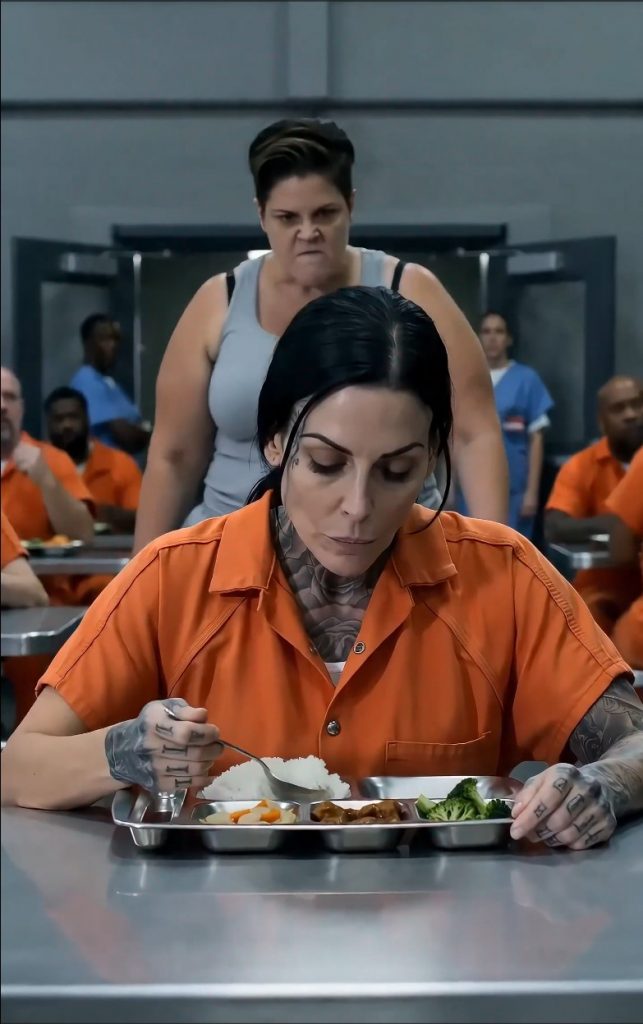
She sat alone at a bolted metal table under the cold fluorescent lights, orange jumpsuit sleeves rolled just enough to show the dark ink winding across her arms. More tattoos climbed her neck and disappeared beneath her collar, giving her the look of someone who had already lived through the worst rumors could invent.
Across the room, inmates stopped talking.
A large woman in gray sweatpants marked 24701 stepped into Mara’s space.
Her name was Deena Briggs, but nobody in Southgate Correctional called her that. They called her Brick because she came at people like one. Big shoulders. Short dark hair. A voice that carried across concrete.
She leaned over Mara’s tray.
“Give me your food,” she said. “Right now.”
Mara lifted her fork slowly.
Rice. Vegetables. No meat. Nothing worth a fight.
That was the point.
Brick did not want the food.
She wanted the room.
Mara chewed once, swallowed, and set the fork down with careful quiet.
Brick’s face darkened.
Nearby, an inmate whispered, “Don’t.”
Whether she meant Brick or Mara, nobody knew.
Prison staff in blue scrubs stood near the wall, watching with the bored stiffness of people who had decided not to see too much.
Brick smiled.
“You deaf?”
Mara looked at her tray.
Not at Brick.
Not at the staff.
At the tray.
Brick’s hand moved fast.
The metal tray flew off the table and hit the floor with a crash that split the cafeteria open. Rice scattered across the tile. Vegetables slid under the bench. A fork skittered until it struck someone’s shoe.
The whole room froze.
Brick pointed down.
“Get on your knees. Now.”
Mara did not move.
For three long seconds, the only sound was the fading ring of metal and the hum of fluorescent lights.
Then Mara raised her head.
Her eyes locked on Brick’s face.
No fear.
No rage.
No performance.
Just a cold, controlled stillness so complete that Brick’s smile faltered.
And somewhere near the wall, one of the prison workers in blue scrubs quietly reached for the radio.
Act II
Mara Venn had entered Southgate Correctional twelve days earlier.
By lunchtime on the first day, everyone had already decided what she was.
The tattoos did most of the work.
Ink on her fingers. Ink along her wrists. Ink curling up one side of her throat. Names. Dates. Small symbols. A black sparrow behind one ear. A line of numbers beneath her left collarbone.
The women at Intake assumed gang history.
The officers assumed violence.
The staff psychologist assumed trauma and wrote that down without asking which kind.
Mara let them assume.
She had learned years ago that people reveal more when they think they have already understood you.
In truth, every tattoo had a witness behind it.
A date from a court file.
A name from a closed case.
A sparrow for her brother, Jonah, who used to whistle outside her window when they were children because their mother worked nights and he did not want her waking scared.
Jonah was the reason Mara was in Southgate.
Not because he put her there.
Because he had once been there himself.
Southgate had housed men before a state reorganization turned it into a women’s facility, but the culture remained the same. Gray walls. Bad cameras. Missing reports. Guards who retired before investigations caught up with them.
Jonah Venn spent eleven months inside Southgate after taking a plea for a crime he did not commit because his public defender told him trial was a gamble poor people could not afford.
He wrote Mara letters every week.
At first, they were normal.
I’m fine.
Don’t worry Mom.
Food’s bad but I’ve had worse.
Then the handwriting changed.
Men are paying for protection with food.
The staff know.
There’s a woman here named Briggs who runs messages between blocks.
She wears gray, not orange.
Mara had stared at that line for a long time.
A woman named Briggs.
Years later, after the facility changed populations, Deena Briggs was still there. Not as staff. Not officially powerful. Just useful. She had survived every transfer, every investigation, every new warden, every reform memo pinned to a bulletin board for visitors to admire.
Jonah came home from Southgate quiet.
Too quiet.
He did not talk about what happened. He did not eat at tables with his back to doors. He flinched when trays fell in diners. Then one winter morning, he left a box of letters on Mara’s porch and disappeared from her life for eight years.
Not dead.
Not unreachable.
Just gone somewhere pain could not be questioned by family.
Mara became a prison-rights investigator because of him.
She learned how institutions hid cruelty behind paperwork. She learned how fear moved through cafeterias, laundry rooms, transport vans, medical lines. She learned that the person throwing the tray was rarely the highest person responsible.
The person throwing the tray was the hand.
Mara wanted the hand.
But more than that, she wanted who trained it.
Southgate had beaten three lawsuits, buried two internal complaints, and fired one nurse who tried to report food extortion. Every complaint named the same pattern.
A target.
A tray.
A demand.
A staff member watching from the wall.
Then retaliation in a room without cameras.
Mara did not get sent to Southgate by accident.
Her conviction was real, but incomplete. She had been charged after refusing to hand over notes from an investigation and shoving a private security officer who tried to take her camera outside a courthouse. The sentence should have been probation. Instead, a judge known for favors gave her thirty days.
Someone thought Southgate would scare her.
Mara thought Southgate had finally opened the door.
And on her twelfth day, Deena Briggs walked straight through it.
Act III
Brick expected pleading.
That was how the ritual worked.
The new woman would get embarrassed. She would look at the food on the floor, then at the watching room, then at the staff who would not help. She would understand the lesson.
Power belongs to whoever can humiliate you in public and make everyone pretend it is normal.
Then she would kneel.
Or she would fight.
Either answer gave Brick control.
Mara gave her neither.
She only looked up.
The cafeteria shifted around that stare.
An inmate at the next table stopped breathing through her mouth. A worker in blue scrubs lowered her serving spoon. Even the officers near the double doors seemed to feel the room balancing on a thin wire.
Brick leaned closer.
“You think tattoos make you tough?”
Mara’s voice, when it came, was quiet.
“No.”
Brick blinked, thrown by the simplicity.
Mara glanced at the number printed on Brick’s sweatpants.
Then she looked back into Brick’s eyes.
“You still use the tray test.”
Something flashed across Brick’s face.
Not fear yet.
Recognition.
She tried to cover it with a laugh.
“What did you say?”
Mara rested both hands flat on the table.
The tattoos across her fingers became visible.
One word on each knuckle.
SAY WHAT HAPPENED.
Brick read them.
So did half the table behind her.
Mara spoke again.
“My brother wrote about you.”
The cafeteria went colder.
Brick’s jaw tightened.
“You don’t know me.”
“Deena Briggs,” Mara said. “Southgate runner. Block C messenger. Cafeteria enforcer. Moved between units because staff said you were useful during disruptions.”
Brick’s eyes flicked, just once, toward the staff along the wall.
Mara saw it.
So did the woman in blue scrubs who had reached for the radio.
Her name was Carla Monroe.
She had worked at Southgate for nineteen years and had spent the last five pretending she did not know exactly why trays crashed in the cafeteria. She had two kids, a mortgage, and a husband on disability. That was the excuse she gave herself every time fear looked like practicality.
But Mara had spoken the name.
Deena Briggs.
And names make hiding harder.
Brick slammed both palms onto the table.
“Get up.”
Mara did not.
“You want me on my knees because that’s how they taught you to make women disappear without moving them.”
Brick’s face twisted.
“You better shut your mouth.”
Mara leaned forward a fraction.
“Make me.”
The room inhaled.
Brick lifted her hand.
Not far.
Not enough to strike yet.
Just enough to prove she could.
Before she brought it down, Carla Monroe shouted from the wall.
“Enough!”
Everyone turned.
Carla stood with her radio in one hand and her face pale beneath the fluorescent lights.
Brick stared at her like a dog hearing a chain snap.
Carla’s voice shook, but it held.
“Officer Reed, escort Briggs to holding.”
The officer by the door frowned.
“Monroe, stand down.”
Carla looked at him.
“No.”
That one word did what the tray crash had not.
It broke the room open.
Act IV
The official story tried to form quickly.
It always did.
Inmate disagreement.
Food-related disturbance.
No injuries.
Resolved by staff.
But the room had changed too much for that old language to fit.
Carla Monroe refused to sign the cafeteria report as written. She wrote a separate statement instead. Then another worker added her name. Then two inmates asked to speak to the new deputy warden, who had been in the job only three weeks and had not yet learned which silences Southgate expected him to inherit.
By evening, there were seven statements.
By morning, twelve.
By the end of the week, twenty-six women had described the same pattern.
Food taken.
Medication traded.
Phone time controlled.
Letters delayed.
Women forced to kneel or clean up food while staff looked away.
And in the middle of many stories was Deena Briggs.
But behind Briggs were staff names.
Officer Reed.
Counselor Pike.
Former Captain Mallory.
Men and women who never shoved trays themselves because they had people for that. People like Brick. Inmates granted privileges, protection, extra portions, and warnings before inspections.
Mara gave her statement on the second day.
She sat across from the investigator with her hands folded, tattoos visible.
“You provoked her,” the investigator said.
Mara almost smiled.
“No. I ate lunch.”
“You knew she might confront you.”
“Yes.”
“Why not report your concerns before?”
Mara looked through the reinforced glass toward the corridor.
“Because reports vanish here. Cafeterias don’t.”
The investigator had no answer for that.
Then Mara opened the folder her attorney had fought to deliver. Inside were copies of Jonah’s letters, old grievances, nurse Monroe’s unsigned draft complaints, and a photo of Jonah taken before Southgate.
Smiling.
Young.
Still trusting rooms.
Carla Monroe cried when she saw that photo.
“I remember him,” she said.
Mara looked at her.
Carla covered her mouth.
“I’m sorry.”
Mara’s face did not soften.
Not yet.
“Sorry is a door,” she said. “Walk through it.”
So Carla did.
She testified.
She named staff.
She described the tray test from the beginning, how it started as a way for inmate enforcers to mark who could be pressured and became a system everyone understood without needing it written down.
Brick tried to deny everything.
Then video from the cafeteria surfaced.
Not the old official camera, which conveniently blurred the corner where most incidents happened. A maintenance camera had been installed above a ceiling panel during recent electrical work and left running while technicians tested angles.
It had captured the tray.
The demand.
The staff watching.
Brick’s face when Mara said her name.
And Carla’s refusal.
Once the video reached the state oversight board, Southgate could no longer call cruelty a misunderstanding.
But the hardest moment did not happen in a hearing room.
It happened three weeks later, when Jonah Venn walked into the visitors’ area.
Mara had not seen her brother in eight years.
He was thinner than she remembered. Beard longer. Eyes older. He stood on the other side of the glass holding the phone with both hands as if he did not trust his own grip.
Mara picked up her phone.
For a long moment, neither spoke.
Then Jonah said, “You got yourself locked up for me?”
Mara shook her head.
“For what they did after you.”
His eyes filled.
“I should’ve told you more.”
“You told me enough.”
“I ran.”
“You survived.”
The word landed between them.
Jonah lowered his head.
Mara pressed her palm to the glass.
After a moment, he pressed his to the other side.
Their hands did not touch.
But for the first time in eight years, they met in the same pain without turning away.
Act V
Deena Briggs did not fall like people expected.
There was no dramatic cafeteria fight. No shouted confession. No revenge delivered under the same fluorescent lights where she had humiliated so many women.
That would have made the story smaller than it was.
Brick was transferred pending investigation. Her privileges were revoked. Her phone records and visitor logs were pulled. The staff who had used her as a weapon began turning on one another with the speed of people who mistook loyalty for convenience.
Officer Reed resigned before the hearing, then was subpoenaed anyway.
Counselor Pike tried to claim she was unaware of cafeteria dynamics until three inmates produced copies of grievances marked received by her office.
Captain Mallory, retired and living comfortably two counties away, discovered that retirement did not erase signatures.
Mara watched it unfold from inside Southgate, then from outside it after her attorney got her sentence overturned and the original charge dismissed as retaliatory.
The day she walked out, there were no cameras waiting.
She had asked for none.
Jonah was there.
So was Carla Monroe, standing near the parking lot fence in plain clothes, no badge, no scrubs, holding a cardboard box of personal items after resigning from the facility.
Mara saw her and stopped.
Carla’s face tightened with shame.
“I don’t know where to go from here.”
Mara looked at the box.
“Forward is traditional.”
Jonah laughed once under his breath.
Carla almost did too, but her eyes filled instead.
“I should’ve spoken sooner.”
“Yes,” Mara said.
The honesty hurt.
Then Mara added, “You spoke.”
It was not forgiveness.
It was a map.
Months later, the cafeteria at Southgate changed in ways visitors could see and ways inmates felt more.
New cameras. Independent monitors. Staff rotations. Anonymous reporting that did not pass through the same hands being accused. Meal distribution rules. Medical diet protections. A ban on inmate-controlled food access.
None of it fixed everything.
Institutions do not become humane because someone changes a policy.
But policy can remove a weapon.
The bolted tables stayed.
The fluorescent lights stayed.
The EXIT sign still glowed red over the double doors.
But the tray test ended.
At least there.
At least for now.
Mara returned to Southgate one year later, not in orange, but in a black blazer with her tattoos visible above the collar. She came as an advocate for women filing abuse and retaliation claims. Some staff hated seeing her walk through the entrance with visitor clearance.
That pleased her more than she admitted.
In the cafeteria, a young inmate sat alone, shoulders tight, guarding her tray as if someone might take it.
Mara paused near the doorway.
The young woman looked up and recognized her from whispered stories.
“You’re the one who didn’t kneel,” she said.
Mara shook her head.
“That’s not the important part.”
“What is?”
Mara glanced at the metal tables, the gray walls, the women eating under the same hard lights.
“The important part is that everyone saw who asked me to.”
The young woman thought about that.
Then she nodded slowly and went back to eating.
Mara stepped into the hall, where Jonah waited for her near the vending machines. He still struggled in crowds. Still disliked metal clatter. Still had days when the past sat too close.
But he was there.
That was not small.
“You okay?” he asked.
Mara looked back through the cafeteria window.
For a moment, she saw the tray falling again. Rice scattering. Brick pointing down. Staff watching. A room holding its breath to see whether humiliation would become law.
Then she saw Carla’s hand reaching for the radio.
She saw Jonah’s palm against the glass.
She saw the young inmate eating because nobody had taken her food.
“Not okay,” Mara said.
Jonah smiled faintly.
“Honest.”
“Trying it out.”
They walked toward the exit together.
Outside, the winter light was pale and cold, but real.
Mara paused at the gate and touched the tattoo beneath her collarbone. The numbers there were not a gang mark. Not decoration. Not a threat.
A date.
The day Jonah’s first letter arrived.
The day she learned that silence could be evidence if someone survived long enough to explain it.
Years later, people still told the cafeteria story wrong.
They made it about fearlessness. About tattoos. About the stare that made Brick Briggs hesitate in front of the whole room.
Mara corrected them every time.
“I was afraid,” she would say. “I just wasn’t alone.”
Because the truth had been sitting with her at that table.
In her brother’s letters.
In the women watching.
In the staff member finally too ashamed to keep pretending.
In the tray crash that echoed loud enough to reach beyond Southgate’s walls.
And in the moment after Brick shouted for her to kneel, when Mara raised her head and let the whole cafeteria see that power built on humiliation only works while everyone agrees to look down.