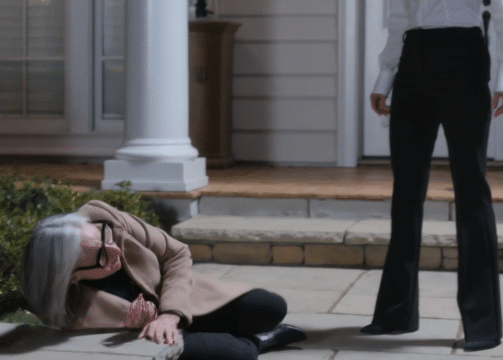
Act I
The coffee hit Ruth Collins before she could raise both hands.
One second, she was standing beside the chrome stools with a fresh pot trembling in her fingers. The next, hot brown liquid splashed across her teal uniform, her white apron, and the side of her face.
The diner went silent so fast the jukebox in the corner suddenly sounded too loud.
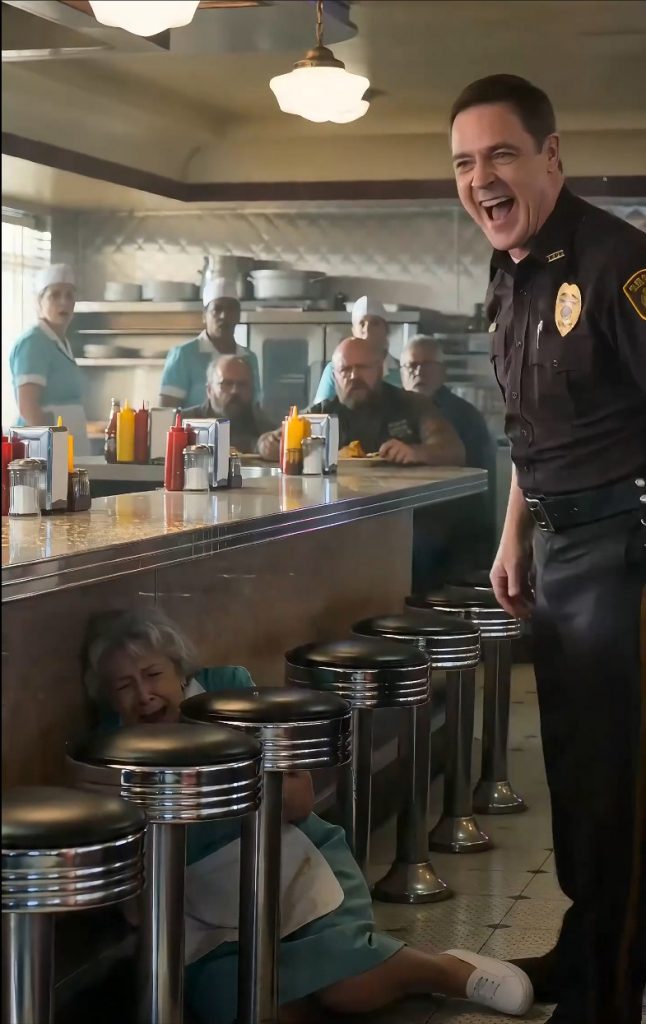
Ruth gasped and stumbled back toward the counter stools, one hand flying to her cheek. Her shoes slipped on the tiled floor, and the coffee pot clattered against the marble counter before someone behind her caught it.
Officer Wade Harlan laughed.
Not loudly.
Worse.
Softly.
Like the sound belonged to someone who knew no one in the room would dare stop him.
“Look at that,” he said, looking down at the elderly woman crouched near the stools. “Still shaking after all these years.”
Ruth tried to stand, but her knees gave. She was seventy-two, thin as a broom handle, with silver hair pinned beneath a diner cap and hands that had poured coffee for truckers, judges, nurses, drunks, and pastors for nearly four decades.
She had survived rude customers.
She had survived unpaid bills.
She had survived the night her husband never came home.
But Wade Harlan in a police uniform still made her afraid.
The badge on his chest caught the warm overhead light. He leaned over her like the whole diner was his precinct, his courtroom, and his private little stage.
“You dropped something, Ruthie,” he said.
There was nothing on the floor but coffee and humiliation.
No one moved.
A cook froze in the kitchen doorway. A young couple in a booth stared down at their plates. A man at the counter tightened his grip around a fork and did nothing with it.
Then, from booth seven, silverware touched a plate.
A small sound.
Almost polite.
The biker had stopped eating.
He was a huge man with long dark hair streaked with gray, a thick beard, tattooed arms, and a black leather vest worn soft from years of road wind. He had been sitting alone, quietly cutting into meatloaf, saying nothing to anyone.
Until Ruth hit the floor.
He placed his fork down.
Then his knife.
The booth creaked beneath him as he stood.
Every head in the diner turned.
Officer Harlan noticed him last. His smirk held for a second, then stiffened as the biker stepped into the aisle.
The man did not hurry.
He did not shout.
His boots landed heavy on the tile, one slow step after another, until even the kitchen refrigerator hum seemed to lower itself out of respect.
Ruth looked up through wet lashes, still crouched near the counter.
“Don’t,” she whispered.
The biker did not look away from Harlan.
He stopped inches from the officer’s face.
The badge. The beard. The uniform. The leather. Two kinds of men the room had been taught to fear.
Then the biker spoke one word, low and gravelly enough to make the coffee cups tremble.
“Move.”
Harlan tried to laugh again.
But this time, no sound came out clean.
Because the biker had not stood up for a stranger.
He had stood up for the woman who once saved his life.
And Officer Wade Harlan had just made the worst mistake of his career.
Act II
Everyone in Miller’s Diner knew Ruth Collins.
She opened the place at five every morning, even though her joints complained before sunrise. She knew who took cream, who lied about being fine, and who needed an extra biscuit wrapped in foil without being made to feel poor.
She called truck drivers “honey” and judges “sweetheart.” She kept birthday candles in the register drawer for regulars who pretended not to care.
But she did not talk about the old case.
Not unless someone brought up her husband.
Frank Collins had been a deputy in the county back when the town still believed good men could keep bad ones afraid. He had been broad-shouldered, gentle with animals, and stubborn about doing the right thing even when it cost him friends.
Twenty-one years earlier, Frank pulled over a patrol car outside an abandoned feed mill.
Inside was a young officer named Wade Harlan.
In the trunk were seized drugs that never made it to evidence.
Frank filed a report the next morning.
Two nights later, he was dead.
The official story was a roadside accident. Bad weather, poor visibility, tragic loss. Ruth wore black to the funeral and listened while the sheriff praised her husband’s service with Wade Harlan standing in the back row, dry-eyed and smiling just enough for Ruth to see.
She knew.
But knowing was not proof.
For years, Wade climbed higher. Patrolman. Sergeant. Lieutenant. The badge changed, but the eyes did not. Wherever he went, complaints disappeared. Witnesses changed their minds. Small businesses paid “fines” that never made it to city records.
Ruth refused.
That was why he came to the diner.
Not every day. That would have been too obvious.
Just often enough.
He sat at the counter, sent food back, mocked her hands when they shook, dropped coins in spilled ketchup, and reminded her with every smile that he was still standing while Frank was in the ground.
And Ruth kept working.
Because the diner was all she had left.
Or so people thought.
They did not know about the shoebox beneath her bed.
They did not know about the copies of Frank’s old notes, the photographs he had hidden behind a loose floorboard, the names written in his careful block letters.
They did not know Ruth had spent two decades building a quiet case.
And they did not know the biker at booth seven had been part of it.
His name was Eli Mercer.
Twenty years earlier, Eli had not looked like a man anyone would cross. He had been twenty-four, skinny, angry, and freshly back from a war he refused to discuss. He drank too much. Fought too often. Slept behind gas stations when his nightmares got loud.
Then he was arrested for assaulting an officer.
The officer was Wade Harlan.
The story was simple: violent drifter attacks decorated cop.
The truth was that Eli had seen Harlan meet a dealer behind the feed mill. He ran because he knew what men with badges could do when no one was watching. Harlan caught him, beat him, and charged him before sunrise.
No one believed Eli.
Except Ruth.
She showed up at the county jail with a paper bag full of sandwiches and said, “My Frank wrote your name down before he died.”
That was the first time anyone had spoken to Eli like he was not already guilty.
Ruth paid for a lawyer she could not afford. She found another witness. She testified. The charges were reduced, then quietly dropped, though Harlan’s name never appeared in the paperwork.
Eli left town after that.
Ruth told him to go.
“Get your life back before this place steals the rest of it,” she said.
So he did.
He built a towing business two counties over. Joined a motorcycle club made up of veterans, mechanics, and men who looked rougher than they were. He grew older, bigger, steadier. He stopped drinking. He learned how to sit with silence instead of fighting it.
But every year, on the anniversary of Frank Collins’s funeral, Eli rode back to Miller’s Diner.
He ordered meatloaf.
Ruth pretended it was coincidence.
Eli pretended she believed him.
This year, he had come for a different reason.
Ruth had called three nights earlier.
Her voice had been small but clear.
“I found Frank’s last tape,” she said.
And now Wade Harlan had thrown coffee in her face before she could hand it over.
Act III
“Move,” Eli said again.
Officer Harlan tilted his chin. “You threatening a police officer?”
Eli’s expression did not change.
“No.”
The diner held its breath.
“I’m telling you to move away from her.”
Harlan glanced around, remembering there were witnesses. That was the only thing that kept his hand away from his weapon.
Ruth slowly pushed herself up with one trembling hand on the chrome stool. Coffee dripped from her apron onto the tile.
Eli shifted, blocking Harlan’s view of her.
That small movement enraged the officer more than any insult could have.
“You don’t know what she is,” Harlan said. “Old women like her lie when they get lonely.”
Ruth flinched.
Eli noticed.
His eyes darkened.
“She fed me when I had nothing,” he said. “So I know exactly what she is.”
A murmur moved through the diner.
Harlan smirked again, but it was weaker now. “Touching story. Sit down before I make your day worse.”
From the kitchen doorway, the cook finally stepped forward.
“Officer,” he said carefully, “maybe you should leave.”
Harlan turned his head slowly.
The cook stopped.
Fear worked like that. It did not need to raise its voice.
Ruth wiped her cheek with a napkin. Her hand shook badly, but her eyes had changed. The terror was still there, but beneath it something older had woken up.
She reached into the pocket of her apron.
Harlan saw it.
“Ruth,” he warned.
She pulled out a small cassette tape sealed inside a plastic sandwich bag.
The whole diner seemed to lean toward it.
Harlan’s face emptied.
For the first time, he looked not cruel, not amused, not irritated.
Afraid.
Eli looked down at the tape, then back at Ruth.
“That it?”
She nodded.
“Frank hid it in the wall behind the pantry,” she whispered. “I found it last week when the freezer line broke.”
Harlan stepped forward.
Eli stepped with him.
The distance between them vanished again.
“Don’t,” Eli said.
Harlan’s jaw clenched. “That tape is stolen evidence.”
Ruth gave a broken laugh.
“No, Wade. It’s Frank’s voice.”
The officer’s eyes flicked toward the door.
Too late.
A young woman in the corner booth had her phone raised. A trucker at the counter had already dialed someone. The cook had disappeared into the back, not to hide, but to lock the rear exit.
Harlan had built his power on rooms where people looked away.
This room had stopped looking away.
Ruth’s voice shook, but she kept going.
“Frank recorded you that night.”
Harlan stared at her.
“He knew you’d deny it,” she said. “He knew the sheriff would cover for you. He told me there was one more copy if anything happened to him.”
Eli’s hands curled once, then relaxed.
He was not going to give Harlan the fight he wanted.
That was the difference between rage and discipline.
Harlan turned toward Ruth with a smile that tried to be calm and failed.
“You’re confused. You’re hurt. You’re making accusations in public because you’re embarrassed.”
Then Ruth said the sentence that ended his performance.
“I mailed a copy to Internal Affairs this morning.”
Harlan stopped breathing.
Eli almost smiled.
Almost.
Ruth lifted her chin, coffee still staining her uniform, her hair loose at the temples, her face pale but steady.
“This one,” she said, holding the tape tighter, “is for the town.”
The diner door opened behind them.
Two men in plain clothes stepped inside.
Neither ordered coffee.
Act IV
The first man showed his badge.
“Lieutenant Harlan,” he said, “step away from Mrs. Collins.”
Harlan turned slowly.
His face tried to rebuild itself into authority, but there were too many cracks now.
“What is this?”
“Internal Affairs.”
The second man moved toward Ruth, gentle but alert. “Mrs. Collins, are you injured?”
Ruth shook her head automatically.
Eli glanced at her.
She corrected herself.
“Yes,” she said softly. “I am.”
That one word seemed to surprise even her.
For forty years, Ruth Collins had minimized pain because survival had taught her to. She had said she was fine after Frank died. Fine when bills piled up. Fine when Harlan walked into her diner and made her hands tremble.
But she was not fine.
And she did not owe anyone that lie anymore.
Harlan straightened. “This is absurd. That woman has harassed me for years with conspiracy stories.”
The IA investigator looked toward the table near the window.
A teenage busboy stood there holding a small black device with a blinking red light.
“We also have today’s assault on video,” the investigator said.
Harlan’s eyes snapped toward the boy.
The busboy swallowed but did not lower the device.
Ruth looked at him, stunned.
He whispered, “I’m sorry, Miss Ruth. He’s been coming here too much. I started recording whenever he walked in.”
The officer’s mask vanished.
“You little—”
Eli moved once.
Not a shove. Not a threat.
Just one step between Harlan and the boy.
The officer stopped.
Everyone saw it then.
The badge had not made Harlan brave.
It had only made other people cautious.
Without their silence, he was smaller than anyone remembered.
The IA investigator held out a hand. “Your badge and weapon.”
Harlan laughed sharply. “You don’t have the authority.”
“Your chief signed the order fifteen minutes ago.”
The room rippled.
A woman in the booth began to cry quietly. The cook crossed himself. Someone behind the counter whispered Frank’s name like a prayer finally allowed out loud.
Harlan’s hand hovered near his belt.
Eli’s voice dropped.
“Don’t make that mistake.”
For a moment, the diner balanced on the edge of something terrible.
Then Harlan looked around.
Patrons. Staff. Phones. Investigators. Eli.
Ruth.
All the people he had counted on frightening into silence.
His hand fell.
He removed his badge with stiff fingers and placed it on the counter.
It landed in a small puddle of coffee.
No one moved to wipe it clean.
The IA officers took him outside through the front door. Not the back. Not quietly. The bell above the entrance jingled as if it were any ordinary customer leaving after breakfast.
But there was nothing ordinary about the silence that followed.
Ruth stared at the badge on the counter until one of the investigators collected it.
Then her knees buckled.
Eli caught her before she hit the floor.
For the first time since he had stood up, his face changed.
“Ruth,” he said, and the gravel left his voice. “Hey. I’ve got you.”
She gripped his leather vest like a lifeline.
“I thought he’d die with it,” she whispered. “I thought Frank’s truth would die with me.”
Eli looked toward the door where Harlan had disappeared.
“No,” he said. “It just took a long road getting here.”
The cook brought a clean towel. Someone else brought water. The young woman from the corner booth set her phone down and said she had uploaded everything to a secure folder before anyone could make it vanish.
Ruth laughed then.
One small, broken sound.
Not joy.
Relief.
Outside, police lights flashed against the diner windows.
Inside, the old woman in the coffee-stained uniform finally let herself shake.
Because the man who haunted her was gone.
But the truth he feared was only beginning to speak.
Act V
By sunset, everyone in town had heard.
By morning, everyone in the county knew.
The video traveled faster than any official statement. It showed Officer Wade Harlan throwing coffee at an elderly waitress. It showed him laughing. It showed the biker standing up. It showed the moment Harlan realized the room had turned into a witness stand.
But the video was only the door.
Frank Collins’s tape was the house behind it.
The recording was old and grainy, full of static and wind, but his voice was clear enough. Frank had named dates, badge numbers, missing evidence, and the officers involved. Wade Harlan’s voice could be heard too, arrogant and young, telling Frank he should have minded his business.
Frank had not.
That was why he died.
The investigation tore through the department like a storm through rotten wood. Retired officers were questioned. Old files reopened. Families who had been told to stop asking questions came forward with names, dates, photographs, and memories sharpened by years of being dismissed.
Harlan was charged first.
Others followed.
The sheriff who buried Frank’s report had been dead for years, but his reputation did not survive the week.
Ruth closed the diner for three days.
No one complained.
On the fourth morning, the lights came on at 5:00 a.m. like always. The coffee brewed. The grill hissed. The chrome stools shone under the warm lamps.
But something was different.
A framed photograph sat beside the register.
Frank Collins in uniform, smiling with one arm around Ruth outside the diner on its opening day.
Under the photo was a small handwritten note.
He told the truth.
People came in quietly at first.
Truckers removed their caps. Teachers left flowers. An old man Ruth had served for thirty years took her hand and cried without explaining why.
Eli came at noon.
Booth seven was empty, though the diner was packed. Someone had left it for him without being asked.
Ruth carried over a plate of meatloaf and set it down.
“You didn’t have to come back,” she said.
Eli looked up at her.
“Yes, I did.”
Her eyes softened.
For a moment, he was twenty-four again, bruised and furious in a jail cell, watching a widow hand him a sandwich through the bars because she believed the world still owed him a chance.
“You saved me once,” he said.
Ruth shook her head. “I just fed you.”
“That’s how it started.”
She smiled faintly.
Then she placed something on the table beside his plate.
A folded envelope.
Eli frowned. “What’s this?”
“Frank wrote letters,” she said. “In case things went bad. One was for me.”
Her voice trembled.
“One was for you.”
Eli did not touch it at first.
The diner noise softened around him.
Finally, he opened the envelope.
The paper inside was yellowed with age. Frank’s handwriting was firm, careful, unmistakable.
Eli read slowly.
Ruth watched his face change.
Frank had written that Eli was not what the police report said he was. That men like Harlan counted on wounded people staying wounded. That if Eli ever found a life beyond anger, he should live it without shame.
The last line made Eli close his eyes.
Ruth knew it by heart.
You are not the worst thing they accused you of being.
Eli folded the letter with hands that were not quite steady.
For a long time, he said nothing.
Then he stood and walked to the wall near the register. He took off his black leather vest, the one with miles of road worn into every seam, and removed a small patch from the inside pocket.
It was shaped like a winged wheel.
Beneath it were three words.
No One Left.
He placed it beside Frank’s photograph.
Ruth touched the patch gently.
“What does it mean?” she asked.
Eli looked around the diner.
At the busboy who had recorded.
At the cook who had locked the back door.
At the patrons who had finally stayed.
“It means we don’t ride past people who are down,” he said.
Ruth swallowed hard.
After that day, booth seven became unofficially reserved.
Not because Eli demanded it.
Because the town remembered.
Sometimes he came alone. Sometimes he came with other bikers, big men with tattoos and rough hands who spoke softly to Ruth and tipped too much. They fixed the diner’s back steps. Repaired the neon sign. Walked waitresses to their cars after late shifts.
Ruth pretended to fuss about it.
Nobody believed her.
Months later, when Harlan’s trial began, Ruth walked into court wearing the same teal uniform he had stained with coffee. She had washed it, pressed it, and pinned Frank’s old badge to the inside of her apron where only she could feel the weight.
Eli walked beside her.
Not in front of her.
Beside her.
Reporters shouted questions. Cameras flashed. Ruth kept her eyes forward.
Inside the courtroom, Wade Harlan would not look at her.
That was fine.
For twenty-one years, he had forced Ruth Collins to remember him.
Now the whole county would remember Frank.
And when Ruth took the stand, her voice did not shake.
She told them about the coffee.
The laughter.
The tape.
The fear.
Then she told them about a husband who had believed a badge was not a shield for cruelty, but a promise to stand between cruelty and everyone else.
By the time she finished, even the judge was silent.
That evening, Ruth returned to Miller’s Diner after court. She unlocked the door, stepped inside, and stood beneath the warm lights.
The marble counter gleamed.
The chrome stools waited.
The place smelled like coffee again.
For a second, she saw herself on the floor, hands raised, drenched and shaking while a cruel man laughed.
Then she saw what happened after.
The fork set down.
The booth creaking.
The boots on tile.
One man standing, and then a whole room remembering how.
Ruth walked behind the counter, tied on a clean apron, and poured the first cup of the night.
When Eli entered, the bell above the door rang softly.
She looked at him and smiled.
“Usual?”
He sat at booth seven.
“Always.”
Outside, the highway kept moving. Trucks rolled past, headlights cutting through the dusk. The world remained loud and unfair and full of men who mistook power for permission.
But inside Miller’s Diner, no one laughed when an old woman was afraid.
Not anymore.
Because one day, a cruel officer threw coffee in her face.
And the scariest-looking man in the room turned out to be the first one brave enough to stand.