Act I
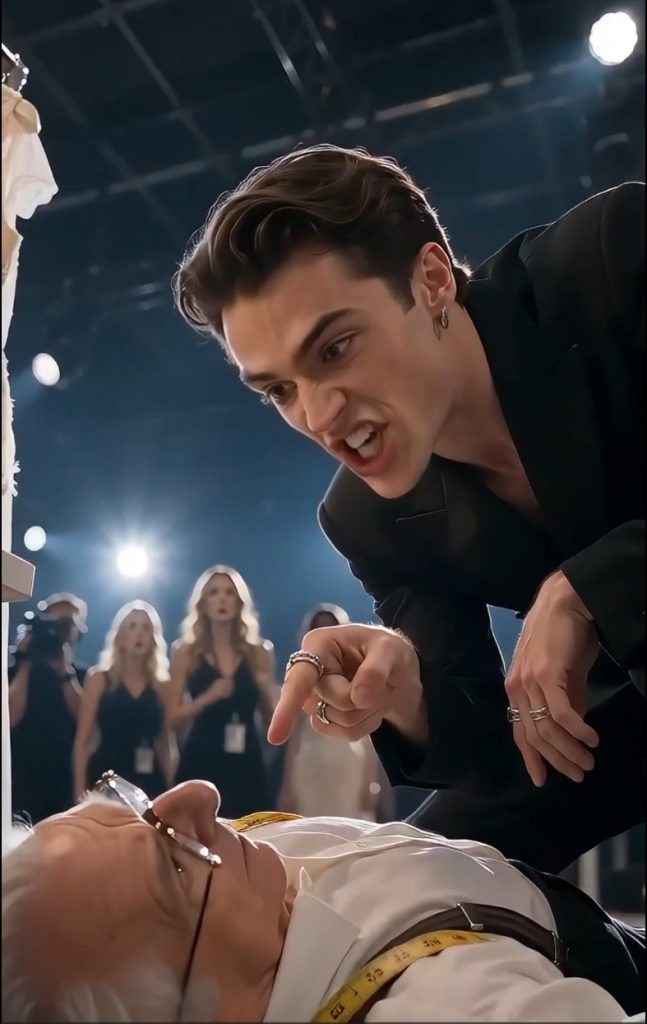
The measuring tape slipped from his shoulder before the gown stopped moving.
It fell in a yellow curve beside the sewing table, landing across a fragile old pattern sheet that had drifted loose from Mr. Bellini’s hand. The paper was thin from age, marked with pencil lines, tiny notes, and the kind of careful measurements no computer could make warmer.
Then Mr. Bellini hit the floor.
His round glasses slid crooked on his face. One hand caught the edge of the sewing table. A small mark appeared near his lip, but he did not curse, did not shout, did not raise a hand back.
He only looked toward the pattern sheet.
As if that old paper mattered more than the pain.
The young designer stood over him in an all-black outfit, silver rings flashing under the backstage lights, styled hair perfect, cheekbones sharp enough to look carved. Behind him, couture gowns trembled on rolling racks while models, stylists, makeup artists, and camera operators froze in horror.
“You stitch hems,” the designer hissed, jabbing a finger toward the old man’s chest. “You don’t touch gowns that make history.”
The words sliced through the frantic backstage air.
A model in half-finished makeup covered her mouth. A stylist lowered a steaming iron without realizing it. Someone near the curtain whispered, “Oh my God.”
Mr. Bellini stayed low.
His silver hair had fallen across his forehead. His suspenders were twisted. The measuring tape lay beside him like a fallen ribbon of proof.
The designer’s name was Dorian Vale.
He was thirty-two, celebrated, photographed, dangerous in the way insecure men become dangerous when too many people call them genius. Tonight was supposed to be his coronation: the Los Angeles debut of his first couture collection, a show promised by fashion magazines to “rewrite American luxury.”
And then an old backstage tailor had touched the lead gown.
That was all Dorian needed to explode.
The curtain entrance opened.
Naomi Brooks, the runway director, rushed in with her headset on and the show clipboard clutched in one hand. She stopped when she saw Bellini on the floor, the pattern sheet beside him, and Dorian standing over him like cruelty was a form of authority.
Her face changed.
The entire backstage area felt it.
Naomi moved directly to Mr. Bellini and knelt beside him.
Then she turned her voice toward the room.
“Mr. Bellini,” she said, clear and formal, “the entire collection carries your original patterns.”
A gasp moved through the crew.
The lead gown shifted under the light.
Inside its bodice, a small label showed in black thread.
BELLINI ATELIER.
Dorian’s mouth opened.
“Bellini?”
Act II
Salvatore Bellini had spent forty-six years making other people look brilliant.
That was the secret history of fashion no magazine wanted to print too plainly. Behind every dramatic silhouette was someone bent over paper. Behind every effortless runway moment was a pair of hands that had measured, cut, pinned, corrected, and started again when the body refused to obey the sketch.
Bellini had those hands.
Careful hands.
Patient hands.
Hands that could feel a flawed seam allowance through fabric before a younger tailor saw it with his eyes.
He was born in New Jersey to Italian parents who ran a small alteration shop between a bakery and a laundromat. His mother could rebuild a dress from a ruined hem. His father could tailor a suit so gently that men stood taller without knowing why.
Bellini learned by watching.
At twelve, he swept thread from the floor. At fourteen, he marked hems. At sixteen, he was trusted with wedding gowns, not because he was fast, but because he listened to fabric as if it were speaking.
By thirty, he had moved to Los Angeles and opened Bellini Atelier with two sewing machines, three borrowed dress forms, and a sign painted by a friend who accepted payment in jackets. The atelier never became a celebrity empire, not in the way people understood empires.
It became something better.
A place designers came when their sketches were impossible.
A place actresses came when their gowns had to move under lights without betraying them.
A place young assistants came to learn that beauty was not born from arrogance. It was built through correction.
Bellini did not chase cameras.
He chased the line of a shoulder.
The fall of silk.
The quiet miracle when a garment stopped being cloth and became presence.
Then the industry changed.
Fast fashion made patience look old. Investors bought labels. Designers became brands before they became craftsmen. Bellini Atelier survived for years on loyalty and reputation, but reputation did not pay Los Angeles rent forever.
A bad licensing deal finally broke it.
An archive company bought the atelier’s patterns after promising they would be preserved, credited, and used for educational purposes. Bellini signed because he was tired, because medical bills were rising, because the lawyer said it was safe, and because he still believed powerful people meant what contracts said.
The patterns vanished into storage.
The atelier closed.
Bellini kept working wherever he was needed.
Backstage fittings. Emergency alterations. Bridal repairs. Museum restorations. Fashion week temp calls where twenty-two-year-olds called him “sir” only when they needed a zipper saved in four minutes.
He never complained.
But he kept one folder.
Old pattern sheets.
Original notes.
The first drafts of gowns he had once dreamed would carry his name.
That folder was under his arm the night he entered Dorian Vale’s backstage world.
He had not come to take anything.
He had come to protect what was already his.
And he saw the mistake the second the lead gown rolled past him.
Act III
Dorian Vale had built his career on mood.
He could stand in front of a camera and make emptiness sound profound. He could say “tension,” “memory,” and “architectural femininity” in one sentence and make editors nod as if they had witnessed scripture.
He was talented.
That made everything worse.
A talent without humility becomes a weapon that eventually turns on the people who sharpened it.
Dorian’s first collections were praised for attitude but criticized for construction. His clothes photographed beautifully and moved badly. Seams pulled. Bodices buckled. Sleeves fought the body. Reviewers called the work “conceptually strong but technically uncertain.”
He hated that phrase.
Technically uncertain.
It haunted him more than failure.
Then one of his investors introduced him to a private archive containing old couture patterns from a closed Los Angeles atelier. The name meant little to Dorian at first.
Bellini.
He opened the boxes and found genius.
Not loud genius.
Quiet genius.
Pattern sheets drawn with breathtaking economy. Notes about how silk reacted under warm lights. Adjustments for movement, breath, posture, fatigue. Designs that understood the body as living, not decorative.
Dorian should have felt gratitude.
Instead, he felt opportunity.
He used the archive as bones for his new collection. He changed surface details, added black lacquered accessories, sharpened necklines, cut away softness, and built a story around “the future of American couture.”
The press believed him.
Investors believed him.
Maybe part of him did too.
But Naomi Brooks did not.
Naomi had directed runway shows for twenty years. She knew timing, lighting, models, photographers, panic, lies, and the difference between inspiration and theft. When she saw the first fitting, something about the garments felt older than Dorian’s language.
Too resolved.
Too balanced.
Too wise.
Then she saw the inner labels.
Bellini Atelier.
At first, she thought Dorian had arranged proper credit.
Then the press packet arrived.
No mention of Bellini.
No mention of the archive.
No mention of the living man whose patterns held the collection together.
Naomi made one call.
Then another.
By show day, she had found Salvatore Bellini.
He arrived quietly, wearing a white shirt, suspenders, round glasses, and a measuring tape around his neck because old habits are sometimes the last honest uniform a person owns.
Naomi asked him to inspect the lead gown before the runway.
Bellini touched the bodice once.
His face changed.
“The front panel is forced,” he said softly.
A junior stylist blinked.
“It passed fitting.”
“It passed standing. It won’t pass walking.”
He opened his old pattern sheet on the sewing table.
His finger traced a pencil note written decades earlier.
Allow breath before drama.
Naomi stared at the words.
Bellini moved toward the gown to correct the tension at the side seam.
That was when Dorian saw him.
And Dorian understood, in one terrible instant, that the old man was not touching his collection.
He was recognizing it.
Act IV
Naomi Brooks did not raise her voice.
She did not need to.
Backstage chaos obeyed people who knew exactly where time was running out, and Naomi had spent half her life commanding disasters without blinking.
“Stop the runway clock,” she said into her headset.
A stunned assistant whispered, “We go live in six minutes.”
“Then we are stopped for six minutes.”
Dorian turned on her.
“You can’t stop my show.”
Naomi looked at him.
“It became your show by theft.”
The word landed harder than a thrown glass.
Dorian’s face twisted.
“That old man is confused.”
Bellini slowly rose with Naomi’s help, though he did not lean on her for long. He gathered the old pattern sheet first, smoothing one creased corner with careful fingertips.
“I know my own line,” he said.
The room went silent.
Dorian laughed, but it came out wrong.
“These are references. Everyone references. Fashion is conversation.”
Bellini looked at the lead gown.
“Conversation requires answering.”
Naomi opened her clipboard and pulled a set of printed documents from the back.
“Bellini Atelier archive licensing agreement. Preservation clause. Credit requirement. Design provenance schedule.”
Dorian froze.
His manager whispered, “Dorian…”
Naomi continued.
“Every major garment in this collection traces to registered Bellini Atelier patterns. The estate archive license required full attribution. You removed it from the press packet.”
Dorian’s eyes flashed.
“I modernized them.”
“You hid him,” Naomi said.
A stylist near the gown spoke up, voice shaking.
“He told us not to mention the labels.”
Dorian snapped his head toward her.
The stylist flinched, then kept going.
“He said old names make new designers look derivative.”
The word derivative moved through the room like a match near silk.
Bellini did not smile.
There was no pleasure in watching someone panic over a truth they had buried under lighting.
Dorian tried one more time.
“You people don’t understand fashion. History belongs to whoever pushes it forward.”
Bellini folded the pattern sheet carefully.
“History belongs to the hands that survived long enough for someone else to rename it.”
No one breathed.
Naomi turned to security.
“Mr. Vale is removed from backstage access pending legal review.”
Dorian’s face went pale.
“You remove me and there is no show.”
Naomi looked at the racks.
Then at Bellini.
Then at the crew.
“No,” she said. “We finally have one.”
Dorian’s voice cracked.
“Bellini?”
This time, the old tailor did not answer.
The label inside the gown already had.
Act V
The show began twenty-one minutes late.
In fashion, twenty-one minutes could mean scandal, collapse, or genius depending on who controlled the story afterward. That night, the delay became something else.
Correction.
The runway lights dimmed first.
Then the original opening music cut out.
The giant screen behind the runway, which had been prepared to display DORIAN VALE: FUTURE FORM, went black. For three long seconds, the audience whispered into the darkness.
Then new words appeared.
BELLINI ATELIER ARCHIVE.
A murmur rolled through the room.
Backstage, Dorian Vale was gone.
Not dramatically. Not screaming through the curtains. Security had escorted him to a private office where lawyers were already waiting. His absence did not destroy the show.
It made space for the truth.
Naomi stood at the curtain entrance with her headset on, eyes sharp, clipboard steady. Bellini sat beside the sewing table while a makeup artist gently cleaned the small mark near his lip. He hated the attention and tried twice to stand.
Naomi stopped him both times.
“You can fix gowns sitting down,” she said.
He almost smiled.
The lead gown was corrected in fourteen minutes.
Not redesigned.
Respected.
Bellini released the forced tension at the side seam, adjusted the front panel, and restored the breath the garment needed. When the model tried it again, the gown moved differently.
The backstage crew saw it immediately.
It no longer fought her.
It followed her.
The first model stepped onto the runway under a narrow beam of light. The gown was ivory, severe at the shoulders, soft through the waist, and alive when it moved. Editors leaned forward. Cameras lifted. The audience, expecting spectacle, received discipline.
Then the screen showed a close-up of an original pattern sheet.
Handwritten notes.
Bellini’s pencil lines.
Allow breath before drama.
By the third look, the whispering had changed. People were no longer asking why the show was late. They were asking who Bellini was.
Naomi made sure they knew.
Each garment walked with attribution projected behind it.
Original pattern: Bellini Atelier.
Pattern maker: Salvatore Bellini.
Restored under supervision: Salvatore Bellini.
The fashion press would later call the show “a public act of archival justice,” because fashion liked elegant phrases after ugly behavior. But backstage, it felt simpler.
An old man had been struck for touching work that came from his own hands.
Then the work testified for him.
At the finale, Naomi did something Bellini had not agreed to.
She sent a model to bring him out.
He shook his head immediately.
“No. No, I don’t walk.”
Naomi leaned close.
“You already did. For forty-six years. Tonight they watch.”
The model offered her arm.
Bellini looked at the runway lights.
For a moment, he seemed to see every room he had worked in without credit. Every fitting where someone else took the bow. Every young designer who learned from his patterns without learning his name. Every late night at Bellini Atelier when he stayed after everyone left because the line of a sleeve still felt wrong.
Then he stood.
The applause began before he reached the runway.
It was not polite applause.
It rose like recognition arriving late and ashamed.
Bellini walked slowly beneath the lights in his white shirt and suspenders, measuring tape still around his neck. He did not wave like a celebrity. He did not perform surprise. He placed one hand over his heart and bowed his head once.
In the front row, editors stood.
Then buyers.
Then models backstage watching on monitors.
Naomi remained near the curtain, blinking hard and pretending it was because of the lights.
The consequences came quickly after that.
Dorian’s investors suspended him from the label pending legal action. The archive licensing violation became public. Former assistants came forward with stories of erased credit, stolen sketches, and craftsmen dismissed as “technical labor” after saving his collections from failure.
Some defended him.
They said fashion was built on borrowing.
Bellini answered only once.
“Borrowing returns what it takes.”
That sentence traveled farther than any press release.
Bellini Atelier was revived within the year.
Not as a nostalgia brand.
As a craft house.
Naomi helped structure it so pattern makers, tailors, seamstresses, and cutters received visible credit in every collection. Every runway program included the names of the people who built the garments. Every intern spent time at the sewing table before attending a design meeting. No sketch could enter production without the person drafting the pattern signing off on feasibility.
The old pattern sheet from the night of the punch was framed in the atelier, but not behind glass that made it untouchable.
Bellini insisted on a copy being used in training.
“Patterns are not relics,” he said. “They are instructions for care.”
Near the entrance hung the yellow measuring tape.
A small plaque beneath it read:
Measure the garment. Measure the ego twice.
Naomi laughed when she saw it.
Bellini pretended not to be pleased.
Years later, people still told the story of that night backstage in Los Angeles.
The young designer punched the old tailor.
The measuring tape fell.
The runway director arrived with the clipboard.
Every gown carried Bellini’s original patterns.
Bellini?
It was satisfying because arrogance panicked beneath the lights it had stolen.
But Bellini never liked that version best.
It made recognition the lesson.
The punch had been wrong before anyone saw the label.
The insult had been ugly before Naomi read the documents.
The old tailor beside the sewing table had deserved respect before the room learned his patterns held the collection together.
That was why, whenever students visited Bellini Atelier, he did not begin with his famous runway bow.
He began with the floor.
He showed them scraps beneath the cutting table. Threads caught on black fabric. Chalk marks. Pin cushions. Seam rippers. The quiet tools that never appeared in campaign photos.
Then he would hold up the yellow measuring tape.
“This,” he told them, “knows more truth than a camera.”
The students would laugh softly, unsure if he meant it.
He always did.
A camera loved the finished thing.
The measuring tape knew how many times the finished thing had failed before becoming beautiful.
On quiet mornings, Bellini still worked at the long table by the window. His hands were slower now, but not uncertain. Naomi visited often, usually pretending it was business when really she liked watching him correct impossible garments with two pins and a sigh.
One afternoon, a young intern rushed in holding a gown with a twisted lining.
“I ruined it,” she said, near tears.
Bellini looked over his glasses.
“Good.”
She blinked.
“Good?”
“Now it can teach you.”
He took the garment gently, as if mistakes deserved dignity too.
The atelier went on around him: sewing machines humming, pattern paper rustling, young designers learning to listen before they renamed themselves visionaries.
Outside, Los Angeles kept chasing the next show, the next face, the next word for brilliance.
Inside, Bellini taught a quieter truth.
Fashion was not made by the person who shouted history loudest.
It was made by the hands patient enough to shape it, humble enough to correct it, and brave enough to let the world see the stitches.