Act I
The old ski pole clattered across the lodge floor before the fire cracked again.
It slid over the polished wood, struck the leg of a leather chair, and spun beneath the glow of the massive stone fireplace. The scratched handle was wrapped in faded tape. Near the grip, almost hidden by age, two initials had been carved into the wood.
W.W.
Then Mr. Whitaker hit the wool rug.
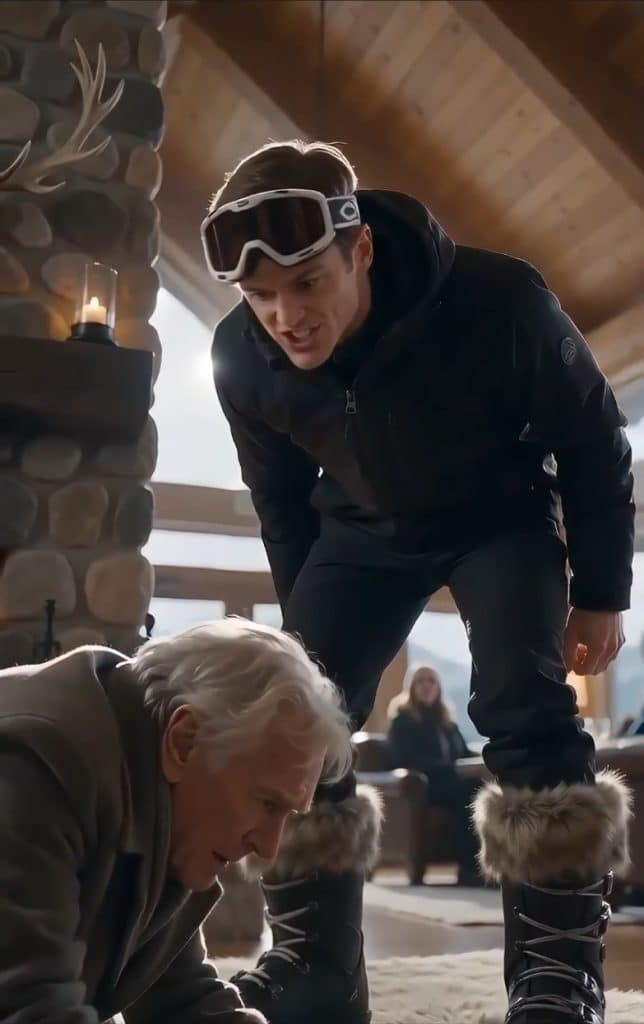
He landed hard beside the hearth, one gloved hand bracing against the floor. His old wool coat twisted at the shoulder. A faint mark showed near his mouth, but he did not make a sound.
The lobby froze.
Wealthy skiers in designer jackets stopped beside fur throws and champagne glasses. Children in matching winter gear stared from near the panoramic windows where the snowy mountains rose silver in the afternoon light. Bartenders, bell staff, and front desk clerks turned toward the fireplace as if the whole lodge had forgotten its own warmth.
The man who had punched him stood above him in a black ski jacket and fur-lined boots.
Designer goggles rested on his head. His jaw was tight. His boots were planted wide, as if the floor, the fire, the windows, and the mountain beyond them answered to him.
“This fire is for paying guests,” he said, voice loud and icy. “Not frozen old men wandering in.”
The insult seemed to make the room colder.
Mr. Whitaker stayed low, breathing carefully.
His weathered face held pain, but not surprise.
That was the part some witnesses would remember later. Not the fall. Not even the punch.
The look in his eyes.
As if he had been waiting to see whether the lodge would remember him.
The resort operator, Blake Harlan, turned toward the stunned guests with a sharp, polished smile.
“Apologies,” he said. “We’ve had problems with vagrants slipping in during storms.”
No one answered.
The old ski pole lay between the fireplace and the front desk.
That was where Eleanor Price saw it.
The lodge manager rushed from behind the counter, her forest-green blazer buttoned over a snowflake scarf, gold name badge flashing as she crossed the lobby. She did not look first at Harlan.
She looked at the pole.
Then at the old man on the rug.
Her face went pale.
“Mr. Whitaker,” she said, voice breaking with reverence, “your family still owns the mountain.”
The lodge fell silent.
Above the fireplace, between vintage ski photos and old trail maps, hung a framed black-and-white photograph labeled:
WHITAKER MOUNTAIN, 1952.
In the photo, a younger man stood beside the first rope tow, holding the same wooden ski pole.
Blake Harlan’s lips parted.
“Whitaker?”
Act II
Walter Whitaker had known that mountain before it became a resort.
Before the private chalets.
Before the heated boot rooms.
Before the champagne terrace, the luxury spa, the celebrity ski weekends, and the glossy advertisements promising exclusivity at altitude.
When Walter was a boy, the mountain was simply home.
His father, Henry Whitaker, ran cattle along the lower meadow in summer and cut ski trails in winter with a stubborn hope that ordinary families might come up from town and feel, for a few hours, as if the world had opened. Henry built the first rope tow with borrowed parts, bad wiring, and help from neighbors who were paid in stew, coffee, and lift passes.
It was not glamorous.
The lodge was one room then. Rough beams. Potbelly stove. Hooks for wet coats. A hand-painted sign by the door:
IF YOU’RE COLD, COME IN.
Walter’s mother made soup for skiers, truck drivers, schoolkids, lost hikers, and anyone else who stumbled in from a storm. Nobody asked first whether they could pay. Henry said the mountain had survived too many winters to become stingy with warmth.
Walter grew up believing that.
He carried that scratched wooden ski pole everywhere because his father had carved the initials into it after Walter broke his first pair. W.W. for Walter Whitaker. Henry said a person who loved a mountain should learn to walk it before trying to own it.
Years passed.
The town changed.
Aspen changed faster.
Land that had once been dismissed as too steep, too difficult, too far from the right roads became valuable. Developers came with maps and promises. Henry refused them all while he lived.
Walter was less able to refuse.
After his wife died and his own health began to weaken, he leased operations of the ski lodge and resort facilities to Harlan Alpine Group. The land remained in the Whitaker family trust. The lease was clear: the resort could operate luxury accommodations, but the mountain’s public easements, warming access, and historic lodge protections could not be removed.
Blake Harlan signed that lease with a smile.
Then spent eight years trying to bend it until it looked like ownership.
The old warming hut near the lower trail was closed “for safety.” Local passes became harder to obtain. Service staff were told not to let non-guests linger by the fire. The original lodge room, once open to anyone caught in weather, became a VIP lounge with a whiskey menu and a velvet rope.
Walter heard rumors.
At first, he dismissed them.
Then letters began arriving.
A retired ski instructor wrote that he had been turned away from the fireplace during a storm because he no longer had a membership pass. A mother from town said her two children were denied entry to warm their hands after their bus broke down. A former employee sent a photo of the original sign, IF YOU’RE COLD, COME IN, lying in a storage closet behind boxes of branded candles.
That was when Walter came back.
No announcement.
No lawyer beside him.
No family office representative.
Just an old wool coat, knitted gloves, weathered face, and the wooden ski pole his father had carved for him.
He wanted to know what the mountain had become when no one knew its owner was watching.
Blake Harlan showed him.
Act III
Blake Harlan had never loved the mountain.
He loved what the mountain could sell.
Snow as status. Fireplaces as backdrops. Silence as privacy for people who paid to avoid ordinary life. He turned weather into branding and altitude into social hierarchy. Under his operation, the lodge’s old warmth became something packaged, priced, and protected.
He called it refinement.
Staff called it fear.
Harlan watched everything: which guests received window seats, which families looked expensive enough for the main lobby, which workers smiled too openly, which locals entered as if they still believed the lodge belonged to memory.
That last group offended him most.
Locals carried history in their posture. They remembered cheap coffee by the fire. School ski days. Old lift lines. Henry Whitaker fixing bindings with frozen fingers. They spoke of the place as if it had existed before Harlan named the cocktail bar.
He hated that.
The mountain, to him, had no past worth honoring unless it could be framed and hung above a fireplace for guests to admire without understanding.
That afternoon, snow had started falling harder than forecast. The lobby filled with guests warming themselves beside the stone hearth. Harlan stood near the fireplace, hosting two investors and describing the expansion he planned for the upper ridge.
Private villas.
Restricted trail access.
A helipad.
All things the lease did not allow.
Then Walter Whitaker walked in.
He came through the main entrance slowly, brushing snow from his old coat, his wooden pole tapping softly against the floor. He did not approach the desk. He did not announce himself. He moved toward the fireplace because the cold had reached his bones and because, for seventy years, that fire had been the first promise of the lodge.
Harlan noticed him immediately.
“Can I help you?” he asked.
Walter looked at the fire.
“I’m just warming up.”
“Are you a guest?”
Walter paused.
“In a way.”
Harlan’s eyes narrowed.
That answer sounded too calm.
Too unafraid.
He looked at the old coat, the knitted gloves, the scratched wooden pole.
“No,” Harlan said. “You’re not.”
A family near the window turned.
Walter’s voice remained quiet.
“This lodge used to keep the fire open.”
Harlan smiled.
“That was before it became valuable.”
Walter looked at him then.
“Is that what you think happened?”
Something in the question irritated Harlan beyond reason. It carried memory. Authority. Judgment without volume.
He stepped close.
“I don’t know where you wandered in from, but you don’t stand here scaring my guests.”
“I’m not scaring them.”
“You’re lowering the room.”
Walter’s fingers tightened around the ski pole.
“Then the room is already too small.”
The punch came before the nearest staff member found courage.
The pole flew.
The old man fell.
And the lodge finally heard the sound of its own forgetting.
Act IV
Eleanor Price knelt beside Walter Whitaker with tears she refused to let fall.
Her grandfather had worked the original rope tow. Her mother had served soup in the old lodge kitchen. Eleanor had grown up under those wooden walls, watching Henry Whitaker treat strangers with more courtesy than some hotels showed paying guests.
She had recognized the ski pole before she recognized the man.
That made her ashamed.
“Mr. Whitaker,” she whispered, “I am so sorry.”
Walter pushed himself upright slowly.
“Are you sorry because you know me, Eleanor?”
Her face tightened.
The question hurt because it was fair.
Blake Harlan tried to step in.
“There has obviously been confusion,” he said. “This gentleman did not identify himself.”
Walter turned toward him.
“No. I didn’t.”
Harlan latched onto that like rescue.
“Exactly. I had no way of knowing—”
“You knew I was cold.”
The lodge went still.
The fire cracked behind them.
Walter continued, voice quiet enough that everyone leaned in.
“You knew I was old. You knew I was standing by a fire. That should have been enough.”
Harlan’s face flushed.
“I am responsible for protecting the guest experience.”
Eleanor stood.
“And the landowner’s covenant.”
Harlan’s eyes snapped toward her.
She straightened, all manager now.
“The original lease requires the hearth room to remain open as a warming space during severe weather. It also preserves public access across the lower trail and forbids exclusive development above the east ridge.”
The investors near the fireplace exchanged looks.
Harlan’s jaw tightened.
“We were revisiting outdated language.”
Walter picked up the wooden ski pole from the floor.
His hand moved slowly over the carved initials.
“You were violating it.”
The words carried more weight than accusation.
They carried ownership.
Eleanor turned toward the front desk.
“Secure lobby footage. Preserve audio. Contact the Whitaker family attorney and resort security.”
Harlan’s confidence cracked.
“Security? Eleanor, be careful.”
She looked at him.
“I should have been careful sooner.”
A bartender near the fireplace stepped forward.
“He told us to turn people away,” he said.
Harlan whipped around.
The bartender did not stop.
“During storms. Locals. Workers. Drivers. Anyone who wasn’t staying here.”
A young desk clerk added, “He had the old sign removed.”
Walter’s eyes moved to her.
“Where is it?”
The clerk swallowed.
“Storage. Behind the spa boxes.”
Walter nodded once.
That wounded him more visibly than the punch.
Harlan tried one final time.
“Mr. Whitaker, I have increased this property’s value tenfold.”
Walter looked toward the panoramic windows, where the mountain rose beyond the glass, white and vast and older than every contract in the room.
“No,” he said. “You increased the price of standing near it.”
Harlan’s mouth opened.
“Whitaker?”
Walter did not answer.
The mountain already had.
Act V
Blake Harlan was removed from lodge operations before sunset.
Not dragged through the lobby. Not shouted at. Not given the dramatic exit he would have known how to twist into victimhood.
He was escorted away by security while guests watched from beside the fireplace he had tried to reserve for wealth. His designer goggles remained pushed on his head, absurd now, like a crown from a kingdom that had never belonged to him.
Walter Whitaker stayed by the hearth.
Eleanor brought him a chair.
He refused it at first.
Then accepted, not because he was weak, but because age had taught him not to mistake stubbornness for dignity.
A little girl in a silver ski jacket approached quietly with the old wooden pole in both hands.
“You dropped this,” she said.
Walter took it from her gently.
“Thank you.”
She looked at the initials.
“Is it special?”
Walter smiled faintly.
“My father made it when this place was mostly snow and bad coffee.”
The girl looked around the luxury lobby.
“It was different?”
“Yes.”
“Better?”
Walter thought about that.
“No,” he said finally. “Not better in every way. Just kinder.”
That answer settled into Eleanor like instruction.
The legal process began the next morning.
The Whitaker trust suspended Harlan Alpine Group’s operational authority pending investigation. Attorneys reviewed lease violations. The proposed ridge expansion was halted. Public easement complaints were reopened. Staff testimony confirmed that Harlan had knowingly restricted warming access during dangerous weather to preserve “guest optics.”
The local paper ran the story first.
Then the ski press.
Then national outlets that preferred scandals involving rich people, mountains, and a punch near a fireplace.
But Walter did not care for the headlines.
He cared about the sign.
Eleanor found it in storage, exactly where the desk clerk said it would be. Dusty. Scratched. Wedged behind boxes of luxury spa candles labeled Alpine Silence.
She carried it to Walter herself.
The old hand-painted letters were faded but readable.
IF YOU’RE COLD, COME IN.
Walter touched the sign with two fingers.
For the first time since returning to the mountain, he looked close to breaking.
“My mother painted that,” he said.
Eleanor lowered her head.
“I should never have let it leave the wall.”
“No,” Walter said. “You shouldn’t have.”
She accepted the correction.
That was why he trusted her with what came next.
The lodge changed before the season ended.
The hearth room reopened as a public warming space during storms. Not a charity corner. Not a hidden room near the back hallway. The main fireplace. The original fire. Anyone caught in weather could come in, warm their hands, drink coffee, and sit without being questioned about room numbers or jackets.
The old sign returned above the stone hearth.
Below it, Eleanor added a smaller plaque:
Henry and Ruth Whitaker believed warmth was not a luxury.
The velvet rope disappeared.
So did the VIP-only whiskey menu.
Guests complained.
Some said the lobby felt less exclusive.
Walter answered that complaint in a letter posted at the front desk.
The mountain was never meant to flatter people who need others kept outside to feel comfortable.
Several guests canceled.
More arrived.
Locals came back slowly, cautious at first, as if kindness might be temporary. A retired instructor drank coffee near the fire. Two bus drivers warmed their hands after a road closure. A young lift operator sat beneath the old ski photos after his shift and stared at Henry Whitaker’s rope tow like he had inherited something without being related by blood.
Walter visited often that winter.
Always in the old wool coat.
Always with the scratched wooden pole.
Never announced.
Sometimes he sat near the fireplace and watched the room breathe.
One afternoon, a wealthy guest in a fur-lined jacket approached Eleanor at the desk.
“There’s a man by the fire who doesn’t seem to be staying here,” she said.
Eleanor looked toward Walter, then back at the guest.
“The fire is doing its job.”
The woman blinked.
Then, to her credit, said nothing else.
Weeks later, Walter asked Eleanor to walk with him outside.
They stood beneath the lodge roof while snow fell softly beyond the entry lights. The mountain disappeared and reappeared through the weather, immense and patient.
“I’m amending the trust,” Walter said.
Eleanor looked at him quickly.
“The land will remain protected. No private ridge villas. No helipad. Public lower access stays. The lodge operates only as long as it keeps the warming covenant.”
Her eyes filled.
“And if future operators object?”
Walter planted the ski pole in the snow.
“Then they can build luxury somewhere that doesn’t remember my mother.”
By spring, the resort had a new operating structure. Staff representation on the advisory board. Local access guarantees. Emergency warming policies. Clear conduct rules for guests who mistreated workers or non-guests. Harlan’s expansion plans were shelved permanently.
The lodge was still beautiful.
The antler chandeliers still glowed. The fur throws still lay across leather chairs. The panoramic windows still showed the kind of snowy mountain view people traveled thousands of miles to see.
But the beauty no longer required forgetting.
The old wooden ski pole was eventually mounted beside the 1952 photograph above the fireplace. Walter resisted at first.
“I still use that,” he said.
Eleanor had a replica made for the wall and returned the original to him.
Beneath the mounted pole, a small brass plate read:
A mountain does not belong to the man who prices the view. It belongs to those who keep the fire lit.
People stopped to read it.
Some understood immediately.
Some needed the story.
And the story spread, of course.
The resort operator punched an old man by the fire.
The ski pole clattered across the lodge floor.
The manager recognized him.
His family owned the mountain.
Whitaker?
It was satisfying because arrogance panicked beneath the very roof it had mistaken for power.
But Walter never liked that version best.
It made ownership the lesson.
The punch had been wrong before Eleanor spoke.
The insult had been ugly before anyone saw the old photograph.
The old man on the rug had deserved warmth before the room learned his family name was carved into the mountain’s history.
That was why, on the last storm of the season, Walter sat by the fireplace and watched a young delivery driver step hesitantly into the lobby, snow crusted on his shoulders.
The driver looked at the luxury guests.
Then at the front desk.
“I’m sorry,” he said. “Road’s closed. Can I just stand here a minute?”
Eleanor pointed to the fire.
“You can sit as long as you need.”
The driver blinked.
Relief changed his whole face.
Walter looked up at the old sign.
IF YOU’RE COLD, COME IN.
For the first time in years, the words felt true again.
Outside, snow buried the slopes in silence.
Inside, the fire kept burning for everyone.