Act I
The robotics goggles skidded across the stage before the demo robot powered down.
They slid under the blue glow of the LED wall, clear plastic flashing once beneath the conference lights, then stopped beside an equipment case near the robotics platform. A warning tone chirped from the robot’s control station and died into silence.
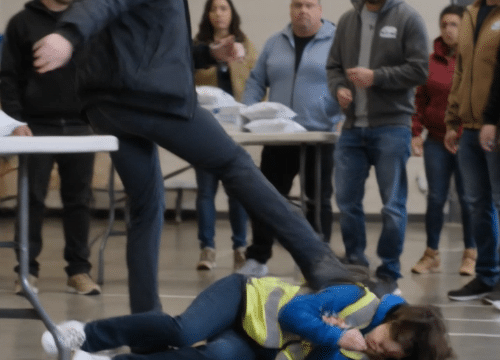
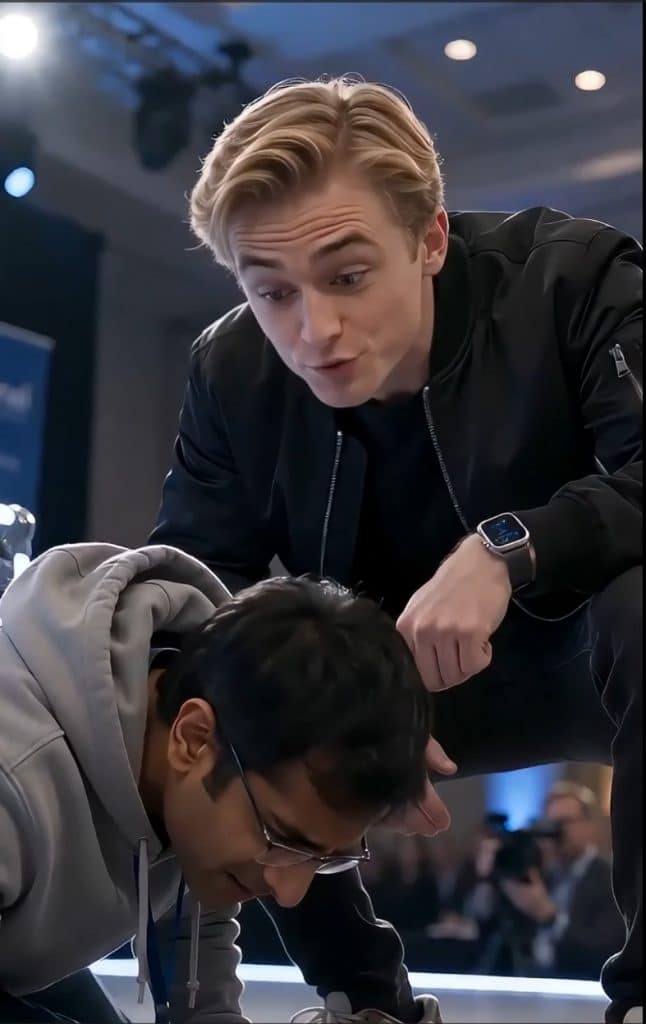
Dr. Arjun Patel landed beside the case.
His gray hoodie twisted at the shoulder. His thin glasses slipped down his nose. A small mark appeared near his lip, but he did not swing back, did not shout, did not even reach first for his face.
He reached for the goggles.
As if safety mattered more than humiliation.
The man who had punched him stood over him in a black bomber jacket, designer sneakers planted wide, smart watch glowing on his wrist like a tiny badge of importance. His blond hair was styled perfectly. His grin was not.
It was smug.
Ugly.
Performed for the cameras.
“Innovation is for founders,” the man snapped, pointing toward the exit. “Not basement coders looking for free snacks.”
The insult froze the conference hall.
Investors stopped whispering in the front rows. Engineers looked up from laptops. Journalists lowered their cameras, then raised them again because the instinct to record humiliation often arrives faster than the instinct to stop it.
On the glowing stage behind them, sponsor banners framed the robotics demo area like a shrine to ambition.
The man who threw the punch was Tyler Grant, founder of a fast-rising robotics startup called NuroSpan. He had spent the morning telling anyone with a badge that his company was “redefining machine intelligence for the human age,” though no one had yet seen his product work outside a polished slide deck.
Dr. Patel had only stepped near the demo platform to shut down a robot arm that was moving out of calibration.
Tyler saw a hoodie.
Sneakers.
A low-clipped access badge.
A man too quiet to be powerful.
That was all he needed.
Then the backstage curtain moved.
A woman in a red blazer rushed out with a headset mic and a digital run-of-show tablet pressed against her chest. Elena Morales, the conference MC, stopped hard when she saw Patel on the floor and Tyler standing over him.
Her face changed from panic to recognition.
Then to fear for the entire conference.
She hurried to Patel and lowered her voice with open respect.
“Dr. Patel,” she said, clearly enough for the microphones to catch, “your keynote is scheduled in three minutes.”
The main LED screen flickered.
Tyler’s startup logo vanished.
A keynote slide appeared in its place.
DR. ARJUN PATEL
Lead Robotics Scientist
Opening Keynote: Machines That Learn to Protect
The audience gasped.
Tyler’s grin collapsed.
“Dr… Patel?”
Act II
Arjun Patel had spent most of his life making machines quieter.
Not weaker.
Quieter.
He believed the best technology did not announce itself with arrogance. It noticed the moment before harm, adjusted before damage, helped before anyone begged for help. A good robot, he often told his students, should not make people feel impressed first.
It should make them feel safe.
That belief came from his mother.
She was a physical therapist in Fremont who worked with stroke patients, injured workers, children with mobility challenges, and elderly people learning to trust their own bodies again. Arjun grew up after school in the corner of her clinic, doing homework while people practiced walking between parallel bars.
He watched machines fail them all the time.
Rigid braces that pinched. Cheap mobility aids that broke. Rehabilitation devices designed by people who had never spent an afternoon beside someone ashamed of falling.
His mother used to say, “The patient is not the problem the machine must solve. The machine must learn the patient.”
Arjun carried that sentence into college, then graduate school, then the robotics lab where he became famous long before most people knew his face. His research changed adaptive motion systems. His team built robots that could sense instability in a patient’s posture and respond gently instead of forcing correction. Hospitals began using his work. Rescue teams adapted it for hazardous environments. Assistive robotics companies licensed his algorithms.
He disliked attention.
That made him valuable to men who loved it.
Dr. Patel’s name appeared on papers, patents, and keynote programs, but he rarely appeared in glossy videos. He preferred labs to stages, peer review to applause, working prototypes to investor slogans. He dressed like someone who expected to crawl under a demo table at any moment because he often did.
The San Francisco conference was supposed to be different.
Elena Morales had convinced him to give the opening keynote because the field was drifting in a dangerous direction. Founders were raising money on robotics demos that barely worked. Safety language was being twisted into branding. Engineers were being pushed to ship systems before they understood the people those systems could hurt.
“You need to say it on a big stage,” Elena told him.
Arjun resisted.
Then one of his former students sent him a video.
A warehouse robot had malfunctioned during a private investor preview. No one was badly hurt, but the incident had been hidden. The company behind it called the event “an unexpected interaction.”
Arjun hated that phrase.
Unexpected interaction.
A polished way to avoid saying near miss.
So he agreed to keynote.
Machines That Learn to Protect.
That was the title.
He arrived at the conference early, wearing a gray hoodie, dark jeans, sneakers, and a small robotics access badge clipped low because he did not like lanyards swinging near machinery. He checked the demo area before his talk the way he always checked labs before students entered.
That was when he saw Tyler Grant’s robot arm drifting past its safety boundary.
And that was when he stepped in.
Act III
Tyler Grant had built a company out of confidence and borrowed vocabulary.
He knew how to stand under lights. He knew how to say “embodied intelligence,” “adaptive autonomy,” and “human-centered systems” with the intense eye contact investors mistook for vision. He knew how to turn incomplete work into urgency, urgency into funding, and funding into another stage.
He did not know how to listen to engineers who told him no.
That had become a problem.
NuroSpan’s demo robot was supposed to appear during a founder showcase after Patel’s keynote. Its arm was sleek, white, and beautiful under LED lighting, but its safety layer was unstable. The engineering team had warned Tyler that the system needed another month.
Tyler told them that fear was not a product strategy.
Then he cut the caution slide from the presentation deck.
Arjun noticed the issue before most people knew there was one.
The robot arm was performing a simple object-sort routine near the platform edge, but its calibration was wrong by a few degrees. Not dramatic. Not visible to a casual observer. But enough that, during a live demo, it could swing into the presenter space if someone crossed the line at the wrong moment.
Arjun reached for the safety goggles first.
Then the emergency software lock.
A junior engineer from NuroSpan saw him and whispered, “Thank you.”
That whisper told Arjun more than the robot did.
He was entering someone else’s fear.
Then Tyler arrived.
“What are you doing?” Tyler demanded.
Arjun did not look up.
“Powering down your arm.”
“My arm?”
“The safety boundary is misaligned.”
Tyler laughed once, loud enough for nearby cameras.
“Do you work here?”
“In a way.”
“Great. A hoodie guy with access.”
Arjun tapped the shutdown confirmation.
The robot arm slowed.
Tyler’s smile sharpened.
“You just interrupted a private demo.”
“I stopped an unsafe one.”
Tyler stepped closer.
Several investors turned.
The press noticed.
Tyler noticed them noticing.
That was the real ignition.
He could survive a technical correction. He could not survive looking corrected.
“You people are all the same,” Tyler said. “You hover around conferences, touch things you don’t understand, then call it expertise.”
Arjun finally looked at him.
“I understand this system well enough to know it shouldn’t be live.”
Tyler’s jaw tightened.
“This is my company.”
Arjun looked at the robot arm.
“Then you should care whether it hurts someone.”
The sentence exposed too much.
Not only the machine.
The man.
Tyler punched him.
The goggles flew.
The robot powered down.
And the conference saw exactly what happens when performance mistakes caution for weakness.
Act IV
Elena Morales did not ask the audience to calm down.
She knew better.
Rooms like that did not need calming. They needed truth, quickly, before the wrong person regained the microphone.
“Cut the founder showcase feed,” she said into her headset.
A producer replied, “We’re live to the overflow stream.”
“Then they can watch us handle it correctly.”
She knelt beside Dr. Patel.
“Can you stand?”
Patel nodded.
One of the engineers moved to help him, then stopped, unsure. Patel noticed and gave him a small nod.
“It’s all right.”
He stood slowly.
The crowd stood with him in spirit, if not in body. You could feel it: a room of people realizing that the man in the hoodie was not a trespasser, not tech support, not a nobody.
He was the reason half of them had bought tickets.
Tyler stared at the keynote slide as if the screen had betrayed him.
“Dr. Patel,” he said quickly, voice changing shape, “I didn’t recognize you.”
Patel picked up the goggles from the floor.
“No,” he said. “You didn’t.”
Tyler swallowed, almost relieved.
Then Patel continued.
“But you recognized someone you thought you could humiliate.”
The silence after that was enormous.
It swallowed the hum of the LED wall, the camera shutters, the nervous typing from reporters in the second row.
Elena stood beside Patel and looked toward security.
“Mr. Grant is removed from the demo floor.”
Tyler’s eyes widened.
“You can’t remove me. I’m a sponsor.”
Elena’s voice stayed professional.
“You were a sponsor.”
A few investors exchanged looks.
That single past-tense word cost Tyler more than he understood.
A NuroSpan engineer stepped forward, face pale.
“The arm wasn’t cleared,” she said.
Tyler turned on her.
“Don’t.”
She flinched, but her voice continued.
“We filed the safety note yesterday. He overrode it this morning.”
Another engineer lifted his hand slightly.
“I can confirm.”
The conference hall changed.
This was no longer about a punch.
It was about a culture everyone in tech recognized and too many people had learned to survive: the founder who sold risk as courage, doubt as weakness, engineers as replaceable, safety as bad storytelling.
Patel looked at the robot arm, now motionless on the platform.
Then at Tyler.
“Your product did not fail today,” he said. “Your judgment did.”
Tyler’s face tightened.
“Dr… Patel?”
This time, Patel did not answer.
The keynote slide behind him already had.
Act V
The keynote began eleven minutes late.
No one left.
If anything, more people crowded near the side aisles, phones lowered now, not because there was nothing to record, but because something in the room had become too serious for performance.
Dr. Patel walked to the center of the stage with the clear safety goggles in one hand.
He did not change clothes. He did not clean himself into a more acceptable version of authority. The gray hoodie stayed. The dark jeans stayed. The small mark near his lip stayed visible under the stage lights, quiet evidence of what arrogance had tried to do before the speech even began.
Elena introduced him again.
This time, the applause lasted too long.
Patel waited it out with visible discomfort.
Then he placed the goggles on the podium.
“I was going to begin,” he said, “with a slide about safety boundaries.”
A nervous laugh moved through the crowd.
He did not smile.
“I think we can begin without the slide.”
The room became still.
Patel looked toward the powered-down robot arm.
“In robotics, a boundary is not an obstacle to innovation. It is what allows innovation to enter the world without harming the people around it.”
He paused.
“The same is true of power.”
That sentence traveled through the hall like current through a wire.
For forty minutes, Dr. Patel spoke about machines that learned to protect. But everyone knew he was speaking about more than machines. He talked about assistive robotics and patient dignity. Warehouse automation and worker safety. Emergency-response robots designed to support first responders instead of impress investors. He spoke about the responsibility of anyone who builds a system that can move, decide, adapt, or fail near human beings.
Then he spoke directly to the culture that had made Tyler Grant possible.
“Speed is not a moral value,” he said. “Scale is not a moral value. Disruption is not a moral value. If a company cannot listen to the people warning it about danger, then it is not building the future. It is gambling with someone else’s body.”
No one clapped at first.
They were too busy absorbing the accusation.
Then, from the engineering section, applause began.
Slow.
Then stronger.
By the time it reached the investors, some clapped because they agreed, and some because not clapping had become its own statement.
That was fine.
Patel was not asking for purity.
He was asking for accountability.
The fallout began before the conference ended.
NuroSpan’s demo slot was canceled. Its sponsor banner came down by afternoon. Two investors announced they were pausing commitments pending safety review. By night, the video of the punch was everywhere, but the clip that lasted longer was not the impact.
It was Patel’s line.
Speed is not a moral value.
The phrase became quoted, reposted, argued over, printed on slides, mocked by people who wanted technology without conscience and repeated by people who were exhausted from being called blockers for doing their jobs.
Tyler issued a statement.
It was bad.
Then a second statement.
Worse.
By the end of the week, NuroSpan’s board placed him on leave. The internal safety complaints leaked. Engineers who had been dismissed as negative were suddenly invited into rooms where decisions were made.
Some of them accepted.
Some left anyway.
Patel did not celebrate.
He had seen too many institutions mistake one punished man for one solved problem.
Instead, he worked with Elena to build something lasting from the wreckage.
The conference created a new rule: no robotics system could demo live without independent safety review. Engineers, not founders, had final authority to pause demos. Safety officers could not be overruled by sponsors. Every founder showcase required technical sign-off from the people who actually built the product.
Some sponsors complained.
Elena sent them the new policy and one sentence.
Innovation that cannot survive inspection is marketing.
Patel approved of that.
Months later, he returned to the same conference hall for a smaller robotics ethics workshop. The stage looked different without the giant sponsor spectacle. Less glamorous. More useful.
On a table near the entrance sat the clear safety goggles from the day of the punch.
Patel had not wanted them displayed.
Elena insisted.
“People remember objects,” she said. “Especially ones that slid across a floor while everyone watched.”
The plaque beneath them read:
Protective equipment is not only for machines.
Patel pretended to dislike it.
He did not.
A young engineer stood near the display for a long time after the workshop. She finally approached Patel during a break.
“I was on a team like that,” she said.
He did not ask which company.
She looked back at the goggles.
“I kept thinking maybe I was too cautious.”
Patel shook his head.
“Caution is not the opposite of courage.”
Her eyes softened.
“What is?”
“Pretending not to see risk because someone powerful wants applause.”
She nodded once, as if something inside her had been put back in place.
Years later, people still told the story of the San Francisco conference.
The startup founder punched a man in a hoodie.
The goggles slid across the stage.
The MC ran out with a tablet.
The man was Dr. Patel.
Dr… Patel?
It was satisfying because arrogance panicked in front of the investors it had been trying to impress.
But Patel never liked that version best.
It made status the twist.
That was too small.
The punch had been wrong before the keynote slide appeared.
The insult had been ugly before anyone saw his portrait on the LED screen.
The man on the floor had deserved protection before the room learned he was the lead scientist.
That was why Patel kept returning to stages he did not enjoy.
Not for applause.
Not for prestige.
Not because the world needed another famous technologist in a hoodie.
He returned because somewhere in every audience sat a young engineer, researcher, tester, nurse, technician, or quiet person with a safety concern they had been taught to swallow.
He wanted them to hear him say what no ambitious room should forget.
A future built on humiliation is already broken.
A machine that cannot be questioned is unsafe.
And a person does not become worthy of respect when their title appears on a screen.
They were worthy the moment they stepped onto the floor.