Act I
“You scratched a government officer’s vehicle.”
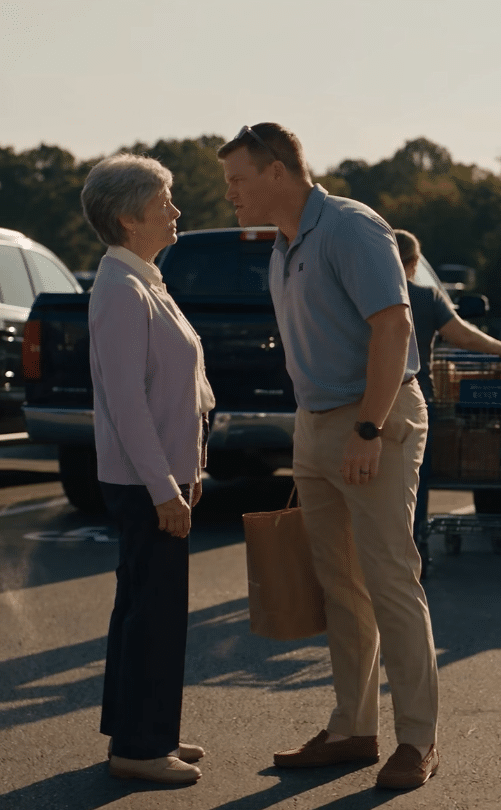
The colonel’s voice cut through the noise of the busy grocery store parking lot. He stood beside an expensive SUV, his sunglasses reflecting the afternoon sun, one hand pointing accusingly at an elderly woman in a pale-blue cardigan.
She was sixty-eight years old, with short silver hair and a grocery cart full of ordinary weekend purchases. Nothing about her appearance suggested power, wealth, or influence. She looked like someone who had come to buy bread, milk, and vegetables before heading home.
But she did not look afraid.
“That cart never touched the paint,” she replied calmly.
The colonel’s jaw tightened. He was forty-eight, dressed in an expensive golf shirt, khaki trousers, and polished loafers. He carried himself like a man accustomed to having the last word, and his confidence seemed to grow whenever he believed the person standing before him had no power to challenge him.
A few shoppers slowed their steps. A mother beside a minivan pulled her child closer, while an older man paused with one hand resting on his shopping cart.
The colonel glanced at the woman’s cardigan, then at her worn walking shoes.
He had already decided what kind of person she was.
Without warning, he grabbed a grocery bag from her cart and hurled its contents at her. Tomato sauce splattered across her silver hair and pale-blue cardigan. Packaged food scattered over the asphalt, and the woman instinctively raised her hands to protect her face.
Then he slapped her.
The crack echoed between the parked vehicles.
Her head snapped to one side. Before she could regain her balance, he shoved her backward, sending her onto the pavement. She caught herself with both palms, scraping them against the rough asphalt as her groceries spilled around her.
For a moment, the parking lot seemed to stop breathing.
The woman remained conscious, one hand guarding her reddened cheek. A faint trace of blood appeared at the corner of her mouth, but she made no attempt to plead with him or beg him to stop.
The colonel looked down at her as though he had just corrected an inconvenience.
“People like you should stay away from officers.”
Nobody moved.
Several people had witnessed everything. One woman held her phone in trembling fingers, uncertain whether to call for help or record what had happened. Another shopper stared at the scattered groceries, unable to comprehend how a minor argument over a car’s paintwork had become an assault.
The colonel adjusted his sunglasses.
He expected tears. He expected apologies. Most of all, he expected the elderly woman to understand that he was someone she should never have challenged.
Instead, she slowly pushed herself upright.
And when she finally looked at him again, there was something in her expression that made his smile falter.
He had humiliated her in front of an entire parking lot.
He had no idea who had just witnessed it.
Act II
The woman steadied herself against the shopping cart, breathing carefully through the pain in her cheek.
Her cardigan was stained, her silver hair was tangled with tomato sauce, and her palms stung where they had struck the pavement. Yet she moved with a quiet precision that seemed strangely out of place in the middle of the chaos.
She picked up one fallen grocery item and placed it back in the cart.
Then another.
The colonel watched her, growing irritated by the absence of the reaction he wanted.
“Are you even listening to me?” he demanded, stepping closer.
She did not answer.
For years, he had lived by a simple assumption: authority belonged to whoever could make another person afraid. His rank mattered to him, but so did the expensive things surrounding it, the titles people used when addressing him, and the way strangers instinctively stepped aside when he entered a room.
He had learned to confuse respect with submission.
In his mind, a government officer’s vehicle was not merely a vehicle. It was a symbol of status, and anyone who supposedly threatened it had to be put in their place.
The woman before him did not fit into his understanding of the world.
She was old enough to be his mother. She had no uniform, no visible security detail, and no obvious means of protecting herself. Yet even after he struck her, she refused to lower her eyes.
That refusal angered him more than the alleged scratch ever had.
“Look at the mess you made,” he muttered, gesturing toward the groceries he had scattered himself.
A shopper standing near a pickup truck shook his head in disbelief. The woman beside the minivan whispered something to her husband, who was already watching the colonel with open disgust.
Nobody applauded him. Nobody rushed to defend him.
But the colonel seemed too consumed by his own anger to notice.
He had spent years believing that his position made him untouchable. He assumed the people around him would always calculate the risks before daring to oppose him.
And if someone did complain, he believed the complaint could be dismissed, buried, or explained away.
What he failed to understand was that the elderly woman had not remained silent because she was powerless.
She had remained silent because she was deciding what to do next.
She carefully wiped the corner of her mouth with a tissue. Then she reached into her pocket and took out her phone.
The colonel gave a short, contemptuous laugh.
“Who are you calling? The police?”
She looked at the screen, selected a contact, and lifted the phone to her ear.
Her voice was steady when she spoke.
“West Market parking lot. Five minutes.”
She ended the call.
That was all.
No explanation. No accusation. No threat.
For the first time since the confrontation began, the colonel appeared uncertain.
Then he recovered himself, forcing a smirk onto his face.
“Call your whole family.”
He said it loudly enough for the surrounding shoppers to hear, turning the words into one final attempt to humiliate her.
The woman lowered her phone.
She did not argue.
She simply stood beside her damaged groceries and waited.
The colonel turned toward his SUV, convinced that whatever she had done would amount to nothing.
Five minutes, he thought.
What could possibly happen in five minutes?
He was about to find out.
Act III
The first sign was the sound of engines.
At the far end of the parking lot, several dark military vehicles entered the lane in a coordinated procession. Their movement was controlled and deliberate, cutting through the ordinary weekend traffic of minivans, pickup trucks, and shoppers searching for empty spaces.
Heads turned.
A man pushing a cart stopped in the middle of the lane. The woman beside the minivan lowered her phone slightly, staring toward the approaching convoy.
The colonel heard the engines too.
At first, he barely glanced in their direction. Military vehicles were not unheard of in the area, and he had no reason to believe they had anything to do with a dispute over a parked SUV.
Then the lead vehicle slowed.
Another followed.
The convoy moved directly toward the section of the lot where the elderly woman stood.
The colonel straightened.
The woman did not.
She remained beside her cart, her stained cardigan hanging loosely around her shoulders. Her expression had settled into the same quiet composure she had possessed before the first accusation.
A military vehicle stopped nearby.
Its door opened.
A senior figure stepped out.
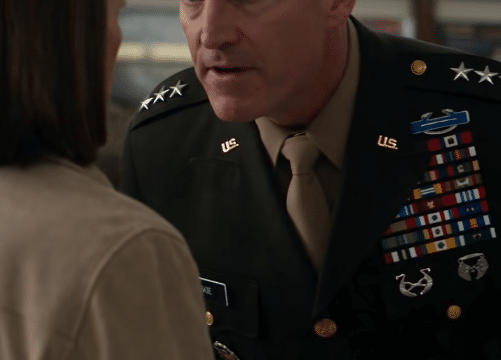
The camera revealed no face. Only the broad shoulders of a formal uniform covered with stars, the dense rows of ribbons and decorations across the chest, the sharply pressed trousers, and the polished boots touching the asphalt.
Every detail suggested a level of authority far beyond anything the colonel had expected to encounter that afternoon.
The senior figure moved away from the vehicle.
Another door closed behind him.
Footsteps crossed the parking lot, measured and unhurried.
The shoppers who had witnessed the assault watched in silence. Even the people who had been moving toward the grocery store entrance seemed reluctant to interrupt what was unfolding.
The colonel’s expression changed.
He knew enough about military protocol to recognize that the approaching officer was not someone who could be casually dismissed. The stars on those shoulders represented a level of command that made his own position seem suddenly, painfully small.
He looked toward the elderly woman.
She was not surprised.
That was the first thing he noticed.
She did not look toward the convoy with the bewilderment of someone witnessing an unexpected spectacle. She watched the approaching figure as though she had known precisely when the vehicles would arrive.
The colonel swallowed.
Perhaps she knew someone important, he thought. Perhaps she had called a relative who happened to serve in the military. Perhaps the situation was still something he could explain away.
He reached for the familiar defenses that had always protected his pride.
He had been provoked.
He had been protecting government property.
She had disrespected him.
But the explanations were already beginning to sound hollow, even inside his own head.
Because the woman had not called for a crowd.
She had not threatened to expose him.
She had simply given someone a location and a time.
And someone with extraordinary authority had come.
The senior figure continued toward her, his face remaining outside the camera’s view.
The colonel watched the decorated shoulders, the ribbons, and the polished boots.
Then he noticed the direction in which the officer was walking.
Not toward the SUV.
Not toward the colonel.
Toward the woman he had thrown onto the pavement.
And suddenly, the entire parking lot seemed to tilt beneath him.
Act IV
The colonel had faced difficult inspections, tense briefings, and confrontations with officers whose approval could influence his career.
But none of those experiences had prepared him for the silence that followed the senior figure’s arrival.
There was no shouting.
No dramatic announcement.
No one needed to explain the rank displayed across that uniform.
The approaching officer continued forward, and the colonel found himself standing rigidly beside his SUV, his hands no longer moving with their earlier confidence.
He looked at the elderly woman again.
The stains on her cardigan had not disappeared. Her cheek was still red and beginning to swell. The groceries lay scattered around the cart, and the faint mark at the corner of her mouth remained visible.
The evidence of what he had done was right there in front of him.
He had slapped her because he believed she could not retaliate.
He had shoved her onto the asphalt because he believed nobody important would care.
And he had mocked her phone call because he assumed that anyone she contacted would be just as insignificant as he imagined her to be.
Now a senior military officer had arrived within minutes of that call.
The colonel’s sunglasses suddenly felt like a poor disguise for his growing alarm.
He shifted his weight, then stopped himself. His gaze darted toward the people who had witnessed the assault.
They were still watching.
The man beside the pickup truck had not looked away. The woman with the phone held it at chest level, her expression transformed from shock into grim attention.
A few minutes earlier, the colonel had controlled the entire encounter. He had decided when to speak, when to move closer, and when to strike.
Now he could not control a single pair of eyes in the parking lot.
The senior figure reached the woman.
Only the decorated shoulders and uniform remained visible. The camera never revealed the officer’s face, and no one announced his identity.
The woman lifted her chin slightly.
There was no triumphant smile on her face. No gesture inviting the crowd to admire her revenge. She did not point at the colonel or make a show of her injuries.
She simply stood her ground.
That quiet dignity unsettled the colonel more than any accusation could have.
He tried to reconcile what he was seeing with what he had believed only moments earlier. The woman had looked ordinary. She had spoken calmly. She had refused to fight back.
He had mistaken all of those things for weakness.
Now he was beginning to understand that a person’s appearance could tell him almost nothing about the life behind it.
The convoy stood behind the senior officer. The shoppers watched from a cautious distance. The colonel’s expensive SUV remained parked exactly where it had been when he started the argument.
Nothing about the vehicle had changed.
But everything about the situation had.
He looked from the senior officer to the woman again, searching her face for an explanation she had never offered.
Then a possibility emerged in his mind.
It was so unexpected that he almost rejected it immediately.
He stared at the woman’s silver hair, her familiar composure, and the way she seemed entirely unafraid of the decorated officer standing before her.
His mouth opened slightly.
For the first time, the colonel looked less like a man accustomed to giving orders and more like someone who had just realized he had made a catastrophic mistake.
Because the person he had humiliated might not have been an ordinary stranger at all.
And the person who had answered her call might be connected to her in a way that made the colonel’s behavior far more dangerous than he had imagined.
Then the truth struck him.
Act V
The colonel’s face lost its color.
His eyes moved from the senior officer’s decorated shoulders to the elderly woman, then back again. The confidence that had carried him through the confrontation dissolved so completely that even his posture seemed to betray him.
He had thought her age made her an easy target.
He had thought her ordinary clothes meant she had no influence.
He had thought that because she stood alone, nobody would come for her.
But the convoy had arrived.
The officer was standing beside her.
And the woman who had refused to beg was looking at the colonel with the same steady expression she had worn before he raised his hand.
He tried to speak, but no explanation came.
The camera moved closer, isolating him against the blurred shapes of the parking lot. The military vehicles disappeared into the background. The shoppers vanished from view.
There was only the colonel’s face.
The man who had been so eager to lecture an elderly woman about respecting officers now looked terrified of what her single phone call might mean.
His gaze flicked once more toward the senior figure.
Then he turned back to the woman, disbelief overtaking every trace of arrogance.
“That’s your daughter…?”
The words escaped him as a question, almost a whisper.
His expression held the full weight of the realization he had been trying to avoid.
The senior officer he had just seen was apparently connected to the woman he had assaulted in a way he had never anticipated. The family relationship he had failed to imagine was suddenly the one fact he could no longer ignore.
The woman said nothing.
She did not need to.
The colonel had already revealed his deepest mistake. He had not merely misjudged one elderly shopper. He had built his entire understanding of respect around the idea that people deserved dignity only when they possessed enough status to demand it.
And now, faced with the possibility that the woman he had treated as insignificant was the mother of someone far more powerful than himself, he could barely hold his expression together.
But the most damning part of the afternoon had nothing to do with the stars on a uniform.
The witnesses had seen what he did before the convoy arrived.
They had watched him throw food at an older woman, strike her across the face, and shove her onto the pavement. They had heard him mock her while she struggled to stand.
No rank could erase those moments.
No explanation could make the scattered groceries disappear or turn the assault into an act of justified authority.
The woman had not needed to threaten him. She had not needed to reveal her family connection to earn the basic respect he had denied her.
She had deserved that respect from the beginning.
The colonel’s final question hung in the air, unanswered, as the scene cut to black.
And for the first time that afternoon, he was the one left standing without a defense.