Act I
“That seat isn’t for people like you.”
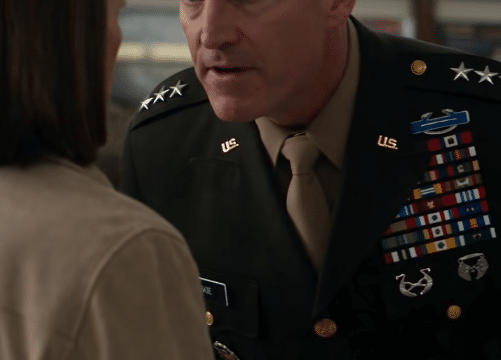
The brigadier general delivered the insult loud enough for the nearest banquet tables to hear. Crystal glasses trembled as guests turned toward the confrontation, their conversations fading beneath the sudden tension inside Convention Hall B.
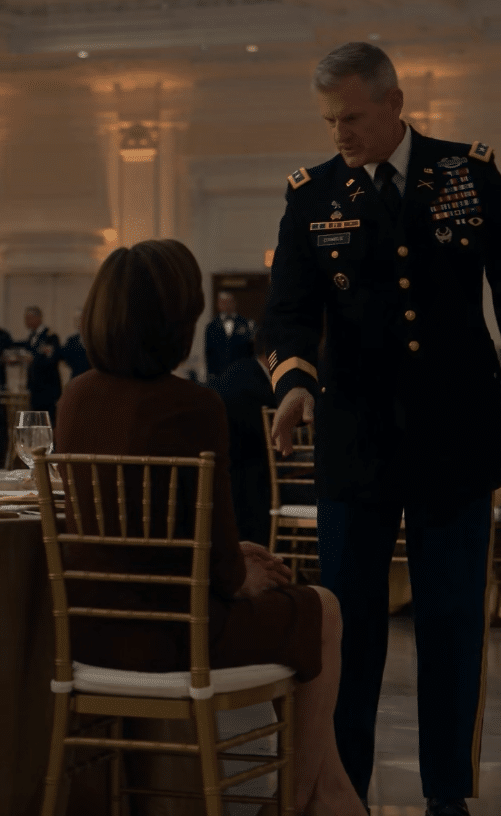
The woman standing before him wore a forest-green evening dress, black heels, and a simple gold necklace. At forty-seven, with short brown hair and an unmistakably composed expression, she looked like someone who had come to enjoy the veterans charity banquet, not become the center of a public spectacle.
She glanced at the chair he was guarding.
“Then show me the name on it.”
For a moment, the general simply stared at her.
He was fifty, dressed in a decorated military uniform, with rows of ribbons and insignia that announced his rank before he ever opened his mouth. Around him sat donors, retired service members, and active-duty officers who had gathered to support veterans and their families.
He was accustomed to being noticed.
More importantly, he was accustomed to being obeyed.
The woman had neither stepped aside nor apologized. Her calm response had challenged him in front of people whose approval he desperately wanted.
His expression hardened.
He seized a nearby wineglass and flung its contents into her face. Red wine splashed across her cheeks and the front of her dress before he hurled the glass onto the floor.
It shattered beside the chair.
A woman at the nearest table gasped. Someone pushed back from the table so abruptly that a chair scraped across the floor.
The general was not finished.
He struck the woman hard across the cheek. Her head turned with the impact, and a red mark immediately began spreading across her skin. Before she could regain her balance, he drove a punch into her stomach.
She doubled forward, struggling to catch her breath, and fell painfully beside the banquet chair.
The room froze.
The woman remained conscious, one arm protecting her abdomen as she fought to breathe normally. A faint trace of blood appeared at the corner of her mouth, but she made no attempt to plead with the man standing above her.
The general looked down at her with cold contempt.
“You don’t sit where command sits.”
He straightened his uniform, as though the assault had been nothing more than an unpleasant interruption.
Around him, guests stared in disbelief. Some recognized the insignia on his chest. Others recognized the unmistakable cruelty of a powerful man using his position to silence someone who had refused to flatter him.
Nobody moved during the assault.
Nobody had expected to witness a senior officer behave this way at a charity event honoring people who had served their country.
The general looked around the room, apparently satisfied that he had restored his authority.
Then the woman slowly raised her head.
Despite the pain, despite the wine staining her dress, and despite the hundreds of eyes watching her, she looked directly at him.
There was no fear in her expression.
Only a quiet resolve that made his confidence feel suddenly less secure.
He had humiliated her in front of the entire banquet.
But the woman was about to make one phone call.
And the man who answered would change everything.
Act II
For several seconds, the woman remained beside the fallen chair, one hand pressed against her abdomen.
Her breathing came in short, guarded pulls. She waited until she could straighten without collapsing again, then carefully pushed herself upright, using the edge of the table for support.
Wine dripped from the hem of her dress.
She glanced at the broken glass on the floor, then at the general.
He seemed almost offended that she had managed to stand.
Most people in his world had learned to read a decorated uniform as a warning. They adjusted their language, softened their disagreements, and offered smiles even when they had nothing to smile about.
He had mistaken that behavior for admiration.
Over the years, the distinction had disappeared entirely.
At professional functions, he enjoyed being introduced before everyone else. He expected donors to remember his name and junior officers to anticipate his preferences. Even at a charity banquet, where the evening was supposed to honor veterans rather than glorify senior leadership, he had found a way to make the occasion revolve around his own importance.
The reserved seating area had become another opportunity to demonstrate who belonged and who did not.
The woman had ruined that performance by asking a simple question.
Show me the name on it.
He could have answered her. He could have called an event organizer, checked the seating chart, or simply allowed her to take the chair while the confusion was resolved.
Instead, he had chosen violence.
Now, as the guests watched, he seemed to expect her to understand that the humiliation was over and that she should quietly disappear.
She reached into her small evening bag and removed her phone.
The general gave a dismissive laugh.
“What’s that supposed to accomplish?”
She ignored him.
Her fingers moved across the screen with steady precision. She selected a contact, lifted the phone to her ear, and waited for the connection.
The general watched her, irritation replacing his earlier satisfaction.
He wanted her to argue. He wanted her to threaten him so he could dismiss her as hysterical or unreasonable. He wanted an excuse to turn his own conduct into a story about an insubordinate civilian who had disrupted a formal military event.
Instead, she spoke only five words.
“Convention Hall B. Four minutes.”
She ended the call.
The words were so ordinary that several guests exchanged confused looks.
The general’s mouth curled into a sneer.
“Bring whoever taught you that attitude.”
He delivered the insult with deliberate theatricality, making sure the nearest tables could hear him.
Then he turned away, apparently convinced that the woman had called a friend, a relative, or perhaps an event employee who would arrive to apologize for the inconvenience she had caused him.
But the woman did not explain herself.
She placed the phone back in her bag and stood beside the chair, one hand still resting protectively against her abdomen.
A veteran at the next table watched her with a troubled expression. He had spent enough years around military leadership to understand that rank and character were not always the same thing.
The general had displayed plenty of the first.
He had shown almost none of the second.
As the seconds passed, the room gradually returned to a strained silence. Conversations did not resume. Nobody seemed eager to pretend the assault had not happened.
The general adjusted his ribbons and glanced toward the ballroom doors.
Four minutes.
He had challenged her to bring someone who could teach her a lesson.
He had no idea that the person arriving would be the one man whose presence could make every decoration on his own uniform feel insignificant.
Act III
The ballroom doors opened.
Two aides entered first, moving with the quiet precision of people accustomed to accompanying senior leadership. Behind them came a figure in a ceremonial military uniform.
The camera revealed no face.
Only four stars on the shoulders, an impressive array of decorations across the chest, sharply pressed formal trousers, and polished boots moving across the ballroom floor.
The room changed instantly.
Conversations died in mid-sentence. A retired veteran near the stage straightened in his chair. Several active-duty officers turned toward the entrance, their expressions shifting from curiosity to immediate recognition of the rank on display.
The general followed their gaze.
At first, he looked merely annoyed by the interruption.
Then he saw the four stars.
His expression tightened.
A four-star general occupied a level of authority that made the room’s ordinary social hierarchies seem suddenly irrelevant. The person approaching was not simply another distinguished guest or an influential donor.
This was someone whose presence demanded attention from nearly everyone wearing a uniform in the hall.
The brigadier general instinctively straightened his back.
He tried to compose his face, smoothing away the contempt that had been there moments earlier. His eyes moved toward the aides, then toward the decorated shoulders of the approaching figure.
He wondered why such a senior officer had arrived without appearing on the evening’s schedule.
Then he looked at the woman in the green dress.
She had not moved toward the entrance.
She had not looked surprised.
She simply watched the approaching figure with quiet familiarity.
That detail unsettled him.
The senior general continued across the ballroom, passing the tables and the stunned guests. The camera remained carefully framed from the shoulders down, never revealing the officer’s face.
The four stars caught the ballroom lights.
The decorations remained perfectly aligned against the formal uniform.
Each step brought the figure closer to the woman the brigadier general had assaulted only minutes earlier.
The general’s thoughts began racing.
Had she complained to someone in the command structure? Was she connected to a senior officer? Had he just assaulted a person whose family could bring his conduct under immediate scrutiny?
He searched his memory for anything she might have said that would explain the arrival.
She had offered no name.
No rank.
No threat.
Only a location and a time.
The senior officer passed another table, and several guests instinctively shifted aside to clear the way.
The woman remained still.
For the first time, the brigadier general noticed the difference between her composure and his own.
She had been struck in front of hundreds of people and still refused to surrender her dignity.
He, meanwhile, was standing in a room full of witnesses, desperately trying to conceal the fear beginning to take hold of him.
The senior figure stopped near the woman.
Only the decorated uniform, the four stars, and the polished boots remained visible.
The woman lifted her chin.
The general looked from the officer to her.
Then something about the scene began to make sense.
Not the whole truth.
Not yet.
But enough to make him wish he had never touched her.
Act IV
The silence inside Convention Hall B became almost unbearable.
The four-star general stood beside the woman in the green dress. The camera revealed only the uniform, its decorations, and the officer’s shoulders, preserving the mystery of the face that remained outside the frame.
The brigadier general could not stop looking.
A few minutes earlier, he had been the most important person in his immediate surroundings. Guests had listened when he spoke. Junior officers had recognized his rank. Donors had given him the deference he expected.
Now those same people were watching him with expressions he could not control.
He had wanted to demonstrate that the chair belonged to command.
Instead, he had demonstrated exactly what happened when someone confused command with personal entitlement.
His gaze returned to the woman.
She was still standing, although her posture was careful. Her cheek had reddened, and her breathing remained guarded after the blow to her stomach. Wine stained her dress, and the broken glass lay on the floor where he had thrown it.
There was no way to disguise what had happened.
He had done it in public.
In front of donors.
In front of veterans.
In front of officers who understood precisely how damaging an abuse of authority could be.
The general attempted to summon the confidence that had served him so well before the confrontation.
Perhaps he could explain the dispute as a misunderstanding. Perhaps he could claim that the woman had provoked him. Perhaps the presence of such a senior officer meant nothing more than an unfortunate coincidence.
But each possibility collapsed under the weight of what everyone had witnessed.
She had asked him to show her the name on a chair.
He had thrown wine in her face, shattered a glass, slapped her, and punched her in the stomach.
There was no plausible version of that sequence in which he emerged looking like a disciplined leader.
The woman glanced briefly toward the fallen chair.
Then she looked at him again.
She did not point at the senior officer. She did not demand an apology. She did not use her apparent connection to claim special treatment.
Her silence was not weakness.
It was a refusal to participate in the little performance he had tried to force upon her.
The general shifted his feet.
He could feel the room’s attention settling on him, and for the first time, he understood how exposed he was. The people who had watched him strike the woman were no longer merely spectators to an argument about seating.
They were witnesses to his character.
The senior figure remained beside her.
Four stars.
A full rack of decorations.
A level of authority the brigadier general could not casually challenge.
He looked at the woman once more, searching for the connection that would explain why she seemed so certain that someone would come.
Then the answer surfaced.
It was not simply that she knew a four-star general.
It was the possibility that she knew him in a way that rank, protocol, and formal introductions could never capture.
The brigadier general’s expression changed.
His shoulders stiffened.
The arrogance that had driven him to attack a woman over a chair gave way to a dawning, dreadful realization.
He had not humiliated a stranger who happened to attend a military banquet.
He had humiliated someone whose relationship to the approaching officer made his behavior an entirely different kind of mistake.
And when he finally understood that relationship, he would have no way to pretend that his earlier words had meant anything else.
Act V
The brigadier general stared at the woman.
The wine on her dress, the swelling on her cheek, and the careful way she protected her abdomen were no longer details he could dismiss as an unfortunate scene at a crowded banquet.
They were evidence of what he had done.
The four-star general remained beside her, his face still hidden from view. The aides stood nearby, and the entire ballroom seemed to wait for something that nobody wanted to be the first to say aloud.
The brigadier general tried to reconcile the scene with his assumptions.
He had judged the woman by her simple necklace, her unassuming dress, and her refusal to flatter him. He had decided that she did not belong among people he considered important.
He had believed that the uniform gave him the right to decide who deserved respect.
Now he was beginning to understand that the woman had never needed his permission to belong anywhere.
Her composure had not come from ignorance of the power in the room.
It had come from knowing exactly who she was.
And the person standing beside her was not merely an officer whose rank could intimidate a room full of guests.
He was her family.
The brigadier general’s face drained of color as the connection settled into place. His mouth opened, but for several seconds he seemed incapable of forming a complete sentence.
He looked from the four-star insignia to the woman, then back again.
The answer was suddenly so obvious that he could hardly believe he had failed to see it coming.
His voice emerged thin and uncertain.
“That’s your brother…?”
The question hung between them.
For the first time that evening, the brigadier general looked completely powerless. The man who had struck a woman for challenging his authority now seemed terrified of the consequences of discovering that she was the sister of someone whose authority dwarfed his own.
The camera stayed on his face.
No one else entered the frame.
There was no need for a dramatic speech or an immediate public confrontation. His expression had already exposed the truth about him more clearly than any confession could.
He had not cared whether the woman deserved the chair.
He had cared whether she looked important enough to occupy it.
He had not cared that she was attending a charity banquet meant to honor veterans.
He had cared that she refused to treat his rank as a personal crown.
And he had not stopped to consider whether she might have a life, a family, or a history beyond what he could see.
He had simply assumed that he could hurt her without consequence.
Now he understood that he had been wrong.
But the most important revelation was not that the woman had a four-star general for a brother.
It was that she had deserved dignity before the doors opened, before the aides arrived, and before the four stars appeared beneath the ballroom lights.
She had deserved it when she asked a simple question about a chair.
She had deserved it when the wine struck her face.
She had deserved it when she struggled to stand.
And she deserved it now, regardless of who had answered her call.
The brigadier general had spent the evening insisting that she did not belong where command sat.
In the end, it was his own conduct that would determine whether he belonged among the people entrusted to lead others.
His lips remained parted as he stared at the woman he had underestimated.
The ballroom stayed silent.
Then the scene cut to black, leaving his question unanswered and his arrogance in ruins.