Act I
The champagne hit her face before anyone in the ballroom had time to understand what was happening.
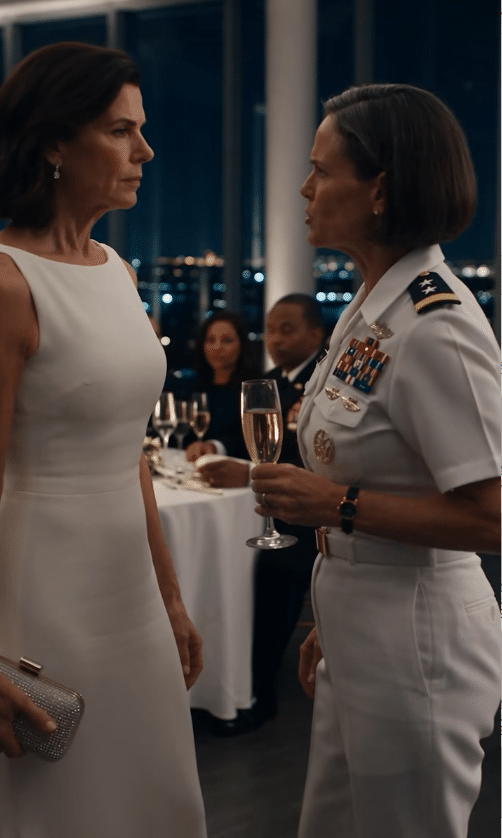
One moment, Morgan Hayes was standing quietly beside a dining table in an elegant white evening gown. The next, a female two-star general had thrown an entire glass of champagne at her, soaking her dress and sending the glass crashing onto the polished floor.
“You stepped on my shoe.”
The accusation had come over something so insignificant that several guests initially assumed it was a joke.
Morgan glanced down briefly before looking back at the woman confronting her. At forty-three, she had shoulder-length black hair, pearl earrings, and the kind of composed expression that made it difficult to tell what she was thinking.
“Barely. I’m sorry.”
It was a reasonable apology. A simple accident. Something that should have ended the confrontation before it began.
But Major General Victoria Sterling wasn’t interested in an apology.
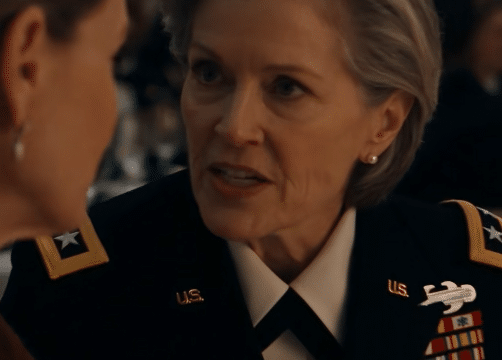
At forty-nine, Victoria had spent years cultivating an image of absolute authority. Her decorated Air Force uniform, perfectly arranged ribbons, and polished shoes were as much a part of her identity as her rank.
She was accustomed to people moving out of her way.
And she was especially accustomed to people apologizing when she demanded it.
“Sorry doesn’t fix disrespect.”
Before Morgan could respond, Victoria lifted her glass and emptied the remaining champagne across the front of her white gown.
A stunned silence spread through the surrounding tables.
Then came the slap.
Victoria struck Morgan across the face with enough force to turn her head. Morgan staggered, one hand instinctively reaching toward her cheek. A red mark began to rise beneath her skin, and a faint trace of blood appeared at the corner of her mouth.
But Victoria wasn’t finished.
She grabbed Morgan by the hair and pulled her away from the table, throwing her down beside a dining chair.
A woman gasped.
Someone dropped a fork.
Several uniformed officers stood halfway from their seats, seemingly unable to decide whether they had just witnessed a personal dispute or something far more serious.
Morgan remained conscious, her expression tight with pain.
She didn’t scream.
She didn’t beg.
And she didn’t tell Victoria who she was.
That silence would become the most expensive mistake the major general had ever made.
Because the woman lying on the ballroom floor was not an ordinary guest.
And within minutes, everyone in that room would learn exactly whom Victoria had just assaulted.
Act II
The Air Force anniversary dinner was supposed to be an evening of celebration.
Held high above the city in an exclusive hotel restaurant, the event brought together senior military officers, distinguished guests, retired commanders, and several prominent civilian officials.
Floor-to-ceiling windows overlooked the glittering skyline. Air Force flags stood beside the stage, while white tablecloths, crystal glasses, and carefully arranged floral centerpieces gave the ballroom an atmosphere of prestige.
This was not an ordinary dinner.
It was an evening dedicated to service, sacrifice, leadership, and the people who had helped shape the institution.
Victoria Sterling knew exactly how important the occasion was.
She had spent years building her reputation inside the military. Her promotions had brought her increasingly influential positions, and she had become particularly skilled at making sure everyone understood her authority.
Some officers admired her discipline.
Others privately considered her impossible to work with.
She had a habit of turning small mistakes into public lessons. A misplaced document, an incorrect form of address, or a junior officer arriving seconds late could become an opportunity for a humiliating lecture.
Victoria believed that fear was a form of respect.
And she rarely questioned whether the people around her actually respected her.
Morgan Hayes was different.
She had arrived without a visible military rank, wearing a simple but elegant white gown. Her pearl earrings and understated clutch suggested sophistication rather than an attempt to impress anyone.
She had greeted several guests warmly but had deliberately avoided making herself the center of attention.
To Victoria, that made her seem insignificant.
There was no uniform to identify her. No visible insignia. No entourage following her from table to table.
Victoria had made an assumption.
And because she was used to being the most powerful person in any room, she never considered the possibility that her assumption might be wrong.
What she didn’t know was that Morgan had spent much of her career working in environments where appearances meant very little.
She understood that leadership wasn’t measured by how quickly someone could command attention.
It was measured by what happened when nobody was watching.
Morgan had been invited to the anniversary dinner as one of the evening’s most distinguished guests. Her presence had been carefully coordinated by the event organizers, and the master of ceremonies had been instructed to make a formal announcement at the appropriate moment.
But before that announcement could happen, Victoria had turned a minor accident into a public assault.
And now the ballroom was waiting to see what Morgan would do next.
Act III
Morgan slowly pushed herself upright.
Her white gown was stained with champagne. One side of her hair had become disheveled, and her cheek was visibly swollen.
She reached for a napkin and carefully wiped the small trace of blood from the corner of her mouth.
Her movements were deliberate.
There was no frantic attempt to escape the room. No desperate search for someone who might protect her.
She simply straightened herself as much as possible.
Across from her, Victoria adjusted the front of her uniform.
The major general seemed almost satisfied.
She looked around the room, perhaps expecting someone to laugh nervously or offer an approving nod. Instead, she encountered a collection of uncomfortable expressions.
A senior colonel had stopped speaking entirely.
An older officer near the windows was staring at Morgan with visible concern.
Two women seated at the nearest table exchanged a look that seemed to communicate the same question.
How could this happen at an Air Force anniversary dinner?
Victoria interpreted their silence as uncertainty.
She assumed that nobody wanted to challenge her.
What she failed to notice was that several guests had begun looking toward the stage.
The master of ceremonies had received the signal that the formal program was about to continue.
He stepped forward, took his position, and waited for the room to settle.
A microphone came alive.
“Please stand and form the ceremonial aisle.”
The announcement immediately changed the atmosphere.
Chairs moved backward. Officers rose from their seats. Guests began forming two orderly lines through the center of the ballroom.
The ceremonial aisle was a familiar tradition at important military events. It was an expression of respect, reserved for distinguished guests and individuals whose service deserved public recognition.
Victoria straightened her shoulders.
For a moment, she appeared to believe the ceremony had nothing to do with the confrontation.
She even glanced toward the stage with the confidence of someone expecting another opportunity to demonstrate her own importance.
Then the master of ceremonies continued.
“Our distinguished guest, Lieutenant General Morgan Hayes.”
The room changed.
Not gradually.
Instantly.
Several officers turned toward the woman in the white gown.
A retired commander near the front of the ballroom stood completely upright, his expression shifting from confusion to recognition.
One by one, the senior officers began straightening their uniforms.
Victoria stopped moving.
The name had reached her ears.
But the meaning had not yet fully registered.
Lieutenant General Morgan Hayes.
She looked toward the woman she had just thrown onto the floor.
And suddenly, the champagne, the slap, the shattered glass, and the humiliation seemed to belong to a completely different story.
Act IV
Morgan Hayes rose to her feet.
She adjusted the fabric of her white gown, carefully smoothed her hair, and lifted her chin.
Her cheek still showed the consequences of Victoria’s attack.
But her posture had changed the entire room.
There was no need for her to announce her rank. No need to demand respect or explain why she had been invited.
The master of ceremonies had already done that.
Lieutenant General Morgan Hayes was not simply another senior guest attending a ceremonial dinner.
She was one of the Air Force’s most distinguished leaders, a three-star general whose career had taken her through years of demanding assignments and responsibilities.
Her reputation had been built on decisions made under pressure, difficult leadership challenges, and the trust of people who had served alongside her.
The officers forming the ceremonial aisle recognized the significance of the announcement.
They stood straighter.
Some looked toward Morgan with unmistakable respect.
Others appeared troubled as they noticed the condition of her face and the champagne covering her dress.
Morgan took her first step toward the aisle.
Victoria didn’t move.
Her eyes traveled from Morgan’s injured cheek to the white gown, then back to her face.
The realization was devastating.
The woman she had treated as an insignificant civilian was a lieutenant general.
A superior in rank.
A distinguished guest whose presence had been important enough to receive a formal ceremonial announcement.
Victoria’s confidence began to collapse.
Her shoulders, previously held high, lowered almost imperceptibly.
The aggressive expression that had dominated her face moments earlier disappeared.
She looked around for help.
But the room offered no reassurance.
The officers who had witnessed the assault were no longer looking at her with admiration or deference.
They were looking at her as a senior officer who had just demonstrated an extraordinary failure of judgment.
And worse, she had done it publicly.
There would be no private explanation that could erase what everyone had witnessed.
No convenient misunderstanding.
No claim that the incident had been exaggerated.
The shattered champagne glass was still on the floor.
The stain across Morgan’s gown was still visible.
And the witnesses were still standing there.
Morgan continued toward the center aisle.
She did not stop to confront Victoria.
She did not need to.
The ceremonial corridor opened before her as the officers stood in recognition of her position.
For Victoria, every second became unbearable.
She had spent years demanding that people respect her rank.
Now she was watching the entire room recognize someone she had just humiliated.
And the difference between them was suddenly impossible to ignore.
Act V
Victoria’s face lost its color.
She stared at Morgan as if the announcement might somehow be reversed.
But the name remained in the air.
Morgan Hayes.
The woman in the white gown was the same person Victoria had accused of disrespect over a shoe.
The same person she had drenched with champagne.
The same person she had slapped and dragged to the floor in front of dozens of witnesses.
Victoria’s lips parted.
For the first time that evening, she seemed unable to find the right words.
Her eyes widened as the implications began to settle in.
The incident had happened during an official anniversary celebration. Senior officers had witnessed it. The event staff had seen it. And the person she had assaulted was now walking through a ceremonial aisle formed in her honor.
Morgan reached the center of the ballroom.
Her expression remained controlled, although the pain in her cheek had not disappeared.
She looked ahead rather than back toward Victoria.
That was perhaps the most devastating part.
She didn’t need to humiliate the major general in return.
She didn’t need to raise her voice, threaten her career, or demand an apology in front of the guests.
The truth had already done something far more powerful.
It had revealed the difference between wearing authority and understanding it.
Victoria had believed that rank gave her permission to treat others however she pleased.
Morgan’s composure demonstrated the opposite.
Real authority did not need to announce itself through cruelty.
And real leadership did not disappear when someone was denied recognition.
The camera moved closer to Victoria’s face.
Her arrogance had vanished.
Her jaw trembled slightly, and her eyes remained fixed on the woman she had just attacked.
Then, barely able to believe what she was seeing, she whispered:
“Morgan Hayes…? No…”
For the first time in her career, Victoria Sterling looked genuinely afraid.
And the most frightening realization was not that Morgan Hayes outranked her.
It was that the entire ballroom had witnessed what Victoria had done before learning who Morgan was.
Because if a person’s dignity only deserves protection when their rank is known, then that person has never truly understood the meaning of service.
The anniversary dinner had begun as a celebration of the United States Air Force.
But by the time Morgan Hayes entered the ceremonial aisle, everyone in the room had been reminded of a far more important principle:
A uniform can display authority. It cannot manufacture character.