Act I
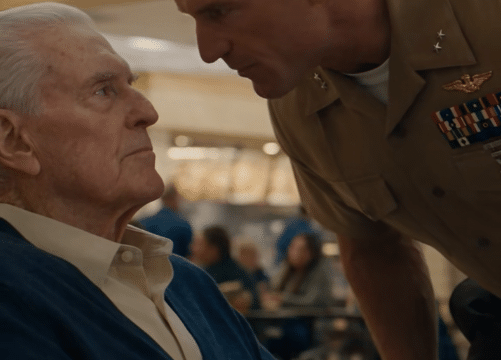
The old man was still on the supermarket floor when the colonel looked down at him and smiled.
A few feet away, a shopping cart stood crooked beside a wooden display of fresh vegetables. A handful of apples had rolled across the polished tile. The misting system hissed softly over the lettuce, and shoppers who had been reaching for tomatoes moments earlier now stood frozen, afraid to move.
It had started with something so small that nobody should have remembered it.
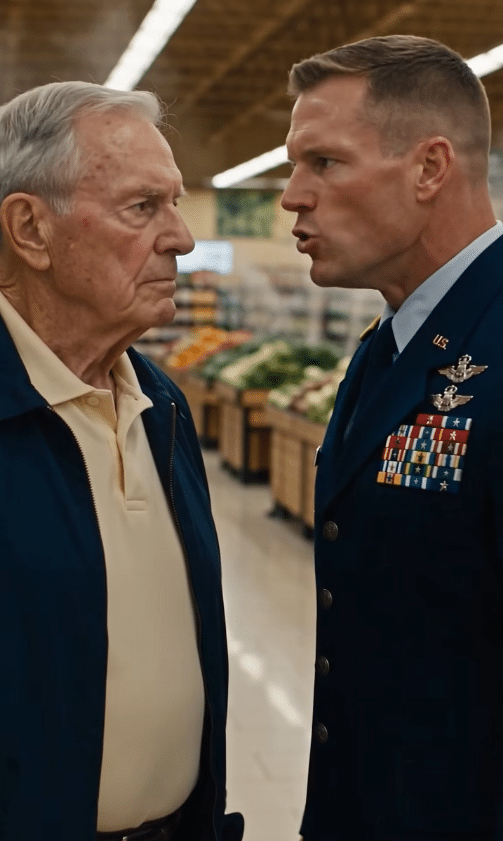
The colonel, a polished forty-six-year-old officer in a perfectly pressed Army service uniform, had been pushing his cart through the produce aisle when it brushed against the old man’s. The older man, seventy-one, wore an olive jacket over a cream polo shirt. His short silver hair and dignified face made him look like someone who had spent a lifetime learning not to make a scene.
The colonel turned sharply.
“You hit my cart.”
The old man glanced at the cart, then at him.
“Nothing happened.”
That should have ended it.
Instead, the colonel seemed offended by the calmness of the response. His silver eagle insignia caught the supermarket lights as he stepped closer, his polished shoes stopping just inches from the older man’s walking shoes.
He was accustomed to people moving when he entered a room. He was accustomed to being addressed carefully, obeyed quickly, and never questioned in public.
The old man had done none of those things.
And the colonel took it personally.
He struck him across the face.
The blow landed with brutal suddenness. The old man’s head snapped sideways, and a red swelling began to rise across his cheek. A thin trace of blood appeared at the corner of his mouth.
He stumbled backward, struggling to keep his balance.
Then the colonel kicked his right lower leg.
The impact struck the side where the old man’s prosthetic leg was concealed beneath his trousers. The support shifted out of its stable position, and his body twisted before he fell hard onto the tile.
One hand caught the floor.
His other pressed instinctively against his injured side.
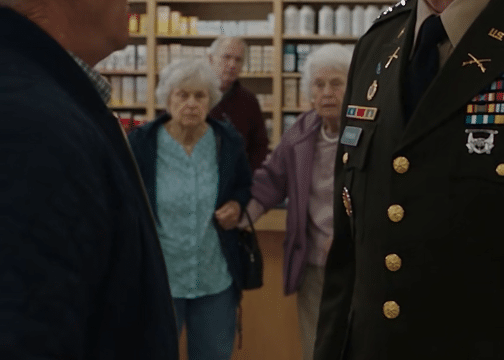
A woman near the refrigerated display gasped. A father pulled his young daughter behind him. Someone reached for a phone but hesitated, as though the colonel’s uniform had made everyone forget that what they were witnessing was an assault.
The colonel stood over the fallen man.
“Maybe you shouldn’t be shopping alone.”
The old man did not beg. He did not curse. He did not ask the colonel to help him up.
He simply looked at him.
And there was something in that look the colonel failed to understand.
Because the old man was not looking at him like a helpless victim.
He was looking at him like a man who had just made a decision he could never take back.
The worst part was that the colonel still believed he had won.
He had no idea who had just witnessed what he had done.
Act II
The old man’s name was Arthur Bennett.
To the people in that supermarket, he was simply an elderly shopper who had been attacked by a man wearing an Army uniform. His olive jacket was ordinary, his cream polo shirt slightly faded, and his walking shoes showed the wear of someone who preferred practical things over expensive ones.
Nothing about him announced power.
That was precisely how Arthur liked it.
For most of his adult life, he had lived in a world where every introduction came with a title, every disagreement could become a matter of command, and every mistake carried consequences far beyond the person who made it.
He had once been a Lieutenant General in the United States Army.
He had commanded soldiers, advised senior leaders, and spent decades making decisions that affected people he would never meet. His career had taken him through difficult deployments, long nights in command centers, and ceremonies where medals were pinned onto uniforms beneath bright lights.
But none of those things had made him believe that a uniform made someone better than the person standing beside them.
After retirement, Arthur had deliberately stepped away from that world.
He stopped attending events where people competed over titles. He avoided conversations that began with questions about his old position. He wanted to buy groceries, walk through quiet neighborhoods, and spend time with people who knew him simply as Arthur.
His right leg had been replaced with a prosthetic after an injury years earlier. It was a permanent part of his life, not a tragedy he needed strangers to understand.
He had learned how to walk with it, how to adapt, and how to keep moving without expecting the world to slow down for him.
He never wanted pity.
That morning, he had come to the supermarket for a few ordinary things. Vegetables, coffee, and something simple for dinner. It was the kind of errand that made retirement feel peaceful.
Then the colonel appeared.
The younger officer was everything Arthur had learned to distrust in a certain kind of leader. His uniform was immaculate. His ribbons were arranged with precision. His posture suggested confidence, but his eyes revealed something less admirable: an expectation that everyone around him should recognize his importance.
The colonel had not asked whether Arthur was hurt after the cart incident. He had not even considered that the collision might have been accidental.
He had seen an older man who did not immediately apologize.
And he had decided that the man needed to be taught a lesson.
Now Arthur was on the floor, breathing through the pain, his cheek swollen and his prosthetic leg displaced.
The colonel could have stepped back.
He could have called for assistance.
He could have realized that an elderly man lying on a supermarket floor was not an opponent to defeat.
Instead, he remained standing over him.
That was when the witnesses understood something important.
The attack was not over because the old man had fallen.
It was over only because the colonel had chosen to stop.
And nobody knew what he would do next.
Act III
The first person to move was a supermarket employee.
She hurried toward Arthur, then stopped when the colonel shifted his attention toward her. His expression was enough to make her hesitate.
A shopper finally stepped forward, keeping a careful distance.
The colonel looked around and seemed irritated by the attention. He adjusted his uniform, straightened his shoulders, and glanced at the phones now raised throughout the aisle.
He did not appear frightened.
He appeared annoyed that people were recording him.
Arthur remained on the floor. His breathing was controlled, but the pain was obvious. His right leg could no longer support him properly, and the prosthetic had shifted beneath his trouser leg.
The employee knelt nearby.
Arthur gave her a small nod, silently acknowledging her concern.
He was not asking anyone to fight for him. He was not trying to turn the incident into a spectacle.
He simply wanted the situation handled without anyone else getting hurt.
But the colonel had already made the mistake of believing that the only consequence worth fearing was one that arrived immediately.
Outside the supermarket, a different kind of arrival was beginning.
Several military vehicles pulled up sharply near the entrance. Their sudden appearance drew the attention of customers near the windows. Doors opened, and officers stepped out with the practiced urgency of people accustomed to moving together.
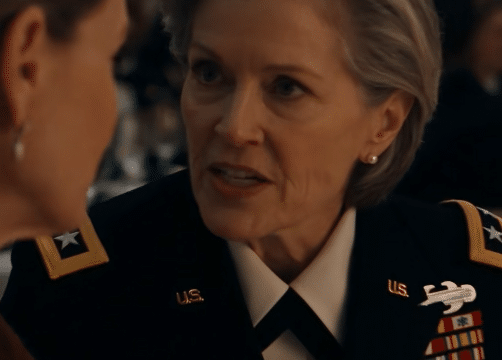
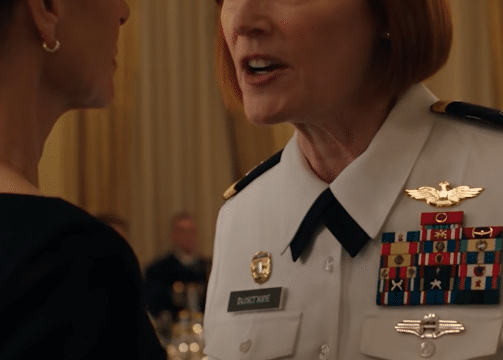
A Four-Star General entered with five officers.
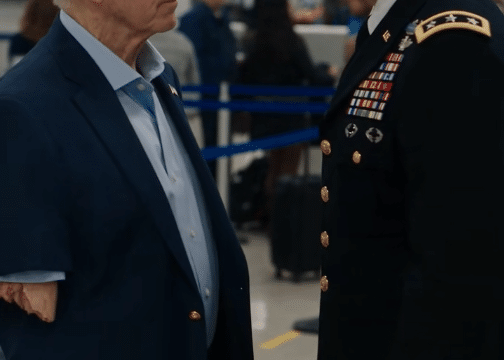
The general’s face remained hidden from view. The camera caught only decorated shoulders, four stars, a dense arrangement of ribbons and medals, formal trousers, and polished boots moving across the supermarket floor.
The entourage did not stop to speak with the shoppers.
They moved quickly through the entrance and into the produce section.
The colonel turned toward the sound of synchronized footsteps.
At first, he looked confused.
Then he noticed the insignia.
His expression changed.
He had spent years learning the visual language of military authority. He knew what a colonel’s insignia meant. He knew the difference between a senior officer’s decorations and the rank worn by someone whose authority stood far above his own.
And he knew exactly what four stars represented.
The general’s entourage parted just enough to allow the senior officer to approach.
The general looked at Arthur on the floor.
Then the general’s attention moved to the displaced prosthetic leg.
For a moment, nobody spoke.
The supermarket seemed to become smaller around them. The hum of refrigerators, the misting system, and the distant movement of shopping carts faded beneath the weight of the silence.
The colonel stood rigidly beside his cart.
He looked at the general’s uniform again.
Then at Arthur.
Something was beginning to make sense.
But he still did not know how much trouble he was in.
Act IV
The Four-Star General stopped beside Arthur.
The senior officer did not need to raise their voice. The rank on those shoulders, the decorations across the chest, and the five officers standing behind them made the hierarchy unmistakable.
The colonel’s own silver eagle insignia remained visible.
A moment earlier, he had worn it like a shield.
Now it looked painfully small.
The general’s attention remained on the injured man. There was no theatrical anger, no dramatic gesture, and no attempt to impress the watching crowd.
Only a controlled stillness.
Then came the question.
“Which leg did you kick?”
The words cut through the produce aisle.
The colonel’s face began to lose its color.
He looked down at Arthur’s right side. Then he looked back at the general, as if searching for some explanation that might make the question less dangerous.
There was none.
The general had not asked which cart had been touched. There had been no question about who started the argument or whether the old man had apologized.
The general had asked about the leg.
That meant the senior officer already understood the most important part of what had happened.
The colonel swallowed.
He glanced at the five officers accompanying the general. None of them appeared surprised. Their expressions were controlled, but their attention was fixed on the scene before them.
The shoppers remained silent.
A woman still held her phone in both hands. The supermarket employee stayed beside Arthur. A little boy stared at the stars on the general’s shoulders, then at the silver eagle on the colonel’s uniform.
The colonel shifted his weight.
His confidence had begun to collapse, but the reason was larger than the presence of a superior officer.
He was finally seeing the scene from the outside.
An elderly man lay injured on the floor. His face was swollen. His prosthetic leg had been struck. A dozen witnesses had watched the attack, and several had recorded it.
The attacker was not an unknown stranger.
He was an active-duty Army colonel wearing his uniform.
There was no way to pretend that this had been a private disagreement. There was no way to hide behind a misunderstanding about the shopping cart.
And there was no way to make the old man disappear from the story.
Arthur slowly lifted his eyes toward the general.
There was recognition there, but no visible surprise. He seemed to understand why the senior officer had come, even if the shoppers did not.
The general did not explain their connection.
They did not need to.
The colonel looked from the four stars to the man on the floor again. His jaw loosened. Sweat appeared along his forehead, and the posture he had carried so proudly minutes earlier began to fold inward.
The uniform was still perfect.
The authority he thought it gave him was gone.
For the first time, the colonel seemed to understand that he was not standing over someone powerless.
He was standing in front of a truth he could not command away.
Act V
The supermarket remained silent.
No one applauded. No one cheered. There was no dramatic announcement explaining Arthur’s career or listing the positions he had once held.
The general had asked one question, and that question had changed the entire meaning of the encounter.
Arthur Bennett had spent years serving in the Army. He had carried responsibility at the highest levels, and he had paid a personal price for that service.
But he had not walked into the supermarket expecting anyone to recognize him.
He had not worn a uniform. He had not displayed his rank. He had not asked for special treatment.
He had simply wanted to buy groceries.
The colonel, meanwhile, had seen the absence of visible status as permission to humiliate him. He had mistaken age for weakness, disability for helplessness, and a quiet response for submission.
Now every witness could see the difference between the two men.
One had spent a lifetime carrying authority without needing to display it.
The other had used a uniform to intimidate someone who could not fight back.
The general’s face remained outside the frame. Their decorated shoulders and four stars filled the space above Arthur, while the five accompanying officers stood close behind.
The colonel’s breathing grew shallow.
He looked at the general’s insignia once more, then down at his own uniform. The silver eagle was still there, but it no longer seemed to offer protection.
His eyes widened.
His lips parted.
And the question he finally managed to ask sounded nothing like the confident voice that had accused Arthur of touching his cart.
“Sir… why are you here?”
The words hung in the air.
No answer came before the scene ended.
But the question itself revealed everything.
The colonel had believed the old man was alone. He had believed nobody important would care what happened to him. He had believed that a uniform could turn cruelty into authority and make witnesses too intimidated to speak.
He had been wrong about every part of it.
Arthur had never needed to announce that he was a retired Lieutenant General. He had never needed to remind the colonel what rank he once held.
His dignity had been there before the general arrived.
And it remained there after the colonel’s confidence disappeared.
Because the real lesson of that afternoon was not that the old man had once been powerful.
It was that he had never needed power to deserve respect.
The colonel had kicked a prosthetic leg because he thought he had found someone who could not fight back.
Then a Four-Star General walked through the supermarket doors and asked which leg he had kicked.
Suddenly, the only thing the colonel could no longer stand on was his own arrogance.
Clarify why the general arrivedFix the prosthetic-leg continuity