Act I
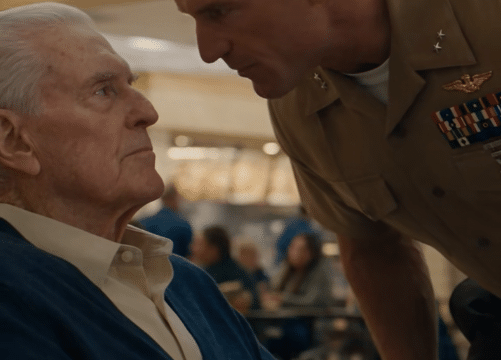
The old man was lying on the airport floor when the Lieutenant General looked down at him.
Travelers stood frozen between the security barriers and the X-ray scanners. Plastic trays sat abandoned on the conveyor belt. A suitcase rolled slowly away from the checkpoint, its owner too stunned to retrieve it.
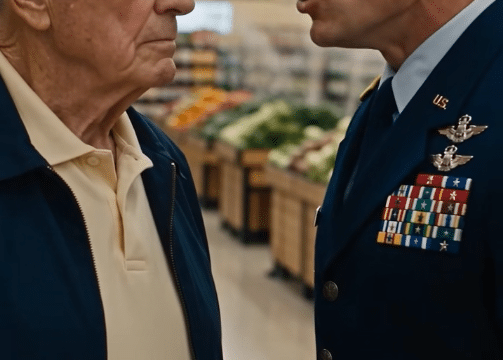
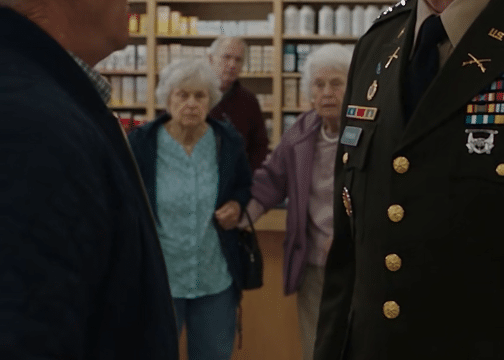
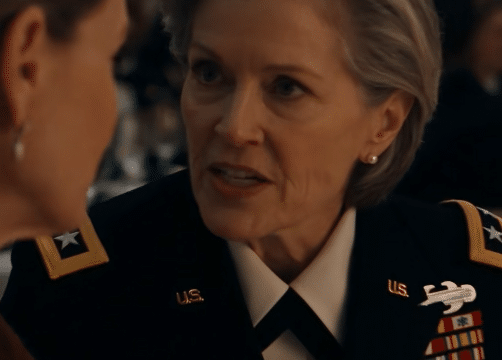
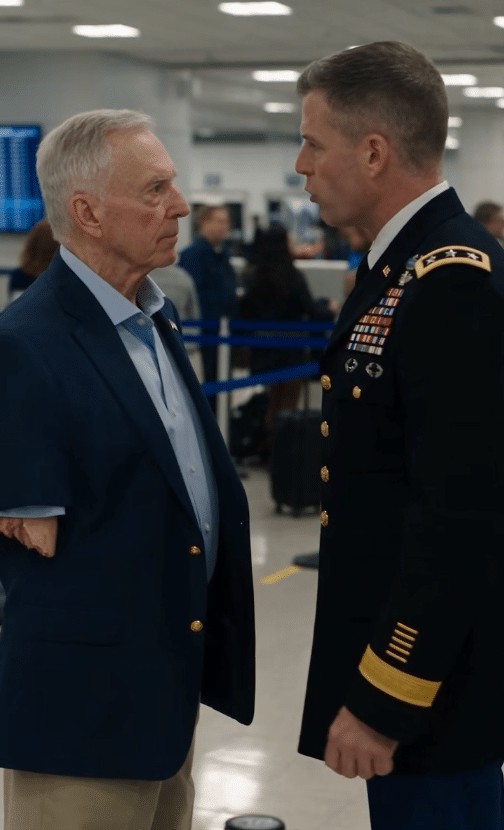
The officer standing over the fallen man wore a spotless Army service uniform. Three stars gleamed on his shoulders, and his ribbon rack filled the space above his nameplate. At fifty, he carried himself like someone accustomed to having an entire room move out of his way.
The old man wore a navy blazer, a white shirt, khaki trousers, and brown leather shoes. His silver hair was neatly combed. His right sleeve had been tailored around an amputation below the elbow, leaving no question that he had learned to navigate the world with one arm.
The trouble had begun with the slow movement of the security line.
The older man had taken a moment to gather his belongings and move forward. The Lieutenant General, impatient behind him, had decided that the delay was unacceptable.
“You’re holding everyone up.”
The old man turned his head.
“Then go around.”
It was a simple answer. No insult. No raised voice.
But the officer’s expression darkened as if he had been publicly challenged.
He stepped closer, looking at the older man’s shortened sleeve with open contempt. The people nearby began to notice. A young traveler stopped arranging his laptop in a tray. A woman holding a passport lowered her phone.
Then the Lieutenant General punched the old man across the face.
The blow snapped his head sideways. His cheek reddened almost immediately, and a faint trace of blood appeared at the corner of his mouth.
The old man staggered but managed to remain standing.
The officer took a forceful step and kicked him in the chest.
The impact knocked him backward onto the airport floor. With only one full arm, he could not break his fall properly. His shoulder and side struck the ground, and his breath left him in a painful gasp.
A suitcase tipped over.
Someone screamed.
The Lieutenant General stood above him, adjusting his uniform as if the interruption had been nothing more than an inconvenience.
“People like you shouldn’t slow everyone else down.”
The old man looked up at him.
His face showed pain, but not fear. He did not beg for help or apologize for taking up space.
The officer saw the look and mistook it for weakness.
He had no idea that the quiet man on the floor had once held a rank that could have made the entire checkpoint stand at attention.
And he had no idea who was about to arrive.
Act II
His name was Thomas Walker.
He was sixty-eight years old, silver-haired, composed, and missing his right forearm. The navy blazer he wore was carefully fitted, with the sleeve neatly tailored to accommodate his amputation. It was not a disguise, and he had never treated it as something to hide.
Thomas had learned to live with one arm years earlier.
The adjustment had been difficult, but he had never allowed his disability to become the center of his identity. He had learned new ways to carry luggage, button a shirt, open doors, and manage the ordinary inconveniences that most people never think about.
He disliked being treated as fragile.
He disliked even more being treated as a burden.
Before retirement, Thomas had served as a Major General in the United States Army. His career had taken him through years of command, demanding assignments, and responsibilities that followed him long after he left the office.
He had known men who wore their rank with humility and men who treated it like a weapon.
The distinction had always mattered to him.
A uniform was supposed to remind its wearer of the people who depended on them. It was not a license to intimidate anyone who stood in the way.
After retiring, Thomas had deliberately stepped away from military life. He no longer needed ceremonial introductions or people addressing him by his former title. He traveled when he wanted, visited old friends, and tried to live without every ordinary interaction becoming a conversation about his service.
That morning, he had been passing through airport security like thousands of other travelers.
He had no desire for special treatment.
He had simply wanted to get through the checkpoint.
The Lieutenant General had seen something different. He had seen an older man moving more slowly than he preferred, someone whose missing forearm made him an easy target for contempt.
When Thomas refused to apologize for existing at his own pace, the officer had responded with violence.
Now Thomas lay on the floor, one arm close to his chest, breathing carefully through the pain. His cheek was swollen, and the faint blood at the corner of his mouth made the assault impossible to dismiss as a minor disagreement.
A traveler crouched nearby but hesitated to touch him.
Another person called for airport security.
The Lieutenant General looked at the gathering crowd and appeared irritated by the attention. He straightened his jacket and glanced at the cameras above the checkpoint.
He still seemed to believe that the situation could be controlled by the authority of his uniform.
But there was something he did not know.
Thomas had spent decades in a world where people were judged by what they did when nobody powerful was watching.
And now, for the first time in a long while, the officer’s actions had been witnessed by people who were not going to look away.
Act III
The airport security area fell into an uneasy silence.
Passengers who had been arguing over tray space moments earlier now stood motionless. A young father moved his child behind him. An older woman held her boarding pass in one hand and her phone in the other, staring at the three stars on the officer’s shoulders.
The Lieutenant General noticed the attention.
He looked from face to face, apparently expecting someone to challenge him. Nobody did.
That silence seemed to restore some of his confidence.
He had spent years moving through military environments where people knew when to step aside. He was accustomed to seeing his rank before anyone saw the person wearing it.
He had apparently forgotten that the same uniform carried obligations as well as privileges.
Thomas remained on the floor.
He made a small effort to shift his weight, then stopped when the pain tightened across his chest. His expression remained controlled, but his breathing was uneven.
A security employee began moving toward him.
Then the doors beyond the checkpoint opened.
A senior decorated general entered with five officers.
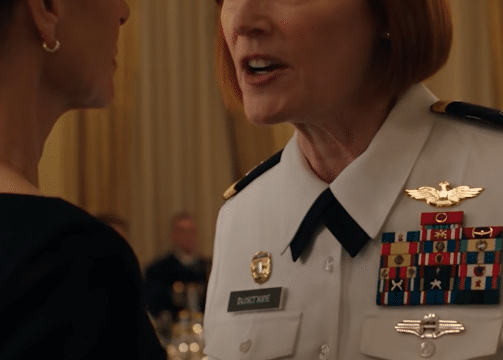
The arrival was immediate and unmistakable. The five officers moved together, their uniforms decorated with ribbons and service insignia. At their center was a senior commander whose face remained outside the camera’s view.
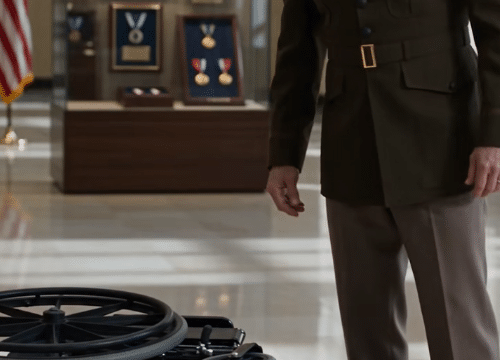
The frame showed only the decorated shoulders, the higher-ranking insignia, the ribbon and medal rack, formal trousers, and polished boots.
The group moved quickly through the security area.
Travelers stepped aside.
The Lieutenant General turned at the sound of approaching footsteps. At first, he seemed confused by the arrival. Then he recognized the rank displayed on the senior officer’s uniform.
His posture changed.
The three stars on his own shoulders suddenly seemed less impressive.
The senior general did not stop to greet him.
Instead, the commander looked directly at Thomas on the floor.
Then at the officer standing above him.
The five accompanying officers closed the distance, their attention fixed on the scene.
The Lieutenant General straightened again, but this time the movement looked automatic rather than confident.
He glanced at the senior commander’s insignia.
Then at Thomas.
For the first time, he seemed to understand that the man he had attacked might not be an ordinary traveler.
But he still had not understood the full meaning of what he had done.
Act IV
The senior general stopped beside Thomas.
The five officers stood behind the commander, creating a quiet wall of military authority. The travelers watched from behind the retractable barriers, and the security employees seemed reluctant to interrupt.
The senior officer’s face remained hidden.
There was no need to show it. The higher rank, the decorations, and the disciplined entourage made the hierarchy unmistakable.
The commander looked down at Thomas.
The retired Major General met that attention without speaking. His cheek was swollen, and his chest still hurt from the kick. But his expression remained steady.
The senior general then turned toward the Lieutenant General.
The officer’s three stars were clearly visible.
For a brief moment, neither man moved.
Then the question came.
“Which boot put him on that floor?”
The words were quiet, but they carried across the checkpoint.
The Lieutenant General’s face began to change.
He looked down at his polished shoes.
Then at the senior general’s higher insignia.
Then at Thomas.
The question had removed every possible distraction. It was not about the security line. It was not about an impatient traveler or a disagreement over who had the right to move first.
It was about the man lying injured on the floor.
And the officer knew exactly which boot had put him there.
The travelers remained silent.
The woman with the phone held it steady. The older passenger near the conveyor belt looked at the Lieutenant General with open disbelief. The young father kept his child close.
The officer shifted his weight, but there was nowhere to move.
His uniform was still immaculate. His ribbons were still arranged. His rank insignia had not changed.
Yet none of it could alter what the witnesses had seen.
Thomas had not threatened him. He had not struck him. He had not even raised his voice.
He had simply refused to apologize for moving at a pace the officer disliked.
The Lieutenant General’s jaw loosened.
Sweat appeared along his forehead. His posture, once rigid with superiority, began to collapse.
He looked at the senior commander again, searching for a way to explain himself.
But the question remained unanswered.
And the silence made the truth impossible to escape.
Act V
The airport checkpoint had become a place where nobody wanted to be the first person to speak.
The senior general stood beside Thomas. Five officers remained close behind, their decorated uniforms and polished boots contrasting with the ordinary travelers gathered around them.
The Lieutenant General stared at the senior commander’s insignia.
Then he looked down at Thomas again.
The older man had once been a Major General. He had served in the same institution, carried its responsibilities, and spent decades understanding what military authority was supposed to mean.
But he had not announced any of that.
He had not used his former rank to demand a place at the front of the security line. He had not expected anyone to recognize him or treat him differently because of his service.
He had simply wanted to pass through an airport.
The Lieutenant General had seen the missing forearm and assumed the man was an inconvenience.
He had mistaken disability for weakness and patience for permission to be cruel.
Now the officer was discovering that the person he had kicked to the floor was not someone whose dignity could be measured by his ability to carry a suitcase or move quickly through a crowded checkpoint.
Thomas had never needed both arms to deserve respect.
He had never needed a uniform to prove that he mattered.
The senior general’s arrival did not create the injustice. It made it impossible for the officer to pretend the injustice had not happened.
The five officers stood in silence.
The passengers watched.
And the Lieutenant General, who had been so certain of his authority only moments earlier, finally seemed unable to find a single word that could protect him.
His eyes moved from the senior commander’s insignia to Thomas’s face.
His voice broke.
“Sir… I didn’t know…”
He could not finish.
The sentence revealed more than he intended. He had not said he was sorry. He had not asked whether Thomas was hurt. He had not acknowledged the cruelty of what he had done.
He had only admitted that he would have behaved differently if he had known who the old man was.
That was the real disgrace.
Because Thomas Walker had deserved respect before anyone discovered his former rank. He had deserved it when he was standing in line, when he answered calmly, and when he lay injured on the airport floor.
The three stars on the Lieutenant General’s shoulders had never given him the right to decide otherwise.
And as the airport fell silent around him, he finally understood that the most important thing he had failed to recognize was not Thomas Walker’s rank.
It was his humanity.
Add a concrete justice payoffTrim repeated moral reflections