Act I
The bowl of sauce hit her face before anyone at the banquet could react.
A moment earlier, the two women had been standing beside a beautifully arranged dining table at an exclusive Joint Command banquet. Now, a woman in an elegant black dress was wiping sauce from her cheek while a female Army brigadier general stared at her with open hostility.
“You did that on purpose.”
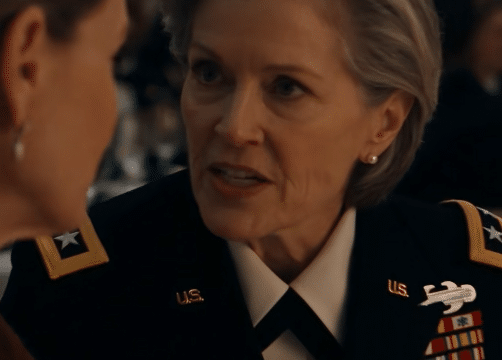
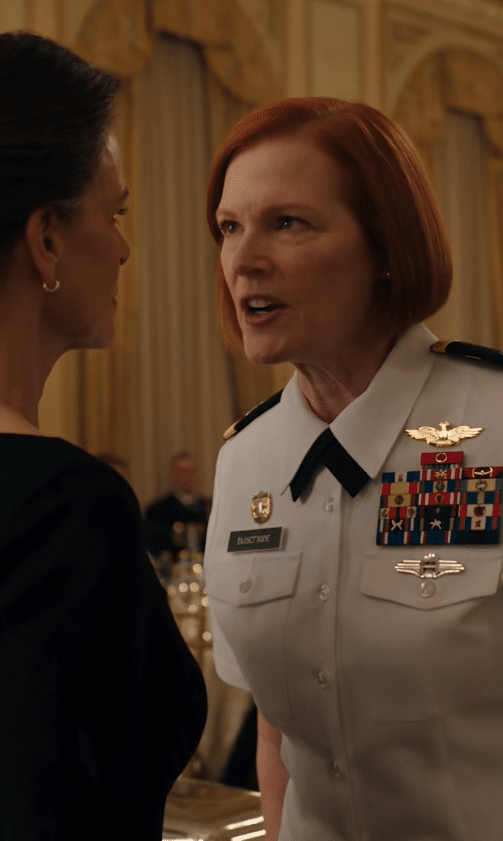
The accusation came from Brigadier General Rebecca Mitchell, a fifty-year-old officer with an auburn bob, a perfectly fitted dress uniform, and ribbons that seemed to demand attention wherever she went.
The woman facing her remained composed.
Her dark hair was swept back neatly, and a thin gold necklace rested against her black dress. She looked at the small disturbance near the table before meeting Rebecca’s eyes.
“No. And you know it.”
That answer made Rebecca’s expression harden.
She had expected an apology. Perhaps even an embarrassed explanation. Instead, she had received a calm response that sounded almost like a challenge.
Rebecca stepped closer.
“People learn respect when they meet rank.”
Several guests turned toward them.
The woman in black didn’t move.
Then Rebecca reached for a small bowl on the table and hurled its contents into her face.
The sauce splattered across the woman’s cheek and dress.
A sharp gasp escaped from someone nearby.
Before the victim could recover, Rebecca slapped her hard across one cheek. Her head turned with the impact, leaving a rapidly reddening mark and a faint trace of blood at the corner of her mouth.
But Rebecca wasn’t finished.
She grabbed the woman’s hair, pulled her off balance, and violently threw her onto the floor.
A chair scraped backward.
A glass toppled from the table.
For several seconds, nobody seemed capable of speaking.
The woman in black slowly lifted her head. She was hurt, humiliated, and covered in sauce, but she didn’t beg or cry.
Rebecca looked down at her with unmistakable satisfaction.
She believed she had just taught someone a lesson about military authority.
She had no idea that the woman on the floor was about to receive the kind of recognition Rebecca herself could only dream of.
And the announcement was coming from the most important microphone in the ballroom.
Act II
The banquet was being held inside a historic luxury hotel, where polished marble floors, crystal chandeliers, and enormous arrangements of flowers gave the evening an atmosphere of old-fashioned prestige.
It was a Joint Command celebration.
Senior military leaders, decorated officers, distinguished guests, and their spouses had gathered to honor years of cooperation and service.
Service flags stood near the stage. A brass band occupied one side of the ballroom, and long dining tables stretched toward a central aisle.
Every detail had been planned carefully.
Rebecca Mitchell had made sure she looked the part.
Her uniform was immaculate, her ribbons perfectly arranged, and her posture suggested someone who had spent years expecting immediate obedience.
She enjoyed being recognized.
She enjoyed the way junior officers straightened when she entered a room and the way conversations sometimes stopped when she approached.
But behind that polished appearance was a reputation that not everyone admired.
Rebecca had developed a habit of confusing authority with personal privilege.
She corrected people publicly, treated minor mistakes as serious offenses, and rarely allowed anyone to challenge her version of events.
She believed that respect should be automatic.
The woman she had attacked represented everything Rebecca had failed to understand.
Her name was Victoria Cross.
At forty-seven, Victoria had built a career defined by difficult assignments, strategic decisions, and the trust of people who had served under her command.
She was not wearing a uniform that evening.
There were no visible stars on her shoulders, no ribbons on her chest, and no military aides announcing her arrival.
She had deliberately chosen a simple black evening dress.
Victoria had never believed that an important person needed to advertise importance every minute of the day.
Her invitation to the banquet, however, was no ordinary invitation.
She was the evening’s honored guest.
The organizers had prepared a formal welcome, and the master of ceremonies had been instructed to announce her name when the guests were assembled.
But Victoria had arrived early and spent much of the evening quietly greeting people she knew.
Rebecca had never been introduced to her.
And when the accidental contact near the dining table occurred, Rebecca had made the same mistake she often made: she judged someone by what she could see.
She saw a woman without a uniform.
She assumed that meant a woman without authority.
Now Victoria was sitting on the ballroom floor, carefully wiping the sauce from her face.
Rebecca adjusted her uniform.
She still believed she had won.
But the master of ceremonies was already approaching the stage.
And the next announcement would change the meaning of everything that had just happened.
Act III
Victoria placed one hand against the floor and slowly pushed herself upright.
Her cheek was swollen and red. A faint trace of blood remained at the corner of her mouth, and sauce had stained the front of her black dress.
She reached for a napkin.
Carefully, without making a scene, she wiped her face.
Her eyes briefly met Rebecca’s.
There was no pleading in them.
No desperation.
Only a controlled expression that made the brigadier general uncomfortable for reasons she couldn’t quite explain.
Rebecca folded her arms.
“People learn respect when they meet rank.”
She delivered the words with the confidence of someone who believed the argument had already been settled.
But the surrounding guests were no longer looking at her with approval.
An older officer near the front table had stopped moving.
A senior commander exchanged a concerned glance with another guest.
Several people had witnessed the entire incident, and their expressions suggested that they understood its seriousness.
The master of ceremonies stepped onto the stage.
The brass band fell silent.
A microphone was adjusted, and the room gradually turned toward the front.
Rebecca glanced at the stage, apparently expecting the evening’s program to continue without interruption.
Then the announcement came.
“Command requests everyone form two lines along the center aisle.”
Chairs moved backward.
Officers rose.
Guests began arranging themselves into two orderly lines on either side of the ballroom’s central passage.
The atmosphere changed from casual conversation to ceremonial attention.
Rebecca straightened her shoulders.
For a brief moment, she seemed almost pleased by the sudden formality.
She assumed the event was preparing to welcome another senior commander.
Perhaps someone from the Joint Command leadership.
Then the master of ceremonies looked toward the assembled guests and spoke again.
“Please welcome General Victoria Cross.”
The words seemed to freeze the ballroom.
A senior officer immediately straightened his posture.
Another turned toward the woman in black.
Recognition spread through the guests, moving from one table to another.
Rebecca’s expression changed.
Her eyes moved toward Victoria.
The name sounded familiar.
Too familiar.
She stared at the woman whose hair she had just grabbed, whose face she had struck, and whose dress she had covered in sauce.
For the first time, the possibility began to form in her mind.
And she desperately wished it weren’t true.
Act IV
Victoria slowly rose to her feet.
She took a moment to adjust her black dress, wiped away the remaining sauce, and carefully composed herself.
The movement was simple.
Yet the entire ballroom seemed to respond to it.
The senior officers standing closest to the aisle straightened their backs. A few adjusted their uniforms instinctively as Victoria prepared to walk forward.
Nobody needed to tell them twice.
General Victoria Cross was the evening’s honored guest.
Her career had placed her among the highest levels of military leadership. Her name carried weight far beyond the ballroom, and the people gathered there understood the significance of her presence.
But the most important detail was not her rank.
It was what had happened before anyone announced it.
Victoria had been assaulted in front of dozens of witnesses while wearing an ordinary evening dress.
Rebecca had not recognized her.
She had not bothered to ask.
She had simply assumed that someone without visible insignia deserved less consideration.
Now the woman she had thrown to the floor was standing in front of her as the room formed an honor corridor.
Victoria began walking toward the aisle.
Her expression remained controlled, although the injury on her cheek was still visible.
She did not stop beside Rebecca.
She did not demand an explanation.
She did not raise her voice.
That silence made Rebecca’s situation even more uncomfortable.
The brigadier general looked around, searching for a familiar face.
But the people who had previously appeared impressed by her confidence were now watching her with unmistakable concern.
One senior officer lowered his eyes briefly.
Another stood rigidly, his expression unreadable.
Rebecca’s posture began to collapse.
The realization was no longer something she could dismiss.
She had assaulted a general at a formal military banquet.
And she had done it while telling the woman that people needed to learn respect when they met rank.
The irony was almost unbearable.
For years, Rebecca had treated rank as a weapon.
Now she was watching an officer with far greater authority demonstrate more dignity in a stained black dress than Rebecca had shown in her entire uniform.
Victoria continued forward.
The officers on either side of the aisle stood at attention.
And Rebecca remained frozen, unable to escape the consequences of what everyone had witnessed.
Act V
The camera moved closer to Rebecca’s face.
Her confidence was gone.
The auburn-haired brigadier general stared at Victoria as though she were seeing a completely different person.
But it was the same woman.
The same black dress.
The same gold necklace.
The same face she had slapped only moments earlier.
Only now, the ballroom knew her identity.
Rebecca’s eyes widened.
She tried to speak, but the words seemed to disappear before reaching her lips.
Her mind raced through the events of the evening.
The accusation.
The bowl of sauce.
The slap.
The hair grab.
The fall.
Every moment had happened in front of people who now understood exactly who had been assaulted.
There was no way to turn it into a misunderstanding.
No way to claim that she had simply been correcting an unknown civilian.
The victim had been the honored guest all along.
Victoria reached the ceremonial aisle.
The officers stood respectfully as she moved between them.
Her injured cheek remained visible beneath the ballroom lights, but she held her head high.
Rebecca finally understood that the greatest mistake of the evening had not been failing to recognize a superior officer.
It had been believing that someone needed a superior rank before she deserved basic human respect.
Her lips trembled.
She stared at Victoria and managed only two words.
“General Cross…?”
The question hung in the air.
For once, Rebecca Mitchell had no commanding speech, no sharp correction, and no humiliating remark ready.
Only disbelief.
And fear.
The banquet had been organized to celebrate military leadership.
But in those final seconds, the entire room had witnessed a lesson no ceremonial speech could have delivered.
Rank can make people stand when you enter a room. Character determines whether they respect you when you leave.
Make the opening more immediately grippingReduce repetitive explanation across acts