Act I
“You ruined my shoes.”
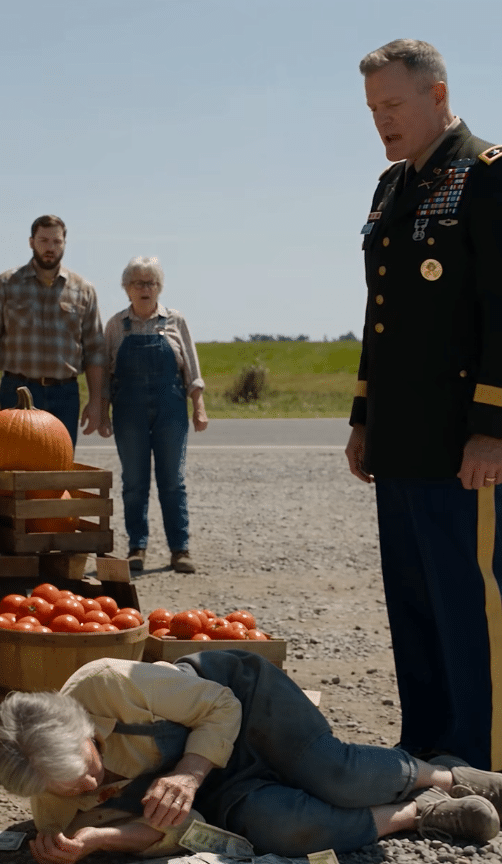
The words came from a two-star Major General standing in the middle of a roadside produce stand, his polished black military shoes stained with bright red tomato juice.
Across from him stood a 69-year-old woman in a pale-yellow shirt and faded green apron. Her name was Margaret Hayes, and she had spent nearly forty years selling vegetables from the same little wooden stand in a quiet farming county. Her hands were rough from years of carrying crates, her silver hair was neatly trimmed, and her old sneakers were covered in dust from the gravel road.
A few tomatoes had rolled beneath the general’s expensive shoes.
Margaret glanced down at the mess, then calmly looked back at him.
“It’s tomato juice. It washes off.”
She said it without sarcasm or attitude. It was simply the truth.
But the general wasn’t interested in the truth.
Major General Richard Caldwell had spent most of his adult life surrounded by people who stood when he entered a room, followed his orders without question, and carefully measured every word they spoke in his presence.
He had just returned from an official military event in the county. His uniform was immaculate, his two-star insignia gleamed beneath the afternoon sunlight, and his chest was decorated with rows of ribbons and service badges.
To him, the little roadside stand was an inconvenience.
The elderly woman behind it was an even bigger one.
Caldwell looked at the tomato stain again, then slowly raised his eyes toward Margaret.
“Buy yourself better produce.”
Before she could respond, he kicked the nearest wooden crate.
It crashed against the stand.
Tomatoes scattered across the gravel. A basket of corn toppled over, and several pumpkins rolled toward the roadside.
Margaret instinctively reached out to save what she could.
That was when Caldwell struck her.
His hand came across her face with such force that her head snapped sideways. She stumbled against the wooden counter, one hand flying to her cheek.
A moment later, he kicked her hard in the torso.
Margaret fell backward onto the gravel.
The entire stand seemed to go silent.
A farmer holding a paper grocery bag froze. A woman beside her pickup truck covered her mouth. Even the man who had been loading pumpkins into his car stopped moving.
Caldwell looked down at the woman lying on the ground.
Then he reached into his pocket, pulled out several dollar bills, and threw them directly onto her face.
The money landed across her cheek and apron.
Margaret struggled to catch her breath. Her cheek was already red and swelling, and a faint trace of blood appeared at the corner of her mouth.
But she didn’t beg.
She didn’t apologize.
She simply looked up at the man who had just assaulted her.
And what happened next would turn his entire military career upside down.
Act II
For the people who knew Margaret Hayes, the little produce stand represented far more than a way to earn money.
It was her independence.
Her husband, Thomas, had built the wooden counter with his own hands nearly thirty years earlier. He had planted the first rows of sweet corn behind their farmhouse, repaired the old roof every spring, and painted the handwritten price boards whenever the letters began to fade.
After Thomas died, Margaret refused to close the stand.
Every morning, she woke before sunrise, picked vegetables from the fields, arranged tomatoes in wooden crates, and placed fresh pumpkins near the entrance.
She knew which customers preferred smaller tomatoes, which families bought corn every Saturday, and which elderly neighbors needed their vegetables carried to their cars.
Some customers paid in cash.
Others promised to return the following week.
Margaret never made a fuss about either arrangement.
She had raised her only son to believe that a person’s character mattered more than the money in their pocket or the stars on their shoulders.
That son, Daniel, had left their small farming county decades earlier.
He had joined the United States Army as a young man, built a remarkable career, and eventually risen to a position that few officers ever reached.
Margaret rarely discussed his achievements.
She didn’t hang photographs of him in the produce stand or tell strangers about his decorations. When customers asked about the framed military photograph inside her farmhouse, she simply smiled and said he was a busy man.
To Margaret, he was still the little boy who used to run through the cornfields with muddy shoes.
But Caldwell knew nothing about that family.
He saw an old woman in a faded apron.
He saw a wooden stand selling inexpensive vegetables.
And he assumed that nobody important would ever care what happened there.
That assumption became even more dangerous when the witnesses began realizing that the incident wasn’t going to end with an apology.
One man quietly stepped away from his truck and reached for his phone.
Another customer moved closer to Margaret, but stopped when Caldwell turned his head.
The general adjusted his uniform and looked around as though he had every right to be there.
He had assaulted an elderly civilian in front of multiple witnesses.
And he still appeared convinced that his rank would protect him.
Margaret slowly pushed herself up onto one elbow.
Her breathing was uneven. One hand rested against her ribs, while the other remained pressed to her swollen cheek.
Caldwell glanced at the scattered money.
He seemed satisfied.
Then, without offering assistance, he turned slightly toward the road.
He had no idea that someone was already on the way.
And the person approaching would not be another local officer, a concerned farmer, or an ordinary military representative.
It would be someone whose authority made Caldwell’s two stars look very different.
Act III
At 3:17 that afternoon, a convoy of black military SUVs appeared at the far end of the country road.
At first, the witnesses barely noticed.
The road was occasionally used by military vehicles traveling between nearby installations, and the convoy seemed like just another official group passing through the farming county.
Then the vehicles slowed.
Their brake lights illuminated almost simultaneously.
The first SUV stopped beside the produce stand, followed by the others in a precise line.
Caldwell turned toward the road.
His expression changed slightly.
The doors opened.
Five senior military officers stepped out, their uniforms carrying the unmistakable appearance of experienced command personnel. Their movements were coordinated, their expressions serious, and none of them seemed interested in the produce scattered across the gravel.
They were looking at Margaret.
Then the final vehicle opened.
A senior officer stepped out.
The camera caught only his decorated shoulders, the unmistakable four-star insignia, the dense rows of ribbons and medals across his chest, and his polished military boots touching the gravel.
His face remained outside the frame.
But the authority surrounding him was impossible to miss.
Four stars.
A distinguished service record.
Five senior officers accompanying him.
This wasn’t an ordinary visit.
It was the arrival of someone who had spent decades operating at the highest levels of military command.
Caldwell immediately straightened his posture.
For a brief moment, he appeared relieved.
Perhaps this was an opportunity to explain himself. Perhaps the senior officer had come to inspect the area. Perhaps the situation could still be controlled.
But then something unusual happened.
The four-star general didn’t look at Caldwell.
He didn’t inspect the damaged crates or ask the witnesses what had happened.
He walked directly toward Margaret.
One of the accompanying officers moved ahead, carefully clearing a path through the scattered vegetables. Another stopped beside the overturned crate and looked at the dollar bills lying near the elderly woman’s feet.
The four-star general reached Margaret.
She looked up.
For the first time since Caldwell had struck her, the tension in her expression softened.
It was a small change.
Almost invisible.
But the man standing in front of her noticed it immediately.
He stopped beside her, his decorated uniform filling the frame.
Then he turned toward Caldwell.
The question he asked was quiet.
But it was more frightening than a shout.
“Which hand touched her?”
Nobody moved.
Caldwell’s expression changed.
He looked at the four-star insignia, then at the senior officers standing behind him.
His lips parted, but no answer came.
The witnesses suddenly understood that the convoy had not arrived by coincidence.
This man wasn’t here to inspect a military event.
He was here because the woman on the gravel mattered to him.
And Caldwell was about to discover exactly how much.
Act IV
The four-star general remained beside Margaret.
He didn’t raise his voice.
He didn’t threaten Caldwell.
He simply stood between the elderly woman and the officer who had assaulted her, while the five accompanying officers watched in rigid silence.
One of them knelt beside Margaret to assess her condition.
Another carefully collected the dollar bills that had been thrown onto her face, preserving them as potential evidence.
The general’s attention never left Caldwell.
For the first time in his career, Richard Caldwell found himself standing in front of a superior officer without knowing what to say.
He looked down at his own uniform.
The two stars on his shoulders were still there. His ribbons were still perfectly arranged. His nameplate remained visible.
Nothing about his appearance had changed.
Yet suddenly, everything those symbols had represented seemed fragile.
The four-star general had not needed to announce his identity.
His rank had already spoken.
Caldwell attempted to recover his composure.
He shifted his weight, straightened his jacket, and glanced toward Margaret as if trying to reconstruct a version of events that might somehow save him.
But the witnesses had seen everything.
The farmer had watched the crate being kicked.
The woman beside the pickup had seen the slap.
The man with the grocery bag had witnessed the kick that sent Margaret onto the gravel.
And several people had watched Caldwell throw money into her face.
There was no confusion about what had happened.
No misunderstanding.
No accidental collision.
A uniformed two-star general had used his position to humiliate and physically assault a 69-year-old civilian woman.
Then he had thrown money at her as though her dignity had a price.
The senior officers understood the seriousness of the situation.
One moved toward Caldwell and asked him to remain where he was. Another began speaking with the witnesses, making sure their accounts would be preserved.
The four-star general finally looked down at Margaret again.
She was still holding her ribs.
Her cheek remained swollen.
But she was conscious, alert, and watching the officers with a quiet composure that made the contrast between her and Caldwell almost unbearable.
The general’s posture changed.
His shoulders tightened.
For a moment, the only sounds were the wind moving through the nearby cornfield and the faint ticking of one of the idling SUVs.
Then Caldwell made the mistake of speaking.
He looked toward the senior officer’s stars, then back at the elderly woman.
His confidence had disappeared.
His face had gone pale.
A bead of sweat ran down his temple.
He swallowed hard.
“Sir… she is…?”
He couldn’t finish.
Because the answer was already standing in front of him.
And the four-star general wasn’t going to give him an excuse to misunderstand it.
Act V
The four-star general was Daniel Hayes.
Margaret’s only son.
The little boy who had once helped his father carry tomato crates across the same gravel driveway.
The young soldier who had left home with a packed bag and promised his mother he would never forget where he came from.
And now, after decades of service, he had returned to the very place where his story began.
He had not arrived expecting to find his mother injured.
He had not expected to see her lying among broken produce, with money scattered across her face.
He had certainly not expected to find another general standing over her.
Daniel had been traveling through the county with his senior staff when he learned there had been an incident at his mother’s roadside stand.
At first, he had been told only that she was hurt.
He had ordered the convoy to stop immediately.
Now he understood why the report had sounded so serious.
He looked at the red mark across Margaret’s cheek.
Then at the scattered tomatoes.
Then at the man whose hands had caused all of it.
For years, Daniel had been taught that command was not about privilege.
It was about responsibility.
The stars on a uniform were not permission to intimidate people. Decorations were not proof of character. And authority did not make a person better than the civilians whose freedom he had sworn to protect.
Caldwell had forgotten every one of those lessons.
Daniel turned toward his senior officers.
His instructions were immediate.
The assault needed to be formally documented. The witnesses needed to be interviewed. Available recordings needed to be preserved. Margaret needed medical attention, and Caldwell’s conduct needed to be referred through the appropriate military investigative and command channels.
No one would be allowed to bury the incident simply because the person responsible wore a decorated uniform.
The officers moved into action.
Caldwell stood motionless.
He had entered the produce stand believing that two stars made him untouchable.
Now those same stars seemed to weigh heavily on his shoulders.
His military career, his reputation, and the authority he had spent decades building were suddenly facing questions he could no longer answer with a confident smile.
But Daniel’s attention was elsewhere.
He turned back toward his mother and carefully offered her his hand.
Margaret looked at him.
For a moment, the general disappeared.
There was no command staff, no convoy, no rank insignia, and no military protocol.
There was only a mother and her son.
She reached up and took his hand.
“Your father would have hated seeing this place like this,” she said softly.
Daniel glanced at the overturned crates.
A faint, painful smile crossed his face.
“He’d be more upset about those tomatoes than anything else.”
Margaret almost laughed, but the pain in her ribs stopped her.
Daniel immediately supported her as the officers helped her toward the SUV.
Before leaving, she looked back at the little wooden stand.
The vegetables were scattered everywhere. Several price boards had fallen, and the money Caldwell had thrown at her was now being documented by the officers.
But Margaret wasn’t looking at the damage.
She was looking at the people who had witnessed what happened.
She wanted them to know that they had done the right thing by speaking up.
Because the most important thing that afternoon wasn’t that her son happened to be a four-star general.
It was that a man wearing a military uniform had finally been forced to answer for what he had done to an ordinary civilian.
As the SUV door closed, Daniel remained beside his mother.
Behind them, Caldwell stood surrounded by officers, his earlier arrogance replaced by a silence he could not escape.
He had believed he was humiliating a powerless old woman.
Instead, he had revealed something far more damaging about himself.
And the four-star general’s question would follow him long after the convoy disappeared down the country road:
“Which hand touched her?”