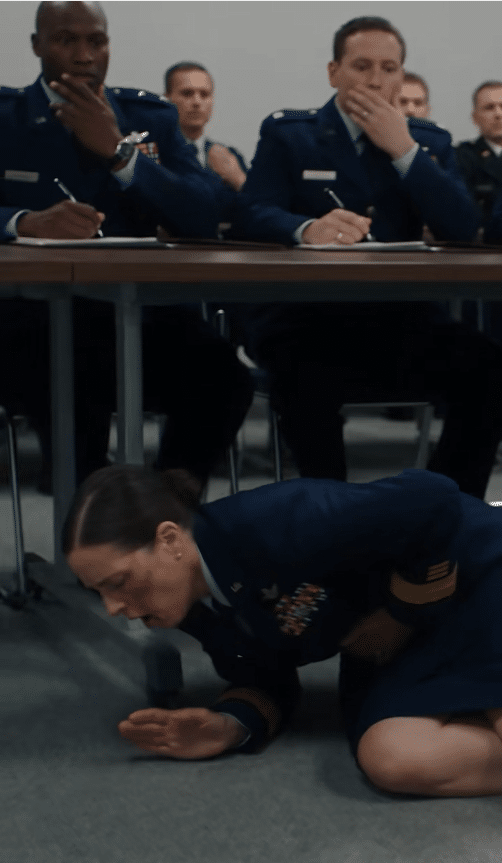
Act I
“I haven’t finished.”
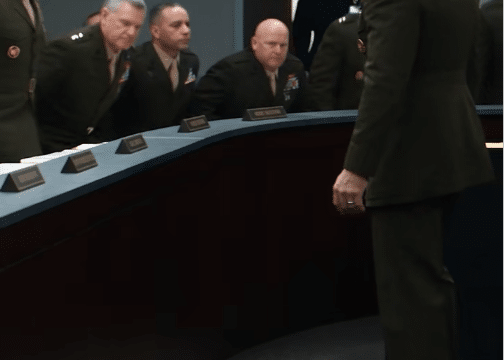
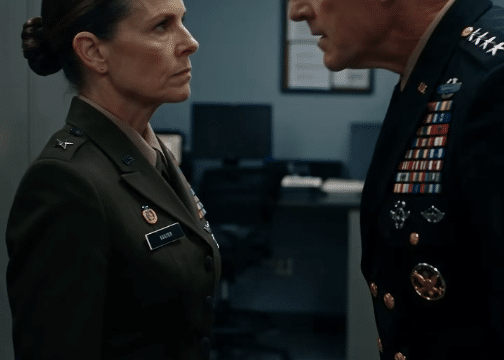
The woman stood beside the long hearing table, one hand resting on an open folder. Her dark hair was secured in a formal bun, and her Army service uniform carried three stars with remarkably few decorations. Her expression was calm, analytical, and entirely unmoved by the man standing across from her.
The Brigadier General was forty-nine, with a polished service uniform, a prominent ribbon rack, and the unmistakable confidence of an officer accustomed to controlling every room he entered.
“You’re finished when I say you are.”
He leaned across the table, glaring at her as though her refusal to stop speaking were a personal insult.
“Get out of my hearing.”
Several Inspector General staff members exchanged uneasy looks. Recorders sat between folders and official documents, capturing the proceedings. The hearing had already become tense, but the General’s behavior was crossing a line that even his rank could not excuse.
The woman did not leave.
She looked down at the folder, then back at him. There was no anger in her expression, only the quiet determination of someone who had not finished examining the evidence.
The Brigadier General stepped closer.
He believed he was dealing with an officer he could intimidate into silence.
He was about to discover that the woman he wanted removed from his hearing was the reason the hearing existed at all.
Act II
The investigation had begun with a complaint that seemed simple enough.
Several officers had reported that the Brigadier General had used his command position to suppress internal concerns, pressure witnesses, and discourage subordinates from documenting questionable decisions. At first, the complaints appeared unrelated. Different units, different dates, different circumstances.
But when the Inspector General staff began comparing the statements, a pattern emerged.
Reports had been revised after submission. Written objections had disappeared from official correspondence. Officers who initially agreed to provide statements later withdrew them, sometimes after private meetings with the General’s staff.
The most troubling detail was that the same command office appeared in every trail.
The Brigadier General insisted there was no pattern. He described the complaints as misunderstandings, personal grudges, and administrative confusion. Whenever investigators asked about the missing records, he shifted the conversation toward his years of service and the responsibilities he carried.
He expected his rank to end the questions.
It had worked before.
For years, people around him had learned that challenging his decisions came at a cost. Some officers had chosen silence rather than risk becoming the next subject of his displeasure. Others had convinced themselves that the problems were too complicated to pursue.
But the Inspector General inquiry had continued.
The woman at the hearing table had reviewed the statements, the discrepancies, and the original records. She had also noticed something the General seemed determined to ignore: the complaints were no longer isolated allegations. They were pieces of a larger account of how his command operated.
She had allowed him to respond because that was what a fair investigation required.
She had listened to his objections, examined his explanations, and given him opportunities to address the evidence.
What she had not done was accept his demand that the questions stop.
That was why he had become increasingly aggressive.
He could not control the documents. He could not make the witnesses forget what they had reported. And he could not persuade the woman across the table to abandon the investigation simply because he disliked its direction.
He was running out of ways to control the room.
So he chose intimidation instead.
Act III
The Brigadier General moved before anyone could react.
His hand struck the woman’s cheek with tremendous force.
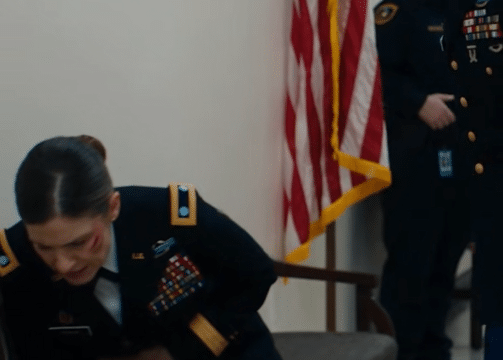
Her head turned sharply, and she staggered beside the hearing table. A red mark appeared across her face, quickly developing into visible swelling. A small trace of blood formed at the corner of her mouth.
The staff members froze.
Then the General drove a hard kick into her abdomen.
She fell beside the table, one hand instinctively moving toward her stomach as the impact forced the breath from her lungs. Papers shifted across the tabletop, and a folder slipped toward the edge.
She tried to brace herself with one hand.
The General delivered another hard kick into her side.
The sound echoed through the chamber.
For a moment, the only movement came from the papers settling on the floor. The Assistant Inspector General’s usual professional composure would soon be tested, but the assistant was not yet in the room.
The Brigadier General stood over the woman, breathing heavily.
He looked down at her with the satisfaction of someone who believed he had finally silenced an inconvenient witness.
“Get out of my hearing.”
The words sounded different now.
He had not merely ordered an officer to leave. He had attacked a woman during an official proceeding, in front of the very staff responsible for documenting the investigation.
The woman remained conscious. Her cheek was swollen, and she held her abdomen protectively as she tried to breathe through the pain.
But her eyes stayed on him.
There was no pleading in them.
The General mistook her inability to stand immediately for defeat. He straightened his uniform and looked around the chamber, apparently expecting everyone else to accept what had happened as another display of his authority.
Instead, the staff members stared at him in disbelief.
He had turned an investigation into something far more serious.
And he still did not know who was about to walk through the door.
Act IV
The door opened.
The Assistant Inspector General entered carrying a folder, moving with the purposeful composure of someone arriving for an important scheduled briefing.
Then the assistant saw the woman on the floor.
The folder stopped moving.
The Assistant Inspector General immediately came to attention, recognizing the three-star officer despite her injuries. The Brigadier General turned toward the doorway, irritated by the interruption.
But the assistant did not look at him.
The words were directed to the woman on the floor.
“Ma’am, the Inspector General panel is ready.”
The room changed.
The Brigadier General’s expression shifted from irritation to confusion. He looked at the assistant, then at the injured woman, then back at the three stars on her uniform.
The Assistant Inspector General remained at attention.
The staff members around the table now understood why the woman had refused to abandon the questioning. They had not been watching a disagreement between a Brigadier General and a junior investigator.
They had been watching a senior officer attempt to intimidate the Lieutenant General leading the Inspector General panel.
The woman slowly lifted herself from the floor.
Her movements were careful. Pain tightened her expression as she guarded her abdomen, and the swelling across her cheek was impossible to miss. But she did not rush or lose control.
She looked toward the assistant.
The assistant’s formal recognition had established what the General had failed to understand: she was not merely part of the investigation.
She was its highest authority in that room.
The three stars on her uniform were no longer an incidental detail. They were the clearest possible answer to the Brigadier General’s assumptions.
He had told her she was finished when he said so.
He had ordered her out of his hearing.
He had physically attacked her because she refused to stop examining his conduct.
And now the Assistant Inspector General was standing at attention before her, addressing her as the officer responsible for the panel.
The General’s face began to lose color.
He looked toward the recording equipment. The folders. The staff members who had witnessed the assault. Every detail of the room suddenly seemed to have acquired a different meaning.
Nothing had gone the way he imagined.
Act V
The Lieutenant General remained composed as she regained her footing.
The Assistant Inspector General waited for her direction. Around the hearing table, the staff members stood in disciplined silence, their attention fixed on the woman the General had tried to remove.
Her face was visibly injured, and she continued to protect her abdomen. Yet her expression had returned to its earlier precision.
She had not needed to announce her authority.
The assistant had recognized it immediately.
The Brigadier General looked as though he wanted to speak, but the confidence that had driven his earlier commands had vanished. His one-star insignia remained on his uniform, but it no longer seemed to offer him any protection from the reality of the situation.
He had assaulted the Lieutenant General leading the Inspector General panel.
He had done so during an official hearing, with staff members present and recording equipment running.
And the investigation he had tried to silence was now connected to an incident that could not be dismissed as a disagreement over procedure.
The woman looked toward the documents on the table. They were still there. The statements, the reports, the discrepancies, and the questions he had tried to prevent from being asked remained part of the inquiry.
His violence had not erased a single fact.
If anything, it had made the central issue impossible to ignore: a senior officer had used his position to intimidate others, and when confronted with scrutiny, he had resorted to physical force.
The Assistant Inspector General stood ready beside her. The staff members maintained their attention. The General stood alone in the center of a room he had believed belonged to him.
He stared at the three stars on her uniform.
His jaw loosened. Sweat appeared along his forehead, and his eyes moved between the woman and the assistant who had just recognized her.
The arrogance that had filled his voice only moments earlier was gone.
He finally understood that the person he had tried to silence was the person empowered to investigate him.
His voice came out in disbelief.
“Inspector General… you?”
Clarify her identity earlierReplace repeated realization beats