Act I
“Give me the file.”
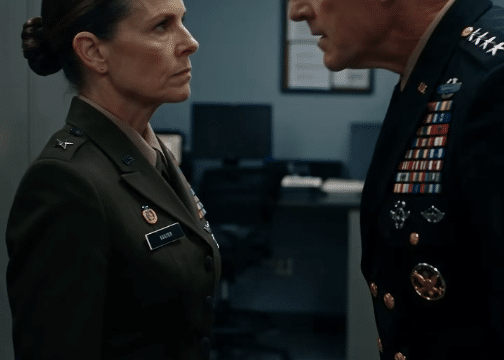
Brigadier General Daniel Mercer stood in the polished hallway outside a military courtroom, his one-star insignia shining beneath the overhead lights. His full Army service dress uniform was immaculate, his medals arranged neatly across his chest. But his expression was anything but composed.
The woman facing him held a sealed folder against her side.
“You’re named in it.”
Mercer’s jaw tightened.
“You don’t investigate generals.”
She did not step back. Her dark hair was secured in a formal bun, and her Army service uniform carried two stars, though her restrained decorations and calm demeanor had drawn little attention from the officers passing through the corridor.
Mercer reached for the folder.
When she refused to release it, he tore it from her hands, broke the seal, and threw the papers across the polished floor. Several pages slid toward the courtroom doors.
Then he slapped her.
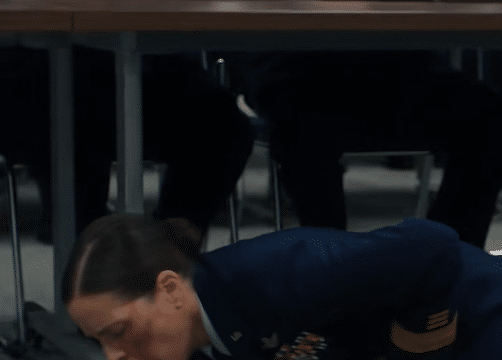
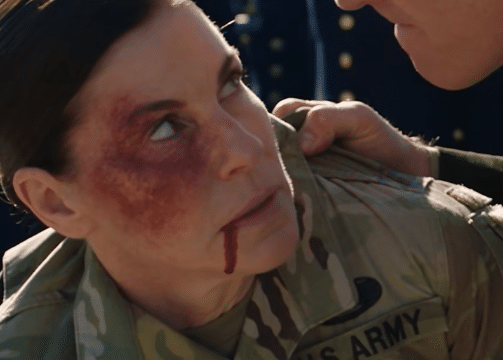
The sound cracked through the hallway. Her head turned sharply, and a red swelling spread across her cheek. A faint trace of blood appeared at the corner of her mouth.
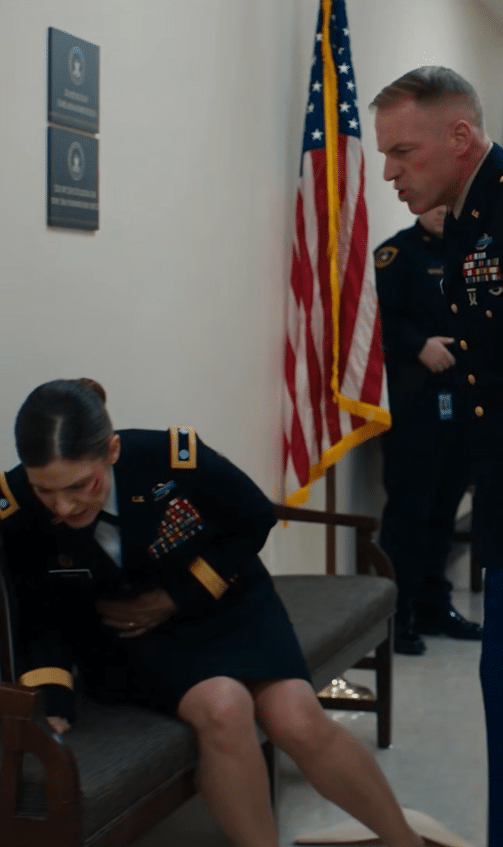
Before she could recover, Mercer drove a hard kick into her abdomen, knocking her down beside a courtroom bench. He kicked the folder farther away, scattering its contents even more.
JAG officers stopped walking.
Two military police officers stared in disbelief. A bailiff near the courtroom doors froze, watching the Brigadier General stand over the injured woman as if he had just settled a routine disagreement.
Mercer looked satisfied.
He believed the file was no longer a threat.
But he had made one fatal mistake: he had attacked the person who was about to preside over the very proceeding that could determine his future.
And the courtroom doors were about to open.
Act II
Her name was Margaret Collins.
At forty-five, Major General Collins had built her reputation on precision, discipline, and an unusually strong understanding of military law and command accountability. She was not known for theatrical speeches or public displays of authority.
She preferred documents that could withstand scrutiny, testimony that could be verified, and decisions that remained defensible long after the people involved had left the room.
That was why she carried the sealed case file herself.
The investigation concerned a series of decisions made under Mercer’s command. At first, the irregularities had seemed administrative: missing approvals, altered reports, and conflicting accounts of how certain operational resources had been assigned.
But the deeper investigators looked, the more troubling the pattern became.
Several documents had been revised after the fact. A report that should have recorded a serious failure had been softened. Witness statements appeared to have been summarized in ways that omitted important details.
And Mercer’s name appeared repeatedly.
He had spent weeks trying to find out how much the investigators knew. He had questioned staff members, demanded updates, and used his position to pressure people who were supposed to remain independent.
The sealed folder contained material that could no longer be dismissed as an administrative misunderstanding.
Margaret had been assigned to serve as the presiding authority in the military proceeding. Her responsibility was to ensure that the process followed the applicable rules and that the evidence was handled properly.
She understood the sensitivity of the case.
She also understood why Mercer was becoming increasingly desperate.
He had mistaken her quiet manner for an opportunity to intimidate her. When he saw the folder in her hands, he assumed he could take it, destroy the immediate threat, and force the matter back under his control.
He had not considered the possibility that the woman holding the evidence was also the senior authority overseeing the proceeding.
Now the folder lay open on the hallway floor.
Its seal was broken. Papers were scattered beneath the bench. Margaret was on the ground, breathing carefully through the pain in her abdomen.
Mercer stood above her, still convinced that his rank gave him the right to decide what happened next.
But the people in the corridor had witnessed everything.
And the courtroom was waiting for its presiding authority.
Act III
The courtroom doors opened.
The bailiff stepped into the hallway.
He saw the scattered papers, the injured general, and Mercer standing nearby. His expression tightened, but his voice remained formal and controlled.
“All rise for the presiding authority.”
The command changed the atmosphere instantly.
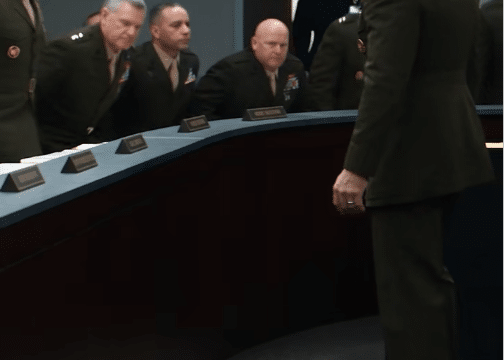
The JAG officers straightened. The military police stood at attention. Personnel inside the courtroom rose from their seats, and the movement spread through the room.
Mercer looked toward the open doors.
He seemed confused.
The bailiff had not addressed him. No one was preparing to welcome him as the senior officer in the hallway.
Instead, the judge officer turned toward Margaret.
The injured woman slowly began to rise. Her cheek was swollen, and the trace of blood at her mouth remained visible. She moved carefully, one hand close to her abdomen, but her expression was controlled.
The judge officer looked directly at her.
“General, we’ve been waiting for you.”
For a moment, Mercer did not move.
The words were simple, but their meaning was unmistakable.
The woman he had assaulted was not a junior investigator. She was not a clerk, a staff officer, or someone who could be ordered away from a sealed case file.
She was Major General Margaret Collins.
And she was the presiding authority.
The officers in the corridor recognized her role immediately. Their attention shifted toward her, not Mercer. The courtroom was standing for the woman he had just knocked to the floor.
Mercer looked at the courtroom doors, then at Margaret.
His expression began to change.
He had spent the confrontation insisting that generals could not be investigated. Now he was facing the senior authority responsible for overseeing a proceeding in which his own name appeared.
The sealed file had not been a weapon she was using against him.
It was evidence that had to be handled through a lawful process.
And he had just made himself part of the most disturbing evidence in the hallway.
Act IV
Margaret stood beside the scattered papers.
The hallway remained silent. The JAG officers were rigid with attention, and the military police watched Mercer carefully. No one appeared willing to pretend that the assault had been an ordinary disagreement.
The broken seal lay among the documents.
It was a small detail, but it represented something larger: Mercer had tried to take control of evidence that did not belong to him. Then, when he could not force the woman holding it to comply, he had used physical violence.
The distinction between a command dispute and an abuse of authority had become impossible to ignore.
Margaret looked toward the folder.
Her injuries were visible, but she did not allow them to distract from the proceedings. She had spent her career understanding that military justice depended on evidence, procedure, and the willingness to apply standards even when the person involved held an impressive rank.
Mercer had built his confidence around the opposite belief.
He thought his stars made him untouchable.
He thought a sealed file could be taken from someone who lacked the power to resist him.
He thought the presence of witnesses would make people too frightened to challenge his behavior.
But the courtroom had just risen for Margaret.
The JAG officers recognized her authority. The bailiff had addressed her as the presiding authority. The judge officer had made it clear that the proceeding was waiting for her arrival.
Mercer’s face began to lose color.
He glanced at the documents on the floor, then at the open courtroom doors. His jaw loosened, and his shoulders dropped.
The realization was settling in.
He had not stopped an investigation.
He had not intimidated a junior officer into surrendering evidence.
He had assaulted a two-star general who was responsible for presiding over the proceeding in which he was named.
And every person in the hallway had seen it happen.
Margaret remained composed.
She did not need to threaten him or announce what would happen next. The evidence, the witnesses, and the formal proceeding already existed independently of his wishes.
His rank could not make the broken seal disappear.
It could not make the scattered papers vanish.
And it could not erase the fact that he had attacked the very authority he had been trying to intimidate.
Act V
The hallway had become an extension of the courtroom.
The JAG officers remained standing. The military police maintained their positions. The bailiff waited near the doors while the judge officer kept his attention on Margaret.
Mercer looked smaller than he had only minutes earlier.
His uniform was still perfect. His medals still shone. The one star on his shoulder had not changed.
But the authority he had tried to impose through intimidation had collapsed.
Margaret stood with visible injuries, her cheek swollen and her breathing still guarded. She had every reason to be angry, yet she did not allow the moment to become a personal spectacle.
The proceeding mattered more than his reaction.
The sealed file mattered more than his threats.
And the truth mattered more than the rank he had used to try to suppress it.
She looked down at the scattered documents. They had been thrown across the floor as if their contents could be destroyed by force.
But evidence did not become meaningless because someone disliked what it revealed.
The people who had witnessed the assault now understood the stakes in a way no briefing could have conveyed. They had seen a senior officer attempt to take a sealed file, reject the possibility of investigation, and use violence against the woman responsible for presiding over the case.
The irony was impossible to miss.
Mercer had insisted that generals could not be investigated.
Now he stood outside a military courtroom, facing a presiding authority who wore two stars and had just been publicly assaulted by him.
He looked toward Margaret, then toward the judge officer. His face was pale, and sweat had begun to gather along his forehead.
The certainty in his voice was gone.
He finally managed to speak.
“Presiding… authority?”
No one answered for him.
The courtroom was still waiting.
And the sealed case file was still on the floor.
Add a decisive courtroom consequence