Act I: The Patch in Her Hand
The bar went quiet before I knew why.
Not the soft quiet of men listening to a song or waiting on a punchline. The harder kind. The kind that starts near the doorway and moves table by table until even the ice in the whiskey glasses seems to stop shifting.
I looked up from the pool table and saw her standing in the light.
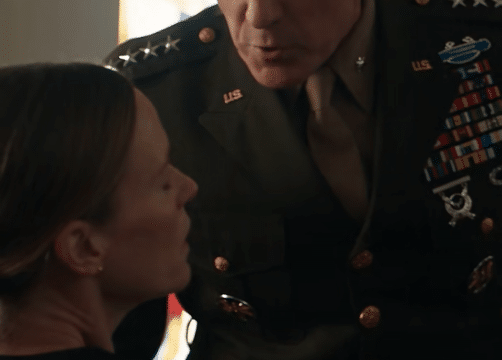
She was old enough that nobody should have mistaken her for a threat. Short gray hair. Dark olive shirt under a black leather vest. A weathered face. Small shoulders. The sort of woman most men in a room like ours would underestimate before she finished crossing it.
But she walked straight through the doorway like she owned the floor.
The afternoon sun behind her made the smoke and dust in the bar look almost holy for half a second. Then the door swung shut, and she kept coming toward us past the old jukebox, past the booth where the prospects sat, past three men with beer bottles in their fists and questions on their faces.
I stepped away from the pool table.
“Lady,” I said, “ten seconds to leave.”
A few of the boys laughed.
Not because it was funny. Because that was the script. Strange old woman walks into a biker bar full of patched men, gets warned off, maybe cries, maybe curses, maybe leaves. That was the shape everyone thought the scene would take.
She stopped three feet from the table.
Not scared. Not angry. Just tired enough to stop pretending life still surprised her.
Then she held up the patch.
Big circular leather. Old. Cracked at the edges. Skull with wings. Faded lettering still visible under years of weather and handling.
FIRST 5 FOUNDER
DUTCH
Nobody laughed again.
The room changed all at once. You could feel it in the posture of the men nearest me. Shoulders locking. Beer bottles lowering. Eyes narrowing toward the patch the way old soldiers look at medals they thought had been buried with the man who earned them.
“I drove 400 miles to be here tonight,” she said.
Her voice was rough but steady.
I stepped closer.
“What do you want?”
She lifted the patch a little higher.
“Stand the hell down.”
That should have made me angry.
It didn’t.
Because I knew that leather. I knew the shape of the stitching and the way Dutch had the first run of founder patches embossed deeper than necessary because he used to say if men were going to betray a flag, they should at least have to feel it in their hands.
Then she said the line that turned memory into evidence.
“He wore this the night they told me he died,” she said. “No. He had a daughter.”
My mouth went dry.
Dutch never had a wife.
That was the line we’d all been given for thirty years. No wife. No child. No one left to inherit his patch, his share, or his version of the story. Just a dead founder, a missing cash box, and a reputation that split our club in half before it ever learned how to heal.
I heard myself say it out loud anyway.
“Dutch never had a wife.”
The woman looked at me like she pitied my ignorance more than she feared my size.
Then her eyes shifted to the wall behind me.
I turned.
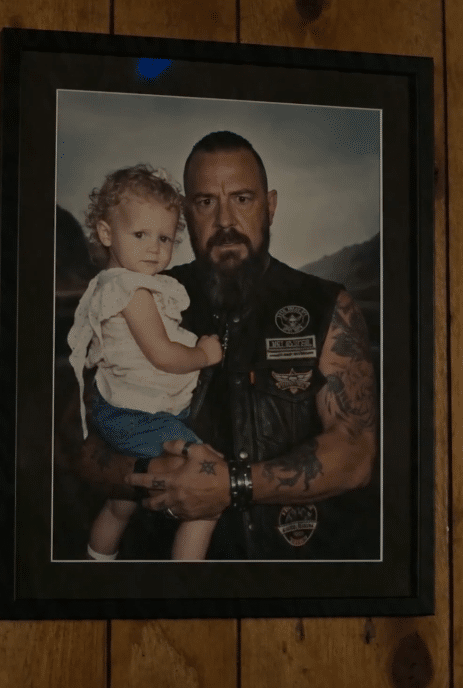
There, in a frame I had passed a thousand times, was a photo of me at twenty-two holding a baby girl in my arms.
And for the first time in thirty years, I understood that the dead man we built our history around had left a witness inside our clubhouse the whole time.
Act II: The Night They Said Dutch Betrayed Us
His real name was Adrian Hollis, but no one called him that after twenty-one.
He became Dutch the way some men become weather. Slowly at first, then all at once. By the time I met him, he had already built Iron Tiger from five men, a storage garage, and a bad idea into a club people crossed the county line to avoid disrespecting. He taught me how to fight without performing it, ride without panicking in crosswind, and keep my mouth shut when older men started talking about land deeds, sheriffs, and money hidden from banks.
He was the first man who treated me like I might grow into something worth trusting.
That matters when you’re twenty and angry enough to confuse loyalty with hunger.
Back then, I would have sworn Dutch feared almost nothing. Not rival clubs. Not cops. Not winter roads. Not bar fights. But the summer before he disappeared, I noticed something new in him.
Care.
He started leaving early after meetings. Stopped sleeping at the clubhouse. Took rides alone to the east county that he wouldn’t explain. Once, when I asked if he was seeing a woman, he smiled so strangely I stopped asking.
Then the money vanished.
So did the original deed to our old clubhouse property and the black lockbox holding the founder ledger. Same week. Same silence. Three nights later, Dutch was reported dead after a shootout by the river quarry, and Sheriff Maddox himself stood in our lot telling us our founder died resisting arrest with cash in his truck and blood on his conscience.
Deke Rains was vice president then.
He took over before Dutch’s body had even been put in the ground.
That should have bothered me more than it did. But grief makes men stupid in groups. We wanted a shape for the betrayal. Deke gave us one. Dutch stole from the club. Dutch ran. Dutch got cornered. Dutch died dirty. Sheriff’s reports backed it. The quarry burned enough to explain why no one saw much. And any man who hesitated too long was asked whether he wanted his patch or his sentiment.
I kept my patch.
I still taste the shame of that some nights.
There had only been one detail that never fit.
A week before the quarry, Dutch had handed me a bundled infant wrapped in a faded yellow blanket and told me to drive twenty miles east to Saint Agnes House, no lights, no questions, no club colors. He met me behind the old chapel wall with a duffel bag, a bottle warmer, and a look on his face I had never seen before.
Fear.
“Take her,” he said. “Leave her with Sister Miriam. Tell her the river name.”
I did what he asked.
When I came back, he was gone.
Deke told me later the baby had belonged to a woman Dutch used on the side, some bad choice from the outskirts, nothing that mattered after the girl “didn’t make it.” Sheriff Maddox added that the woman had run before statements could be taken. I was young enough to believe older men when their lies came dressed as certainty.
So I buried that night inside the rest of it.
The photo on the wall had been taken at Saint Agnes by one of the nuns who said every child deserves a picture with the man who carried them out of danger, even if no one will ever frame it. Dutch got the original. I thought the copy in our bar was just some strange memorial to a night no one wanted to discuss.
Now the old woman standing in front of my pool table had made that photo mean something else.
Not a nameless baby.
Not an inconvenience.
A daughter.
Dutch’s daughter.
And whatever else I might have believed about him, I knew one thing deep enough to hurt:
If Dutch lied to the club, he always did it for a reason bigger than money.
The woman reached into her vest and pulled out a yellowed envelope.
“My daughter sent this before they put her in surgery,” she said. “She said if anything happened to her, I was to find Tiger and make him tell the truth.”
That was when I stopped seeing an old woman with a patch.
I started seeing a ledger I had failed to read three decades ago.
Act III: The Daughter Who Came Back Without Walking In
Her name was Lena Marquez.
The old woman—June, she finally told us—said it with the flat ache of someone who had spent too many years speaking around a person instead of about them. Lena had found her five months earlier after a foster father died in New Mexico and left her a cedar box wrapped in church linen.
Inside the box were the founder patch, the photo of me holding her as a baby, and three pages of Dutch’s handwriting.
Not a confession.
A map.
June handed me the letter first.
The paper was worn soft where someone had opened it too many times, and Dutch’s writing looked exactly the way I remembered—tight, leaning forward, like the words themselves were trying to get somewhere before the page ended.
If you’re reading this, then either I’m dead, or Deke lied well enough that death was easier for the boys to carry than my side of it.
I stopped there.
The room around us had gone utterly silent. Men I had known twenty years stood with their jaws locked and their eyes on the paper in my hands. No one reached for a drink. No one cracked a joke. No one pretended this was anything but a founder’s ghost speaking from a time we all let harden too quickly into history.
Dutch wrote that he had discovered Deke and Sheriff Maddox were using the club’s land deed as collateral for a development deal none of us had approved. Storage units, private condos, river access sold off under shell names. When Dutch confronted them, Deke tried to flip the blame back onto him, so Dutch pulled the founder ledger and the deed before they could formalize the theft.
Then June became leverage.
She had been a waitress at a highway diner outside town, the kind of place patched men stopped for eggs and old ladies stopped for pie. Dutch fell in love with her in secret because he knew what men like Deke do with anything tender they can’t understand. When Lena was born, Dutch decided to keep them hidden until he could push Deke and Maddox into daylight.
He never got the chance.
The night of the quarry, according to the letter, Deke set the whole thing up. Sheriff report, staged cash, burned truck, false witness chain. Dutch sent me with the baby because I was the one man young enough to obey quickly and stupid enough not to ask the right questions until it was too late.
I felt every eye in the bar on me then.
Not accusing.
Worse.
Understanding.
June spoke into the quiet.
“They told me he died. Then they told me my baby died too.”
Her voice broke for the first time.
“Except she didn’t. She grew up in another state with a church family that was paid to keep her name changed and her mouth shut. She found me because her foster father finally got afraid enough of dying with all that sin still in his house.”
I lowered the letter.
“Where is Lena now?”
June looked straight at me.
“In a trauma ward outside Wichita. Three nights ago, someone ran her off the road after she opened the bank box Dutch named in the letter.”
That brought the whole thing into the present so hard it felt like a door slamming.
This was no old grief dressed up for a bar confrontation.
Lena had gone looking for the truth, and someone had tried to kill her for arriving at the right box too late. Which meant the land, the deed, the ledger, or whatever else Dutch hid still mattered enough to hurt people in 2026.
June reached back into the envelope and gave me a small brass key taped to an index card.
Box 119 — Plains State Bank
For Tiger. No one else.
That was when I realized why she had driven 400 miles.
Not for sympathy.
Not even for answers.
For alliance.
Because Dutch’s daughter had woken up just long enough after the crash to say three words before the surgeons took her back under.
Find. The. Club.
Act IV: The Men Who Built The Lie Stayed Local
Deke Rains was still president of Iron Tiger.
He had more gray in his beard now and less muscle across the shoulders, but power had settled into him the way rot settles into beams. Quietly. Permanently. He wasn’t in the bar that night because he’d gone to a regional charter meet in Tulsa, which suddenly felt less like chance and more like instinct.
Cowards always prefer to miss the beginning of their own collapse.
Sheriff Maddox, meanwhile, had retired with honor, a fishing boat, and enough county worship to make decent people sound paranoid whenever they brought up the old quarry case. Men like him never disappear. They simply become respected in slower clothes.
I read the rest of Dutch’s letter standing by the pool table while my brothers watched thirty years rearrange themselves.
He had hidden the founder ledger and the land deed in a safe-deposit box under the bank name of a dead mechanic who once rode with us and trusted no one with paperwork except Dutch. He wrote that if he didn’t come back from the quarry, the only man allowed to open the box was the one who carried Lena out.
Me.
Not because I was the strongest.
Because I had already touched the truth before anyone else knew it existed.
I hated that line.
Not because it wasn’t true.
Because it landed too close to the shame I’d spent years pretending was loyalty. I had helped save Dutch’s daughter. Then I let older men tell me what that night meant and built my adulthood around the lie they preferred.
June watched my face while I read.
“What did he say?”
I looked up.
“He said he trusted the wrong men and the right one too late.”
That got a grim little laugh out of one of the old-timers at the back. The sort of laugh men make when a dead friend finally says something so exact it hurts more than a sermon.
Then I did what should have been done decades earlier.
I called for a closed table.
No hang-arounds. No prospects. No drunk cousins or bar regulars leaning in from the jukebox. Just patched brothers, June, and Dutch’s letter in the middle of the green felt where everybody could see whose ghost had just sat down with us.
I read every word out loud.
By the end, three men were crying openly and pretending not to be. Two more looked sick. One old bastard named Grady, who had voted hardest to strip Dutch’s photo from the back wall in 1998, took off his cap and put it on the table like he was sitting through church.
Then he said what all of us were thinking.
“If Deke knew the girl lived, then every order that came after Dutch’s death was poison.”
Exactly.
Club votes.
Land sales.
Patch removals.
Charity rides.
All of it.
Because leadership does not just shape the future. It edits the past until the men who lived it stop trusting their own memory.
I slid the brass bank key across the felt.
“Tomorrow morning,” I said, “we open the box.”
June shook her head.
“Tonight.”
I looked at her.
She looked back with the raw patience of someone who had spent three decades waiting for men to do the right thing on a reasonable timeline and had buried that illusion long ago.
“My daughter may not wake up,” she said. “I am done giving old liars one more sunrise.”
So we rode.
Twelve bikes.
One pickup.
One old woman with Dutch’s founder patch in her lap and tears she refused to wipe because pride had outlived vanity.
When we got to Plains State Bank’s night depository entrance, the lot was already half-lit and empty except for one black county SUV parked crooked near the curb.
Sheriff Maddox had retired, yes.
But his son still wore county tan.
And when he stepped out of that SUV with two deputies beside him, I knew the family business hadn’t ended with the badge changing hands.
Act V: The Founder’s Blood Was Still Here
They tried the old trick first.
Legal tone.
Public property.
Do not interfere with an active county matter.
Deputy Maddox stood under the bank light with one hand on his belt and his father’s jaw in his face, telling me the box was sealed pending fraud review tied to “the late Adrian Hollis.” Dutch’s real name, spoken like evidence instead of memory. That was supposed to settle it.
It did the opposite.
Because if the county had sealed the box before we ever arrived, then they had known June was coming. Which meant someone still tied to Deke or the Maddox line had eyes on Dutch’s daughter in Wichita, on her mother in the car, or both.
June stepped out of the pickup before I could stop her.
She held up the founder patch in one hand and Dutch’s letter in the other.
“Tell your daddy,” she said, voice sharp as broken glass, “that I have spent thirty years being polite enough for all of us.”
I’ve seen armed standoffs calmer than what happened next.
Not because weapons came out. They didn’t. Because truth shifted the balance faster than force ever could. Half the county knew our club. All of them knew the founder patch. One of the younger deputies looked at it and then at me and understood, in the exact second decent men always do, that the story he’d been told at briefing had just gone rotten in his mouth.
I called the state investigator Dutch had named in the margin of the letter—retired now, but still mean enough to answer a midnight call when an old founder’s bloodline and a county seal appeared in the same sentence. By 2 a.m., state police were on scene. By 2:30, the bank manager was opening Box 119 with trembling hands and too much coffee in his bloodstream.
Inside was everything.
The original deed.
The founder ledger.
Payoff sheets.
Recorded audio.
Photographs of Deke, Sheriff Maddox, and the developer.
A notarized statement from Dutch.
And one tiny hospital bracelet with Lena Hollis crossed out and Lena Marquez written above it in the same hand that had built the little silver bike.
When I handed that bracelet to June, she bent over it as if a whole life had finally become small enough to hold.
By dawn, Deke Rains was being picked up on conspiracy, fraud, and old felony warrants that should have surfaced twenty years earlier if money didn’t travel so well through county offices. The Maddox boy lost his badge before breakfast. His father’s “retirement peace” ended around lunchtime when state investigators reopened the quarry file and found the original ballistic report exactly where Dutch said it would be hidden.
Lena survived surgery.
That was the part that mattered most.
We rode to Wichita two days later with the founder patch in a sealed case and Dutch’s name finally carried the way it should have been all along. She looked so much like him it hurt. Not in the obvious features. In the eyes. The same way of holding on to your face when pain wants to rearrange it.
When she woke fully, June was on one side of the bed and I was on the other.
She looked at me first.
Then at the patch.
Then she smiled weakly and said, “I figured if anyone still had a conscience, it’d be the one in the picture.”
I laughed at that and felt my throat close around it.
Weeks later, we held a patch meeting at the old yard.
No booze.
No music.
No speeches longer than they had to be.
I stood in front of the chapter with Dutch’s founder patch in both hands and Lena seated beside her mother in a folding chair, arm still in a sling, chin lifted like she had spent her whole life learning not to ask men for the room they already owed her.
“Dutch did have a daughter,” I said.
Nobody interrupted.
“And every lie we swallowed after his death was built to keep her from standing where she stands now.”
Then I gave the patch to Lena.
Not because she wanted the club.
Not because blood automatically earns a bike or a vote.
Because history belongs first to the people someone tried hardest to keep out of it.
She held the leather carefully, like something alive.
Then she looked at me and asked, “What happens now?”
I thought about the little girl in the photo.
The baby in the blanket.
The man I called a traitor because it was easier than admitting I’d helped bury him.
The old woman who drove 400 miles into a room of dangerous men carrying the one object she knew would force them to listen.
And I told her the truth.
“Now,” I said, “they start saying his name clean again.”
That, in the end, was what Dutch had really hidden.
Not money.
Not land.
Not proof alone.
A future.
One he knew would be killed if the wrong men got to write the story first.
They almost did.
Then an old woman walked into our bar with a founder patch in her hand and grief in her spine, and every man at the pool table had to face the same ugly fact:
The dead founder we’d been mourning, cursing, and misunderstanding for thirty years had not left us a betrayal.
He had left us a daughter.