Act I: The Bench in the Snow
The snow had started as a soft drift and turned mean by afternoon.
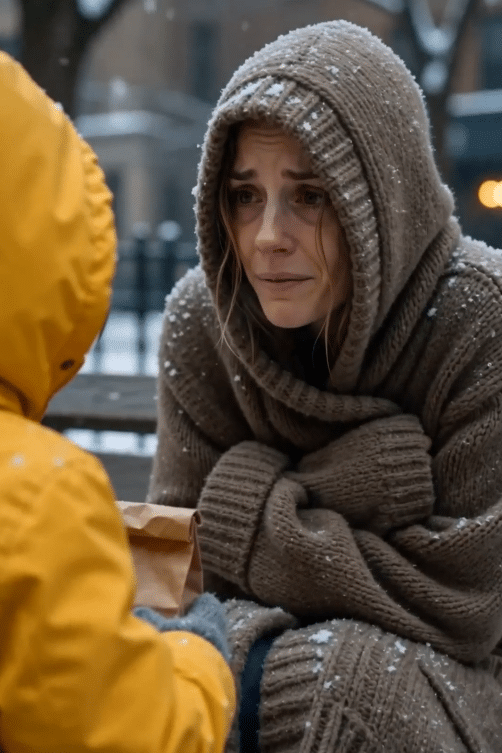
It clung to the bench slats, gathered on the curb, and melted into a dark shine on the woman’s bare feet. She sat hunched inside a long brown cardigan with the hood pulled up, as if wool alone might be enough to negotiate with winter.
Most people passed her without looking.
That is one of the first lessons cities teach. A woman on a bench in the snow becomes part of the weather if enough people decide not to meet her eyes.
The little girl in the yellow parka did the opposite.
She walked straight toward the bench with both mittens wrapped around a small brown paper bag. Her tan boots made soft crunching sounds in the snow, and the man several feet behind her slowed but did not call her back.
“Are you cold?” the girl asked.
The woman looked up slowly.
Her face was thinner than it should have been, but still beautiful in the worn way some faces are beautiful after life has taken far too much and still failed to make them cruel. Snow had caught in her dark hair. Her hands were red from the cold.
“A little,” she said. “But I’m fine.”
Children know when adults lie for dignity.
The girl held out the bag anyway.
“This is for you.”
The woman hesitated before taking it. Her fingers trembled around the folded paper, and when she opened it, the smell of warm rolls and fried potatoes drifted up between them like something from another life.
“Daddy bought them for me,” the girl said. “But you look hungry.”
The woman swallowed hard.
“Thank you.”
That should have been the end of it. A kind child. A grateful stranger. Snow between them and a city pretending not to see. Instead, the little girl stayed where she was and looked at the woman with a sincerity so complete it made the world around them feel briefly ashamed.
Then she said the line that changed everything.
“You need a home,” she said, “and I need a mom.”
The woman froze.
Not in the ordinary way people freeze when children say heartbreaking things in public. Something deeper moved through her face. Shock first. Then recognition. Then the kind of pain that arrives when a sentence does not just wound you—it opens a locked room inside you that you had spent years bricking shut.
The man in the background took one step forward.
Snow caught on the shoulders of his dark coat. He had been watching carefully the whole time, not like a man afraid for his daughter, but like a man waiting to see if a certain expression would cross a certain face.
It had.
He stopped only a few feet away from the bench and said, very quietly:
“Elena Reyes?”
The woman looked up at him as if she had just heard a dead language spoken aloud.
And in that moment, before anyone moved again, he knew what she was before she said a single word.
Act II: The Child They Told Her Never Breathed
Elena had been twenty when they took the baby.
At least that was the age on paper. In truth, she had already lived older than that by then. Her mother had died when she was fifteen. Her father had disappeared into another family before the funeral flowers were dry. By nineteen, Elena was waitressing nights, cleaning office suites at dawn, and learning the exact number of crackers a body can call dinner before sleep becomes impossible.
The pregnancy was not part of the plan.
Neither was love, really. Mateo Solis was kind in the way poor young men sometimes are kind before life teaches them to hide it. He worked construction, smelled like dust and citrus soap, and kissed her like he meant every promise he made.
Then he fell from a scaffolding in July and never woke up.
By the time Elena realized she was carrying his child, she was already alone.
Saint Gabriel Maternity Center took charity cases if the paperwork was right and the gratitude was visible enough. Elena spent six months hearing phrases like support options, placement pathways, and temporary guardianship from women in soft cardigans who smiled too gently to be honest.
She refused every form they put in front of her.
She told them she would keep her baby even if she had to raise her in a room no bigger than a bus stop. She told them hunger was not the same thing as not loving someone. She told them no so many times the social worker finally stopped sounding patient and started sounding tired.
The labor came early during a thunderstorm in March.
Elena remembered the white ceiling. The nurse with the pearl earrings. The bright pain. Then a woman she had never seen before entered the room with a doctor and spoke to the staff as if the hospital belonged partly to her simply because she expected it to.
Her name, Elena would later learn, was Judith Whitmore.
By the time the baby came, Elena was too weak to argue clearly and too conscious to be fooled easily. She heard a cry. She saw a tiny dark head. She reached out once before someone pressed her shoulder back to the bed.
Then the doctor said the words that carved her life in two.
“I’m sorry. She didn’t make it.”
Elena screamed until they sedated her.
When she woke, the room was empty except for flowers she had not asked for and a woman from the hospital office standing beside the bed with a release packet in her hands. No body. No bracelet. No blanket. No crib roll to sign. Only soft voices and harder eyes and the repeated insistence that she should rest.
She checked herself out against medical advice before dawn.
She went to the records desk. The nurse station. The chapel. The service hall.
A janitor finally told her the newborn floor had been locked for a private family transfer in the middle of the night.
She spent the next five years trying to prove what her body already knew.
No infant death certificate was ever shown to her directly. Her questions went unanswered. The social worker vanished. The doctor “retired.” A hospital clerk took pity once and whispered that some women with money treat maternity wards the way they treat antique shops: if they want something badly enough, someone always finds a way to make the papers cleaner.
Elena lost jobs chasing those questions.
She lost apartments too.
By the time winter found her on the bench, she had stopped telling most people the truth because grief without proof starts sounding to strangers like instability, and instability is a language cities punish quickly.
Still, she kept one thing.
A yellow knit bonnet she had made in her seventh month.
When the little girl in the yellow coat stood in front of her and said she needed a mom, Elena felt something under the scar tissue of those years begin to move.
Then the man in the dark coat said her name.
And she understood that somehow, impossibly, the child she had buried without ever seeing might have survived long enough to learn how to walk through snow.
Act III: The Letter His Wife Left Behind
Daniel Whitmore had not come to the bench by accident.
He had been looking for Elena for thirty-eight days.
Not publicly. Not through police or reporters or lawyers with smooth voices and slower loyalties. Quietly. Through records, church ledgers, old maternity logs, and one retired nurse in Yonkers who cried into the phone when she heard the child’s birth date and said, “I knew somebody would come back for that girl eventually.”
His wife Claire had died in October.
Cancer, fast and merciless. The sort that strips away denial first and pride second. Daniel had cared for her at home through the final weeks, and in the last lucid hour she had, she told him something she had carried in silence for six years.
Sophie was not legally or morally theirs in the way he had believed.
Judith Whitmore—Daniel’s mother—had arranged everything.
Claire had wanted a child so badly she let herself believe the story she was handed: a newborn in crisis, an overwhelmed mother who had signed relinquishment, emergency private adoption to spare the baby foster care. By the time Claire discovered the papers had been forged and the birth mother had never consented, Sophie was already three.
Claire broke under the knowledge of it.
Not all at once. Slowly. Like ice splitting under weight that has nowhere else to go. She had tried to confront Judith. She had been threatened with losing Sophie in a trust fight she could not win while ill. She had tried to tell Daniel twice, Claire confessed, but each time she stopped at the edge of the truth because she could not bear the possibility of becoming to him what Judith already was to herself.
A thief dressed up as a mother.
After the funeral, Daniel found the box Claire had hidden in the cedar chest at the back of their closet.
Inside was a photograph from Saint Gabriel Maternity Center. A young woman in a hospital bed, exhausted and holding nothing because someone had already taken the child from her arms. Written on the back in Claire’s hand were three words.
Find Elena Reyes.
There was a second item too.
The yellow knit bonnet.
Claire had taken it from Judith’s locked vanity drawer after the first time she suspected the adoption story was a lie. She kept it for years because she did not know what to do with a piece of another woman’s heartbreak sitting in her house while her daughter slept upstairs.
Daniel had stared at that bonnet for so long the room stopped feeling like his.
Then he started looking.
He found Elena first in a shelter intake photograph from two winters earlier. Then in a church food pantry log. Then finally, three days before the bench, in the line outside a mission dining hall, hood up, hands in borrowed sleeves, moving through the world with the posture of someone who had learned disappearance as a survival skill.
He brought Sophie to the park that afternoon because she had insisted on taking her lunch to “the cold lady with sad eyes.”
He told himself he was only confirming what the files suggested.
But when Sophie stood there in the snow, holding out the paper bag, and Elena looked at her with that awful, startled recognition, Daniel knew confirmation had become something far more dangerous.
Hope.
“Elena Reyes?” he said again.
She rose too quickly from the bench.
The paper bag almost slipped from her hands. Her bare feet sank deeper into the slush, but she did not seem to feel it. Her eyes went from Daniel’s face to the little girl beside him and back again, searching for mercy and trap at the same time.
“How do you know my name?”
Daniel reached slowly into his coat pocket.
Not for a wallet.
Not for a phone.
For the yellow bonnet.
The moment Elena saw it, all the color left her face.
She made a sound Daniel would later remember more vividly than anything else from that winter—small, broken, and intimate, like grief recognizing its own handwriting after years of pretending it could no longer read.
Then she whispered the child’s name before anyone had spoken it.
“Sophie.”
And the little girl in the yellow parka looked up at her and said, with innocent certainty, “That’s me.”
Act IV: The Mother Who Bought Silence
They went inside the diner on the corner because snow was thickening and no one should learn a truth like that on a public bench while their feet turned blue.
Sophie sat in the booth between them with a mug of hot chocolate and no understanding yet of why the adults across from her looked as if they were trying not to break apart in front of her. Children know emotion before they know context. She kept reaching one mittened hand toward Elena, as if the body can sometimes decide family faster than the law ever will.
Elena did not touch the hot tea Daniel ordered for her.
She held the yellow bonnet in both hands and stared at it like it might vanish again if she blinked. When she finally spoke, her voice was low and scraped thin by years of having no safe room in which to tell the story.
“She was alive.”
Daniel nodded.
“Yes.”
Elena shut her eyes.
Only for a second. But long enough that when she opened them, whatever had been keeping her upright on the bench had altered into something more dangerous than grief.
Anger.
“Your mother did this.”
It was not really a question.
Daniel didn’t insult her with denial.
“Yes.”
Sophie looked from one face to the other.
“Grandma Judith?”
Daniel reached for the hot chocolate before she could, buying himself two seconds he did not deserve but badly needed. There is no clean way to tell a child that one grandmother lied about where she came from and another mother was made to live without her.
He chose the shortest truth.
“She hurt people to keep you,” he said.
Sophie frowned in that serious little way Claire used to say meant a thought was trying to arrive fully formed.
“But you kept me too.”
That landed harder than accusation would have.
Daniel swallowed.
“Yes,” he said. “I did. But I didn’t know at first.”
Elena stared at him over the table.
That was the real dividing line now, not biology or even loss. Knowledge. When did he know? What did he do when he knew? How much of her daughter’s life had been built in innocence, and how much in comfort purchased from someone else’s wound?
He told her everything.
Claire’s confession.
The hidden box.
The forged relinquishment forms.
The nurse who remembered Judith’s car in the ambulance bay after midnight.
The lawyer who quietly advised Daniel that if he challenged the adoption too abruptly, Judith would use the family trust to drag custody into a war Sophie would feel in her bones.
“She still can,” he said.
Elena’s fingers tightened around the bonnet.
So there it was. The next cruelty waiting just behind the miracle. Sophie had been found, yes. But she also belonged to a wealthy family machine that would not surrender a child, an estate narrative, or its own reputation without trying to make the birth mother look unstable, unfit, or dangerous.
Elena laughed once.
Not because anything was funny.
Because she had learned, perhaps earlier than either of them, that women like Judith never admit theft. They reframe it as rescue and call any woman who objects too damaged to be trusted around what was stolen from her.
As if summoned by the thought, Daniel’s phone lit up on the diner table.
JUDITH.
He silenced it.
Then it rang again.
And again.
Finally a message came through instead.
If that woman is with you, do not bring Sophie near her. She is unstable and was paid off years ago.
Elena looked at the screen and did not blink.
“There,” she said. “That’s the lie she kept ready.”
Sophie reached for Elena’s hand then and, for the first time, Elena let her take it.
Her own fingers shook.
The child’s did not.
“You don’t look scary,” Sophie said.
That nearly undid both adults at once.
Daniel looked out through the snowy diner window at the darkening street and understood what Claire had tried to warn him of in the last week of her life. Finding Elena would not end the story. It would begin a war Judith Whitmore had assumed time already won for her.
And the first battle was going to start before they even left the booth.
Because when Daniel looked back at the diner door, he saw Judith herself stepping in out of the snow.
Act V: The Child Who Chose First
Judith Whitmore had always dressed like a woman who expected rooms to obey her.
Camel coat.
Black gloves.
Perfect hair untouched by weather that ruined ordinary people by noon.
She saw Elena, saw Sophie holding Elena’s hand, and did not bother pretending surprise. That told Daniel she had known where he was going, perhaps from the start. Wealth often mistakes surveillance for concern when it becomes embarrassing to name the difference.
“Sweetheart,” Judith said to Sophie, voice soft enough to make strangers think grandmotherly and sharp enough for Daniel to hear the command underneath it, “come here.”
Sophie did not move.
Children can be manipulated for years and still, at the right moment, make one clean choice no adult planned for. She looked up at Elena, then at Daniel, then back at Judith, and in that one small silence declared where fear lived and where it did not.
Judith’s expression tightened.
“Elena,” she said, now turning the softness into measured contempt, “you were compensated for your circumstances. We all suffered. There is no need to confuse the child.”
Elena stood.
She still had no shoes.
Her hair was damp with melted snow. Her cardigan hung on her like winter itself had been wearing her down in public for years. But when she looked at Judith across that diner, Daniel saw something in her that money could never counterfeit.
Moral clarity.
“You told me she died,” Elena said.
A waitress stopped pouring coffee three booths away.
The room heard the sentence even if it did not know what to do with it.
Judith lifted her chin. “You were in no condition to raise a baby.”
“There it is,” Elena said. “That’s how you made it sound noble in your own head.”
Daniel rose beside her.
Not to speak for her.
To make it clear she would not be made to stand alone while truth was translated into class language again.
Judith saw that too, and the first real panic crossed her face.
“You would put this child through a public scandal?” she asked him. “After everything Claire wanted?”
At that, he felt something inside him go still.
“Claire wanted Elena found,” he said. “She hid the proof because she didn’t know how to undo what you did. I do.”
Judith laughed once, but the sound came out thin.
“You think a court will hand a little girl to a homeless woman on a bench?”
It was a cruel line.
A practiced one.
And it might have worked on almost anyone else in the room.
But Sophie slid out of the booth before either adult could stop her, walked around the table, and tucked herself against Elena’s side with total, simple trust. Then she looked up at Judith and said the sentence Daniel knew would stay in his bones for the rest of his life.
“You said moms always know,” she said. “She knew my hat.”
The yellow bonnet lay between the sugar jar and the salt shaker like a witness.
Judith had no answer for that.
Not because courts care about knit caps or instinct or children who reach for the right hand in the right room. But because for the first time since the secret was born, the child at the center of it had made a public choice before Judith could arrange the explanation.
Later there would be lawyers.
DNA tests.
Custody hearings.
Affidavits.
Old nurses with shaking hands and hospital records someone failed to destroy cleanly.
Those things mattered.
But the first truth arrived in a diner with snow on the windows and hot chocolate cooling untouched in a child’s cup. It arrived when Sophie stood where she wanted to stand and made every adult around her understand that no amount of money, paperwork, or polished denial could force the body to love the wrong person on command.
Judith left the diner alone.
Not defeated forever, perhaps. Women like her rarely surrender that cleanly. But wounded. Exposed. Forced, at last, to see that the version of the story she had repeated for six years no longer had the only available witnesses.
An hour later, Daniel drove Elena and Sophie to a small hotel outside the city because the shelter Elena used would not be safe once Judith started making calls. Sophie fell asleep in the backseat clutching the yellow bonnet like it was the first true possession she had ever chosen for herself.
At the hotel room door, Elena stopped Daniel with one hand on his sleeve.
“I don’t know how to do this,” she said.
Neither did he.
Not really.
He knew only fragments: how to file an injunction, how to call the right lawyer, how to keep Judith from reaching the child first in the morning, how to say Claire’s name without turning it into a shield against the living. The rest would have to be learned slowly, painfully, and in public.
“You don’t have to know tonight,” he said.
Inside, Sophie was already curled under the blanket with the kind of sleep only children can manage after the world finally gives them the right person at the wrong time.
Elena stood in the doorway looking at her daughter—her daughter—and the tears came then, silently, without performance, because some grief only becomes safe enough to leave the body once the impossible is asleep in the next room.
For six years, Judith Whitmore had built a family out of theft and called it salvation.
For six years, Elena had sat inside shelters, buses, church basements, and winter benches with a wound no one could see and no institution wanted to name.
And all of it began to break because a little girl in a bright yellow coat saw a barefoot woman in the snow and decided kindness first, before any adult could tell her who belonged to whom.
That is the part I keep thinking about.
Not the forged papers.
Not the money.
Not even the courtroom still waiting down the road.
Just the child, the bag of food, and the seven words that made a stolen life turn back toward its rightful name.