Act I
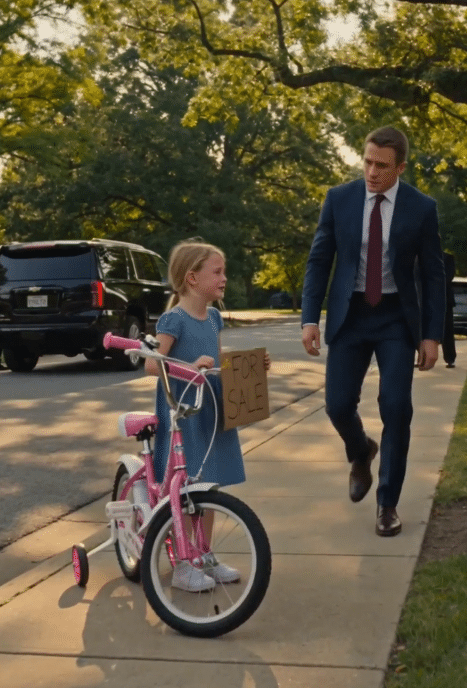
The little girl stood beside the pink bicycle like it was the last thing she owned in the world.
It was too small for the sidewalk, too bright for the fear on her face, too innocent for the cardboard sign tied to the handlebars with a pink ribbon.
FOR SALE.
The letters were uneven, written in thick black marker by a child who had pressed too hard on every stroke.
Cars slowed as they passed the quiet suburban street, but none stopped. People looked, then looked away. Some probably told themselves it was a game. A lemonade-stand version of hardship. A child playing shop beneath the green shade of old maples.
But the girl was not playing.
Her cheeks were blotchy from crying. Her blonde hair clung to her damp face. She kept wiping her nose with the back of her wrist, trying to stand straight, trying to look brave, while her small shoulders shook so hard the cardboard sign trembled.
At the curb, a black Chevrolet Suburban sat polished and silent, the kind of vehicle that made neighbors pause behind curtains. Two security men stood near it with their hands folded, eyes scanning the street.
And beside the SUV stood a man in a navy-blue suit.
He had just stepped out to take a call when he heard the girl’s voice.
“Sir,” she said, barely louder than a whisper. “Would you buy my bike?”
The man turned.
The girl gripped the handlebars as if letting go would mean losing herself too.
“My mom hasn’t eaten in days,” she said, tears spilling again. “So I’m selling my bike.”
For a moment, no one moved.
The man ended the call without looking at the screen.
His name was Ethan Whitmore, and most people in that neighborhood knew him only from magazine covers, courthouse steps, charity galas, and the kind of headlines that made him seem less like a person than a locked door with money behind it.
He was not the kind of man who crouched on sidewalks.
But he did now.
He lowered himself until his eyes were level with hers and placed one hand gently on her shoulder.
“Where is your mother?” he asked.
The girl looked toward the black SUV, not because she knew what it meant, but because she had learned that powerful men usually arrived in dark cars.
Then she looked back at him.
Fresh tears gathered at her lashes.
“She told me to sell it before they took her.”
Ethan’s hand stilled.
The street seemed to lose sound.
“Who took her?”
The girl leaned closer, her voice breaking under the weight of something she had been too young to carry.
“My mom said if I ever saw you, I should ask for help.”
Ethan stared at her.
And then, in front of his guards, in front of the quiet houses and trimmed lawns and closed windows, a single tear slid down his face.
Because there were only three people in the world who knew that sentence.
One was dead.
One had disappeared seven years ago.
And one was standing in front of him with her mother’s eyes.
Act II
Her name was Lily.
She said it the way frightened children say their names to adults, as if hoping the right answer might make the world gentler.
Ethan asked her where she lived. Lily pointed down the block toward a pale yellow rental house with weeds growing through the front walk and one curtain hanging crooked in the window.
The house was no more than six doors away from one of the most secure private residences in the county.
That detail hit Ethan harder than it should have.
Seven years of private investigators. Seven years of sealed reports, dead ends, unanswered calls, and payments made to people who swore they had searched every shelter, hospital, airport, and small-town motel on the East Coast.
And all this time, maybe she had been close enough to see his gates.
“What’s your mother’s name?” Ethan asked, though some part of him already knew.
Lily swallowed.
“Emma.”
The name struck him like a door slamming open in a dark room.
Emma Vale.
He had not said it aloud in years. Not in interviews. Not in court. Not even when he was alone.
Once, Emma had been the only person in the Whitmore estate who spoke to him like he was human. She had started there as his father’s assistant, though everyone quickly learned she was sharper than most of the executives who strutted through the halls.
She had a way of seeing through polished lies. She noticed when Ethan skipped meals during board battles. She left coffee on his desk without asking. She challenged him when he was cruel from exhaustion. She laughed at his jokes only when they were actually funny.
He loved her before he admitted it.
His father hated her before Ethan understood why.
To Henry Whitmore, love was a liability, and Emma was worse than that. She was honest. She had seen documents she was never supposed to see. She had heard late-night conversations behind study doors. She had once warned Ethan not to sign a merger agreement that would have buried hundreds of families under illegal debt.
Ethan listened to her.
For the first time in his life, he defied his father.
Two weeks later, Emma vanished.
The story handed to Ethan was neat, ugly, and convincing enough to destroy him. His father’s attorneys produced emails showing Emma had stolen company funds. A bank statement showed a transfer in her name. A note appeared in her apartment saying she was leaving before things got worse.
Ethan had not believed it.
Not at first.
But grief has a cruel way of wearing down certainty. Every investigator came back empty-handed. Every lead collapsed. Every person who claimed to have seen her was wrong.
Then Henry Whitmore died, leaving behind an empire, a legacy, and one final warning in a private letter to his son.
Some people are meant to leave. Let them.
Ethan burned the letter.
But he could not burn the question.
Now a child in a polka-dot dress stood on the sidewalk with a bicycle for sale, telling him Emma had not left.
She had survived.
And someone had taken her again.
Ethan rose slowly, keeping one hand near Lily as if the world might try to snatch her too.
His head of security, Miles, stepped forward.
“Sir?”
Ethan did not look away from the girl.
“Call the police. Not the local precinct. State investigators. And get Dr. Lawson here now.”
Lily flinched at the word police.
Ethan saw it.
He crouched again.
“Lily,” he said softly, “I’m going to help your mom. But I need you to tell me exactly what happened.”
She hugged herself.
“They came this morning.”
“Who?”
“Two men. One lady. The lady had papers. She said Mommy was sick and needed to come with them.”
Ethan’s jaw tightened.
“Did your mother go with them?”
Lily shook her head quickly.
“She said no. She said they didn’t have the right papers. Then the lady said if Mommy made trouble, they would take me too.”
The words landed like ice.
Ethan kept his face calm, but inside him something ancient and furious began to move.
“What did your mother tell you to do?”
“She put me in the closet,” Lily whispered. “She gave me the sign. She said to wait until they were gone, then sell my bike because I would need food. And she said if I ever saw the man from the picture, I should run to him.”
“What picture?”
Lily reached into the pocket of her blue dress and pulled out a folded square of paper, worn soft at the edges.
It was a photograph.
Ethan took it with careful fingers.
He knew it immediately.
He was younger in the picture, standing beside Emma on a rainy afternoon outside a courthouse, both of them smiling like they had stolen a moment from a world determined to separate them.
On the back, in Emma’s handwriting, were seven words.
If anything happens, find Ethan Whitmore.
Ethan closed his eyes.
For seven years, he had believed the worst thing his father had done was make Emma disappear.
Now he realized the worst thing might be that he had helped keep her hidden without knowing it.
Because the men who took Emma had not been searching for a poor woman in a rental house.
They had been cleaning up an old crime.
And Lily was the proof they had missed.
Act III
The yellow house looked smaller up close.
The front porch sagged. The mailbox hung crooked. A plastic flowerpot sat by the door, dry soil cracked inside it. There were no toys scattered on the lawn, no sign of a child except a pair of tiny sneakers placed neatly beside the mat.
Ethan noticed that.
The neatness.
Poverty had pressed itself into every corner of the house, but dignity still lived there.
Inside, the air held the faint smell of soap, old wood, and boiled rice. A child’s drawing was taped to the refrigerator. A blanket was folded carefully over the back of the couch. On the kitchen table sat an empty bowl, a half cup of water, and a stack of envelopes marked FINAL NOTICE.
Lily stood in the doorway, clutching the sleeve of Ethan’s suit.
“She said not to come back alone,” she whispered.
“You’re not alone,” he said.
Miles and another guard checked the house. Within minutes, they found the closet where Lily had hidden. Inside was a backpack packed with socks, a toothbrush, a small stuffed rabbit, and an envelope sealed with tape.
On the front, Emma had written one name.
ETHAN.
His fingers shook when he opened it.
The letter inside was dated three days earlier.
Ethan,
If you are reading this, then they found us.
I tried to stay hidden because I thought it was the only way to keep Lily safe. I know what they told you about me. I know what your father made you believe. I never stole from you. I never left because I wanted to.
The night I disappeared, I was taken from my apartment by men working for Whitmore legal security. They showed me documents proving your father could have me arrested, committed, or worse, if I ever contacted you again. I was pregnant. I had no money. I ran because I believed that was the only way our child would live free of your family.
Ethan stopped breathing.
Our child.
The words blurred, then sharpened.
Lily was standing near the refrigerator, watching him with the terrified patience of a child used to adults discovering bad news.
He looked at her hair, her chin, the shape of her expression when she tried not to cry.
And then he saw it.
Not Emma’s eyes.
His mother’s.
The same pale blue-gray that stared back at him from the portrait hanging in the Whitmore library.
He turned back to the letter.
Your father did not act alone. His attorney, Calvin Royce, arranged the papers. Dr. Maren signed the false psychiatric report. A woman named Judith Bell has been following us for months. If she comes with papers, do not trust them.
I kept everything I could. The original sonogram. The recording. The trust amendment Henry forced me to witness before he destroyed it. He knew there might be a child. He knew what that child would inherit.
If you still believe any part of me, go to the blue music box.
Ethan looked up.
“Lily,” he said gently. “Do you know where your mom keeps a blue music box?”
The girl nodded and led him to the bedroom.
Emma’s room was almost bare. A mattress. A lamp. A closet with three dresses. On the dresser sat a chipped blue music box painted with tiny white birds.
Ethan remembered it.
He had bought it for Emma from a street vendor in Prague during the only week they had ever spent away from his father’s shadow. She had cried when he gave it to her, not because it was expensive, because it wasn’t, but because he had noticed her admiring it.
Inside the box, beneath the velvet lining, was a flash drive, a hospital bracelet, and a small silver ring Ethan had once slipped onto Emma’s finger with no witnesses and no permission.
Miles exhaled quietly behind him.
Ethan inserted the flash drive into a secure laptop.
The first file was audio.
His father’s voice filled the room, cold and unmistakable.
“You will disappear, Miss Vale. You will take whatever is in your body and remove it from my son’s life. If you come back, I will bury you so deeply even Ethan will call you insane.”
Then another voice.
Calvin Royce.
“We have the medical certification ready. One signature, and no one will question the transfer.”
Ethan’s blood went cold.
The second file was a scanned legal document.
A trust amendment.
Henry Whitmore had changed the family trust two months before Emma vanished. It stated that any biological child of Ethan Whitmore, born inside or outside marriage, would inherit controlling voting shares at age twenty-one, with guardianship protections until adulthood.
It had been notarized.
Then buried.
For seven years, Ethan had been chairman of an empire that, by his father’s own signed document, partially belonged to the little girl standing in a worn blue dress beside him.
Lily looked up.
“Are you mad at Mommy?”
The question nearly broke him.
Ethan crossed the room and knelt in front of her.
“No,” he said. His voice was rough. “No, Lily. I’m not mad at your mom.”
“Are you mad at me?”
He shook his head, fighting the ache rising in his throat.
“I think,” he whispered, “I’m your father.”
Lily stared at him.
Children do not understand inheritance law. They do not understand forged reports or corrupt attorneys or the violence of powerful families dressed in paperwork.
But they understand absence.
They understand the shape of a missing person in every birthday candle, every school event, every night their mother says, “Maybe someday.”
Lily’s lower lip trembled.
“My daddy?”
Ethan nodded once.
And for one suspended second, neither of them moved.
Then Lily stepped into his arms, and the pink bicycle outside stopped being a thing for sale.
It became the last gift her mother had tried to turn into survival.
But across town, Emma Vale was being wheeled through the back entrance of a private clinic under a false name.
And the woman holding the clipboard had just made one mistake.
She had used a Whitmore account to pay for it.
Act IV
Ethan did not arrive at the clinic like a grieving man.
He arrived like a reckoning.
The Suburban pulled up to the private medical center just as the afternoon sun began to lower behind the glass building. Behind it came two state vehicles, an unmarked investigator’s car, and a sedan carrying Judge Helena Ross, an old family friend who had stopped taking Ethan’s calls years ago because she thought grief had made him obsessed.
One look at Lily changed her mind.
Ethan carried the blue music box under one arm and held Lily’s hand with the other. She refused to stay behind. She had spent the entire drive staring out the window, whispering that her mother hated small rooms.
At the reception desk, a nurse smiled the kind of smile trained to stop questions before they started.
“Sir, visiting hours are—”
Ethan placed a court order on the counter.
The smile disappeared.
Miles leaned in.
“We’re looking for Emma Vale.”
The nurse glanced toward the hallway.
That was enough.
They found Emma in a locked observation room on the second floor.
She was sitting upright on the edge of a narrow bed, pale but alert, one hand gripping the rail as a woman in a gray suit spoke to her in a low voice.
Judith Bell.
Ethan recognized her from the private files his father’s company had kept. Crisis management. Reputation control. A person who knew how to make scandals dissolve into signatures.
Emma looked thinner than he remembered. Older in the way fear ages people. But when she turned her head and saw him through the small window in the door, the years fell away all at once.
Her lips parted.
Then she saw Lily beside him.
Emma stood so quickly the woman in gray grabbed her arm.
Ethan’s voice cut through the hallway.
“Open the door.”
A clinic administrator began protesting. Judge Ross stepped forward and read the order aloud in a voice that made every protest shrink.
The lock clicked.
Lily ran first.
“Mommy!”
Emma dropped to her knees and caught her daughter so tightly it seemed she was trying to pull the child back into her own heartbeat.
“I told you to hide,” Emma whispered, crying into Lily’s hair.
“I found him,” Lily sobbed. “I found the man from the picture.”
Emma looked up.
Ethan stood in the doorway.
For a moment, there were too many things between them. Seven years. Lies. Hunger. Fear. A child. A father’s cruelty. A thousand nights when both of them had thought the other had chosen silence.
“I looked for you,” Ethan said.
Emma’s face crumpled.
“I know.”
That answer told him everything.
She had known enough to forgive him. Enough to suffer alone. Enough to keep his photograph in a child’s pocket like a prayer she was afraid to use.
Judith Bell tried to move toward the door.
Miles blocked her.
“I have legal authority,” Judith snapped. “Miss Vale has a documented history of instability.”
Judge Ross turned slowly.
“Then I assume you won’t mind explaining why the doctor who signed that history retired six years ago under investigation.”
Judith’s mouth closed.
The state investigator entered with a tablet.
“We’ve already confirmed the admission request was filed under a corporate medical account connected to Royce Holdings.”
Calvin Royce.
Ethan’s father’s attorney.
The last living architect of Emma’s disappearance.
Ethan looked at Judith.
“Where is he?”
Judith said nothing.
Emma, still holding Lily, reached into the pocket of her cardigan. Her hand trembled as she pulled out a folded discharge form.
“He came this morning,” she said. “He wanted me to sign this.”
Ethan took the paper.
It was not a discharge form.
It was a custody waiver.
It claimed Emma was voluntarily surrendering all parental rights due to mental incapacity. It did not name Lily directly, only referred to “the minor child.” Once signed, it would have allowed a court-appointed guardian to take control.
And through that guardian, Calvin Royce would control Lily’s inheritance.
Ethan’s voice dropped dangerously quiet.
“He tried to take my daughter.”
The words changed the room.
Not because they were loud.
Because they were final.
By dusk, Calvin Royce was brought in by investigators at the Whitmore estate, where he had apparently been waiting with a team of lawyers and a statement prepared for the press.
He had expected confusion.
He found Emma.
He found Lily.
He found Ethan standing in the main hall beneath Henry Whitmore’s portrait, with the blue music box on the marble table and the recovered trust amendment displayed beside it.
The mansion was full of witnesses.
Board members. Investigators. Judge Ross. Two attorneys from the state’s financial crimes division. Even several household staff who had worked there before Emma vanished and had never believed the official story.
Calvin’s face remained composed until Lily stepped from behind Emma.
Then his eyes flicked, just once, to the portrait on the wall.
Ethan saw it.
So did everyone else.
“You knew,” Ethan said.
Calvin adjusted his cuffs.
“I knew your father was concerned about exploitation.”
“My father threatened a pregnant woman.”
“Your father protected his family.”
“No,” Emma said.
Her voice was quiet, but it carried.
Everyone turned.
For years, Emma Vale had survived by staying unseen. By lowering her voice. By moving apartments. By teaching her daughter not to answer the door unless the knock sounded exactly right.
Now she stood in the center of the house that had tried to erase her.
And she did not look afraid.
“Henry Whitmore protected his name,” she said. “Not his family.”
Calvin’s expression hardened.
“You have no proof that will stand.”
Ethan pressed a button on the laptop.
Henry Whitmore’s voice filled the hall.
You will disappear, Miss Vale.
The words echoed beneath his own painted face.
The staff froze. One board member lowered his eyes. Judge Ross closed hers for a moment, as if ashamed of every year the truth had waited outside locked doors.
Calvin turned pale.
Ethan let the recording play just long enough.
Then he stopped it.
“You built a prison out of paperwork,” Ethan said. “But you made one mistake.”
Calvin swallowed.
Ethan looked toward Lily.
“You forgot children grow up remembering who hurt their mothers.”
Lily held Emma’s hand.
Her face was still tear-stained. Her blue dress was wrinkled. She looked small beneath the chandeliers.
But she did not look powerless anymore.
And when Ethan placed the pink bicycle’s cardboard sign on the marble table, the whole room understood.
FOR SALE.
That was what the Whitmore family had reduced his daughter to.
A child on a sidewalk selling the only thing that was hers because adults in suits had stolen everything else.
By the end of the night, Calvin Royce was no longer giving orders.
He was answering questions.
Act V
The story broke two days later, but not the way Calvin Royce had planned.
There were no photographs of Lily’s face. Ethan made sure of that. No reporter got near her school, her new home, or the hospital where Emma recovered from exhaustion and stress under real doctors with real names and court-monitored care.
But the world learned enough.
They learned that Emma Vale had been falsely accused. They learned that Henry Whitmore’s private circle had used forged medical claims and corporate security to bury a scandal. They learned that a missing trust amendment had named Ethan’s child as a protected heir long before anyone knew she existed.
They learned that power can hide a person.
But not forever.
At the emergency board meeting, Ethan did not defend the family name.
He dismantled it.
He removed every executive tied to Royce. He opened company archives to investigators. He transferred a controlling block of protected shares into a trust for Lily, with Emma named as primary guardian and Ethan as co-guardian only after Emma approved it.
When his attorneys advised him to move slowly, he refused.
“I lost seven years by trusting men who spoke carefully,” he said. “I won’t lose another day.”
Emma did not move into the mansion.
That surprised everyone except Ethan.
She chose a modest house three blocks from a park, with a kitchen full of sunlight and a room Lily could paint any color she wanted. Ethan bought the house through a trust, but Emma made him sign an agreement in plain language that said it was hers and Lily’s, not a gift that could become a leash.
He signed without hesitation.
Trust, he understood now, was not declared.
It was rebuilt in small, unglamorous acts.
School pickup.
A stocked refrigerator.
A phone answered on the first ring.
A father sitting on the porch steps while his daughter explained the complicated politics of second-grade friendships.
The first time Lily called him Dad without thinking, Ethan was tying the laces of her sneakers.
He froze.
Lily froze too.
Then she said, very seriously, “You can keep tying.”
Emma laughed from the doorway.
It was the first laugh Ethan had heard from her that did not have pain hiding under it.
Weeks passed.
The pink bicycle stayed in the garage, untouched.
Lily said she did not want it anymore. Ethan offered to buy her a new one, any color, any size, with glitter streamers or a basket or even a little bell shaped like a ladybug.
She shook her head.
“That bike is sad,” she said.
Emma knelt beside her.
“Sometimes sad things can become something else.”
So on a bright Saturday morning, Ethan carried the bicycle into the driveway. The cardboard sign was gone. The ribbon had been replaced. The tires were full. The training wheels had been tightened.
Lily stood with her arms crossed, suspicious.
“I’m not selling it,” she said.
“No,” Ethan replied. “You’re riding it.”
“I might fall.”
“I know.”
“That’s not comforting.”
Emma smiled.
Ethan lowered himself to one knee, just as he had on the sidewalk the day she found him.
“I’ll be right here.”
Lily studied him.
Children forgive differently than adults. Not all at once. Not because someone deserves it. They forgive in careful steps, testing whether the ground holds.
Finally, she climbed onto the bicycle.
Ethan held the back of the seat while Emma stood at the edge of the driveway, one hand over her mouth, eyes bright.
At first, Lily wobbled. She snapped at Ethan not to let go. Then she snapped at him for holding too tightly. Then, halfway down the quiet street, she pedaled three full turns on her own.
Ethan let go.
Lily did not notice.
For a few seconds, the entire world seemed to hold its breath.
Then she realized she was riding alone and shouted, “Mommy!”
Emma laughed and cried at the same time.
Ethan ran beside the bike, ready to catch her, but he did not have to.
Lily slowed near the maple tree where everything had begun. The same stretch of sidewalk. The same curb where the black SUV had parked. The same patch of sun where a little girl had stood with a sign because she believed selling her childhood might save her mother.
She looked down at the concrete.
Then back at Ethan.
“This is where I found you,” she said.
Ethan nodded.
“No,” Emma said softly from behind them. “This is where we all found each other.”
Lily thought about that.
Then she reached into the white basket attached to the handlebars and pulled out something folded.
A piece of cardboard.
Ethan’s chest tightened before he saw the words.
This time, they were written in purple marker.
NOT FOR SALE.
Lily had decorated the corners with stars.
She tied it to the handlebars herself.
No one spoke for a moment.
There are some victories that do not look like revenge. They look like a child riding past the place where she once begged for food. They look like a mother standing in sunlight after years of hiding. They look like a man who lost the truth and spent the rest of his life making sure it never had to beg to be believed again.
Ethan watched Lily pedal down the street, her hair flying behind her, the little sign bouncing against the front of the bike.
Not for sale.
Not her bike.
Not her mother.
Not her name.
Not the years they still had left.
And for the first time in seven years, Ethan Whitmore did not feel haunted by what had been taken.
He felt humbled by what had survived.