Act I
The groom laughed before the priest could ask the question.
Not loudly enough for the whole cathedral to hear.
Just loudly enough to break the bride.
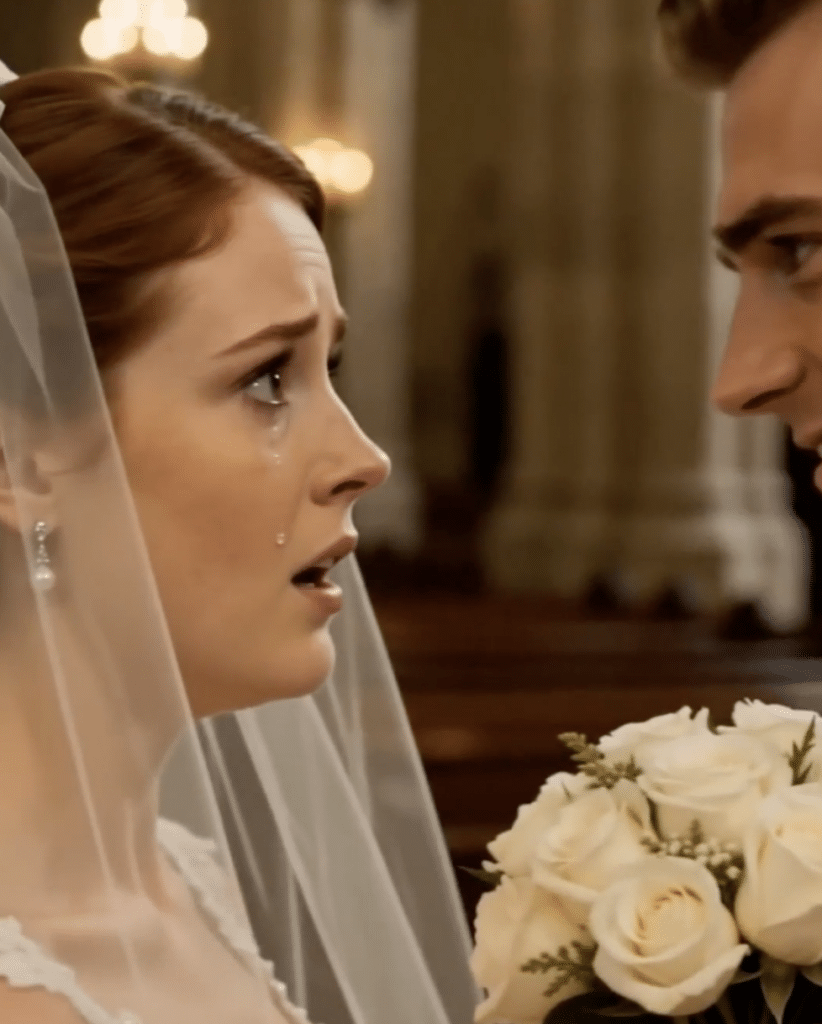
Under the chandeliers, beneath the vaulted stone ceiling and the watching saints carved into the pillars, Nathaniel Cross held Amelia’s trembling hands and leaned close as if whispering something tender.
The guests smiled.
They thought they were witnessing love.
Amelia did too, until he spoke.
“Do you really think I would marry a poor girl like you?” Nathaniel whispered. “I only used you.”
The bouquet of white roses shook in her hands.
For a second, Amelia did not understand him. Her mind refused to accept the words inside a church full of candles, music, and people waiting to clap when she became his wife.
Nathaniel’s smile widened.
“You were useful,” he murmured. “That’s all.”
Amelia stared at him through the lace of her veil.
Her dress had been borrowed from a small bridal shop outside the city, altered three times because she could not afford a new one. The pearls in her earrings were fake. The shoes beneath her gown pinched because they had belonged to her mother.
But she had walked down that aisle believing love had finally given her something wealth never could.
A place to belong.
Nathaniel squeezed her fingers, hard enough to hurt.
“Don’t make a scene,” he whispered. “Smile. You’re good at looking grateful.”
Something inside her went cold.
Behind them, the priest cleared his throat softly, confused by the delay. The guests shifted in the pews. Nathaniel turned his face outward again, wearing his perfect groom’s expression, all polished charm and boyish confidence.
Amelia could barely breathe.
Then the cathedral doors opened.
The sound echoed through the church like a verdict.
Every head turned.
A distinguished man in a navy three-piece suit strode down the aisle with purpose. His gray hair was combed back, his beard neatly trimmed, his expression unreadable. He did not look like a guest arriving late.
He looked like a man entering a room he already owned.
“Sorry I’m late, daughter,” he said, his voice carrying through the stunned cathedral. “I was in an important meeting.”
Amelia turned slowly.
Her heart stopped.
The groom turned too.
At first, Nathaniel looked annoyed.
Then the blood drained from his face.
“Boss?” he whispered.
The man stopped before the altar and looked at him with chilling disappointment.
Nathaniel’s jaw trembled.
“You’re her father?”
The cathedral fell so silent Amelia could hear one rose petal slip from her bouquet and touch the marble floor.
And suddenly, Nathaniel Cross realized he had chosen the wrong woman to humiliate.
Act II
Amelia Hart had grown up with two stories about her father.
The first was her mother’s.
“He loved you before he knew how to stay,” Nora Hart would say, brushing Amelia’s hair at the kitchen table in their tiny apartment above a dry cleaner. “Some people are brave in boardrooms and cowards in kitchens.”
The second story came from everyone else.
“He abandoned you.”
Amelia tried not to believe either version completely.
Her father, Alexander Whitmore, was one of the most powerful men in the country. He owned hotels, shipping lines, technology firms, and half the glass towers people pointed at from taxi windows. His name appeared on hospitals and museums. His face appeared in magazines beside words like empire, discipline, and legacy.
But never beside Amelia.
She was born before the empire fully rose, when Alexander was still a brilliant young executive chasing deals across oceans and Nora was the woman who loved him before money made him suspicious. Their relationship ended badly. Too many missed calls. Too many lawyers. Too many people telling Alexander that Nora wanted his fortune, not his heart.
By the time Amelia was four, her mother stopped waiting for him to come back.
By the time she was ten, Amelia stopped asking why he did not.
Then Nora got sick.
Alexander paid the bills quietly. Amelia did not learn that until years later. Her mother let him help only through anonymous transfers because pride was the last luxury she could afford.
When Nora died, Amelia was nineteen.
At the funeral, a black car parked across the street. A man in a navy suit stood beside it, watching from behind the rain.
Amelia knew who he was.
She did not go to him.
He did not cross the street.
That was the wound neither of them knew how to close.
Years passed.
Amelia worked two jobs, finished school at night, and built a small life out of discipline and exhaustion. She became a literacy counselor for foster children, teaching them how to read stories without feeling like the world had already written their ending.
That was where Nathaniel found her.
He came to the community center with a donation check from Whitmore Global, charming the staff, shaking hands, and pretending not to notice how every camera turned toward him.
He was a rising executive in Alexander Whitmore’s company, handsome, ambitious, and hungry in a way people mistook for brilliance.
He asked Amelia for coffee.
She said no.
He asked again.
She said no again.
The third time, he brought books for the children and sat on the floor reading badly enough to make them laugh.
That was when Amelia started believing maybe he had more heart than polish.
Nathaniel learned her life quickly.
Too quickly.
Her mother’s death. Her estrangement from Alexander. Her refusal to use the Whitmore name. Her discomfort around wealth. Her belief that people were more than what they owned.
He called those things beautiful.
What he meant was useful.
Because Nathaniel Cross had a problem.
He had been stealing from Whitmore Global.
Not dramatically, not all at once. Men like Nathaniel preferred elegant theft. Inflated contracts. Shell consultants. Private transfers hidden inside philanthropic programs. Small leaks in large pipes.
Alexander’s auditors had begun circling.
Nathaniel needed protection.
Then he discovered Amelia was Alexander Whitmore’s daughter.
Unacknowledged publicly.
Emotionally distant.
Legally complicated.
Perfect.
If he could marry her, he could turn himself into family before the investigation reached his desk. If Alexander rejected him, Nathaniel could frame it as class prejudice. If Alexander accepted him, he would gain access, sympathy, and perhaps enough leverage to bury what he had done.
So he played the role.
The devoted man who loved her simplicity.
The wealthy executive humbled by her goodness.
The groom willing to marry a poor girl in a borrowed dress because love mattered more than status.
Amelia believed him because she wanted, just once, to be chosen without being measured.
What she did not know was that Alexander had been watching.
Not from across the street this time.
From close enough to finally act.
The important meeting that delayed him was not a business deal.
It was the signing of the warrant that would expose Nathaniel’s entire lie.
Act III
Nathaniel’s hands went limp around Amelia’s.
Alexander Whitmore stood at the altar, his eyes fixed on the groom.
“Mr. Cross,” he said.
The words were calm.
Too calm.
Nathaniel tried to recover. His smile twitched back into place like a broken machine trying one last time to perform.
“Sir, I didn’t know you were attending.”
“I was invited,” Alexander said.
Amelia turned toward him, stunned.
“I didn’t invite you.”
“No,” Alexander said softly. “Your mother did.”
The words struck her harder than Nathaniel’s cruelty.
Alexander reached into the inside pocket of his suit and removed a small cream envelope, worn at the edges. Amelia recognized her mother’s handwriting before she could read the name.
For Alexander, when Amelia marries.
Amelia’s throat closed.
“She gave that to you?”
“At her funeral,” he said. “Through your aunt. I was told not to open it until today.”
For the first time since entering, Alexander looked at his daughter fully.
Not as a secret.
Not as a regret.
As if every year he had failed her had gathered in his face and finally found nowhere to hide.
“I should have come sooner,” he said. “But I came today.”
Nathaniel’s jaw tightened.
“Sir, perhaps this is a private family matter.”
Alexander’s gaze returned to him.
“No. You made it public when you chose the altar.”
A murmur passed through the cathedral.
Amelia looked between them.
“What is happening?”
Nathaniel stepped closer to her, voice low. “Don’t listen to him. This is about control. He never wanted you to marry me.”
Alexander’s expression hardened.
“You are correct.”
Nathaniel seized that. “See?”
“I didn’t want her to marry you because you are under internal investigation for embezzlement, fraud, and coercive misuse of charitable funds.”
The cathedral erupted.
Guests gasped. A woman in the second pew covered her mouth. Nathaniel’s mother stood halfway, then sat back down as if her knees had failed.
Amelia felt the floor tilt.
“Nathaniel?”
He turned to her quickly. “This is corporate politics. Your father is trying to scare you.”
Alexander lifted one hand.
At the back of the cathedral, two men in dark suits entered with a woman carrying a leather folder. Amelia recognized one of them from newspaper photos.
The company’s general counsel.
Alexander spoke without raising his voice.
“Three hours ago, Whitmore Global’s board received verified records of offshore payments routed through literacy grants meant for foster children.”
Amelia’s face went white.
Her children.
The center.
The books.
The donations.
Nathaniel looked at her, and for the first time, she saw the calculation beneath the tenderness.
Alexander continued.
“Mr. Cross also accessed sealed personnel records to confirm Amelia’s identity before pursuing the relationship.”
Amelia took a step back.
Nathaniel reached for her. “Amy—”
“Don’t,” she whispered.
He froze.
No one called her Amy except her mother.
She had told him that in confidence.
Now even the nickname felt stolen.
The general counsel opened the folder.
“There are also recorded statements from two former assistants confirming Mr. Cross referred to the marriage as ‘insurance.’”
The word echoed in Amelia’s mind.
Insurance.
Not love.
Not commitment.
Insurance.
Nathaniel’s mask finally cracked.
He looked at Alexander with naked hatred.
“You think you can destroy me in front of everyone?”
Alexander’s face was cold.
“No, Nathaniel. I think you destroyed yourself in front of my daughter.”
Amelia stood between them in her white gown, bouquet hanging from her hand, realizing the wedding had never been a beginning.
It had been a trap dressed in lace.
And her father had arrived carrying the key.
Act IV
Nathaniel laughed suddenly.
It was too loud.
Too sharp.
The sound of a man cornered and furious that the room could see it.
“You want the truth?” he said, turning toward the guests. “Fine. Yes, I knew who she was. Everyone in my world knew Alexander Whitmore had a discarded daughter somewhere. I just found her first.”
Amelia flinched.
Alexander’s jaw tightened.
Nathaniel pointed at him.
“You don’t get to play father now. You hid her. You left her poor. You let her mother die in an apartment while your name was glowing on hospital wings.”
The cruelty worked because part of it was true.
Alexander absorbed it like a man accepting a sentence he had earned.
“You’re right,” he said.
The room stilled.
Amelia stared at him.
Alexander looked at her, not Nathaniel.
“I failed you. I let pride, fear, and lawyers stand where I should have stood. I cannot undo that by interrupting your wedding.”
His voice roughened.
“But I will not let another selfish man build his future out of your pain while I stay silent again.”
Amelia’s eyes filled.
Nathaniel sneered. “Beautiful speech.”
Alexander turned back to him.
“The difference between us is that I will answer for what I did.”
The general counsel stepped forward.
“So will you.”
Nathaniel’s best man moved toward him, whispering urgently, but Nathaniel shoved him away.
“You don’t have enough.”
The woman with the folder removed one final document.
Amelia saw Nathaniel’s face change before she knew why.
It was a prenuptial agreement.
The one he had asked her to sign that morning.
He told her it was symbolic. A formality. Something his lawyers insisted on because of his position. She had been too overwhelmed to read every page carefully, too embarrassed to admit she did not understand parts of it.
Alexander’s counsel spoke clearly.
“Section twelve grants Mr. Cross authority to act as Amelia Hart’s financial representative in any inheritance or family settlement dispute arising from acknowledgement by Alexander Whitmore.”
Amelia’s hands went cold.
Nathaniel had not only used her name.
He had tried to gain control over whatever her father might one day give her.
“You asked me to sign that before the ceremony,” she whispered.
Nathaniel’s voice dropped. “I was protecting us.”
“No,” she said. “You were preparing to own my pain before I even knew what it was worth to you.”
The bride who had stood trembling minutes earlier changed before the room.
Her shoulders straightened.
Her tears stayed, but they no longer looked like surrender.
She turned to the priest.
“There will be no wedding.”
The priest nodded, pale.
Nathaniel grabbed her wrist.
The movement was quick, desperate, ugly.
Alexander moved faster than anyone expected.
“Release her.”
The command filled the cathedral.
Nathaniel let go.
Not because he wanted to.
Because every eye in the church had become a witness.
Amelia stepped away from him and slowly removed the engagement ring.
For a moment, she held it in her palm. A perfect diamond. Cold. Expensive. Chosen by a man who understood value but not worth.
She placed it on the altar.
“You can keep your insurance,” she said.
The guests were silent.
Then someone stood.
An older woman from the community center. Then a young teacher. Then one of the foster boys Amelia had helped tutor, now seventeen, wearing a suit that did not quite fit.
One by one, the people who knew Amelia before Nathaniel began standing.
Not applauding.
Just standing.
Nathaniel looked around, realizing too late that Amelia had never been poor in the way he thought.
She had people.
She had truth.
And now she had a name he could no longer use.
At the cathedral doors, two investigators entered.
Nathaniel saw them and whispered, “You can’t do this.”
Alexander looked at his daughter.
“No,” he said. “She did.”
Act V
Amelia left the cathedral through the front doors.
Not the side exit.
Not hidden in shame.
She walked down the long aisle alone, lace veil trailing behind her, white roses still in her hand. The guests parted quietly. Some cried. Some whispered apologies. Some looked away because watching a woman survive humiliation with dignity made them ashamed of having mistaken silence for peace.
Alexander did not walk beside her.
He followed several steps behind.
That mattered.
For once, he did not try to take control of her exit.
Outside, the afternoon light hit the cathedral steps. Cameras had already gathered for what was supposed to be a society wedding. Instead, they captured the bride walking out unmarried, unbroken, and followed by the father who had arrived too late but not useless.
A reporter shouted, “Ms. Hart, what happened inside?”
Amelia stopped.
Alexander’s security moved forward.
She lifted one hand, and they stopped.
Her voice shook, but it carried.
“I almost married a man who thought my poverty made me easy to use,” she said. “He was wrong.”
That was all.
She stepped into the car alone.
Alexander did not follow until she nodded.
The ride to his townhouse was silent for ten minutes.
Then Amelia opened her mother’s envelope.
Inside was a letter.
My dearest Amelia,
If you are reading this, it means I am not there to fix your veil, cry too much, and tell you whether the groom deserves you. So I will say the thing I should have said while I was alive.
Your father loved you badly. But he loved you.
Do not let him excuse himself. Do not let him buy forgiveness. But if he comes to you honestly, make him speak honestly. Men like Alexander hide behind power because they are terrified of needing mercy.
And if the man beside you ever makes you feel small at the altar, walk away before the vows turn into a cage.
Amelia folded the letter with trembling hands.
Alexander stared out the window, his face gray with regret.
“She knew,” Amelia whispered.
“She usually did.”
“Why didn’t you come after she died?”
He closed his eyes.
“Because I thought you hated me.”
“I did.”
“I know.”
She turned toward him.
“But you let that be enough?”
The question landed between them with more force than anger.
Alexander bowed his head.
“Yes.”
It was the first honest answer he had ever given her.
Nathaniel Cross was arrested that evening.
The scandal spread quickly, but it did not consume Amelia the way everyone expected. Nathaniel’s fraud became a corporate case. His cruelty became gossip. His downfall became content for strangers who had not felt his fingers tighten around her hands.
Amelia refused every interview after the first statement.
She returned to the community center two weeks later.
The children had made her a crooked banner that read WELCOME BACK MISS AMELIA. One girl asked if she was sad she did not become a princess.
Amelia smiled.
“No,” she said. “I think I escaped the wrong castle.”
The girl considered that seriously.
“Good.”
Alexander came to the center a month later.
Not with cameras.
Not with a giant donation check.
With a box of books.
Amelia found him standing awkwardly near the door, holding the box like it might explode.
“You can’t fix us with books,” she said.
He nodded.
“I know.”
She took the box anyway.
Healing did not arrive as a grand reunion.
It came in uncomfortable lunches, unanswered questions, and conversations that ended too early because one of them needed air. It came in Alexander learning not to send assistants when he was afraid. It came in Amelia learning that accepting truth did not require offering immediate forgiveness.
On what would have been her wedding anniversary, Amelia visited her mother’s grave.
She brought the white roses from the cathedral, dried now, tied with a blue ribbon from her mother’s old sewing box.
Alexander came too, but waited at the gate until she waved him over.
They stood together in silence.
Finally, Amelia said, “I was so embarrassed.”
“At the altar?”
She nodded.
“I thought everyone saw a poor girl being rejected.”
Alexander looked at the stone with Nora’s name carved into it.
“I think they saw a woman being revealed.”
Amelia glanced at him.
He added, “Not by me. By herself.”
For once, he said the right thing.
Months later, the Whitmore board created a protected fund for the community literacy program. Amelia agreed on one condition: her father’s name would not be on the building.
The sign read Nora Hart House.
Alexander cried when he saw it.
He tried to hide it.
Amelia let him fail.
Nathaniel eventually pleaded guilty to financial crimes. His final public statement claimed he had made “errors under pressure.” Amelia did not watch it. She was busy that day helping a ten-year-old boy read a chapter book aloud without stumbling over the hard words.
That felt more important.
A year after the broken wedding, Amelia returned to the cathedral.
Not for marriage.
For a memorial concert benefiting Nora Hart House.
The pews were full again. The chandeliers glowed. The same aisle stretched long and pale beneath the vaulted ceiling. For a moment, standing at the back, Amelia felt her body remember the humiliation.
Nathaniel’s whisper.
The trembling bouquet.
The ring in her palm.
Then Alexander appeared beside her.
“Ready?” he asked.
She looked down the aisle.
This time, she was not being given away.
This time, she was walking toward something she had built.
“Yes,” she said.
They entered together.
Not as a perfect father and daughter.
Not as a family magically restored.
But as two people who had finally stopped letting silence make their decisions.
At the front, the choir began.
Amelia sat in the first pew beneath the chandeliers and looked toward the altar where Nathaniel Cross had once tried to reduce her to a poor girl grateful for attention.
He had been wrong about almost everything.
She was not poor because she lacked his money.
She was not lucky because he chose her.
She was not ruined because he exposed his cruelty before the vows.
And when her father had walked through those cathedral doors saying, “Sorry I’m late, daughter,” it had not saved her.
Not completely.
It had only opened the door.
Amelia saved herself when she walked through it.