Act I
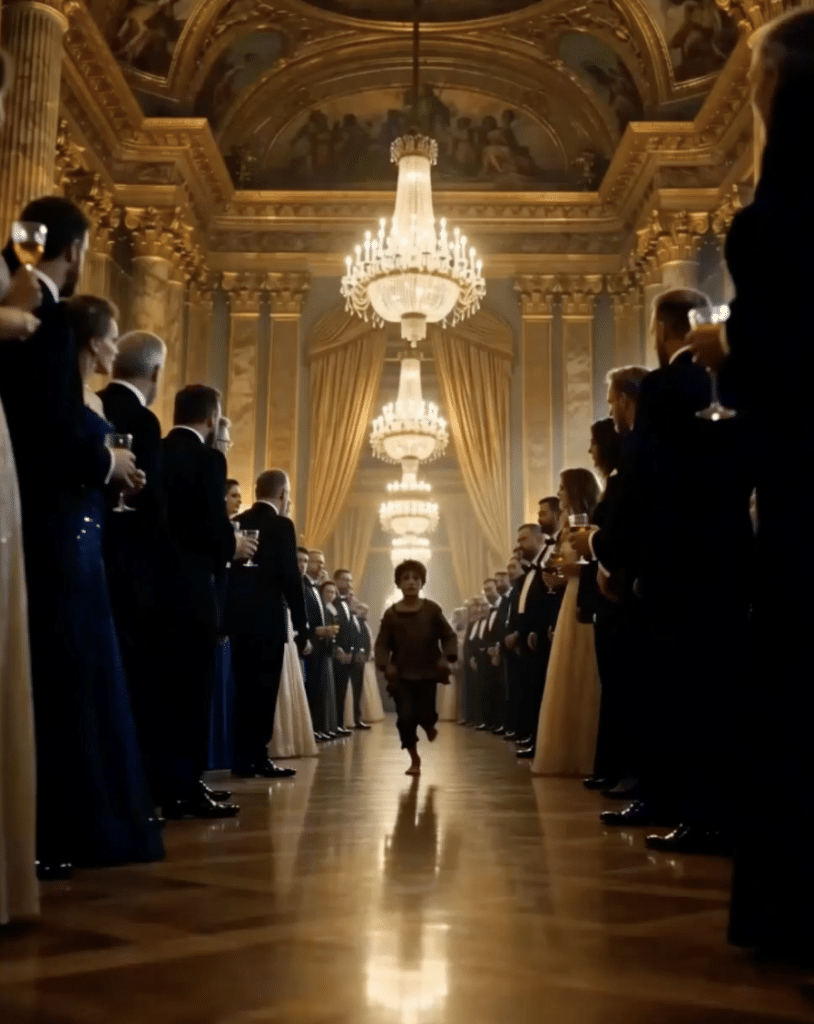
The boy ran barefoot across a floor made for people who had never worried about shoes.
Gasps followed him through the ballroom.
Under crystal chandeliers and gold-leaf columns, the guests turned in waves, their champagne glasses pausing halfway to their mouths. Women in satin gowns stepped back. Men in tuxedos frowned as the child in torn gray-brown rags cut straight through the center of the gala like a stain nobody could politely ignore.
He was eight, maybe nine.
Dirty. Breathless. Determined.
And he was heading directly for the girl in the wheelchair.
She sat beneath the brightest chandelier in a shimmering pale-blue ballgown, her long brown hair falling over her shoulders. Her wheelchair was sleek and black, placed beside her father as if she were part daughter, part symbol, part centerpiece.
Her name was Clara Hawthorne.
Everyone in the room knew that.
Heiress. Survivor. Face of the Hawthorne Hope Foundation.
Her father, Victor Hawthorne, stepped forward before the boy could reach her.
“Stop right there.”
His voice carried through the room with the ease of a man used to being obeyed. He wore a black tuxedo cut perfectly to his frame, his dark hair combed back, his expression sharp with disgust.
The boy stopped a few feet away.
His chest rose and fell. His bare feet were dusty against the polished golden floor.
“Let me dance with her,” he said.
The silence that followed was crueler than laughter.
Victor stared down at him.
“Do you know who she is?”
The boy looked past him, straight at Clara.
“I know she wants to dance.”
Clara’s fingers tightened on the armrest of her wheelchair.
Something moved across her face. Not embarrassment. Not fear.
Recognition.
Victor noticed and shifted slightly, blocking the boy’s view.
“Why should I let you near her?”
The boy swallowed.
For one second, he looked exactly as small as he was.
Then he lifted his chin and slowly extended his hand toward Clara.
“Because I can make her stand.”
A woman near the front gave a horrified little gasp. Someone whispered, “How dare he?” Another guest reached for a phone. Victor’s face hardened into something colder than anger.
But Clara did not look offended.
She looked alive.
Her hand rose before her father could stop it.
Small. Shaking. Hopeful.
She placed it in the boy’s dirty palm.
“Dance with me,” she whispered.
And beneath the chandeliers, in front of the richest people in the city, Victor Hawthorne’s perfect charity gala began to collapse.
Act II
Finn Mercer had not come to the ballroom for food.
That was what security assumed when they saw him slip through the side entrance behind the catering staff. A hungry child in rags at a gala full of roast duck, sugared fruit, and untouched dessert plates. It was the easiest explanation.
It was also wrong.
Finn had come for Clara.
He had known her before the blue gown, before the cameras, before the foundation posters that showed her smiling bravely beside her father. He had known her in a hospital therapy room with scuffed floors and windows that rattled when buses passed outside.
Back then, Clara had not been a symbol.
She had been a girl who hated peas, loved music boxes, and named every therapy band after a dragon.
Finn’s mother, Elise Mercer, had been her movement therapist.
Elise was not famous. She was not rich. She wore cheap sneakers and kept spare granola bars in every bag because she believed frightened children trusted adults faster when they were fed. She specialized in recovery after traumatic injuries, but she never promised miracles.
She used to say, “Standing is not the goal. Choice is the goal.”
Clara had been six when she arrived at the clinic after the car accident that killed her mother. The whole city mourned Evelyn Hawthorne, the beloved philanthropist. Newspapers printed photographs of Victor beside Clara’s hospital bed, one hand on her shoulder, grief arranged perfectly across his face.
But in the therapy room, Clara was not a headline.
She was angry.
She threw blocks. Refused exercises. Screamed when anyone mentioned walking. Then Elise played music one afternoon, held out one hand, and said, “Fine. Don’t walk. Dance sitting down.”
Clara stared at her.
Then she laughed.
That was the beginning.
Week by week, Clara improved. Not magically. Not completely. Some days were painful. Some days she cried. Some days she used her chair and wanted no one to discuss it.
But some days, with braces and support, she stood.
Finn remembered because he was there.
He was five then, always tucked into the corner with crayons while his mother worked. Clara used to sneak him stickers from her reward chart. He used to clap when she completed a transfer or balanced for three seconds longer than before.
Once, when Clara stood between the parallel bars, trembling and furious, Finn had shouted, “You look like a queen!”
Clara had shouted back, “Queens don’t sweat!”
Elise laughed so hard she had to sit down.
Then everything changed.
Victor arrived early one day and saw Clara standing.
He did not smile.
He did not cry from joy.
He went pale.
The next week, Elise was removed from Clara’s care. The clinic was told the Hawthorne family wanted “a more private medical team.” Clara stopped coming. Elise tried to call, then write, then request a welfare review.
No one listened.
Three months later, the Hawthorne Hope Foundation launched.
Its entire campaign was built around Clara’s “permanent condition” and Victor’s devotion as a father. Donations poured in. Board seats opened. Public sympathy turned into influence. Influence turned into money.
Elise kept a folder.
Inside were therapy notes, videos of Clara standing with support, letters she tried to send, and a copy of Evelyn Hawthorne’s will. The will had one strange clause: Clara would inherit her mother’s controlling shares at eighteen, unless she was deemed permanently incapacitated, in which case Victor would manage them indefinitely.
Elise understood then.
Clara’s chair was not the lie.
The lie was that Clara had been denied the truth about her own body.
And Victor Hawthorne had built an empire on that denial.
Act III
Victor grabbed Clara’s wrist before she could fully reach Finn.
“Enough,” he said.
Clara looked up at him.
For years, his voice had been the walls of her life. Gentle in public. Heavy in private. Always reminding her what was safe, what was possible, what would break her if she tried too hard.
But Finn’s hand was still there.
And she remembered him.
Not completely at first.
Memory came like music from another room.
A little boy with crayons.
A woman with kind eyes.
A therapy room where nobody called her tragic.
“Finn?” Clara whispered.
The boy’s face lit briefly, then tightened with urgency.
“You remember.”
Victor’s eyes snapped toward him.
“You know this child?”
Clara swallowed. “I think so.”
“You’re confused.”
“No,” Finn said. “She isn’t.”
Victor turned on him. “Security.”
Two men began moving from the side of the ballroom.
Finn reached into his torn shirt and pulled out a small object tied with blue ribbon.
Clara made a sound.
It was one of her old ballet slippers.
Tiny. Soft. Worn at the toe. The ribbon had faded almost gray with age.
“I kept it,” Finn said. “My mom said one day you might need to remember what they told you to forget.”
Victor’s face changed.
Just slightly.
But in a room full of people watching closely, slight was enough.
Clara stared at the slipper. “Where is Elise?”
Finn’s eyes filled.
“She tried to come tonight. They wouldn’t let her past the gate.”
Victor snapped, “This is absurd. That woman was dismissed years ago for professional misconduct.”
Finn shook his head. “No. She was dismissed because she recorded you.”
The ballroom went still.
Victor laughed once.
It sounded wrong.
“A child in rags is accusing me of what, exactly?”
Finn looked toward the orchestra.
“Play the waltz.”
No one moved.
Then an older violinist lowered his bow and said quietly, “Which one?”
Finn answered, “The dragon song.”
Clara’s eyes widened.
That was not its real name. It had been her name for the therapy waltz Elise used when Clara was too frustrated to continue. One-two-three. Breathe. One-two-three. Shift. One-two-three. Trust the floor.
The violinist looked at Clara.
She nodded.
Victor said, “Do not.”
But the first notes had already begun.
Soft. Trembling. Familiar.
Clara’s hands shook on the armrests.
Finn stepped closer.
“I can’t make you stand by magic,” he said, loud enough for the front rows to hear. “My mom said nobody should ever say that. But I can help you remember that you did.”
Clara looked at her father.
He was no longer calm.
That frightened her more than his anger ever had.
“What did you do?” she asked him.
Victor bent toward her, voice low. “I protected you.”
Finn’s voice cut through.
“No. You protected what you could take from her.”
At the far end of the ballroom, the gold doors opened.
A woman entered leaning on a cane, escorted by a young attorney and two security guards who clearly did not work for Victor.
Elise Mercer had arrived.
And in her hand was the folder Victor had spent years trying to bury.
Act IV
Elise did not look like someone who had come for revenge.
She looked tired.
Her coat was old. Her hair was pinned back carelessly. Her left leg dragged slightly from an injury no one in the room knew about yet. But her eyes were steady as she walked across the golden floor toward the child she had once helped and the son who had run ahead because no adult would let him through the front doors.
Victor’s voice turned icy.
“Remove her.”
The attorney beside Elise raised a document.
“Any attempt to remove Ms. Mercer will be added to the civil complaint already filed with the court.”
The guests murmured.
Civil complaint.
Court.
Those words changed the flavor of scandal. It was no longer a scene. It was evidence.
Elise stopped in front of Clara.
For a moment, the therapist’s composure broke.
“Oh, sweetheart,” she whispered.
Clara stared up at her, tears gathering fast.
“You said I could dance sitting down.”
Elise smiled through her own tears.
“And you told me queens don’t sweat.”
A sob escaped Clara before she could stop it.
Victor stepped between them.
“This woman exploited my daughter’s trauma.”
Elise opened the folder.
“No. I documented her progress.”
The attorney handed a tablet to the nearest foundation board member, a silver-haired woman in emerald silk. On the screen was a video.
Clara at six years old.
Standing between parallel bars.
Shaking. Laughing. Furious.
Finn, tiny and bright-eyed, clapping from the corner.
Elise’s voice in the recording said, “Only as much as you choose, Clara. Your body, your pace.”
The ballroom watched in stunned silence.
Clara covered her mouth.
Victor’s face went gray.
The video shifted to another clip. Victor in the therapy doorway, his expression hard.
His voice came through clearly.
“If she recovers on paper, the trust changes.”
Elise’s recorded voice answered, “She is a child, Mr. Hawthorne. Not a financial structure.”
Then Victor:
“You work for people who can be replaced.”
The board member lowered the tablet as if it had burned her.
Clara looked at her father.
“You knew.”
Victor reached for her. “Clara—”
She pulled back.
The movement was small.
It broke him more effectively than a scream.
Finn held out the slipper.
Clara took it.
Then she looked at Elise.
“Can I try?”
Elise’s face softened with both hope and caution.
“You don’t have to prove anything to anyone in this room.”
“I know,” Clara whispered. “I want to know what’s mine.”
That sentence did what no accusation had done.
It made Victor look afraid.
Elise turned to the wheelchair, checked the brakes, and knelt with care. Finn stood at Clara’s other side, not pulling, not forcing, just offering the same open hand he had offered before.
The music continued.
One-two-three.
Breathe.
Clara placed one foot carefully beneath her gown.
Then the other.
Her arms trembled. Her face tightened. She leaned on Elise and Finn, not like a miracle, not like a cure, but like a girl reclaiming a truth that had been locked away from her.
She rose.
Only halfway at first.
Then fully enough.
The ballroom did not cheer.
Not yet.
They seemed to understand, all at once, that applause would make it a performance.
Clara stood for herself.
For three seconds.
Then five.
Then she laughed and cried at the same time.
Finn whispered, “Queen.”
Clara whispered back, “Still sweating.”
Elise laughed through tears.
Victor turned away, but there was nowhere left to hide.
Act V
The Hawthorne Hope Foundation did not survive the month.
Not as it had been.
By morning, the gala video was everywhere. But the clip people replayed most was not Clara standing. It was the moment before it, when she said, “I want to know what’s mine.”
Those six words became bigger than the scandal.
They became the question investigators started asking.
What had been withheld from her?
Medical records. Therapy options. Financial disclosures. Letters from Elise. Reports buried by private doctors paid through the foundation. A trust management arrangement that gave Victor access to funds that should have been protected for Clara’s future.
Victor denied wrongdoing.
Then the board froze his authority.
Then Evelyn Hawthorne’s old lawyer came forward with notes proving Evelyn had feared exactly this. She had written, in her private instructions, that Clara was never to be used as “an ornament of pity.”
That phrase finished what the video began.
Victor resigned under pressure before criminal inquiries even started. His defenders said he had been a grieving father who made mistakes. Clara heard that and said nothing for a long time.
Then, in a private meeting with the board, she finally spoke.
“Grief does not excuse stealing someone’s choices.”
No one argued.
Elise Mercer was offered a settlement.
She accepted only enough to pay her medical debts and secure housing for Finn. The rest she directed into a patient advocacy fund for children whose families controlled their treatment narratives without independent review.
Finn hated the new apartment at first.
“It has too many doors,” he said.
Elise asked if that was bad.
He shrugged. “Just weird.”
Clara visited two weeks later, wearing sneakers under a simple blue dress. She still used her wheelchair most of the day. Some days she used braces. Some days she did not want to try anything, and Elise made sure everyone understood that trying was not the rent Clara had to pay to be respected.
Finn understood faster than most adults.
When Clara arrived, he did not ask if she could stand.
He asked if she wanted toast.
She did.
Their friendship returned awkwardly, then all at once.
They played cards. Argued over music. Shared memories neither trusted alone. Finn told Clara about hiding near the gala kitchens. Clara told Finn about years of being photographed from her “good side” because Victor said sorrow needed elegance.
“Your dad is awful,” Finn said.
Clara looked at him.
“You can say it,” he added. “I won’t tell rich people.”
That made her laugh so hard Elise had to leave the room.
Months later, Clara took control of her mother’s trust through a court-appointed guardian structure that prioritized her consent. The foundation was renamed The Evelyn Hawthorne Choice Initiative. Its first public statement banned fundraising campaigns that used children’s images without their understanding and approval.
Clara wrote the last line herself.
Help is not ownership.
The ballroom reopened one year after the gala.
Not for another elite fundraiser.
For a dance.
No press wall. No gold donor tiers. No speeches about bravery delivered by people who had never asked the children what bravery felt like. The room was filled with families, therapists, children using wheelchairs, walkers, braces, crutches, prosthetics, and no mobility aids at all.
Some danced standing.
Some danced seated.
Some only watched until they felt ready.
The golden floor belonged to everyone.
Clara arrived in a blue gown again, but this one had been designed with her input: beautiful, comfortable, easy to move in, and not chosen by someone trying to turn her into a symbol. Finn wore shoes this time, though he complained they made him look like a lawyer.
Elise stood near the side, smiling softly.
When the orchestra began the dragon song, Clara looked at Finn.
“You ready?”
He bowed dramatically. “Your Majesty.”
She rolled her eyes and held out her hand.
They moved together beneath the chandeliers.
At first, Clara remained seated, spinning her chair with a grace that made several children cheer. Finn danced around her, laughing when he nearly tripped over his own polished shoes.
Then, later, when the room was no longer watching so closely, Clara touched the brakes.
Finn noticed.
“You want help?”
“Yes.”
He offered his hand.
Elise stepped closer, but Clara shook her head gently.
“Just Finn.”
So Elise stayed back.
Clara rose slowly with Finn’s support. Not to prove Victor wrong. Not to satisfy the crowd. Not to become anyone’s miracle.
To feel the music from another height.
Three steps.
That was all.
Three careful, shaking, magnificent steps across the golden floor.
Then she sat back down, breathless and smiling.
The applause came only after she laughed.
This time, it felt welcome.
Near the entrance, Victor Hawthorne watched from behind a pillar. He had not been invited. He looked older, smaller, stripped of the stage he once controlled. Clara saw him.
For a moment, the old fear flickered.
Then Finn stepped into her line of sight.
“You okay?”
Clara looked at her friend, at Elise, at the children dancing in every possible way across the floor.
“Yes,” she said. “I am.”
Victor left before the final song.
No one followed him.
That was his punishment, in the end.
Not only the investigations. Not only the lost money. Not only the public disgrace.
It was that the room he had built around Clara’s silence had learned to move without him.
At the end of the night, Clara and Finn sat together beneath the largest chandelier, eating cake from paper plates because Clara insisted fancy plates made cake taste nervous.
Finn looked around the ballroom.
“You know, the first time I ran in here, everyone looked at me like I was mud.”
Clara nudged him with her shoulder.
“You were mud.”
“Royal mud.”
“Barefoot royal mud.”
He grinned.
She looked down at the old ballet slipper resting in her lap, the ribbon carefully repaired. It no longer hurt to see it. It no longer felt like proof of what was stolen.
It felt like proof that memory could survive theft.
Clara glanced at Finn.
“You said you could make me stand.”
He looked embarrassed. “I know. My mom said that was a terrible way to say it.”
“It was.”
“I was panicking.”
“I know.”
She smiled.
“But you did help me stand.”
Finn shook his head.
“No. I helped you remember you already had.”
Clara looked out at the golden floor, at children moving under the chandeliers in bodies the world had too often misunderstood, pitied, or controlled.
Then she took Finn’s hand again.
Not because she needed saving.
Because she wanted to dance.