Act I
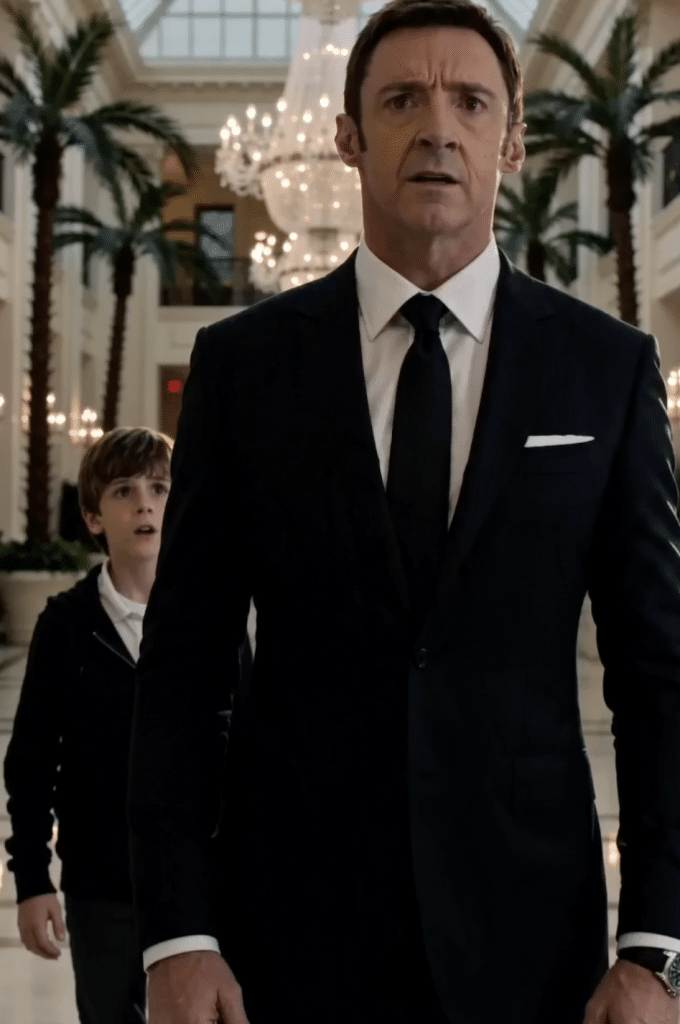
The boy should not have been in that lobby.
Not alone.
Not standing beneath crystal chandeliers in a navy coat with scuffed shoes, freckles across his nose, and both hands clenched at his sides like he was holding himself together by force.
The Grand Meridian Hotel was not built for children like him. It was marble, brass, velvet ropes, quiet money, and people who never raised their voices because they could pay others to do it for them.
Across the lobby, a man in a black suit checked his watch.
He was tall, composed, and expensive in a way that did not need to announce itself. His shirt was crisp. His tie was dark blue silk. Around his wrist sat a stainless steel chronograph, polished but old, its face scratched near the three o’clock marker.
The boy saw it.
And the room seemed to vanish.
He walked toward the man before anyone stopped him.
“Sir…”
The man turned, surprised.
The boy pointed at his wrist.
“That watch. My dad had the same one.”
The man glanced down, then back at the child.
“What did you say?”
“My dad wore it every day.”
Something in the boy’s voice made the man stop adjusting his cuff.
It was not curiosity.
It was certainty.
The kind children carry when grief has made them memorize details adults forget.
The man leaned down, his expression changing from mild irritation to something sharper.
“What’s your dad’s name?”
The boy did not hesitate.
“Scott.”
The name struck the man so hard he almost stepped back.
Scott.
For a second, the chandeliers above him blurred. The polished floor, the palm trees, the soft piano music from the bar, the reception desk in the distance — all of it tilted around one impossible word.
The boy looked at him steadily.
The man’s breath caught.
“Scott…” he whispered. “How do you know that?”
The boy frowned.
“Because he was my father.”
The man stared at him.
And suddenly, the watch on his wrist felt heavier than steel.
It felt like evidence.
Nine years earlier, Marcus Ellery had stood at a cemetery without a body and listened to a priest say prayers over an empty grave.
His younger brother, Scott, had vanished after a hotel fire in Chicago. The official report said he died trapped in the east service corridor. The insurance investigators said the fire was an accident. The family attorney said it was time to accept what could not be changed.
Marcus never accepted it.
But he wore Scott’s watch every day because it was the last thing recovered from the scene.
Or so he had been told.
Now an eight-year-old boy was standing in the lobby of Marcus’s own hotel, claiming his father had worn one just like it.
Not years ago.
Every day.
Marcus looked at the boy’s face again.
Brown hair. Clear eyes. A solemn little mouth trying not to tremble.
And then he saw it.
The same small scar through the left eyebrow.
Scott had one too.
Marcus’s voice came out rough.
“What’s your name?”
The boy swallowed.
“Ben.”
“Ben what?”
The boy glanced toward the revolving doors as if he expected someone to come through them at any second.
Then he reached into his coat and pulled out a folded hotel key envelope.
On the back, in rushed handwriting, were five words.
Find the man with Scott’s watch.
Marcus turned cold.
Because beneath the message was a symbol only two people in the world had ever used.
A tiny crooked star.
Scott’s mark.
The mark he used to draw on every birthday card he sent Marcus when they were boys.
Marcus looked up.
“Who gave you this?”
The boy’s courage finally cracked.
“My mom,” he whispered. “Before the men took her upstairs.”
Act II
Marcus Ellery had spent his entire adult life inside hotels.
His father built them. His grandfather financed them. His mother decorated the first lobby herself, choosing the white marble and brass lamps because she believed wealth should look warm, even when it was cold.
By thirty-eight, Marcus was chairman of Ellery Hospitality Group.
By forty-one, he was alone.
Scott had been the different one.
Younger by seven years, reckless in the way good-hearted people sometimes are when they grow up surrounded by careful liars. Scott hated boardrooms. He hated rehearsed dinners. He hated watching men in suits discuss families like numbers on a spreadsheet.
He loved old motorcycles, cheap diners, street musicians, and broken things he could fix with patience.
Most of all, he loved proving Marcus wrong.
When Marcus said the world was built on leverage, Scott said it was built on trust.
When Marcus called that naive, Scott laughed and said, “Only rich people think kindness is a scam.”
They fought constantly.
Then Scott joined the company anyway.
Not because he wanted money.
Because he suspected their father’s closest advisor, Victor Hale, had turned the hotel group into a laundering machine for people whose names never appeared on guest lists.
Marcus did not believe him at first.
That was the guilt that aged him.
Scott brought him documents. Marcus called them incomplete.
Scott brought him witness names. Marcus said they needed proof.
Scott begged him to delay the Chicago acquisition. Marcus told him not to embarrass the family in front of investors.
Three days later, the east wing burned.
Scott disappeared.
Victor Hale handled the aftermath with perfect sorrow. He arranged the memorial, spoke to the press, comforted Marcus in a voice that seemed almost human.
Then he produced the watch.
Scott’s watch.
Charred at the strap, scratched across the face, but intact.
“They found it near the service corridor,” Victor said. “I’m sorry.”
Marcus took it like a punishment.
The watch had been one of two.
A gift from their mother before she died. Marcus had received one. Scott had received the other. On the inside of Scott’s clasp, she had engraved a sentence.
For the one who runs toward fire.
Marcus wore it after the memorial.
Not his own.
Scott’s.
For nine years, it reminded him that he had not listened fast enough.
Now, in the Grand Meridian lobby, a child named Ben stood under the chandeliers with Scott’s eyes and a message written in Scott’s hand.
Marcus guided him away from the center of the lobby before the staff could stare too openly.
“Your mother,” Marcus said. “What’s her name?”
“Rachel.”
“Rachel what?”
“Rachel Moore.”
The name stirred something old in Marcus’s memory.
A waitress from the Chicago hotel.
No — not waitress. Banquet staff. Scott had mentioned her once, smiling in a way Marcus had been too busy to notice.
“She knew Scott?” Marcus asked.
Ben nodded.
“She said he saved her.”
Marcus knelt in front of him.
“Ben, listen to me carefully. The men who took your mother — did they work here?”
The boy shook his head.
“They wore hotel jackets, but Mom said they weren’t hotel people.”
“What room?”
Ben looked down at the key envelope.
“Seventeen twelve.”
Marcus’s pulse changed.
The seventeenth floor was closed that week for renovation.
No guests. No housekeeping. No reason for anyone to be there.
Except Victor Hale was staying in the presidential suite two floors above for the board gala that evening.
Marcus stood.
Every old instinct screamed at him to call security.
Every memory of Scott told him not to trust the wrong uniforms.
He looked at Ben.
“Did your mother tell you anything else?”
The boy nodded and reached into his pocket again.
This time, he pulled out a small metal object wrapped in tissue.
A watch clasp.
Old. scratched. engraved inside.
Marcus took it.
For the one who runs toward fire.
His chest tightened.
This was Scott’s clasp.
The real one.
Marcus looked down at his own wrist.
The watch he had worn for nine years suddenly became a stranger.
If Ben had Scott’s original clasp, then the watch Victor gave Marcus after the fire had been assembled.
Planted.
A prop in a funeral with no body.
Marcus closed his hand around the clasp.
“Where did you get this?”
“Dad gave it to Mom,” Ben said. “He told her if anything happened, she should keep it hidden until she found you.”
Marcus could barely breathe.
“He was alive after the fire?”
Ben nodded.
“For a while.”
The lobby seemed to darken around them.
Marcus had spent nine years mourning his brother.
But Scott had lived long enough to become a father.
Long enough to hide proof.
Long enough to send his son to the one man who had failed him once and might still be able to make it right.
Then the elevator bell chimed.
Ben’s face went pale.
Marcus turned.
Two men in dark hotel jackets stepped into the lobby.
And both were looking directly at the boy.
Act III
Marcus moved before they did.
He placed one hand on Ben’s shoulder and guided him toward the private lounge beside the lobby, the one reserved for investors and foreign dignitaries. The staff knew not to question him. The door closed behind them with a soft click.
Ben stood near the window, breathing too fast.
Marcus crouched again.
“You’re safe with me.”
“My mom said not to believe rich men.”
Marcus almost smiled, but it hurt too much.
“Your mom sounds smart.”
“She is.”
“Then believe her. Don’t believe me yet. Just stay close.”
That seemed to satisfy the boy more than any promise would have.
Marcus called only one person.
Not hotel security.
Not the police.
Elena Cross.
She had been the company’s general counsel before she resigned after Scott’s disappearance. Back then, she had told Marcus that the fire investigation felt too clean. He ignored her too.
He had been very good at ignoring women who were right.
Elena answered on the second ring.
“Marcus?”
“I need you at the Grand Meridian. Bring a judge if you still know one.”
There was a pause.
“What happened?”
“I think Scott survived the fire.”
Silence.
Then Elena’s voice dropped.
“Do not call hotel security.”
“I know.”
“No,” she said. “You don’t. Victor replaced the entire night command team last month.”
Marcus closed his eyes.
Of course he had.
The gala that night was supposed to finalize Victor Hale’s elevation to co-chairman. The board had grown tired of Marcus’s caution, tired of his refusal to expand into private casinos and offshore resort partnerships. Victor had spent years positioning himself as the practical one.
The man who could move the company forward.
The man who could bury the past.
Marcus looked at Ben.
The past was standing in polished shoes by the window, trying not to cry.
“Elena,” Marcus said, “there’s a woman on the seventeenth floor. Rachel Moore. She may be in danger.”
“I’m on my way.”
Marcus hung up.
Ben watched him.
“Are you going to get my mom?”
“Yes.”
“I’m coming.”
“No.”
Ben’s chin lifted.
“My dad said Ellery men run toward fire.”
The words hit Marcus in the ribs.
For a moment, he saw Scott at twenty-two, grinning from the back of a motorcycle, shouting that exact sentence before doing something reckless and right.
Marcus looked at the child.
“You are eight.”
“Nine next month.”
“My mistake.”
Ben folded his arms.
Marcus sighed.
“You stay with someone I trust. That is not negotiable.”
“I don’t know who you trust.”
“Neither do I anymore.”
That was the truth.
And the truth, strangely, made Ben relax.
Marcus removed the watch from his wrist and placed it in Ben’s hand.
“Hold this for me.”
Ben looked confused.
“Why?”
“Because if I’m wrong, it’s just a watch. If I’m right, it’s the reason this started.”
Ben wrapped his fingers around it.
Marcus went to the service elevator alone.
He knew the old routes better than most executives. Before their father died, he had forced both sons to work every department in every major hotel. Marcus had hated it then. Scott had loved it. He said the back hallways were where the truth lived.
The seventeenth floor smelled of fresh paint and dust.
Plastic sheeting hung over half-finished walls. Work lights glowed along the corridor. No workers were present. No tools sounded. No carts moved.
Room 1712 was at the far end.
Marcus approached quietly.
He heard a woman’s voice before he reached the door.
“I gave you everything I had.”
Then Victor Hale answered.
“No, Rachel. You gave Scott everything he needed to become a problem.”
Marcus stopped.
His hand tightened around the master keycard.
Rachel spoke again, shaking but furious.
“He trusted you.”
Victor laughed softly.
“Scott trusted everyone. That was his defect.”
Marcus slid the keycard into the lock.
Red light.
Access denied.
He tried again.
Red.
From inside, Victor said, “The boy has a copy, doesn’t he?”
Rachel said nothing.
Victor’s voice sharpened.
“Where is your son?”
Marcus stepped back, then drove his shoulder into the door.
Pain shot through him.
The door held.
Inside, something fell. Rachel cried out.
Marcus hit the door again.
This time, a voice behind him said, “Move.”
Elena Cross stood in the corridor with two federal agents and a hotel engineer holding an override device.
Marcus stared at her.
“You said bring a judge.”
“I brought people with warrants. Faster.”
The engineer unlocked the door.
The agents entered first.
Rachel Moore was in a chair, wrists bound with a silk tie, one cheek red where someone had struck her. Victor Hale stood near the window, immaculate in a gray suit, holding a leather folder.
He looked more annoyed than afraid.
“Marcus,” he said. “This is not what it looks like.”
Marcus stepped into the room.
For nine years, he had imagined what he would say if he ever learned someone had taken Scott from him.
He expected rage.
Instead, his voice came out quiet.
“That’s what guilty men always hope.”
Rachel looked at him with exhausted eyes.
“You’re Marcus.”
He nodded.
She began to cry.
Not loudly. Not dramatically.
Like someone who had carried a message across a desert and finally found the person named on the envelope.
“Scott said you’d come,” she whispered.
Marcus swallowed.
“I should have come sooner.”
Victor’s face hardened.
“You have no idea what your brother was involved in.”
Rachel lifted her head.
“He was involved in stopping you.”
Victor smiled thinly.
Then Elena took the leather folder from the table and opened it.
Inside were shipping manifests, offshore account summaries, hotel access logs from the night of the Chicago fire, and a photograph of Scott lying in a hospital bed three weeks after his funeral.
Alive.
Burned, weak, but alive.
Marcus reached for the wall.
Rachel’s voice broke.
“He lived eleven months after the fire. We hid in three states. He was going to testify. Then Victor found us.”
The room went still.
Marcus turned to Victor.
“What did you do?”
Victor adjusted his cuffs.
“I protected the company.”
“No,” Rachel said. “You sent men to our house.”
Victor looked at her with contempt.
“You should have stayed gone.”
Marcus moved toward him, but Elena stepped between them.
“Don’t,” she said. “Let the record take him.”
Marcus stopped.
Barely.
One of the agents lifted another evidence bag from Rachel’s purse.
Inside was a small drive taped behind an old family photograph.
Rachel looked at Marcus.
“Scott made two copies. One for me. One for Ben.”
Marcus closed his eyes.
His brother had known.
Even dying, Scott had planned for the truth to outlive fear.
And downstairs, in the lobby, Ben was holding the fake watch that had helped bury his father.
Act IV
Victor Hale was not arrested in the hotel room.
Not yet.
Elena insisted on letting him walk into the gala.
Marcus understood the strategy immediately and hated it.
The board was gathered in the Grand Meridian ballroom. Investors, partners, politicians, and donors stood beneath chandeliers twice the size of the ones in the lobby. Champagne moved through the room on silver trays. A string quartet played near the west arch.
At the front of the room, a podium waited.
Victor was supposed to be announced as co-chairman.
Instead, he entered with two federal agents behind him and Marcus Ellery beside Rachel Moore.
The music faltered.
Conversation thinned.
Then stopped.
Ben stood near Elena at the side of the ballroom, holding Marcus’s watch with both hands.
When he saw his mother, he broke from Elena and ran.
Rachel dropped to her knees and caught him, holding him so tightly Marcus had to look away.
The board chairman, a smooth old man named Hollis Brent, approached with alarm disguised as dignity.
“Marcus, what is the meaning of this?”
Marcus looked at the room.
For nine years, he had protected these people from scandal.
He had swallowed questions to maintain confidence. He had smiled through anniversaries of Scott’s death because investors disliked grief that lingered. He had allowed Victor Hale to stand beside him in photographs and say words like loyalty, legacy, family.
No more.
Marcus walked to the podium.
Victor’s voice cut through the room.
“I would strongly advise you not to do this publicly.”
Marcus turned.
“Of course you would.”
Then he faced the crowd.
“Nine years ago, my brother Scott Ellery was declared dead after the Chicago Meridian fire. Tonight, I can confirm that report was false.”
A wave of shock moved across the ballroom.
Victor laughed loudly.
“This is absurd.”
Marcus lifted one hand.
The screen behind him came alive.
Elena had connected the drive.
The first image showed Scott in a hospital bed, alive after the fire. The second showed a hotel access log proving the service corridor doors had been locked remotely. The third showed payments to private contractors tied to Victor’s shell companies.
Then came the audio.
Scott’s voice filled the ballroom.
Weak. strained. unmistakable.
“If this reaches Marcus, tell him I was wrong about one thing. I thought Victor wanted money. He wanted control. The laundering, the locked exits, the false report — it all runs through him.”
Marcus gripped the podium until his knuckles whitened.
Scott continued.
“Tell my brother I forgive him for not believing me fast enough. But don’t let him forgive himself so much that he stops fighting.”
A sound escaped Marcus before he could stop it.
Rachel covered her mouth.
Ben stared at the screen as if hearing his father’s voice had turned the air into something sacred.
Victor’s face had gone pale.
Hollis Brent whispered, “My God.”
Marcus looked at the board.
“This company buried my brother while he was still alive. It used its hotels, its accounts, and its influence to protect criminals. Some of you helped. Some of you looked away because profit was easier than truth.”
No one spoke.
Marcus removed a folded document from his jacket.
“Effective immediately, I am suspending all executive authority pending federal review. Every private account, every acquisition, every sealed partnership will be opened.”
Hollis recoiled.
“You can’t do that without a vote.”
Elena stepped forward.
“Actually, he can. Scott Ellery’s shares were never legally transferred because his death was fraudulently certified. Until probate and criminal review conclude, Marcus controls the emergency family trust.”
Victor’s composure broke.
“You think Scott was innocent?” he snapped. “He was going to destroy everything your family built.”
Marcus stepped down from the podium.
“No. He was trying to save what was left of it.”
Victor’s eyes moved toward Ben.
A mistake.
Marcus saw it.
So did Rachel.
So did the agents.
“Your brother left behind a frightened waitress and a child,” Victor said, voice turning cruel. “That is not legacy. That is weakness.”
Ben stepped forward before anyone could stop him.
He held up the watch.
“You gave him the wrong one.”
The ballroom fell silent.
Victor stared.
Ben’s small voice shook, but he kept going.
“My dad’s watch had words inside. Mom kept the real piece. This one doesn’t have them.”
He handed the watch to Marcus.
Marcus opened the clasp.
Blank.
No engraving.
Proof that the watch recovered from the fire had never been Scott’s.
Proof that Victor had staged even the grief.
Rachel took the original clasp from her pocket and placed it beside the fake watch in Marcus’s palm.
For the one who runs toward fire.
The agents moved toward Victor.
This time, he had nowhere to perform.
No locked hallway.
No private room.
No false report.
Only a ballroom full of witnesses watching a little boy finish what his father had started.
As they took Victor away, he looked at Marcus with hatred stripped bare.
“You’ll ruin the company.”
Marcus looked at Ben, then at Rachel.
“No,” he said. “I’m finally finding out what it’s worth.”
Act V
The Grand Meridian did not sleep that night.
Guests whispered in elevators. Board members made frantic calls from marble corridors. Reporters gathered behind police barriers by sunrise, their cameras pointed at the hotel like it had become a crime scene instead of a landmark.
Marcus gave one statement.
Not a polished one.
Not the kind his public relations team would have approved.
“My brother Scott Ellery was not only failed by criminals,” he said. “He was failed by me. The difference is that criminals hide from records. A brother has to live with memory. From this point on, I will cooperate fully until the truth is complete.”
Then he walked away from the microphones.
For once, no one stopped him.
Rachel and Ben were moved into protective housing while the investigation widened. Victor’s accounts were frozen. Three executives resigned before noon. Two hotel security chiefs were taken in for questioning by the end of the week.
The Chicago fire investigation reopened.
The service corridor locks had been overridden remotely. Fire alarms had been delayed in one wing by ninety-two seconds. A maintenance worker who had vanished after giving a statement was found living under another name in Arizona.
The lie did not collapse cleanly.
It tore through everything.
Marcus let it.
He sold two private properties to fund restitution for families harmed by the laundering network. He turned the Grand Meridian’s top floor into temporary housing for witnesses and displaced workers connected to the case. He renamed the company’s charitable foundation after Scott, but only after Rachel agreed.
She did not make it easy for him.
Good, Marcus thought.
He deserved nothing easy.
At first, Ben did not know what to do with him.
The boy remained polite in the cautious way children become when adults have too much power over their lives. He answered questions. He said thank you. He never asked for anything twice.
That hurt Marcus more than suspicion would have.
One afternoon, weeks after the gala, Marcus met Rachel and Ben at a small park behind the courthouse. No chandeliers. No marble. No staff hovering nearby.
Just wet grass, gray sky, and a boy sitting on a bench with his hands in his pockets.
Marcus sat beside him.
For a while, neither spoke.
Then Ben asked, “Did you love him?”
Marcus looked at the trees.
“Yes.”
“Then why didn’t you believe him?”
There it was.
The question no board, lawyer, reporter, or investigator had dared ask plainly.
Marcus took his time.
“Because believing him would have cost me the world I understood. And I was a coward.”
Ben looked at him.
“My dad said you weren’t.”
Marcus smiled sadly.
“Your dad was generous.”
“He said you were slow.”
That startled a laugh out of Marcus.
A real one.
“Yes,” he said. “That sounds more like him.”
Ben pulled something from his pocket.
The original watch clasp.
Rachel had allowed him to keep it after investigators made their copies and photographs. It was sealed now in a small clear sleeve, but the engraving still caught the light.
“Mom says this belongs to you.”
Marcus shook his head.
“No. It belongs to you.”
“But it was his.”
“That’s why.”
Ben stared at the words inside.
For the one who runs toward fire.
“Do you think he was scared?”
Marcus looked at the boy’s small fingers around the sleeve.
“Yes.”
Ben’s face tightened.
Marcus leaned forward.
“Being brave doesn’t mean you’re not scared. It means the thing you love matters more than the fear.”
Ben thought about that.
Then he nodded once, as if accepting a difficult instruction.
Months passed.
The case went to trial.
Rachel testified with her hands folded tightly in her lap. Her voice shook only once, when she described Scott holding newborn Ben and saying that their son had Marcus’s serious face, which Rachel insisted was unfair to the baby.
Marcus testified for seven hours.
He did not protect himself.
When Victor’s attorney tried to suggest Scott had fabricated evidence for revenge, Marcus interrupted before his own counsel could stop him.
“My brother died because he told the truth in a family that rewarded silence,” he said. “That is not revenge. That is character.”
The courtroom went still.
In the end, Victor Hale was convicted on enough counts to spend the rest of his life behind walls he could not buy his way through.
But Marcus did not feel triumph.
He felt grief finally moving in the right direction.
On the anniversary of Scott’s disappearance, Marcus invited Rachel and Ben to the old Chicago hotel site. The damaged wing had been demolished years earlier. In its place stood a garden no one used, built quickly by publicists after the fire to soften the tragedy.
Marcus had it rebuilt properly.
No corporate plaque.
No self-congratulation.
Just a low stone wall carved with the names of those harmed by the fire and the cover-up that followed.
Scott Ellery’s name was not first.
Marcus insisted on that.
He was one of them, not above them.
Ben stood before his father’s name holding Rachel’s hand.
Marcus waited a few steps back.
After a while, Ben turned.
“Can we put the watch here?”
Marcus reached into his coat.
Not the fake watch.
That had gone into evidence.
This was Marcus’s original watch, the twin to Scott’s, the one he had stopped wearing after the gala because he no longer wanted grief on his wrist like punishment.
He handed it to Ben.
The boy opened the clasp.
Inside was the engraving from their mother.
For the one who comes back.
Ben read it softly.
Then he looked at Marcus.
“Did you?”
Marcus’s throat tightened.
“I’m trying.”
Ben held the watch for a long moment, then gave it back.
“You should keep trying with this.”
Rachel looked away, crying silently.
Marcus closed his hand around the watch.
“Thank you.”
Ben nodded with the grave authority of a child who had survived too much and still chosen kindness.
Then he reached into his pocket and pulled out a folded piece of paper.
It was the hotel key envelope from the night they met.
Find the man with Scott’s watch.
Ben placed it at the base of the stone.
“He found him,” he said.
Marcus looked down at the message.
For nine years, he had believed the watch on his wrist was a reminder of the brother he lost.
He knew better now.
It had been a question.
What will you do when the truth comes back wearing a child’s face?
Marcus looked at Ben. At Rachel. At Scott’s name carved in stone beneath a clean gray sky.
Then he fastened his mother’s watch around his wrist for the first time in months.
It ticked steadily.
Not backward.
Not toward the fire.
Forward.
And for the first time since his brother vanished, Marcus Ellery understood that some inheritances are not money, buildings, or names.
Some are debts of courage.
Some are second chances.
Some arrive in a hotel lobby, look up at you with frightened eyes, and say the one name that proves the dead were never silent.
They were only waiting for someone to listen.