Act I
The little girl ran up the cathedral steps like someone was chasing her.
Her oversized olive hoodie hung off one shoulder. Her hair was tangled, her face pale beneath a streak of dirt and a dark bruise under one eye. She pushed through a crowd of guests in satin, diamonds, and polished shoes, nearly slipping on the red carpet that covered the marble stairs.
“Don’t marry her!” she screamed.
The words cut through the wedding music.
Every head turned.
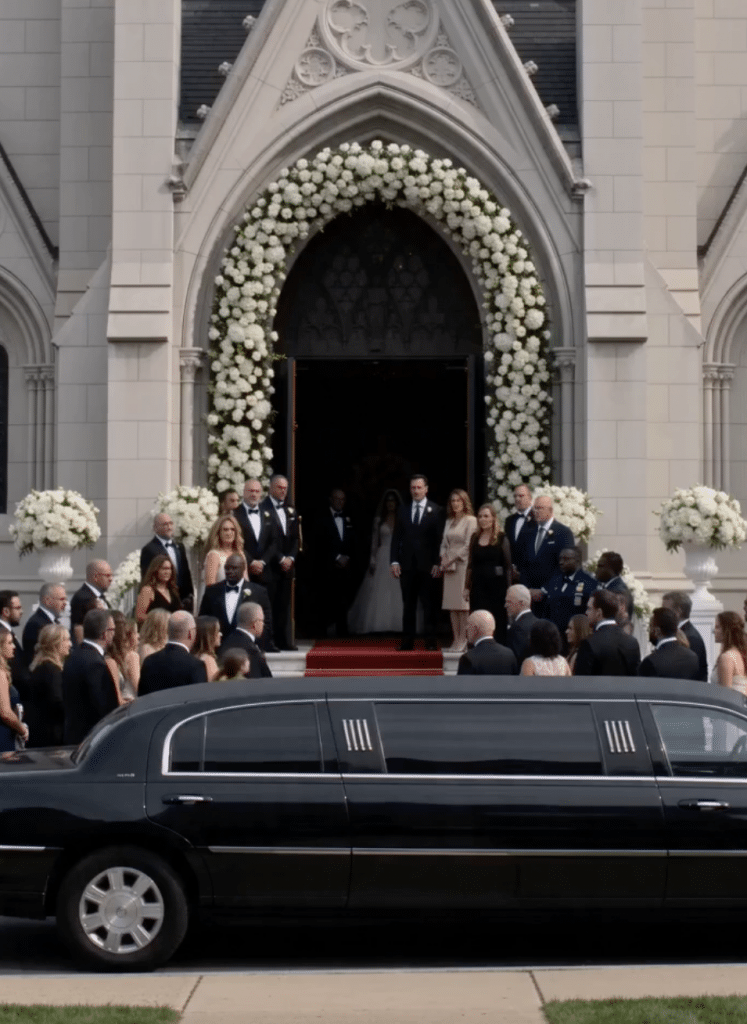
At the top of the steps, Ethan Blackwell stood in his black tuxedo, one hand adjusting his cuff, the other holding the door for the woman he was about to marry. Behind him, the cathedral glowed with candles and white flowers. The archway was wrapped in roses. Cameras waited. Reporters whispered. Guests stared.
It was supposed to be the wedding of the year.
Then the child reached him.
A police officer moved first, stepping between them and catching her by both shoulders.
“Step back,” he ordered.
The girl fought against his grip. “Please. Listen to me.”
Ethan frowned, more annoyed than afraid at first. He was used to interruptions. His family name attracted them. Protesters. photographers. strangers asking for money. People who believed proximity to wealth was a door.
But this child did not look like she wanted money.
She looked like she had spent the night running from something worse.
The officer tried to push her down the steps.
Ethan lifted a hand.
“Wait.”
The officer froze.
The girl looked up at Ethan, breathing hard. Her eyes were too steady for a child’s face.
“If you go in,” she said quietly, “you won’t come out the same.”
The crowd stilled.
Ethan’s expression changed.
“What do you know?”
The girl turned and pointed toward the cathedral doors.
“Her,” she whispered. “And the lawyer.”
At the entrance, the bridal party had gathered in a perfect white-and-gold picture. The bride stood just inside the doorway, veiled and still, holding a bouquet of white flowers. Beside her was a man in a tailored suit, the family lawyer, smiling as though nothing in the world could touch him.
Ethan’s jaw tightened.
He pulled a thick stack of cash from his pocket and shoved it toward the girl.
“Take this,” he said. “Leave.”
The girl did not even look at the money.
Her face filled with a sadness that made him feel suddenly ashamed.
“I don’t want your money,” she said. “I want you alive.”
Then she glanced toward the bride.
“She knows me.”
The cathedral doors seemed darker behind the white flowers.
And when the bride stepped into the light, her face did not show confusion.
It showed recognition.
Act II
Ethan Blackwell had been warned about women like Vivienne Carrington.
Not by friends.
They adored her.
Not by his mother.
She had chosen the flowers.
Not by the newspapers.
They called Vivienne elegant, charitable, mysterious, and exactly the kind of woman who could soften a man like Ethan, who had inherited a fortune too young and trust too late.
The warning came from his grandfather’s last letter.
Do not marry anyone who asks you to sign something before the vows.
Ethan had laughed when he read it.
The old man had been paranoid in his final years, surrounded by lawyers and doctors, convinced everyone wanted the Blackwell estate. But after his death, Ethan learned paranoia could look a lot like experience.
Vivienne arrived six months later at a hospital fundraiser.
She was beautiful in a quiet, dangerous way. Dark hair. Lace sleeves. A calm smile that made noisy rooms bend toward her. She did not chase Ethan like other women did. She did not flatter him. She listened.
That was what undid him.
She listened when he talked about his grandfather. She listened when he admitted he hated being treated like a bank account with a pulse. She listened when he confessed he was tired of wondering whether anyone loved him or only the doors he opened.
Two months later, she was in his life.
Four months later, she was in his home.
Six months later, she was standing at the cathedral entrance in a white lace gown while Ethan’s lawyer, Daniel Mercer, waited inside with a folder that contained the final version of a prenuptial agreement Ethan had barely read.
The agreement was Daniel’s idea.
Or so Ethan believed.
Daniel Mercer had served the Blackwell family for twenty years. He had guided Ethan through probate, estate taxes, trust restructuring, and every legal trap grief had left behind. If Daniel said something was routine, Ethan signed it.
That morning, Vivienne had touched Ethan’s cheek and whispered, “Sign after the ceremony. Then we can disappear from all this noise.”
He thought she meant the crowd.
Now, standing at the cathedral steps with a bruised child refusing his money, Ethan was no longer sure.
The girl’s name was Nora.
She told him only after the police officer loosened his grip.
“Nora Vale,” she said.
The surname struck someone behind him.
A woman gasped.
Ethan turned. “What?”
An older guest near the stairs whispered, “Wasn’t Vale the name of Vivienne’s first husband?”
Vivienne’s first husband had been dead for three years.
Ethan knew the official story.
Jonathan Vale, a wealthy art dealer, had fallen from a balcony during a storm at their estate outside Newport. Vivienne was away in Boston that night. The only child in the house, Jonathan’s young daughter from his first marriage, had been sent to boarding school soon after.
After that, she disappeared from public records.
Ethan had never asked much about it.
Vivienne said the girl’s aunt had taken her overseas.
Vivienne said the past was painful.
Vivienne said good men did not force grieving women to bleed twice.
So Ethan did not ask.
Now the missing daughter was standing in front of him, dirty, bruised, and shaking under a borrowed winter coat someone from the crowd had finally placed over her shoulders.
Nora looked toward the cathedral.
“She told everyone I went to Switzerland,” she said. “I didn’t. She sent me to a house where nobody was allowed to use real names.”
Ethan felt his stomach turn.
The police officer stiffened.
Daniel Mercer began moving down the steps.
Vivienne stayed beneath the flowered arch, perfectly still.
Too still.
Nora saw the lawyer coming and stepped closer to Ethan.
“That’s him,” she whispered. “He brought the papers.”
Ethan looked down at her.
“What papers?”
Nora’s eyes filled.
“The ones that said my father wanted her to have everything.”
The wind moved through the cathedral flowers.
Inside the church, the organ stopped playing.
And Daniel Mercer’s smile finally disappeared.
Act III
Daniel reached them with the practiced calm of a man who had spent a career making panic look unreasonable.
“Ethan,” he said softly, “this child is clearly distressed. We should not turn your wedding into a spectacle.”
Nora shrank behind Ethan’s arm.
That movement told him more than her words.
Ethan looked at Daniel. “Do you know her?”
Daniel’s face did not change.
“I know of her. Jonathan Vale’s daughter. Troubled child, unfortunately.”
Nora’s voice sharpened. “I’m not troubled.”
Daniel gave a sad little smile for the audience. “Sweetheart, no one is blaming you.”
The way he said sweetheart made Ethan cold.
Vivienne started down the steps then, veil trailing behind her, bouquet held neatly at her waist. The crowd parted for her. Even now, with the ceremony unraveling, people made space because beauty still tricks the eye into obedience.
She stopped beside Daniel.
“Nora,” she said gently.
The girl flinched.
Vivienne’s expression softened for the crowd.
“My God. Where have you been?”
Nora stared at her.
“You know where.”
A murmur moved through the guests.
Vivienne’s eyes flashed, but only for a second.
Then she turned to Ethan.
“She was very unwell after Jonathan died. Her aunt took responsibility for her care.”
“I don’t have an aunt,” Nora said.
Daniel stepped in. “This is not the place.”
Ethan’s voice was quiet. “Then make it the place.”
Daniel blinked.
Ethan looked at Nora. “What did you come to show me?”
Nora reached under the hoodie and pulled out a plastic envelope taped against her stomach. Her hands shook as she tore it free.
Daniel lunged.
The police officer caught his arm.
Not hard.
Just enough.
Everyone saw it.
Nora handed the envelope to Ethan.
Inside were three things.
A photograph.
A flash drive.
And a folded letter sealed with wax bearing the Vale family crest.
Ethan opened the photograph first.
It showed Vivienne and Daniel standing in what looked like a private office. Between them was Jonathan Vale, alive, seated at a desk. His face was pale, but his eyes were clear. On the desk was a document Nora had marked with a red circle.
Ethan looked closer.
It was a will.
The date was one week before Jonathan’s death.
Nora whispered, “That was the real one.”
Ethan unfolded the letter.
The handwriting was elegant, uneven, and deeply human.
My Nora,
If you are reading this, then I failed to protect you from the people I allowed too close to our lives. Vivienne does not love this family. Daniel does not serve it. Trust no document signed after this date unless Mr. Halden witnesses it in person.
Ethan looked up.
“Who is Mr. Halden?”
Nora pointed toward the crowd.
A thin elderly man near the bottom step had gone pale.
He removed his hat slowly.
“I am.”
Vivienne’s face changed.
Not much.
Enough.
Mr. Halden stepped forward. “Jonathan called me the night before he died. He said he wanted to remove Mrs. Carrington Vale from all estate authority and change Nora’s guardianship. He never arrived at my office the next morning.”
Daniel snapped, “This is absurd.”
Nora turned to Ethan.
“They did the same thing to my father,” she said. “They’re going to do it to you.”
Ethan looked toward the folder Daniel carried.
The prenuptial agreement.
The documents Vivienne wanted signed after the vows.
His grandfather’s warning returned with terrible clarity.
Do not marry anyone who asks you to sign something before the vows.
Ethan held out his hand.
“Give me the folder, Daniel.”
For the first time in twenty years of service, Daniel Mercer hesitated.
Act IV
The hesitation lasted only a second.
But it ended the wedding.
Ethan took the folder from Daniel’s hand and opened it on the cathedral steps.
The first pages were ordinary. Assets. property. inheritance language. Legal terms written to lull the exhausted into signing.
Then Ethan saw the clause.
Spousal medical authority effective immediately upon marriage.
He turned the page.
Emergency trust access upon incapacity.
Another page.
Pre-approved transfer of voting shares to a temporary marital management structure.
Ethan felt the blood drain from his face.
“What is this?”
Daniel spoke quickly. “Standard protection in the event of an accident or sudden illness.”
Nora’s voice was barely above a whisper.
“My father signed one too.”
Vivienne stepped closer. “Ethan, please. Don’t let a frightened child destroy us.”
He looked at her.
For the first time, he saw the mistake he had made.
He had thought stillness meant peace.
He had thought mystery meant depth.
He had thought being listened to meant being loved.
But Vivienne had not been listening to know him.
She had been collecting keys.
Ethan held up the folder. “Were you going to have me sign this after the ceremony?”
Vivienne’s lips parted.
The guests waited.
She said nothing.
Nora reached for the flash drive.
“There’s more.”
The police officer took it and handed it to Mr. Halden, who had already pulled a small laptop from his leather briefcase with the slow dignity of a man who had waited years for one honest chance.
Daniel stepped back.
The officer moved with him.
“Stay where you are,” the officer said.
The first video opened.
Jonathan Vale appeared on screen, sitting in a private study. He looked tired but alert.
“If this recording reaches anyone outside my home,” he said, “then my daughter is in danger.”
Nora began to cry silently.
Vivienne’s face turned to stone.
Jonathan continued.
“I have discovered forged transfers connected to my estate and to the Blackwell charitable trust. Daniel Mercer has advised both families. Vivienne Carrington has access to the same accounts through marriage. If anything happens to me, protect Nora first.”
The crowd reacted like one body.
A wave of shock.
Ethan stared at Daniel.
“My family trust?”
Daniel’s silence was no longer strategic.
It was guilt wearing a suit.
The second file was audio.
Vivienne’s voice.
Calm. Low. Unmistakable.
“Blackwell is lonely. That makes him easier than Jonathan. Once the medical clause is active, Daniel can move the votes before anyone questions it.”
A man’s voice answered.
Daniel.
“And if he refuses?”
Vivienne replied, “Men who want to be loved are very easy to make tired.”
Ethan closed the laptop.
He did not need to hear more.
The bride stood beneath a garland of white flowers, beautiful as ever, while every lie around her burned.
She looked at Ethan one last time.
“You think she saved you?” she said, glancing at Nora. “That little stray would have been forgotten in a week if I had not shown restraint.”
Nora stepped back as if struck.
Ethan moved in front of her.
“No,” he said. “You are done speaking to her.”
Vivienne laughed, but it came out thin.
“You don’t even know what to do with her.”
Ethan looked down at Nora.
A child with a bruised face, a dead father’s letter, and enough courage to interrupt a cathedral full of strangers.
“No,” he said. “But I know what not to do.”
He turned to the police officer.
“Call detectives.”
The officer nodded.
Daniel tried to run down the side steps.
He made it three feet before two security guards stopped him.
Vivienne did not run.
She only lifted her chin, as if disgrace were another veil she could wear beautifully.
But when Nora looked at her and whispered, “My dad knew,” Vivienne finally blinked.
For the first time, the bride looked afraid.
Act V
The wedding ended before the bells could ring.
Guests were escorted away from the cathedral in stunned clusters. Reporters who had arrived to photograph society glamour captured something far more valuable: a groom standing on red-carpeted steps with a little girl behind him, a bride under investigation, and a lawyer being guided into a police car without his tie straight.
By evening, the story had torn through the city.
By morning, Jonathan Vale’s death was reopened.
So were Daniel Mercer’s files.
The flash drive led investigators through a maze of marriages, trusts, false medical clauses, forged signatures, and charitable accounts emptied under the cover of grief. Vivienne had not acted alone. Daniel had built the legal machinery. She had supplied the charm.
Together, they chose lonely men with money and complicated families.
Then they made themselves necessary.
Nora was taken first to a hospital, then to a child advocacy center where nobody called her troubled. She did not trust warm blankets at first. She hid food in her sleeves. She asked three times whether Ethan was angry she ruined his wedding.
Each time, Ethan gave the same answer.
“You saved my life.”
On the fourth time, Nora whispered, “I was too late for Dad.”
Ethan sat beside her in the quiet room, still wearing his wedding shirt without the bow tie.
“No,” he said. “You brought his truth back.”
That was the beginning.
Not of instant healing.
Nothing that easy.
Nora had nightmares. Ethan had lawyers. The courts had questions no child should have had to answer. Mr. Halden became temporary guardian while relatives were investigated, and Ethan arranged the best support he could without pretending money could replace safety.
Vivienne’s trial came months later.
She arrived in court dressed in ivory.
People noticed.
Nora noticed too, but she did not look away.
When Jonathan’s video played, the courtroom became painfully still. His voice filled the room, speaking from the past with the calm urgency of a father who had known danger was already inside the house.
Protect Nora first.
Ethan watched Nora hear those words in public for the first time.
She did not cry.
She lifted her chin.
Daniel Mercer took a plea before the trial ended. Men like him often do when elegance stops protecting them. He gave records, dates, account numbers, and proof that Vivienne had married Jonathan for access, then targeted Ethan before suspicion could settle.
Vivienne never confessed.
Not fully.
Even after the verdict, she stared ahead as if the room had failed her by seeing too much.
But when officers led her past Nora, the girl spoke.
“You said nobody would believe me.”
Vivienne paused.
Nora’s voice did not shake.
“They did.”
That was enough.
A year after the broken wedding, Ethan returned to the cathedral.
Not to marry.
Not to mourn.
He came with Nora and Mr. Halden for a memorial service honoring Jonathan Vale and the other victims whose names had surfaced through the investigation.
The white floral arch was gone.
The red carpet was gone.
The steps looked simpler without decoration, just old stone beneath a gray sky.
Nora stopped halfway up.
Ethan noticed.
“You okay?”
She looked toward the doors where she had once run screaming.
“I thought if I didn’t get here in time, you’d die too.”
Ethan crouched beside her.
“You got here.”
“My knees were shaking.”
“Mine too.”
She glanced at his expensive coat. “You didn’t look scared.”
He smiled sadly.
“Neither did you.”
For the first time, Nora smiled back.
Inside the cathedral, the pews were full again, but the air was different. No gossip. No champagne waiting outside. No bride hidden behind a veil.
Mr. Halden spoke first.
Then Ethan.
Then Nora, who had written two sentences and practiced them for a week.
She stood at the lectern, small but steady.
“My father told me to protect the truth,” she said. “I thought that meant carrying papers. Now I think it means not letting bad people decide who gets believed.”
She folded the page.
Then she stepped down.
The cathedral remained quiet for one perfect breath.
Then everyone stood.
Not cheering.
Standing.
For her.
Later, outside on the steps, Ethan handed Nora something wrapped in blue cloth.
She frowned. “What is it?”
“Your father’s watch,” he said. “The police released it. Mr. Halden thought you should have it.”
Nora unwrapped it carefully.
The watch was scratched, old, and stopped at 9:17.
The hour Jonathan had recorded his final video.
Nora held it against her chest.
“Can it be fixed?”
“Yes,” Ethan said. “But it doesn’t have to be.”
She thought about that.
“I want it to work.”
So they took it to a watchmaker that afternoon.
Months later, when the repaired watch began ticking again, Nora placed it on the desk in her new room. Not in a mansion. Not in a boarding school. In Mr. Halden’s warm old brownstone, where books leaned in crooked towers and no one locked doors from the outside.
Ethan visited on Sundays.
At first, he brought gifts because he did not know how to arrive empty-handed. Nora eventually told him it was weird.
“You don’t have to buy forgiveness,” she said.
“For what?”
“For not believing me at first.”
Ethan looked down.
“You’re right.”
She shrugged. “You did eventually.”
That was how children sometimes offered mercy.
Not cleanly.
Not cheaply.
But enough to build on.
Years later, people still talked about the wedding that never happened.
They talked about the girl on the steps, the bride in white, the groom holding cash, the lawyer’s face when the old video played. They turned it into scandal, then legend, then a warning told at parties by people who liked drama better than truth.
Nora remembered it differently.
She remembered cold stone under bare feet.
She remembered the officer’s hands on her shoulders.
She remembered Ethan offering money because he did not yet understand that some warnings cannot be paid to disappear.
Most of all, she remembered Vivienne stepping from the cathedral shadows and realizing the girl she had tried to erase had arrived before the vows.
That was the part Nora kept.
Not the fear.
The timing.
She had made it in time.
And sometimes that is what justice is at first.
A breathless child on marble steps.
A sentence no one wants to hear.
A door that never closes because someone finally believes the person trying to keep it open.