Act I
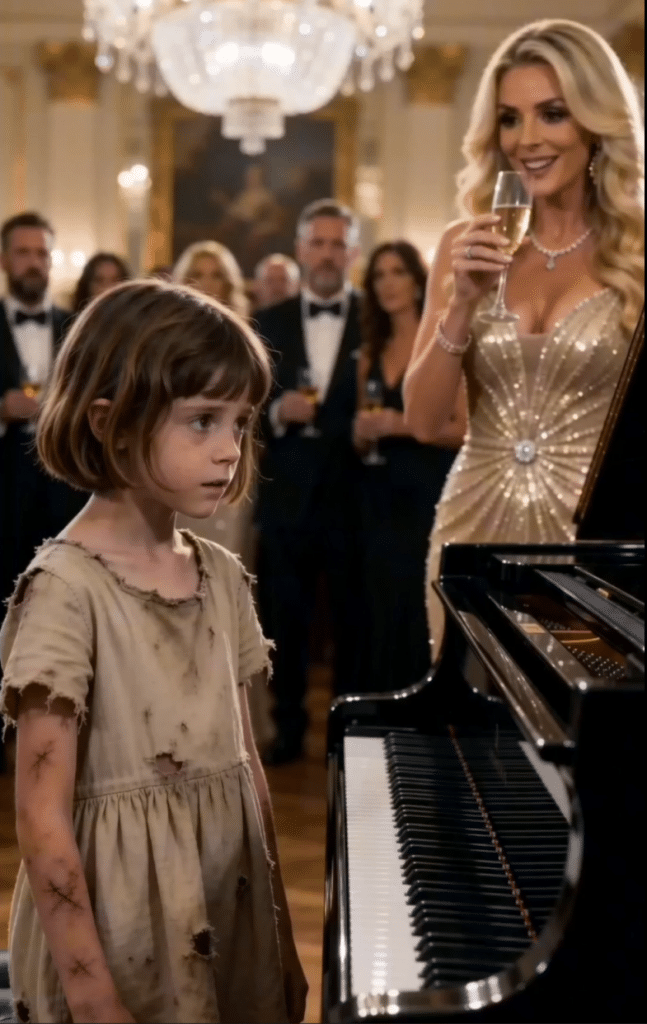
The little girl stood beside the grand piano like a mistake someone had forgotten to remove.
Everything around her shone.
Crystal chandeliers poured gold light over the ballroom. Champagne glasses caught the glow. Diamonds flashed at throats and wrists. Men in tuxedos laughed softly beside women in silk gowns, their voices floating above the polished floor like none of them had ever been hungry in their lives.
Then there was the girl.
She was small, maybe eight years old, with tangled hair, dirt smudged across her cheeks, and a beige dress torn at the hem. Her hands were folded in front of her, but not cleanly, not like a child taught manners at dinner parties. They were folded like she was trying to keep them from shaking.
She looked at the food first.
Not the chandeliers.
Not the paintings.
Not the guests.
The food.
A long table near the wall held silver trays of untouched salmon, tiny pastries, glazed fruit, and bread rolls no one seemed interested in eating. The girl stared at it with the quiet desperation of someone who knew better than to reach.
Finally, she looked toward the blonde woman in the gold sequined gown.
“May I play for food?” the girl asked.
The woman laughed.
Not a surprised laugh.
A cruel one.
It rose through the ballroom, bright and sharp, and several guests smiled because cruelty sounded safer when someone rich started it.
The woman lifted her champagne glass.
“This is not a shelter.”
The girl lowered her eyes.
A few people looked away, embarrassed but not enough to help. The waiters froze along the wall. No one wanted to cause a scene. No one wanted to challenge Vanessa Blackthorne in her own gala hall.
Vanessa loved that.
She had built a life on people’s silence.
Then the girl turned and sat on the piano bench.
A murmur went through the room.
Vanessa’s smile hardened.
“Child, I said—”
The first note stopped her.
It was soft.
Almost too soft to belong in that glittering room.
Then came another.
And another.
The girl’s fingers moved across the keys with a confidence that did not match her torn dress, her bare arms, or the exhaustion in her face. The melody rose slowly, delicate at first, then deeper, aching through the ballroom as if someone had opened a door under the floor and let the past climb out.
Guests stopped speaking.
A waiter lowered his tray.
Vanessa’s champagne glass hung in midair.
Across the room, a man in a black tuxedo turned sharply.
Julian Mercer had not planned to listen to the music that night. He had funded the gala, smiled for photographs, shaken hands with donors, and pretended the anniversary did not hurt.
But that melody found him anyway.
It moved through the ballroom with impossible familiarity.
His late wife’s melody.
The one she had written in secret.
The one no one had ever heard outside their home.
Julian stepped forward, his face draining of color.
“That melody,” he whispered.
The girl kept playing.
The camera of every eye in the room shifted to her hands. Small hands. Dirty hands. Hands with faint scars and rough marks that no child should have had to carry. Yet they moved with astonishing grace, striking grief and tenderness from the piano as if the instrument had been waiting for her.
Julian came closer.
His breath shook.
“No,” he said, barely audible. “That’s my…”
He could not finish.
Because the last time he heard that melody, his wife Clara had been pregnant, sitting at their old piano in the morning light, laughing as she told him their child would know the song before she knew her own name.
That child had died with her.
That was what everyone told him.
That was what Vanessa Blackthorne had arranged the world to believe.
But the little girl at the piano lifted her eyes.
And Julian saw his wife looking back.
Act II
Her name was Lucy.
That was all she said when the final note faded.
Not Lucille. Not Lucia. Not a family name polished for invitations.
Just Lucy.
The ballroom remained silent after she stopped playing, as if applause would be vulgar and breathing too loudly might break whatever had just happened. Vanessa was the first to move. She set her champagne glass down with a careful click and stepped toward the piano.
“Who let this child in?” she demanded.
No one answered.
Lucy flinched.
Julian saw it.
The tiny movement struck him harder than the music. It was not fear of being scolded. It was fear learned from repetition. Fear that had a history.
He moved between Lucy and Vanessa before he had made the decision to do it.
“Don’t speak to her like that.”
Vanessa’s face changed for half a second.
Shock.
Then calculation.
“Julian,” she said, softening her voice, “you’re emotional. The piece startled you. Everyone heard it.”
“No,” Julian said. “Everyone heard music. I heard Clara.”
At his wife’s name, the room seemed to tighten.
Clara Mercer had been dead for seven years.
Her death had made headlines because wealth loves tragedy when it can be photographed respectfully. Beloved pianist. Philanthropist. Pregnant wife of industrial heir Julian Mercer. Lost in a private clinic fire during a storm.
The reports were clean.
Too clean, Julian had thought once.
Then grief swallowed his suspicion.
Clara had been kind in a way that made wealthy people uncomfortable. She played concert halls, then spent afternoons teaching music to children who could not afford lessons. She embarrassed donors by asking what their money cost other people. She refused to let the Mercer Foundation become a beautiful excuse for ugly business.
Vanessa had hated her.
Back then, Vanessa Blackthorne was Clara’s older half-sister and the foundation’s managing director. She wore grief beautifully after the fire. She organized the memorial. She held Julian upright through the funeral. She told him the baby had not survived.
Then, month by month, she moved into Clara’s empty spaces.
Her office.
Her charity.
Her influence.
Eventually, almost his life.
Julian never married her, though society expected it. Vanessa waited anyway. She was patient when there was money at the end of patience.
Now she stared at Lucy as if the girl were not a child, but a document that had escaped a locked drawer.
Julian crouched beside the piano bench.
“Lucy,” he said gently, “where did you learn that song?”
The girl looked at Vanessa first.
That was the answer.
Julian’s voice became quieter.
“You don’t have to be afraid of her.”
Lucy’s small mouth tightened.
“That’s what nice people say before they send you back.”
The words hit the ballroom like a slap.
Vanessa laughed lightly, too quickly.
“This is absurd. She’s a street child who heard a melody somewhere and wandered in for food.”
Lucy looked down at the keys.
“I didn’t wander.”
Julian held still.
“Then why did you come?”
Lucy reached into the torn pocket of her dress and pulled out a folded piece of music paper, worn almost to threads along the crease. She handed it to Julian with both hands.
He opened it.
The notes were written in Clara’s hand.
He knew the slant of it. The way she shaped rests like tiny hooks. The small star she used instead of a dot above certain letters.
At the bottom were three words.
For our daughter.
Julian stopped breathing.
Vanessa stepped closer.
“Give me that.”
Julian did not look at her.
Lucy watched his face carefully.
“My mother said if I ever found the man who cried when he heard the song, I should give him that.”
The room blurred.
Julian gripped the paper.
“Your mother?”
Lucy nodded.
“She said her name was Clara.”
A woman near the front gasped.
Vanessa went white beneath the gold of her dress.
Julian’s voice was barely human.
“Clara is alive?”
Lucy lowered her eyes.
“She was.”
Act III
They moved to the small music room behind the ballroom because Julian refused to let Vanessa turn the child into a spectacle.
Vanessa tried to follow.
Julian stopped at the door.
“No.”
Her smile flickered.
“You are making a mistake.”
“I made one seven years ago,” he said. “I’m correcting it now.”
He shut the door before she could answer.
Inside the music room, the noise of the gala became a distant murmur. The walls were lined with old instruments and framed photographs from charity concerts. Clara’s portrait hung above the fireplace, her hands folded in her lap, her smile caught between joy and mischief.
Lucy stared at it.
“That’s her,” she whispered.
Julian had to sit down.
A doctor from among the guests came in to check Lucy, along with a female security officer who brought water, bread, and a plate of simple food from the kitchen. Lucy did not eat at first. She waited.
“For permission?” the security officer asked softly.
Lucy nodded.
Julian looked away.
Some pain is too quiet to witness without shame.
“You can eat,” he said. “Anything you want.”
Lucy took the bread first.
Not the pastry. Not the glazed fruit.
Bread.
As she ate, carefully and too fast despite trying not to, Julian unfolded the music sheet again.
“Lucy,” he asked, “where is Clara?”
The girl’s eyes darkened.
“At the house with no windows.”
Julian felt the room tilt.
“What house?”
“I don’t know the real name. They called it Briar House.”
The security officer stiffened.
Julian noticed.
“You know it?”
She hesitated.
“There’s an old private rehabilitation estate outside the city. Closed officially years ago. People still use the name.”
Vanessa’s family owned several medical properties through shell companies.
Julian stood.
The officer placed a hand up.
“Mr. Mercer, wait.”
“No.”
“Wait long enough to get proof.”
Lucy reached into her pocket again.
This time, she pulled out a small silver locket.
Julian recognized it instantly.
He had given it to Clara on their first anniversary. Inside, he had placed a tiny photograph of the two of them at a train station in Prague, soaked by rain and laughing because they had missed their connection.
He opened the locket.
The photo was still there.
Behind it, hidden in the backing, was a folded strip of paper.
Clara’s handwriting.
Julian,
If Lucy reaches you, then I am either gone or unable to run again. Vanessa staged the fire. Dr. Bell certified the deaths. I survived because one nurse chose mercy, but Vanessa found us before Lucy turned three.
She kept us hidden because Lucy controls what I left behind.
Do not trust the foundation board.
Do not trust my sister.
The account opens with the song.
Julian read the final line again.
The account opens with the song.
He looked at Lucy.
“What account?”
Lucy wiped crumbs from her mouth.
“Mom called it the promise.”
The word struck him.
Years before Clara died, she had created a separate trust outside the Mercer Foundation. Julian had thought it was for music scholarships. Clara had called it the Promise Fund.
But after her death, Vanessa said the paperwork was incomplete. The assets reverted to the main foundation, where she controlled them.
Julian had signed what she placed in front of him.
He remembered the day now with terrible clarity.
Rain against the windows.
Medication for sleep still heavy in his blood.
Vanessa’s hand on his shoulder.
Her voice saying, “Clara would not want this dragged through court.”
Clara would have dragged it through fire.
Julian stood.
“Bring the foundation attorney here.”
The security officer nodded and left.
Lucy slid off the chair and walked to Clara’s portrait.
“She said you looked sad in pictures.”
Julian looked at his wife’s painted face.
“I was.”
“She said you would think it was your fault.”
His throat tightened.
“What else did she say?”
Lucy touched the frame gently.
“She said you listen better when music tells you first.”
Julian almost smiled through the pain.
That was Clara.
Even imprisoned, even hunted, she had found a way to send truth inside a melody.
Then the door opened.
Not the security officer.
Vanessa entered with two men behind her.
Her gold gown shimmered under the light, but her eyes were flat now. Cold. Finished pretending.
“Julian,” she said, “step away from the child.”
Lucy’s plate slipped from her hands.
And Julian finally saw what his wife must have seen years ago.
Vanessa Blackthorne had never wanted Clara’s life.
She had wanted the power Clara would not let her corrupt.
Act IV
Julian moved Lucy behind him.
It was instinctive.
It was also seven years too late.
Vanessa saw the movement and smiled faintly.
“How touching. You always did need something helpless to worship.”
Julian’s voice turned hard.
“She is a child.”
“She is a legal complication.”
The two men behind Vanessa stepped farther into the room. Private security, not gala staff. Julian recognized one from the foundation offices. The other stood too close to the door.
He kept his eyes on Vanessa.
“Where is Clara?”
For the first time, the name did not make Vanessa flinch.
“She was weak.”
Julian felt his pulse slow.
Danger sometimes brings a strange clarity.
“That is not an answer.”
“It is the only answer that matters. Clara had everything and still wanted to give it away to strangers, to children, to causes that would never return a penny. She would have destroyed the foundation.”
“She was the foundation.”
Vanessa laughed.
“She was a pianist with a conscience. That is charming on stage and disastrous in finance.”
Lucy gripped the back of Julian’s jacket.
Vanessa looked at her.
“And you. You were supposed to stay hidden until the transfer was complete.”
Julian went still.
“What transfer?”
The door opened again.
This time, the foundation attorney entered, but not alone. Behind him came the female security officer, two police detectives, and an older woman with a cane and a face Julian had seen only in Clara’s stories.
Margaret Vale.
Clara’s first piano teacher.
The woman everyone had been told died before the fire.
Margaret’s eyes found Lucy first.
“Oh, baby,” she whispered.
Lucy made a broken sound and ran to her.
Vanessa’s face changed completely.
“You.”
Margaret held Lucy with one arm and lifted her cane with the other.
“Yes, me. Still inconveniently alive.”
The detectives stepped forward.
Vanessa recovered enough to speak.
“This is a private event.”
“Not anymore,” one detective said.
Julian turned to Margaret.
“You knew?”
Margaret’s eyes filled.
“I helped Clara run the first time. I hid them for almost three years. Then Vanessa found the safe house.”
Lucy clung to her.
“Grandma Maggie tried to come back,” the girl whispered.
Margaret nodded, tears running freely now.
“They told me Clara and Lucy had been moved overseas. Then they locked me in legal hell for four years. Conservatorship petitions. medical challenges. Frozen accounts. Every time I got close, someone made me look unreliable.”
Vanessa looked bored, but her hands betrayed her. Her fingers twisted the ring on her right hand.
Julian saw it.
Clara’s ring.
Not her wedding ring.
Her mother’s ring. The one Clara wore when she performed.
“You took that from her,” Julian said.
Vanessa looked down, then smiled.
“She wasn’t using it.”
Julian took one step toward her.
The detective blocked him gently.
“Don’t.”
The attorney opened his briefcase with shaking hands.
“I received a sealed instruction from Clara Mercer six months before the fire,” he said. “It was to be opened only if her original composition, titled ‘Lucy’s Promise,’ was performed in the presence of Julian Mercer and a living witness from the Vale Conservatory.”
Margaret lifted her head.
“That would be me.”
Vanessa snapped, “That document was void.”
“No,” the attorney said quietly. “It was buried.”
He removed a folder.
“The Promise Fund did not revert to the Mercer Foundation. Its controlling assets, including Clara’s shares, publishing rights, and donor endowments, were placed in trust for her child.”
The room went silent.
Julian looked at Lucy.
The attorney continued.
“If the child was declared deceased, control remained with Julian Mercer. If both mother and child were declared deceased, temporary control passed to Vanessa Blackthorne as acting director.”
Vanessa’s face went rigid.
“But if the child is alive,” the attorney said, “Vanessa has no authority.”
The detective looked at her.
“And if those death certificates were falsified, we have a much larger problem.”
Vanessa stepped back.
For the first time, she looked toward the door.
But the second detective was already there.
Julian’s voice was low.
“Where is Clara?”
Vanessa said nothing.
Margaret did.
“Briar House.”
Julian turned.
“She was there three weeks ago,” Margaret said. “I found a nurse willing to talk. Clara was ill, but alive. Vanessa moved her after she learned Lucy escaped.”
Lucy looked up sharply.
“Mom is alive?”
Margaret closed her eyes.
“I don’t know, sweetheart.”
Vanessa smiled then.
Small.
Cruel.
That smile did more than any confession.
Julian turned to the detectives.
“Find her.”
One detective nodded.
“We already have units moving.”
Vanessa’s smile faded.
The gala outside had gone silent. Word had spread through the ballroom, twisting luxury into fear. Guests who had laughed at a hungry child now stood behind the glass doors watching police walk through gold light.
Julian looked at Vanessa one last time.
“You laughed when she asked for food.”
Vanessa lifted her chin.
“She came in looking like a beggar.”
“No,” Julian said. “She came in looking like what you did to her.”
That was when Vanessa finally understood.
The room had turned.
The witnesses were no longer hers.
And the child she had tried to starve into silence had just played the one song that took everything back.
Act V
They found Clara at dawn.
Briar House sat behind iron gates thirty miles outside the city, hidden by trees and old money. Its windows were curtained from the inside. Its records said it was closed. Its basement files said otherwise.
Clara was alive.
Weak, pale, and furious.
When Julian reached the hospital, Lucy was already at her bedside, holding her hand and crying so quietly it broke him more than sobbing would have.
Clara saw him from across the room.
For a moment, they were strangers shaped by the same grief.
Then she smiled.
Not the smile from the portrait.
Not the bright concert smile.
A tired, impossible smile that had survived seven stolen years.
“You heard it,” she whispered.
Julian sat beside her bed.
“I heard her.”
Clara looked at Lucy.
“She played well?”
Julian laughed through tears.
“She stopped a ballroom.”
Lucy wiped her face.
“I asked for food first.”
Clara’s expression crumpled.
Julian closed his eyes.
That would haunt him forever.
Not because Lucy had been hungry.
Because she had expected hunger to be the price of being heard.
The arrests began before noon.
Vanessa Blackthorne was taken from the gala hall still wearing gold sequins, though by then the dress looked less like glamour and more like evidence of a woman who had mistaken shine for power.
Dr. Bell was arrested at his private clinic. Two foundation board members resigned and then tried to flee. The security contractors who moved Clara and Lucy between properties began naming names before their lawyers arrived.
The false death certificates were unsealed.
The clinic fire was reopened.
The Promise Fund was restored.
And the world learned that the famous Mercer gala, long praised for feeding children through music programs, had allowed its founder’s daughter to walk in starving and beg to play for a meal.
That detail did not fade.
It should not have.
Julian made sure it remained at the center of every public statement.
Not the scandal.
Not the money.
The child.
Lucy did not return to the ballroom for months.
When she finally did, the chandeliers were covered. The gold banners were gone. The gala portraits had been removed from the walls, replaced with photographs of the children Clara had taught before the fire, children whose names Vanessa had turned into donor statistics.
At the center of the room stood the grand piano.
Lucy approached it slowly.
Clara walked beside her, still using a cane. Julian stayed behind them, not wanting to crowd a moment that belonged first to mother and daughter.
“Do I have to play?” Lucy asked.
Clara shook her head.
“No.”
Lucy touched the keys.
“They laughed.”
“I know.”
“Do rich people always laugh first?”
Julian answered before Clara could.
“Only the ones who are afraid they might owe someone something.”
Lucy considered that.
Then she climbed onto the bench.
This time, no one watched with champagne in hand. The only people in the room were Clara, Julian, Margaret, the security officer who had helped protect her, and a handful of children from the new music shelter Clara insisted on opening in the old gala wing.
Shelter.
Vanessa had said the word like an insult.
Clara turned it into a sign above the door.
Lucy placed her fingers on the keys.
She did not play “Lucy’s Promise.”
Not that day.
Instead, she played something simple.
A beginner’s song Clara had taught children years ago, before the fire, before the lies, before hunger and locked rooms and a gold-dressed woman laughing in a hall full of food.
Halfway through, one of the younger children began humming along.
Then another.
Lucy looked surprised.
Clara smiled.
Music, Julian realized, had never belonged to the people who could afford the room.
It belonged to whoever needed it badly enough to survive.
Weeks later, Clara testified.
So did Julian.
So did Margaret.
Lucy did not have to. Julian and Clara fought hard for that. Her melody had already testified for her. Her presence had already broken the lie.
Vanessa’s trial lasted longer than anyone expected because powerful people rarely fall without pulling at every curtain on the way down. But the evidence held. The notes, the certificates, the trust, the clinic records, the witnesses, the hidden transfers.
Most of all, Clara held.
When Vanessa’s attorney suggested Clara had hidden voluntarily out of instability, Clara looked at him with the calm of a woman who had finally returned to her own name.
“I hid because your client made the truth dangerous,” she said. “That is not madness. That is survival.”
In the end, Vanessa lost everything she had tried to steal.
The foundation.
The house.
The name.
The illusion.
But Julian learned that justice was only the outer door.
Inside waited the harder work.
Lucy still hid bread in drawers. She still asked before taking seconds. She still startled at laughter from adults wearing expensive clothes. Clara still woke reaching for a child who was finally safe beside her.
So they healed in small rituals.
Breakfast with too much jam.
Piano lessons with no locked doors.
A garden planted behind the shelter.
A rule that no child would ever be asked to perform before being fed.
On the first anniversary of the gala, Julian found Lucy sitting at the piano alone.
She wore a clean blue dress now, her hair brushed but still refusing to stay perfectly in place. Her arms rested gently on the keys.
He stayed near the doorway.
“May I come in?”
Lucy nodded.
He sat beside her on the bench.
For a while, neither spoke.
Then Lucy asked, “Did you really not know?”
Julian looked at the keys.
“No.”
“But you should have?”
The question was not cruel.
That made it worse.
“Yes,” he said. “I should have.”
Lucy pressed one key softly.
It rang between them.
“Mom says people can be sorry and still need to fix things.”
“She’s right.”
“Are you fixing things?”
“I’m trying.”
Lucy looked at him.
“Trying is good if you don’t stop.”
Julian’s throat tightened.
“I won’t.”
She studied him for another moment, then shifted the music paper toward him.
“Play with me.”
“I’m terrible.”
“I know.”
Despite himself, he laughed.
Lucy smiled.
It was small, but real.
Together, they played the opening notes of Clara’s melody. Julian stumbled twice. Lucy corrected him with great seriousness. By the time Clara entered the room, they were both playing badly enough that she had to cover her mouth to keep from laughing.
Lucy turned.
“Don’t laugh.”
Clara lifted both hands.
“I would never.”
Julian gave her a look.
She laughed anyway.
And this time, Lucy laughed too.
The sound filled the room differently than music.
Lighter.
Warmer.
Alive.
Julian looked at his wife, then at the daughter he had thought was buried with her, and understood that the melody had never only been a key to an account.
It was a map.
A mother had hidden love inside notes because paper could be stolen, names could be forged, and bodies could be locked away, but music could enter a crowded room and make liars afraid.
The night Lucy asked to play for food, the rich heard entertainment.
Vanessa heard danger.
Julian heard Clara.
But Lucy had been playing something even older than grief.
Proof that she existed.
Proof that she remembered.
Proof that no matter how loudly the cruel laughed, the truth only needed one clear note to make the whole room fall silent.