Act I
The mop hit the marble floor with a crack that echoed all the way up the grand staircase.
The little girl flinched so hard her small shoulders nearly touched her ears.
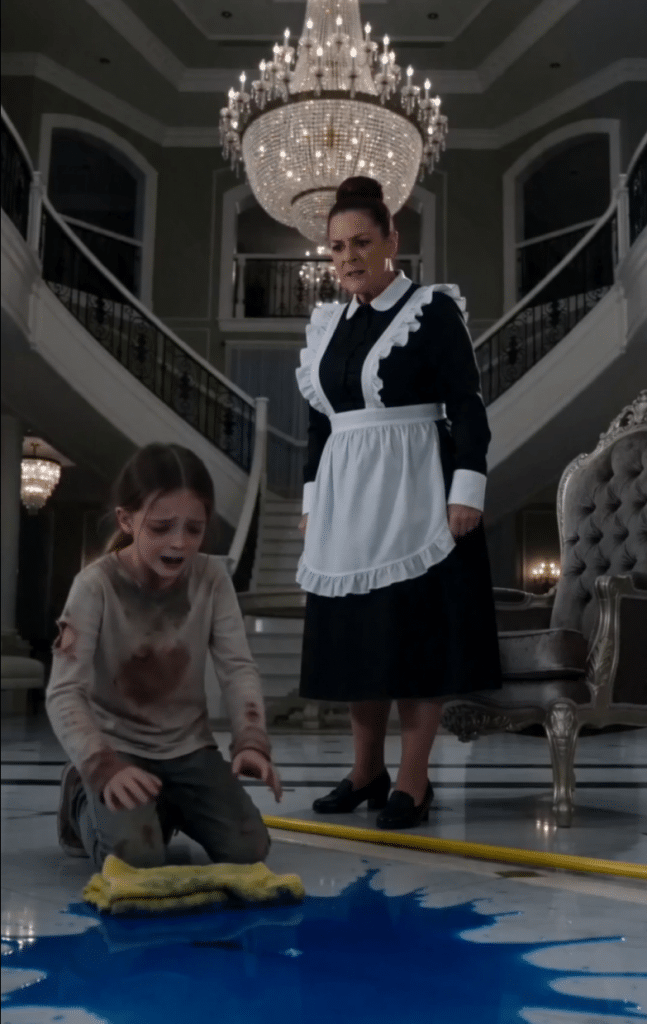
Blue liquid spread across the white marble foyer in a shining puddle, creeping toward the legs of an antique table beneath the crystal chandelier. The house was enormous, silent, and spotless in the way rich houses often are when the people inside care more about appearances than warmth.
The maid stood over the child with her arms crossed.
“Now clean it!”
Her voice snapped through the foyer.
The girl dropped to her knees immediately.
Her name was Lily Harrington. She was seven years old, with dark curls, thin wrists, and the terrified obedience of a child who had learned that crying only made certain adults angrier.
She gripped the mop handle with both hands and pushed it over the spill. It was too big for her. The yellow plastic handle kept slipping. The mop head dragged heavy with liquid, leaving streaks instead of shine.
The maid watched for a few seconds, then turned away as if the sight bored her.
“And don’t stop until it shines!”
Then she sat in one of the ornate chairs near the staircase, opened a bag of chips, and began eating.
Lily sobbed as she scrubbed.
Not loudly. She had learned not to be loud in that house. Her face was red, her breath catching between tiny gasps, but still she pushed the mop back and forth with all the strength in her body.
The maid’s name was Maribel.
For three months, she had ruled the mansion during the hours when Lily’s father was away. She wore a black uniform, polished shoes, and a silver name pin that made her look respectable to visitors. But the moment the front gates closed, respectability peeled off her like paint.
She called Lily spoiled.
She called her dramatic.
She said children in big houses needed to be reminded that marble floors did not make them princesses.
And because Lily’s father, Jonathan Harrington, had been traveling between London, New York, and Zurich trying to save his company from a hostile takeover, Maribel had found more and more ways to make the little girl feel alone in her own home.
That afternoon, the blue liquid had not been Lily’s fault.
Maribel had knocked over the vase herself while checking her reflection in the foyer mirror. Then she blamed the child because it was easier, because no one was there, because she had grown addicted to the power of being believed by absence.
Lily wiped her eyes with the back of her wrist and kept scrubbing.
“What are you staring at?” Maribel snapped.
The girl had stopped moving.
She was no longer looking at the spill.
She was looking at the ceiling.
High above the foyer, tucked discreetly near the chandelier molding, a security camera blinked red.
Lily pointed at it.
Her voice changed.
Soft.
Steady.
Almost calm.
“My dad checks the cameras when he misses me.”
Maribel froze with a chip halfway to her mouth.
The color left her face slowly.
Lily looked back at her, tears still streaming down her cheeks.
Then she whispered the sentence that turned the mansion colder than stone.
“He’s home.”
At the front entrance, the door handle clicked.
And a tall shadow in a business suit appeared behind the glass.
Act II
Jonathan Harrington had not planned to come home early.
The trip to London was supposed to last four days. There were investors to calm, lawyers to pressure, signatures to collect, and board members to remind that his wife’s company had not been built so cowards could sell it to men who smelled weakness.
But at 3:17 p.m., while standing in a private conference room above the Thames, Jonathan opened the security app on his phone.
He did it out of habit.
Out of guilt.
Mostly out of missing Lily.
Since his wife Amelia died two years earlier, the cameras had become a strange comfort. He never used them to spy on staff. He used them to catch glimpses of his daughter moving through the house he had failed to make feel alive again.
Lily doing homework at the breakfast table.
Lily sitting by the piano where Amelia used to play.
Lily carrying her stuffed rabbit from room to room like a witness.
Whenever Jonathan missed her so badly that business words began to blur, he checked the cameras just to see that she was safe.
That afternoon, he saw the mop hit the floor.
He watched Maribel stand over his daughter.
He watched Lily fall to her knees and scrub while crying.
For several seconds, Jonathan did not move.
The men around the table kept talking. Someone mentioned share dilution. Someone else said “strategic concession.”
Jonathan heard none of it.
All he saw was Lily’s small body shaking over the marble.
Then he heard Maribel shout, “And don’t stop until it shines!”
The room in London went silent when Jonathan stood.
His attorney asked if something was wrong.
Jonathan looked at the screen.
“No,” he said, voice flat. “Something has been wrong for a while.”
His jet was already waiting.
He did not call ahead. He did not warn the house. He did not text the staff.
For the first time in months, Jonathan Harrington stopped managing disasters from a distance and went home to face the one inside his own walls.
On the flight, he replayed the footage again and again.
Each time, he saw something new.
The way Lily moved before the mop struck the floor, as if she already expected punishment.
The way Maribel relaxed in the chair, not nervous, not impulsive, but comfortable.
The way Lily looked at the camera.
Not hopeful.
Certain.
As if she had been waiting for the one adult who still loved her to remember where to look.
That hurt worse than anger.
Because Jonathan realized his daughter had not pointed to the camera to threaten the maid.
She had pointed because the camera had become the closest thing to him.
And that was his failure.
By the time the car rolled through the iron gates of Harrington House, dusk had begun to settle over the estate. The windows glowed gold. The fountain ran in the circular drive. Everything looked perfect from the outside.
Jonathan stepped out before the driver could open his door.
Inside, Maribel heard the lock.
Lily heard it too.
The maid rose from the chair so quickly the bag of chips fell to the marble.
“Lily,” she hissed, “not one word.”
But the little girl did not look at her anymore.
She looked at the door.
And when Jonathan entered the foyer, his daughter was still on her knees, holding the mop like a child caught holding evidence of someone else’s cruelty.
Act III
Jonathan did not shout.
That was what frightened Maribel most.
He stood in the doorway, black coat over his business suit, briefcase still in one hand, eyes fixed first on Lily, then on the blue streaks across the marble, then on the maid.
The chandelier light caught the cold fury in his face.
“Lily,” he said, “come here.”
The mop slipped from her hands.
For one second, she did not move.
Children who have been punished for needing comfort do not always know what to do when comfort finally arrives.
Then her face broke.
“Daddy.”
She ran to him.
Jonathan dropped his briefcase and knelt before she reached him. Lily crashed into his arms with such force that he nearly lost his balance. He held her against his chest, one hand on the back of her head, the other wrapped around her shaking shoulders.
“I’m here,” he whispered. “I’m here.”
Maribel began speaking at once.
“Mr. Harrington, I can explain. She spilled the cleaner. I was only trying to teach her responsibility. Children need structure, and with you gone so often—”
Jonathan lifted one hand.
She stopped.
Still holding Lily, he looked toward the ceiling camera.
“Security room,” he said.
Maribel’s lips parted.
A man appeared at the side hall entrance.
Thomas Reed, the head of estate security, older, gray-haired, loyal to Jonathan since before Amelia’s death. His face was pale.
“I saw it, sir.”
Maribel turned sharply.
Thomas did not look at her.
“I saw today. And I checked the archive.”
Jonathan’s jaw tightened.
“The archive?”
Thomas swallowed.
“There’s more.”
Lily’s fingers dug into her father’s coat.
Jonathan closed his eyes.
That was the moment Maribel understood the mistake had not been today’s cruelty.
The mistake had been believing cruelty left no record.
Jonathan stood slowly, lifting Lily into his arms though she was almost too big to carry that way. She clung to him like a much younger child.
“Play it,” he said.
Thomas hesitated.
“Sir, perhaps Lily should not—”
“She already lived it,” Jonathan said quietly. “But she doesn’t need to watch it.”
He handed Lily to Mrs. Alvarez, the cook, who had rushed in from the kitchen with tears in her eyes. Lily resisted for half a second, then Jonathan kissed her forehead.
“I’m not leaving,” he promised. “I will be right there.”
Mrs. Alvarez carried her into the sitting room.
Then Jonathan turned back to Maribel.
“Now.”
Thomas connected the foyer screen.
The footage began.
Maribel yanking a storybook from Lily’s hands and tossing it onto a high shelf.
Maribel telling her she was too old to cry.
Maribel eating food from Lily’s lunch tray while the child sat silent beside it.
Maribel gripping her arm and dragging her away from the staircase before guests arrived.
Maribel standing over Lily in the foyer that very morning, saying, “Your father has better things to worry about than a spoiled little girl.”
Jonathan watched every second.
No one spoke.
The staff had gathered now at the edges of the foyer, drawn by the sound of truth finally entering a house that had been too quiet.
When the video ended, Maribel’s face had gone gray.
“I was under pressure,” she whispered. “You don’t understand. I was told—”
Jonathan’s eyes sharpened.
“Told?”
Maribel immediately realized she had said too much.
Jonathan stepped closer.
“Who told you?”
She shook her head.
“No one.”
Thomas spoke from the side.
“Sir, there’s one more file.”
Maribel turned on him.
“Don’t.”
Jonathan looked at Thomas.
“Play it.”
The screen changed to a hallway camera outside Jonathan’s study.
Maribel stood there three nights earlier with a woman in an ivory coat.
Cassandra Vale.
Jonathan’s late wife’s cousin.
The woman who had been helping arrange the memorial gala upstairs. The woman who had been telling Jonathan for months that Lily was unstable, difficult, and in need of “professional residential care.”
On the recording, Cassandra handed Maribel an envelope.
Her voice came through clearly.
“Keep pushing her. If she breaks down during the gala, Jonathan will sign the placement papers by Monday.”
Jonathan went still.
Maribel covered her mouth.
On the screen, Cassandra added one final sentence.
“Once Lily is out of the house, the Amelia Trust becomes much easier to manage.”
The foyer seemed to tilt.
Jonathan had thought he had come home to punish a cruel maid.
Now he realized someone had been trying to remove his daughter from her own life.
Act IV
Cassandra Vale arrived twenty minutes later wearing diamonds and grief like perfume.
She entered through the side door because she still believed this was her house to move through freely. Her ivory coat was draped over her shoulders, her blonde hair swept back, her expression carefully concerned.
“Jonathan,” she said, “Thomas called me. Is everything all right?”
Jonathan stood at the foot of the staircase.
Behind him, the foyer had changed.
The mop was gone. The spill was cleaned. Maribel sat in a chair near the wall, guarded by Thomas and two officers Jonathan had called without ceremony. The staff stood silent, not as witnesses to gossip, but to a reckoning.
Cassandra saw the officers first.
Then Maribel.
Then the screen.
Her face barely moved.
She was better at control than the maid.
“What is this?” she asked.
Jonathan picked up the remote.
“You tell me.”
The recording played again.
Cassandra watched herself hand Maribel the envelope. Watched herself discuss breaking a grieving child. Watched herself mention the trust.
When it ended, she sighed.
Not cried.
Not denied.
Sighed, as if Jonathan had caught her in an inconvenience rather than a crime.
“You have no idea what you’re doing,” she said.
Jonathan’s voice was cold.
“I know exactly what I’m doing.”
“No. You’re reacting emotionally because of Lily.”
“She is my daughter.”
“She is also Amelia’s heir.”
That sentence exposed her fully.
Jonathan descended one step.
“And there it is.”
Cassandra’s polished mask hardened.
“Amelia left that trust in a reckless structure. Half the company’s voting shares tied up until Lily turns twenty-one, protected by sentimental clauses and guardianship restrictions. You know what the board has been saying. You know what investors fear.”
“I know what you feared,” Jonathan said.
“She is a child.”
“Yes.”
“She cannot control that kind of money.”
“She doesn’t have to. It is protected until she is grown.”
Cassandra laughed softly.
“Protected from whom, Jonathan? From the people trying to save this family? Or from you, who would rather stare at camera footage than admit your daughter is not well?”
Jonathan’s hand tightened around the remote.
“You tried to make her unwell.”
“I tried to create a record.”
“A record of abuse.”
“A record of instability,” Cassandra snapped. “A record that would support temporary placement, psychiatric review, and trustee intervention. It would have saved the company.”
The words landed in the foyer like ice.
Even Maribel looked shocked now, not because she was innocent, but because Cassandra had said the quiet part without shame.
A small voice came from the sitting room doorway.
“Daddy?”
Jonathan turned.
Lily stood there in one of Mrs. Alvarez’s cardigans, her eyes red, her stuffed rabbit pressed to her chest.
Cassandra’s expression shifted instantly into gentle concern.
“Lily, sweetheart—”
The child stepped behind Jonathan’s leg.
Cassandra stopped.
Jonathan looked at his daughter.
“You don’t have to be here.”
Lily stared at Cassandra.
“She said Mommy would be disappointed in me.”
The room went still.
Jonathan’s face changed.
Cassandra saw the danger and spoke quickly.
“She misunderstood.”
Lily shook her head.
“She said Mommy made a mistake leaving me everything because I cry too much.”
Jonathan looked at Cassandra.
For the first time, his anger was not quiet.
It was visible.
“My wife loved her child.”
Cassandra lifted her chin.
“My cousin loved ideals. She never understood survival.”
“No,” Jonathan said. “She understood exactly what people like you become when money is near a grieving child.”
An officer stepped forward.
Cassandra looked offended.
“You cannot be serious.”
Thomas handed Jonathan the envelope from Maribel’s bag. Inside were cash, instructions, and draft copies of the placement petition.
Jonathan passed them to the officer.
“I am.”
Cassandra’s voice dropped.
“You will destroy this family.”
Jonathan looked down at Lily, who had spent months scrubbing, apologizing, and shrinking in a mansion built from her mother’s legacy.
“No,” he said. “I’m saving what’s left of it.”
As the officers led Cassandra toward the door, Maribel began crying.
Not for Lily.
For herself.
Jonathan did not look at either woman.
He knelt in front of his daughter and held out his hand.
This time, when Lily took it, she did not tremble.
Act V
The story never reached the tabloids the way Cassandra wanted.
Jonathan made sure of that.
There were legal filings, yes. Police reports. Protective orders. A private investigation into the attempted manipulation of the Amelia Trust. Maribel was charged for her role and later testified against Cassandra in exchange for leniency she did not deserve but the court allowed.
Cassandra fought longer.
People like her always do.
She claimed Jonathan was unstable from grief. She claimed Lily was troubled. She claimed the footage was taken out of context, the payments misunderstood, the trust issue merely a family disagreement.
Then Thomas produced the archived audio.
Mrs. Alvarez produced the diary Lily had hidden behind the piano bench.
And Jonathan produced every unanswered warning he should have taken seriously months earlier.
That was the part that cost him pride.
He did it anyway.
In court, he did not stand as the perfect father.
He stood as the father who had been absent enough for cruelty to grow in the spaces he left empty.
When asked why he installed the cameras, he said, “Because I missed my daughter. And because missing her from a distance became easier than being present. That was my failure.”
Lily was not required to testify in open court.
Jonathan refused to let adults turn her pain into theater.
But she gave a statement privately through a child advocate.
It was short.
Maribel made me clean because she said I should learn my place. I don’t want another kid to think their place is on the floor.
The judge paused after reading it.
So did everyone else.
After the case, Harrington House changed.
Not in the way Cassandra had once planned. Not with Lily sent away, not with the trust seized, not with Amelia’s name reduced to a signature on documents men could control.
The house changed because Jonathan finally understood that love could not be outsourced to staff, screens, or apologies.
He canceled six months of travel.
The board panicked.
He let them.
He moved his office into the old library, the one beside Lily’s playroom. He walked her to breakfast. He learned which cereals she hated. He discovered she pretended to like violin because Cassandra had said refined girls played violin, when what Lily actually wanted was drums.
So he bought drums.
Mrs. Alvarez threatened to quit.
Then she bought earplugs and stayed.
The foyer remained difficult.
For weeks, Lily avoided the marble floor where the mop had struck. She took the back hallway instead, even when it made the walk longer. Jonathan never forced her through it.
One afternoon, he found her standing at the edge of the foyer, staring at the chandelier.
The floor shone perfectly.
Too perfectly.
Jonathan came beside her.
“Do you want to change it?”
Lily looked up.
“The floor?”
“The floor. The chairs. The whole room.”
She thought about that.
“Can we put a rug there?”
“Anywhere you want.”
“A soft one.”
“Yes.”
“And no yellow mops.”
He swallowed.
“No yellow mops.”
They chose the rug together. Blue, at Lily’s request. Not the harsh blue of the spill, but a deep soft blue like twilight. When it arrived, she stepped onto it barefoot and pressed her toes into the wool.
“It doesn’t echo,” she said.
Jonathan understood.
Sometimes healing was not a grand speech.
Sometimes it was removing the echo from a room where a child had been afraid.
On the first anniversary of Amelia’s death, Jonathan and Lily held the memorial dinner at home. Not a gala. Not a ballroom full of trustees. Just the staff who had stayed, a few true friends, and Amelia’s favorite white flowers placed beneath her portrait.
Before dinner, Lily asked to speak.
Jonathan almost stopped her, afraid she felt obligated.
But she shook her head.
“I want to.”
She stood on the blue rug in the foyer, wearing a pale dress and holding her stuffed rabbit under one arm. Her voice was small at first, then steadier.
“My mom made this house pretty,” she said. “But my dad says houses are not good because they’re pretty. They’re good if people are safe in them.”
Jonathan looked down.
Mrs. Alvarez cried openly into a napkin.
Lily continued.
“So now this house has rules. Nobody yells at kids. Nobody makes people feel small. And if someone cries, we don’t tell them to clean faster.”
A few people laughed softly through tears.
Lily looked at the ceiling camera.
The red light still blinked.
For a long time, Jonathan had considered taking the cameras down. He hated what they represented now. Proof that he had needed a machine to see what he should have seen himself.
But Lily asked him to leave one.
Not because she wanted surveillance.
Because, she said, “It reminds people somebody is paying attention.”
After dinner, Jonathan found Lily sitting on the staircase.
He sat beside her.
“You were brave tonight,” he said.
She leaned against his arm.
“I was scared.”
“Brave usually includes scared.”
She accepted that.
Then she asked, “Do you still check the cameras when you miss me?”
Jonathan looked at her.
“Sometimes.”
“Do you have to?”
The question was gentle, but it cut.
He put an arm around her shoulders.
“No,” he said. “Not like before.”
“Because you’re home?”
He kissed the top of her head.
“Because I’m home.”
Below them, the foyer glowed softly beneath the chandelier. The blue rug warmed the marble. The ornate chair where Maribel had once sat was gone, replaced by a small round table holding fresh flowers and a framed photograph of Amelia laughing with Lily in the garden.
The house was still large.
Still grand.
Still full of rooms where echoes could hide if no one listened.
But it was no longer ruled by silence.
And whenever Jonathan passed the foyer camera, he remembered the little girl on her knees, pointing up through tears, trusting that somewhere her father would finally look.
That trust had almost arrived too late.
Almost.
But not quite.
Because the maid’s worst mistake had not been throwing the mop.
It had been forgetting that love, even when distracted, even when guilty, even when far away for too long, can still come through the door when a child whispers the truth.
He’s home.