Act I
The doctor did not raise his voice.
That made it worse.
“She has no chance.”
The words floated through the ICU room like something cold and final. Machines blinked beside the bed. The blinds were half closed. The air smelled of antiseptic, plastic, and the kind of silence that comes before a family breaks forever.
Mark Evans stood at the foot of his daughter’s bed, unable to move.
Emma looked too small beneath the hospital blanket. An oxygen tube rested against her pale face. Her long brown hair was spread across the pillow, tangled from days of fever and restless sleep.
Only nine years old.
Nine.
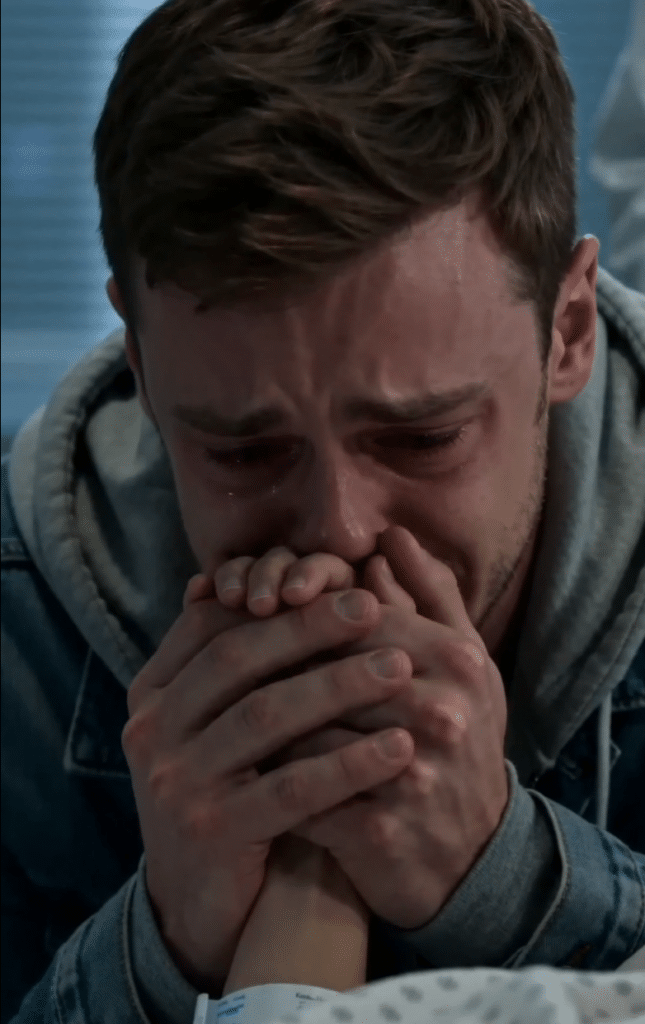
Mark stepped closer and took her hand in both of his. Her fingers felt light, almost weightless. He pressed them against his cheek and shut his eyes.
“Daddy’s here,” he whispered. “I’m right here.”
The doctor looked away.
The monitor beeped slowly.
Too slowly.
Then Mark heard a sound at the door.
Not footsteps.
Just presence.
He lifted his head.
A little boy stood in the doorway.
Barefoot. Dirty-faced. Wearing a torn gray hoodie two sizes too big.
Mark stared at him through tears.
“Sorry…” he rasped. “Who are you?”
The boy did not answer.
He simply walked toward Emma’s bed.
And the room changed before anyone understood why.
Act II
Mark should have stopped him.
Any father would have.
A strange child had just walked into an ICU room past nurses, alarms, locked doors, and hospital rules that treated even visiting grandparents like security threats.
But something about the boy froze him.
He could not have been older than Emma. Maybe nine. Maybe ten. His hair was dark blond and messy, his jeans worn thin at the knees. There was dirt on his cheeks, but his eyes were clear.
Too clear.
He moved as if he already knew the room.
As if he had been there before.
The doctor stepped forward. “Hey, you can’t be in here.”
The boy did not look at him.
He reached the side of Emma’s bed and placed one small hand gently on her forehead.
Mark’s breath stopped.
The boy closed his eyes.
For one second, nothing happened.
Then the heart monitor stuttered.
The doctor turned sharply.
Emma gasped.
Her chest lifted hard beneath the blanket. Her eyes opened suddenly, wide and bright, like she had been pulled from deep underwater.
Mark stumbled backward, both hands flying to his head.
“No…”
The monitor changed.
The slow, weak beeping became steady. Strong. Alive.
The doctor stared at the screen like it had betrayed every law he understood.
Emma turned her head.
Her lips parted.
“Papa.”
Mark broke.
He fell beside the bed, clutching her hand, laughing and crying at the same time.
But when he looked up to thank the boy, the child was no longer at the bedside.
He was standing by the window.
Watching the rain.
As if the miracle had cost him nothing.
But miracles always cost someone something.
Act III
The hospital went into chaos.
Nurses rushed in. The doctor ordered tests. Another physician came. Then another. They checked Emma’s pulse, her lungs, her scans, her blood work.
No one said miracle.
Not out loud.
Doctors preferred words like anomaly, spontaneous response, unexplained recovery.
But Mark had seen what happened.
He had watched death loosen its grip because a barefoot child touched his daughter’s forehead.
When he turned back toward the window, the boy was gone.
Security found no footage of him entering.
No visitor badge.
No parent.
No record.
Only one camera in the hallway had flickered at the exact moment he should have appeared.
By evening, Emma was awake enough to drink water.
Mark sat beside her, afraid to blink.
“Sweetheart,” he said softly, “do you remember anything?”
Emma looked at him with those tired brown eyes.
“I was cold,” she whispered. “And I heard Mom singing.”
Mark’s throat tightened.
Emma’s mother, Laura, had died when Emma was four.
“What else?”
Emma looked toward the door.
“There was a boy.”
Mark leaned forward.
“He told me I couldn’t go yet.”
His chest went still.
“What was his name?”
Emma blinked slowly.
“I don’t know. But Mommy knew him.”
That night, Mark went home for the first time in six days to get Emma’s clothes.
He opened the drawer where Laura’s old things were kept.
Photos. Letters. A wedding ring he still could not bring himself to move.
At the bottom was a faded hospital bracelet.
Not Emma’s.
Not Laura’s.
A child’s bracelet.
Name: Noah Reed.
Mark stared at it.
Then he saw the date.
Nine years ago.
The same week Emma was born.
Act IV
Mark found the truth in a box Laura had labeled “Before Emma.”
Inside were letters he had never read.
Laura had volunteered in a children’s shelter before they met. One boy had followed her everywhere, she wrote. A quiet child named Noah who refused to speak to anyone else.
He had no family.
No one came for him.
Laura had promised him that one day, when she and Mark had a home big enough, they would foster him.
Then Noah got sick.
Fast.
A rare infection. A hospital stay. A decline no one expected.
Laura was pregnant with Emma when she sat at Noah’s bedside.
One letter was dated two days before Emma was born.
He asked if he could meet the baby. I told him yes. I promised him he would never be forgotten.
Mark’s hands shook as he read the next page.
Noah died the morning Emma was born.
Laura never told Mark the full story. Not because she wanted to hide it, but because grief had swallowed those days. A newborn in one room. A small boy lost in another.
Life and death had passed each other in the same hospital hallway.
At the bottom of the box was a photograph.
Laura, younger and smiling through tears, sitting beside a hospital bed.
Next to her was the boy from the ICU doorway.
Same messy hair.
Same serious eyes.
Same gray hoodie.
On the back, in Laura’s handwriting, were six words.
Noah said he’ll protect her.
Mark sank onto the floor.
For years, he had believed his daughter had only one guardian watching over her from the past.
Now he wondered if Laura had sent another.
Act V
Emma recovered faster than anyone could explain.
The doctor never used the word impossible again, but Mark could see it in his face every time he entered the room.
Three weeks later, Emma walked out of the hospital holding her father’s hand.
No wheelchair.
No machines.
Just a yellow sweater, tired steps, and a grip that told Mark she was still afraid to let go.
Before they left, Emma stopped near the pediatric wing.
There, on a bulletin board covered with old charity photos, she pointed.
“Papa.”
Mark followed her finger.
A faded picture showed Laura kneeling beside a group of children at a shelter event.
At the far edge of the frame stood Noah.
Half hidden.
Watching the camera with calm, solemn eyes.
Emma smiled softly.
“That’s him.”
Mark could not speak.
He only nodded.
That spring, he started a fund in Noah’s name for children without families. Not a grand foundation. Not a public performance. Just real help. Hospital bills. Warm clothes. Safe beds. People who showed up.
On the first anniversary of Emma’s recovery, Mark took her to the small shelter where Laura had once volunteered.
Emma carried a box of toys inside.
At the doorway, she paused.
“What is it?” Mark asked.
She looked down the hall and smiled.
“Nothing,” she said. “I just thought I saw someone.”
Mark looked.
The hallway was empty.
But near the window, on the dusty floor, were two small wet footprints.
Barefoot.
Child-sized.
Leading toward the sunlight.
Mark took Emma’s hand tighter.
He had begged for a miracle in the ICU.
But now he understood.
The miracle had not arrived from nowhere.
It had been waiting for years.
A promise kept by a forgotten boy.
A final kindness from the woman he lost.
And a second chance for the daughter they both loved.