Act I
The bell above the pawn shop door gave a tired little ring.
Nobody looked up.
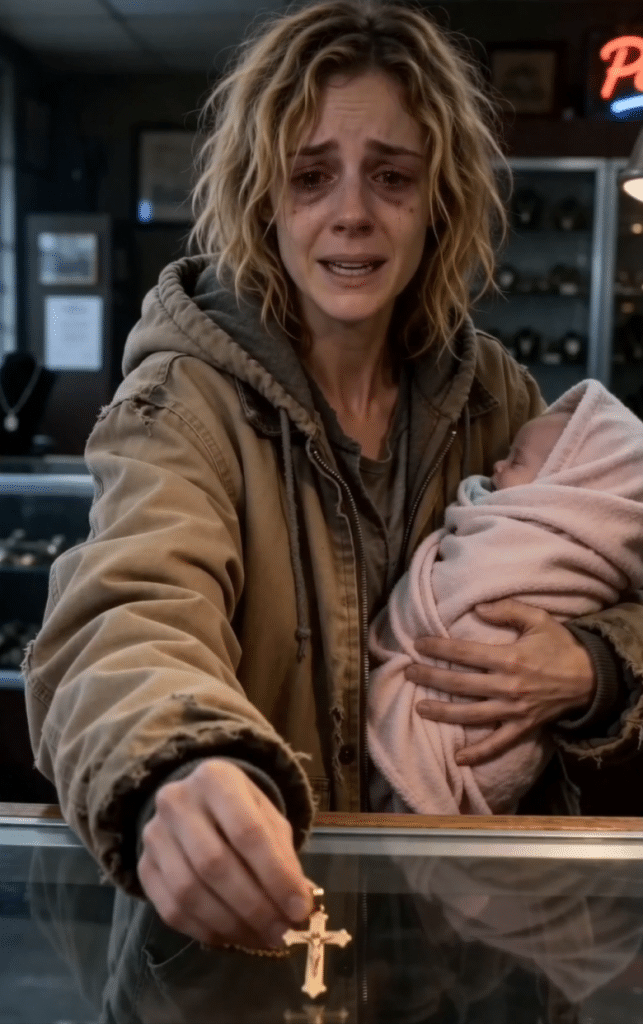
Not until the young woman stepped to the counter with a baby in her arms and desperation written all over her face.
Her hair was tangled. Her tan jacket hung loose on her thin shoulders. The infant slept against her chest, wrapped in a pink blanket that had been washed too many times.
In her shaking hand was a small gold cross.
She placed it on the glass counter like it hurt to let go.
“Please take it,” she whispered.
The pawn shop owner, Frank Bell, leaned forward.
He had seen that look before. Rent due. Food gone. Pride already spent.
He picked up the cross, glanced at it under the lamp, and shrugged.
“It’s old. Not worth much.”
The woman’s eyes filled.
Frank pulled two hundred-dollar bills from his pocket and slid them across the glass.
“Two hundred. Take it and leave.”
She grabbed the money, held her baby tighter, and hurried out into the daylight.
Frank watched the door swing shut.
Then he lifted the cross again.
And saw the engraving on the back.
Act II
Frank stopped breathing.
The name carved into the gold was faint, worn down by years of skin and prayer.
But he knew it.
Eleanor Bell.
His mother’s name.
The cross nearly slipped from his fingers.
For twenty-seven years, Frank had believed that necklace was buried with her. She wore it every Sunday, every Christmas, every time she held him after his father came home drunk and mean.
When Eleanor died, Frank was sixteen.
The necklace vanished the same week.
His older brother, Raymond, told everyone it had been stolen by hospital staff. Frank believed him because grief makes liars sound practical.
Then Raymond left town.
And Frank spent the rest of his life turning hard.
Hard men survived. Hard men did not get cheated. Hard men did not cry over strangers in pawn shops.
But now the past sat in his palm, warm from a desperate mother’s trembling hand.
Frank flipped the cross again.
There was a second engraving beneath the first.
Smaller.
Almost hidden near the bottom edge.
For my granddaughter, Lily.
Frank’s knees went weak.
He looked toward the door.
The woman was gone.
And for the first time in years, Frank ran.
Act III
He reached the sidewalk just in time to see her turning the corner with the baby pressed to her shoulder.
“Miss!” he shouted.
She flinched and walked faster.
Frank slowed down, raising both hands.
“I’m not taking the money back.”
That stopped her.
She turned with fear in her eyes.
“What do you want?”
Frank held up the necklace.
“Where did you get this?”
Her face changed.
The shame came first. Then the grief.
“It was my mother’s,” she said.
Frank’s voice dropped.
“What was her name?”
The baby stirred in her arms.
The woman looked at him like she was deciding whether the truth was safe.
“Lily,” she said. “Lily Bell.”
Frank stared at her.
The city noise around him blurred.
“My brother had a daughter named Lily.”
The woman’s lips parted.
“Raymond?”
Frank stepped back as if struck.
“You knew Raymond?”
“He was my grandfather.”
The cross trembled in Frank’s hand.
All those years, Raymond had not only taken the necklace.
He had taken the family with him.
Act IV
Her name was Hannah.
She was twenty-eight, recently widowed, and living out of a motel with her infant daughter after medical bills swallowed everything her husband left behind.
She had come to the pawn shop because the baby needed formula, diapers, and medicine.
She had not known Frank existed.
Her mother, Lily, had died years earlier. Raymond had raised Lily on bitterness and lies, telling her the Bell family had abandoned him, that Frank was greedy, cruel, and dead to them.
Frank listened from the sidewalk, the necklace cutting into his palm.
Every word was another theft.
Raymond had stolen their mother’s cross.
Then he stole Frank’s niece.
Then he stole the truth.
Frank looked at Hannah’s baby.
“What’s her name?”
Hannah hesitated.
“Ellie.”
Frank closed his eyes.
Eleanor.
His mother’s name again.
He had spent decades surrounded by watches, rings, and old gold, thinking everything had a price.
But the most valuable thing that ever entered his shop had been almost pushed back out the door.
For two hundred dollars.
Act V
Frank closed the pawn shop early that day.
He brought Hannah and baby Ellie inside, not as customers, but as family.
The first thing he did was return the necklace.
Hannah shook her head.
“I sold it.”
Frank placed it gently in her hand.
“No,” he said. “You brought it home.”
By sunset, he had paid for their motel. By morning, he had called a lawyer, a social worker, and the landlord of the apartment above the shop, which had been empty for years.
Hannah cried when he handed her the key.
Frank pretended not to see.
A week later, he hung a photograph behind the counter.
His mother, Eleanor, wearing the little gold cross.
Beside it, he placed a new picture: Hannah holding Ellie, the same cross shining softly against the baby’s pink blanket.
People still came into the pawn shop with broken watches and wedding rings they could no longer afford to keep.
Frank still did business.
But he never again said, “Take it and leave.”
Sometimes, when the bell rang, baby Ellie would laugh from upstairs.
And Frank would look at the cross in the photograph and think about the strange mercy of lost things.
Some heirlooms are not sold.
They are found.
And sometimes, they bring back the family that was stolen with them.