Act I
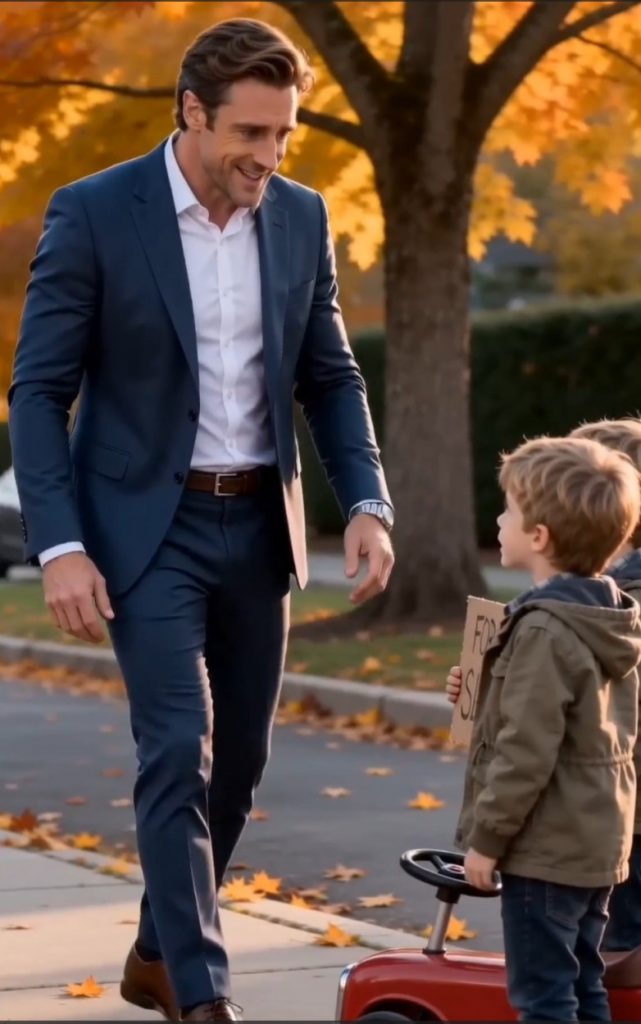
The red pedal car sat on the sidewalk beneath a storm of falling maple leaves.
It was old but polished, with chipped paint along the fenders and a tiny silver steering wheel worn smooth by small hands. A cardboard sign leaned against its side, the words written carefully in black marker.
FOR SALE.
Beside it stood two identical boys in matching olive jackets and plaid shirts, their light-brown hair tousled by the autumn wind. One held the sign with both hands. The other sat in the little car, feet planted on the pavement, trying very hard not to look like he was losing something he loved.
Across the curb, a dark charcoal sedan pulled up.
Ethan Caldwell stepped out in a navy suit, one hand adjusting his blazer, his silver watch catching the late-afternoon sun. He had stopped in front of that bakery a hundred times after board meetings, usually too distracted to notice anything except his phone and the black coffee waiting inside.
But this time, he noticed the boys.
They stared at him with blue eyes so bright, so familiar, that he forgot to shut the car door until his driver cleared his throat.
Ethan closed it slowly.
Leaves scraped softly over the sidewalk as he approached.
“You guys are selling this?” he asked.
The boy holding the sign nodded with surprising seriousness.
“Yes, sir. It’s our favorite car.”
That made Ethan smile, just a little.
He lowered himself to one knee in front of them, the expensive fabric of his suit brushing against the leaf-covered concrete.
Up close, the smile faded.
The twins had his eyes.
Not just blue.
His exact shade. The same sharp outer corners. The same dark rim around the iris. Even the small crease between their brows looked like the one Ethan saw in mirrors when he was tired.
He looked from one boy to the other.
“What are your names?”
“I’m Noah,” said the one with the sign.
“I’m Liam,” said the one in the car.
Their voices were polite, but guarded.
Ethan rested one hand on the little steering wheel.
“Why would you sell something you love so much?”
The twins glanced at each other.
It was quick, but Ethan caught it. A silent conversation only brothers could understand.
Noah looked back at him.
“Because our mommy is very sick,” he said. “She needs medicine we can’t afford.”
Something tightened in Ethan’s chest.
“Medicine?” he asked. “Where is your father? Why isn’t he helping?”
Noah’s face changed.
The boy looked down at the sidewalk, then back up with a kind of honesty that felt too heavy for a child.
“We don’t have one,” he said. “Mommy left him the day she found out she was pregnant with us.”
Ethan’s hand slipped from the toy car.
Noah swallowed.
“She said Grandma told her…”
He stopped.
The wind lifted the cardboard sign, and for a moment, Ethan could not hear the traffic, the bakery door, or the rustle of leaves.
Only his own heartbeat.
“Grandma told her what?” he whispered.
Liam climbed out of the pedal car and reached into his jacket pocket.
He pulled out an old photograph, folded so many times the corners had gone soft.
He handed it to Ethan.
The photo showed a young woman with dark honey hair standing beside a college lake, laughing into the shoulder of a man who looked seven years younger, lighter, alive.
Ethan stared at himself in the picture.
Then at the woman beside him.
Claire.
The name left him without permission.
“No,” he breathed.
Noah’s eyes filled.
“Grandma told her you didn’t want us.”
And that was the moment Ethan Caldwell’s perfect life cracked open on a suburban sidewalk.
Act II
Seven years earlier, Ethan had loved Claire Bennett with the reckless certainty of a man who had never lost anything he truly needed.
She was not from his world.
That was what he loved first.
Claire worked mornings at a bakery and took night classes in nursing. She wore thrift-store sweaters, laughed too loudly in quiet restaurants, and refused to be impressed by the Caldwell name. When Ethan took her to expensive places, she thanked the waiters by name and gave him a look when he forgot.
“You’re not better than people just because your shoes cost more,” she once told him.
He should have been offended.
Instead, he fell harder.
His mother, Victoria Caldwell, hated her immediately.
Victoria did not say it that way, of course. Women like Victoria used softer weapons.
“She’s charming,” she said after meeting Claire. “But charm is not foundation.”
Ethan ignored her.
For the first time in his life, ignoring his mother felt easy.
He and Claire made plans in the ordinary way young people do when they believe love will solve logistics. A small apartment downtown. A dog. Maybe children one day, though Claire always said she wanted to finish school first.
Then Ethan’s father died.
The Caldwell company nearly collapsed under debts Ethan had never been told about. Overnight, he became heir, executive, rescuer, and prisoner. Victoria moved back into the family estate and took control of everything she could touch.
She told Ethan Claire was a distraction.
He told Victoria Claire was the only reason he could breathe.
Then Claire disappeared.
No goodbye.
No phone call.
No final fight.
Just an empty apartment, a disconnected number, and one letter left on Ethan’s desk at company headquarters.
I can’t live in your world. Please don’t look for me.
Ethan did look.
For months.
He called her friends. Went to the bakery. Drove to the campus. Hired a private investigator who found nothing except a bus ticket purchased under Claire’s name and a trail that ended three states away.
Victoria held him through the worst of it.
That was the cruelest part.
His mother, who had caused the wound, was the one who bandaged it.
“She made her choice,” Victoria whispered. “Do not destroy yourself chasing someone who walked away.”
Eventually, Ethan stopped chasing.
Not because he stopped loving Claire.
Because grief, when unanswered long enough, becomes humiliation.
He built the company back. He became colder. Richer. More useful to everyone except himself.
And now, seven years later, two boys with his eyes stood in front of a bakery selling their favorite toy car for medicine.
Claire had not left because she stopped loving him.
She had left pregnant.
And someone had told her he did not want their children.
Ethan unfolded the photograph again with shaking hands.
“Where is your mother?” he asked.
Noah pointed down the street.
“We live behind Mrs. Bell’s old laundry shop.”
Liam added quickly, “Just until Mommy gets better.”
The way he said it told Ethan they had been repeating that hope for a long time.
He stood too fast, nearly losing balance.
“My car is right here. I’ll take you to her.”
The twins stepped back together.
“No,” Noah said.
Ethan froze.
The refusal struck him harder than he expected.
Noah held the sign tighter.
“Mommy said we can’t get into cars with strangers.”
Ethan swallowed.
He was their father.
He was also a stranger.
“You’re right,” he said softly. “That’s a good rule.”
He looked toward the bakery window. An older woman behind the counter had been watching the exchange with concern.
Ethan opened his wallet, took out a business card, and handed it to Noah.
“My name is Ethan Caldwell. I knew your mother a long time ago.”
Noah looked at the card, then at the photo in Ethan’s hand.
Liam whispered, “You’re the man in the picture.”
Ethan crouched again.
“Yes.”
The boys stared at him as if waiting for him to become either miracle or danger.
Ethan’s voice broke.
“I didn’t know about you.”
Noah’s mouth trembled.
“Mom said you were good before Grandma came.”
Ethan closed his eyes.
Before Grandma came.
Victoria.
The woman who had taught him how to read contracts, how to shake hands, how to keep his face calm while losing everything.
The woman who had raised him.
The woman who had buried his sons alive in someone else’s poverty.
Then Liam reached into the pedal car and lifted something from beneath the seat.
A small blue envelope.
“Mommy said if we ever saw you,” he whispered, “we should give you this.”
Ethan took it.
On the front, written in Claire’s handwriting, was one line.
For Ethan, if he ever comes himself.
Act III
The letter was dated six years and eight months earlier.
Ethan read it on the sidewalk with maple leaves catching against his shoes and two little boys watching his face for proof that their mother had not been wrong to hope.
Ethan,
Your mother came today.
She said you knew about the pregnancy. She said you thought I was trying to trap you. She brought a check and papers I didn’t understand. When I refused, she said she would have my nursing scholarship pulled, my landlord pressured, and my name dragged through court until the babies were born into a war I could never win.
I waited for you to call.
You never did.
Then she showed me your letter.
Ethan stopped reading.
His fingers tightened on the page.
There had been no letter from him.
He forced himself to continue.
It said you were sorry, but you had obligations. It said I should be practical. It said the children would be better off without a father who resented them.
I know your voice. The letter didn’t sound like you.
But it had your signature.
Ethan’s vision blurred.
Noah whispered, “Are you mad?”
Ethan looked up.
The boys had moved closer together, shoulder to shoulder.
“No,” he said quickly. “No, I’m not mad at you.”
He looked back at the page.
I am leaving because I do not know how to fight your world while carrying two lives inside me. But I am keeping them. Whatever happens, I am keeping them.
If you ever find this because you came looking with your own feet and not your mother’s lawyers, then know this: I loved you. I think some part of me always will.
But love without courage is just another kind of abandonment.
Claire.
Ethan folded the letter with hands that no longer felt steady.
Love without courage.
The words landed exactly where they belonged.
Because some part of him had known his mother was capable of cruelty. He had known it and called it strength. He had known it and benefited from it. He had let Victoria explain Claire’s disappearance because the explanation hurt less than the possibility that he had failed to protect the woman he loved.
A black town car pulled up across the street.
Ethan looked over.
His mother stepped out.
Victoria Caldwell wore a camel coat, leather gloves, and the expression of a woman arriving to correct an inconvenience. Her silver-blonde hair was perfect. Her lipstick was perfect. Even the way she closed the car door was quiet and final.
Ethan’s driver must have called her.
Or worse, she had been watching him.
Victoria’s eyes moved from Ethan to the twins.
For one tiny moment, her face changed.
Recognition.
Then she smiled.
“Ethan,” she called, crossing the street. “What a charming scene. Are these children bothering you?”
Noah slid behind Liam.
Liam, smaller by perhaps four minutes, stood in front of him anyway.
Ethan turned fully toward his mother.
“Did you know?”
Victoria stopped.
The golden light made her look almost gentle.
“Know what?”
Ethan held up Claire’s letter.
Victoria’s eyes flicked to it.
Not long.
Long enough.
“Careful,” she said softly. “There are children present.”
“Yes,” Ethan replied. “Mine.”
The words escaped into the autumn air.
Noah inhaled sharply.
Liam’s eyes widened.
Victoria’s smile stiffened.
“You don’t know that.”
Ethan looked at the twins, then back at his mother.
“I know enough.”
Victoria stepped closer, lowering her voice.
“You are emotional. This is exactly how women like Claire operate. Years later, when you are wealthy enough to be useful, they send children with sad eyes and rehearsed stories.”
Noah’s face turned red.
“They’re not rehearsed.”
Victoria looked down at him.
“My dear, adults are speaking.”
Ethan moved between them.
“Don’t talk to him like that.”
That surprised her.
For perhaps the first time in his adult life, Ethan saw his mother recalculating.
“Ethan,” she said carefully, “whatever Claire told them, you must protect yourself. You must protect the company.”
“No,” he said. “That’s what you wanted me to protect.”
Victoria’s jaw tightened.
Behind them, the bakery door opened.
An older woman came out wiping her hands on her apron.
“I called Claire,” she said. “She’s coming.”
The twins turned.
Hope and fear crossed their faces together.
Victoria’s eyes sharpened.
“Claire is here?”
Ethan stared at her.
“You thought she was still gone.”
Victoria did not answer.
Then Ethan understood.
His mother had not merely separated them seven years ago.
She had made sure Claire stayed poor enough, sick enough, and alone enough that the truth would never climb back into Ethan’s life.
But the truth had blue eyes.
And it had been waiting beside a red pedal car.
Act IV
Claire arrived wrapped in a faded green coat, one hand pressed against the brick wall as she walked.
Ethan almost did not recognize her at first.
Not because her face had changed.
Because life had been cruel where he had not been watching.
She was thinner than he remembered. Her hair was tied back loosely, her cheeks pale, her steps careful. But her eyes were still Claire’s. Warm, guarded, and strong enough to hurt him.
The twins ran to her.
She caught them both, pulling them into her with a sound that was half relief, half fear.
“What happened?” she asked, then looked up.
Her eyes found Ethan.
The sidewalk disappeared again.
For seven years, Ethan had imagined seeing Claire with anger, with answers, with some cold speech prepared. But standing before her now, he had nothing polished enough to offer.
“Claire,” he whispered.
Her face drained.
Then she saw Victoria.
Everything in her expression hardened.
“Take the boys inside,” she told the bakery woman.
“No,” Noah said, clutching her coat. “Mom, he read the letter.”
Claire closed her eyes.
Pain crossed her face so deeply Ethan almost stepped forward.
Almost.
But he had lost the right to assume she wanted comfort from him.
Victoria spoke first.
“Claire, this has gone far enough.”
Claire laughed once.
It sounded exhausted.
“You said that when I was twenty-four and terrified.”
“You were unstable.”
“I was pregnant.”
“You were manipulative.”
“I was alone.”
Victoria’s voice dropped.
“You were offered help.”
Claire looked at Ethan.
“She offered me money to disappear. When I refused, she gave me a letter with your signature.”
Ethan shook his head.
“I never wrote it.”
“I know that now,” Claire said.
The words were not forgiveness.
They were an autopsy.
Ethan turned to Victoria.
“Say it.”
Victoria lifted her chin.
“I did what was necessary.”
The bakery woman gasped.
A couple walking past slowed.
Victoria noticed the growing attention and lowered her tone.
“Ethan, do not humiliate this family in public.”
Ethan looked at the boys. At the pedal car. At Claire’s worn coat. At the woman who had used the word family like a locked gate.
“You already did.”
Victoria’s eyes flashed.
“I saved your future.”
“You stole my sons.”
“I protected you from scandal.”
“You let them sell a toy car for medicine.”
For the first time, Victoria had no answer ready.
Claire looked down, ashamed.
Ethan felt that shame like a blade.
“You needed medicine?” he asked softly.
Claire’s mouth tightened.
“I needed treatment. The boys misunderstood some of it.”
“They understood enough.”
She looked away.
Ethan took one step closer.
“I would have helped.”
Claire’s eyes snapped back to him.
“I waited for you.”
The sentence stopped him cold.
“I called your office,” she said. “Your number. Your assistant. Your mother answered once and told me if I tried again, she would report me for harassment. Then your attorney sent a letter warning me not to contact you.”
Ethan turned slowly toward Victoria.
His mother’s silence was confession.
Claire continued, voice trembling now.
“I stopped calling because I was scared. Then the twins were born early, and all I had was a rented room and two babies who looked exactly like the man I was trying to forget.”
Noah grabbed her hand.
Liam grabbed the other.
Ethan looked at his children.
His children.
Six years of birthdays. Fevers. First steps. First words. Lost teeth. Nightmares. Drawings taped to refrigerators he had never seen.
A whole fatherhood had happened without him.
No, not happened.
Been taken.
Ethan pulled out his phone.
Victoria’s expression sharpened.
“What are you doing?”
“Calling my attorney.”
“Ethan.”
He ignored her.
“And then a doctor for Claire. And then a private investigator to collect every letter, every forged signature, every threat you sent.”
Victoria stepped toward him.
“You would destroy your own mother?”
Ethan looked at her with tears in his eyes.
“No,” he said. “I’m finally meeting her.”
That wounded her.
Good.
But the final blow came from Liam.
He stepped out from behind Claire, small and shaking, and held up the cardboard sign.
“You can buy the car,” he told Ethan. “But only if Mommy gets better.”
Ethan knelt in front of him.
“I don’t want to buy your car.”
Liam’s face fell.
Ethan gently touched the dented red hood.
“I want to help you keep it.”
Noah stared at him.
“Why?”
Ethan’s voice broke.
“Because a father should not let his sons sell their favorite thing just to survive.”
The twins froze.
Claire covered her mouth.
Ethan looked up at her.
“If you’ll allow it,” he said, “I would like to start making that true.”
Act V
Claire did not let Ethan take over her life.
That was the first thing he learned.
Money could open doors, but it could not erase fear. It could pay doctors, secure housing, hire lawyers, and recover stolen documents. It could not turn seven years of absence into trust overnight.
Claire accepted medical care because she had to.
She accepted a safe apartment because the twins needed one.
She did not accept apologies as payment.
Ethan respected that because respect was the only currency he had left that mattered.
The truth unfolded over months.
Victoria had forged Ethan’s signature on the breakup letter. She had paid his assistant to block Claire’s calls. She had used a Caldwell attorney to send threats disguised as legal caution. She had buried the investigator’s early reports when they found Claire pregnant, then later poor, then working double shifts while raising twin boys.
She had known about Noah and Liam for years.
That was the detail Ethan could not forgive.
Not the lie told in panic.
The maintenance of it.
The annual updates.
The photographs of his sons tucked inside private reports while he stood beside Victoria at charity dinners funding children’s hospitals and family shelters.
When confronted legally, Victoria called it complicated.
The court called it fraud and coercion.
Ethan called it what it was.
Cruel.
He resigned from two Caldwell boards and removed his mother from any role touching family trusts. The press got pieces of the story, but not the boys’ names. Ethan made sure of that. For once, the Caldwell machine protected the people it should have protected all along.
Victoria retreated to the estate and gave one statement through her lawyer.
She had acted in her son’s best interests.
Ethan did not respond publicly.
Privately, he sent back every framed photograph of himself from her house. On the last one, the silver frame engraved with my beloved son, he placed a note.
A son is not property.
Then he drove to Claire’s apartment with groceries, school supplies, and a box of tiny replacement tires for the red pedal car.
The twins met him at the door with suspicion slowly turning into excitement.
Noah was the cautious one.
Liam was the tester.
“Do fathers know how to fix wheels?” Liam asked.
“Bad ones guess,” Ethan said. “Good ones read instructions.”
Noah looked at him seriously.
“Which one are you?”
Ethan sat down on the hallway floor in his suit.
“I’m trying to become the second kind.”
That answer seemed to satisfy him.
Claire watched from the kitchen, still pale but steadier now. She had begun treatment. Some days were better than others. On hard days, Ethan brought soup and left it at the door when she did not want company. On better days, she let him read to the boys while she rested.
They did not become a family all at once.
They became something more honest.
A beginning.
Ethan learned that Noah hated peas, that Liam hummed when nervous, that both boys slept better when their beds were pushed close together. He learned they loved maps, pancakes, and making rules for games they invented halfway through playing.
He learned Claire still took her coffee with cinnamon.
He learned she had stopped singing.
One evening, months after the sidewalk, Ethan found her standing by the apartment window while the boys slept. The city lights reflected against the glass. The room smelled faintly of toast and children’s shampoo.
“I used to hate you,” she said.
Ethan nodded.
“You had reason.”
“I hated that they looked like you.”
He closed his eyes.
“I’m sorry.”
“I know.”
She turned toward him.
“That doesn’t fix it.”
“No.”
“But it matters that you know.”
He looked at her then, really looked, without reaching for the past as if love could be reclaimed by desire alone.
“I missed everything,” he said.
Claire’s eyes softened, but only slightly.
“You missed a lot.”
“I want whatever you’ll let me have now.”
“The boys need consistency, not guilt.”
“Then I’ll be consistent.”
“They need truth.”
“I’ll tell it.”
“They need to know I didn’t keep them from you because I wanted to.”
Ethan’s voice shook.
“They will.”
Claire looked back out the window.
For a long time, neither spoke.
Then she said, “Start with Saturdays.”
So he did.
Every Saturday, Ethan arrived at nine.
Not eight fifty-five with gifts to impress them. Not ten with excuses. Nine.
He took the boys to the park. To the library. To the little bakery with the warm window and the maple leaves outside. Sometimes Claire came. Sometimes she stayed home. Slowly, the red pedal car became too small for them, but they refused to give it away.
“It’s important,” Noah said.
“It found Dad,” Liam added.
The first time Liam called him Dad, Ethan had to turn toward a bakery shelf and pretend to examine muffins until he could breathe again.
A year after they met, the three of them returned to the same sidewalk.
The autumn leaves had come back.
The bakery window glowed.
The charcoal sedan was gone; Ethan had driven himself in a less impressive car because Noah once said the old one looked like “a rich person’s refrigerator.”
The red pedal car sat between them, freshly painted but still wearing one small chip on the fender. Ethan had insisted on keeping it.
Claire arrived last, healthier now, cheeks warmed by the cold air. She carried a small paper bag from the bakery.
“Cinnamon rolls,” she said.
Liam cheered.
Noah studied Ethan.
“Are we still selling the car?”
Ethan smiled. “No.”
“Good,” Noah said. “Because the price went up.”
Claire laughed.
It was the first laugh Ethan had heard from her that did not carry pain inside it.
He looked at her across the pedal car, and for a moment, the years between them stood quietly nearby. Not gone. Never gone. But no longer blocking the whole sun.
Claire met his eyes.
There was no promise there.
Not yet.
Maybe not ever.
But there was peace.
And that was more than Ethan had once deserved.
The twins climbed into the pedal car together, knees crowded, elbows bumping. They argued over who got to steer until Claire told them nobody was driving anywhere without cinnamon rolls first.
Ethan watched them in the golden light.
Two boys who had tried to sell their favorite thing to save their mother.
Two sons who had found him without knowing they were looking.
He thought of the letter Claire had written all those years ago.
Love without courage is just another kind of abandonment.
He could not rewrite the years when he had lacked courage.
But he could write the next ones differently.
Noah looked up from the pedal car.
“Dad?”
The word still shook him.
“Yes?”
“Can we keep this forever?”
Ethan looked at the chipped red hood, the tiny silver steering wheel, the FOR SALE sign now folded and tucked safely under the seat.
“Yes,” he said. “Forever.”
Liam grinned.
Claire smiled down at them.
And as maple leaves spun across the sidewalk, the little red car remained exactly where it belonged.
Not for sale.
Not anymore.