Act I
The beads hit the floor like tiny pieces of bone.
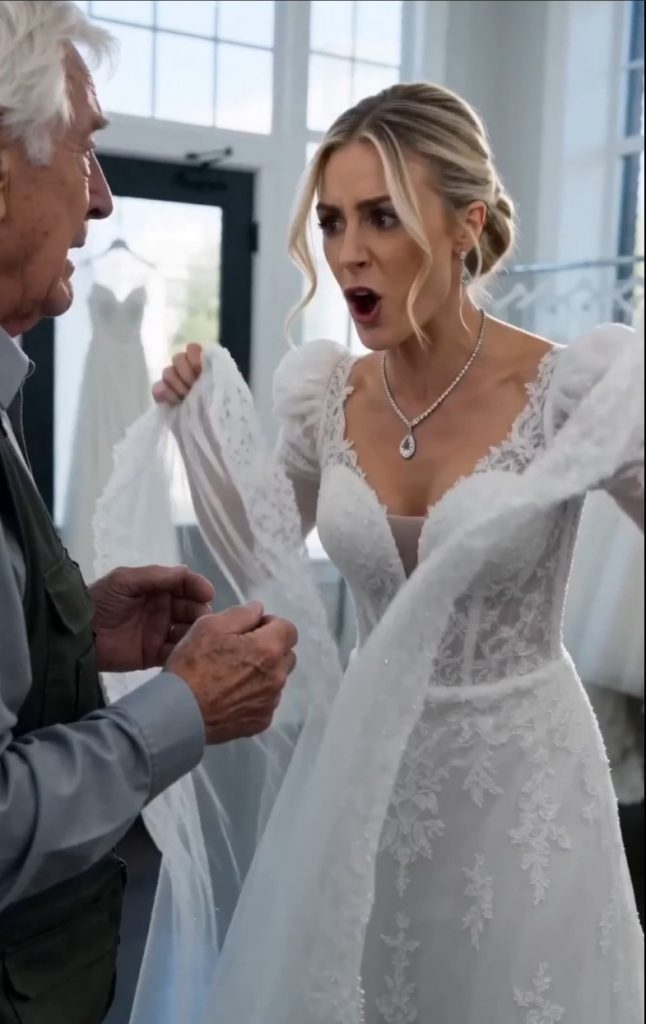
They bounced across the dark wood in bright white flashes, scattering under mannequins dressed in wedding gowns that cost more than most people made in a year. Sunlight poured through the tall windows of the bridal atelier, turning every lace sleeve and silk train into something almost holy.
But there was nothing holy about the bride’s face.
Celeste Langford stood in the center of the room in a gown of white lace and silk, her blonde hair swept into a perfect half-updo, diamonds shining at her throat and ears. She looked like the picture of elegance until she opened her mouth.
“You ruined it!”
Her scream sliced through the boutique.
In her hands was the veil.
Or what had been the veil.
A moment earlier, it had been a delicate waterfall of hand-beaded lace, stitched with a pattern so fine it seemed almost impossible that human hands had made it. Now Celeste gripped both sides of it and tore downward with a violent jerk.
The lace split.
The assistant gasped.
The old tailor stopped breathing.
Celeste threw the two ruined pieces onto the floor as though they were trash.
“There,” she snapped. “Now it looks as worthless as it is.”
Arthur Bell stood frozen in front of her.
He was seventy-four years old, with white hair, a bent back, and hands that had spent a lifetime learning patience. Those hands hovered uselessly in the air now, still shaped around the memory of the veil he had been holding.
For forty years, Arthur had worked with silk, lace, pearl, satin, ribbon, and thread. He had repaired gowns after floods, altered dresses for crying brides, restored heirloom veils yellowed by time. He had worked through arthritis, cataract surgery, and the slow fading of his hearing.
But he had never watched someone destroy his work with such pleasure.
The assistant, Mia, dropped to her knees and began gathering the loose beads with shaking fingers.
“Leave them,” Celeste barked.
Mia froze.
Arthur slowly bent down.
The motion cost him. His knees cracked softly. His breath caught as he reached for the torn lace on the floor. He gathered both pieces into his weathered hands and held them together as if, by touching them carefully enough, he might convince them they were still whole.
His lower lip trembled.
“I made it by hand,” he whispered.
Celeste leaned forward.
Her perfume was sharp and expensive. Her expression was sharper.
“You can’t even hear properly,” she said, each word cruelly clear. “Please stop pretending you know what you’re doing.”
Arthur looked down at the veil.
Mia’s eyes filled with tears, but she did not speak. Nobody spoke to brides like Celeste Langford unless they were rich enough to survive the consequences.
And Celeste knew it.
She was marrying Nathaniel Vale, heir to one of the oldest families in the city. The wedding had already been photographed by magazines before it even happened. The dress had been custom-designed. The venue was a restored estate. The flowers were being flown in from three countries.
Everything had to be perfect.
And if it was not, someone had to be punished.
Arthur was still kneeling when the double doors opened behind them.
Not politely.
Not quietly.
They opened with a force that made the mirrors tremble.
A woman in a navy wrap dress stood in the doorway. She was older, with styled gray hair and the kind of presence that made people straighten before they knew why. Her eyes moved from Celeste’s furious face to Mia on the floor.
Then to Arthur.
Then to the torn veil in his hands.
Her expression changed.
Not into anger.
Into recognition.
“Show me that veil,” she said.
Celeste turned toward her with a sharp laugh. “Why?”
The woman did not look at Celeste.
She looked only at Arthur.
“Please,” she said, her voice suddenly lower. “Bring it here.”
Arthur rose slowly. He crossed the room with the torn lace held against his chest and placed it into her waiting hands.
The woman examined the pattern.
Her fingers began to shake.
Arthur swallowed.
“It was my wife’s pattern,” he said.
The woman stared at the lace as if the room had disappeared around her.
Then she whispered, “My sister made that.”
Celeste’s face tightened.
Mia stopped breathing.
Arthur reached into the pocket of his green vest and pulled out a tiny folded square of white silk. In one corner was a red embroidered mark, small but unmistakable.
The woman took one look at it and nearly dropped the veil.
Because the lace Celeste had destroyed was not just handmade.
It was the last living proof of a woman the Vale family had buried in silence.
Act II
For most of her life, Celeste Langford had understood one simple rule.
Beautiful things belonged to people who could afford them.
She had been raised in private schools, hotel lobbies, charity luncheons, and rooms where women smiled with their mouths while measuring each other’s jewelry. Her mother taught her early that kindness was useful only when witnesses were present.
By the time Celeste met Nathaniel Vale, she had perfected herself into exactly what his world rewarded.
Polished. Photogenic. Untouchable.
Nathaniel was handsome, soft-spoken, and dangerously obedient to his family. He adored Celeste because she made decisions for both of them. His grandmother, Margaret Vale, was harder to impress.
Margaret was the true power behind the Vale name.
She chaired the foundation, controlled the family trust, and owned the old bridal atelier where generations of society brides came to be dressed. The boutique had been founded by Margaret’s mother, but its fame came from a collection of lace patterns known as the Albright Designs.
Brides whispered about them like myth.
The Rose Window veil.
The Dove Lace train.
The Red Thorn edging.
Each piece was said to bring elegance, luck, and legacy.
Celeste did not care about the story. She cared that the magazine editor cared. She cared that wearing a Vale heirloom design would make her look less like a woman marrying into the family and more like a woman born to sit at its center.
So when Margaret offered the old atelier for the final fitting, Celeste accepted as though accepting tribute.
Arthur Bell had not been part of her plan.
He arrived that morning through the service entrance, carrying a long garment box tied with cotton ribbon. He wore a gray shirt and a dark green utility vest with pins, needles, and measuring tape tucked into the pockets. Mia, his granddaughter and assistant, followed him with a smaller case of beads.
Celeste saw him and frowned.
“This is the tailor?”
Margaret’s boutique manager forced a smile. “Mr. Bell is one of the finest restoration specialists in the country.”
“He looks like he should be restoring clocks.”
Arthur heard enough to understand the insult.
He only nodded politely.
He was used to people underestimating old hands.
What Celeste did not know was that Arthur had not come because the boutique hired him often. He came because Margaret herself had requested a specialist for the veil. The original pattern had been missing from the Vale archives for decades. A partial sketch had recently been found in an old family trunk, and Margaret wanted someone capable of completing it by hand.
Arthur had agreed before he knew the name of the bride.
He did not care for wealthy weddings. He cared for the pattern.
Because it belonged to his late wife, Rose.
Rose Albright had been nineteen when Arthur first saw her through the back window of a fabric shop in Boston. She was bent over a frame, stitching red thread into white silk with the concentration of someone praying. He was a young alterations clerk then, poor, awkward, and shy.
She caught him watching and smiled.
“You’re blocking the light,” she said.
He moved at once.
She laughed, and Arthur loved her from that moment with the quiet certainty of a man who had found the one voice he would listen for forever.
Rose was Margaret Vale’s older sister.
Back then, Margaret was still Maggie Albright, the younger daughter of a family that believed status was more important than mercy. Rose was the talented one, the wild one, the one who could draw lace patterns from memory after seeing frost on a window.
Their mother built a bridal business around Rose’s designs.
Their father built walls around Rose’s life.
When Rose chose Arthur, the family called it disgrace. A seamstress could create beauty for the rich, but she was not supposed to marry beneath the family’s ambitions. Arthur had no money. No title. No protection.
Rose left anyway.
She took only a suitcase, her sketchbook, and a square of white silk embroidered with a tiny red mark that she and Margaret had invented as girls.
Two crossing stems.
One small rose.
One hidden thorn.
“It means I was here,” Rose once told Arthur. “Even if they erase my name.”
And they did.
After Rose left, her family continued using her patterns. Her name disappeared from the labels. Her letters to Margaret were returned. Arthur’s letters went unanswered. Eventually, Rose stopped hoping.
But she never stopped stitching.
When she died twenty years later, Arthur kept her silk square in his vest pocket.
Always.
The veil Celeste tore was Arthur’s final tribute to her.
A pattern Rose had drawn but never completed.
A love letter in lace.
And now the woman who had been taught to mourn Rose as a selfish runaway was standing in the boutique, holding the proof that everything she knew was a lie.
Act III
Margaret Vale did not speak for a long time.
The room seemed to hold itself still around her.
Celeste shifted impatiently. “Is someone going to explain what this has to do with my wedding?”
Margaret looked up.
For the first time that day, Celeste seemed to realize she had misjudged the temperature of the room.
“This,” Margaret said quietly, holding the torn veil, “has nothing to do with your wedding anymore.”
Celeste blinked. “Excuse me?”
Arthur closed his eyes.
Mia stood slowly, beads still cupped in her trembling hands.
Margaret turned the small silk square toward the light. The red embroidery glowed faintly against the white.
“I made this mark with my sister,” she said. “We were children. We used to sew it into scraps and hide them inside our mother’s curtains.”
Her voice cracked on the last word.
“My family told me Rose wanted nothing to do with us. They told me she sold designs behind our backs. They told me she chose poverty to punish us.”
Arthur’s face folded with grief.
“She wrote to you for seven years.”
Margaret’s eyes lifted to his.
“No.”
Arthur nodded once, slowly. “Every Christmas. Every birthday. When our daughter was born. When Rose got sick.”
The room went cold.
Margaret gripped the silk square so tightly her knuckles whitened.
“Daughter?” she whispered.
Arthur’s gaze moved to Mia.
Mia looked down.
She had heard the story in pieces all her life. A beautiful grandmother named Rose. A rich family who never came. Letters in a tin box. A photograph of two sisters sitting under a magnolia tree, laughing as if the world had not yet decided to punish them.
Arthur had never been bitter in front of her.
That was the thing that made Mia cry now.
He had every right to be.
“Rose and I had one daughter,” Arthur said. “Elena. She passed five years ago. Mia is Elena’s child.”
Margaret stared at Mia.
The assistant Celeste had ordered onto the floor.
The young woman picking beads out from beneath the bride’s feet.
Her own blood.
Mia’s voice was barely audible. “I didn’t know if you would want to know me.”
Margaret pressed one hand to her mouth.
Celeste let out a sharp breath, annoyed by the emotion in the room.
“This is touching,” she said, “but I still don’t have a veil.”
Margaret turned toward her so slowly that even Celeste fell silent.
“You tore it.”
“It was wrong.”
“No,” Arthur said softly.
Celeste glared at him. “What?”
Arthur looked at the lace in Margaret’s hands.
“It was not wrong. You asked for the old Rose Window pattern, completed in white beadwork, with the lower edge softened so it would not overpower the gown. That is what I made.”
Celeste’s face tightened. “It made me look old-fashioned.”
“It made you look connected to something older than yourself,” Margaret said.
Celeste laughed once. “I don’t need a history lesson from a man who can barely hear or a grandmother getting sentimental over fabric.”
The silence after that was absolute.
Mia whispered, “Stop.”
Celeste swung toward her. “Do not tell me what to do.”
Margaret stepped between them.
The older woman’s face had changed entirely now. The shock had burned away. What remained was colder, sharper, and far more dangerous.
“Celeste,” she said, “do you know why I chose this atelier for your fitting?”
Celeste lifted her chin. “Because I’m marrying Nathaniel.”
“No,” Margaret said. “Because I wanted to see how you behaved when you believed no one important was watching.”
Celeste’s lips parted.
Margaret glanced toward the corner of the room.
A small security camera sat above the carved molding, its dark lens aimed directly at the fitting area.
Celeste followed her gaze.
Her face drained.
“You recorded me?”
“This is a luxury atelier,” Margaret said. “Of course we record the rooms where million-dollar gowns are kept.”
Mia closed her eyes in relief.
Arthur looked down at the torn veil, still unable to accept that Rose’s work had been ripped apart in a tantrum.
Celeste recovered with impressive speed.
“You’re not going to ruin a wedding over one veil.”
Margaret’s answer was soft.
“No. You did that yourself.”
Then she asked the question that finally made Celeste stop breathing.
“Where did you get that pendant?”
Act IV
Celeste’s hand flew to the diamond at her throat.
It was large, old, and unmistakable. A pear-shaped stone set in platinum, surrounded by smaller diamonds like frozen tears.
Margaret had noticed it the moment she entered the room. At first, the torn veil had consumed her attention. But now the pendant shone against Celeste’s chest with a kind of arrogance that felt almost obscene.
“That was in the family vault,” Margaret said.
Celeste’s face hardened. “Nathaniel gave it to me.”
“No,” Margaret replied. “Nathaniel does not have access to that vault.”
Celeste looked toward the boutique manager, then Mia, then Arthur, searching for someone weak enough to blame.
No one moved.
Margaret took out her phone.
Celeste stepped forward. “Don’t.”
Margaret looked at her.
It was a small word. It should not have sounded so frightened.
But it did.
Margaret called Nathaniel on speaker.
He answered on the third ring, cheerful and unaware.
“Grandmother?”
“Did you give Celeste the Albright diamond?”
A pause.
“What? No. That stays in the vault until the ceremony. You said—”
Celeste grabbed for the phone, but Margaret moved it out of reach.
Nathaniel’s voice changed. “Is she wearing it?”
Margaret looked at Celeste.
“Yes.”
Another pause. Longer this time.
Celeste’s expression twisted. “Nathaniel, I was going to put it back. Your grandmother is making this dramatic.”
Margaret said nothing.
She did not need to.
The camera had seen the veil. The staff had seen the necklace. Arthur had seen the cruelty. Mia had lived beneath it for one awful morning, and probably many before it.
Nathaniel’s voice came through the phone, lower now.
“Celeste, why are you wearing my grandmother’s vault jewelry?”
Celeste’s cheeks flushed. “Because I am about to be your wife.”
“Not yet,” Margaret said.
Celeste turned on her. “You think you can cancel me? Do you know how many people are coming tomorrow?”
“I know exactly how many,” Margaret said. “I approved the guest list.”
“You’ll humiliate your own grandson.”
Margaret glanced at Arthur, standing with Rose’s torn pattern in his hands.
“No,” she said. “I will spare him.”
That was when Celeste’s anger broke through her polish completely.
“You people are unbelievable,” she snapped. “You act like I murdered someone. It was a veil. A piece of cloth made by some old man who should have retired before ruining my bridal look.”
Arthur lowered his head.
Mia’s face crumpled.
Margaret’s voice sharpened.
“That old man was married to my sister. That piece of cloth was designed by the woman my family erased while profiting from her genius. And you tore it apart because it did not flatter your reflection quickly enough.”
Celeste opened her mouth.
Margaret raised one hand.
“Do not speak.”
The command landed with such force that Celeste obeyed before she could stop herself.
Margaret turned to the boutique manager. “Call security. The pendant is to be removed and returned to the vault. The gown remains here until ownership is reviewed. Send the footage to Mr. Hale and to Nathaniel.”
The manager nodded quickly.
Celeste let out a laugh that sounded close to panic. “You can’t take my dress.”
“You have not paid for it,” Margaret said. “The Vale family did.”
Nathaniel was still on the phone.
His voice sounded distant now, hollowed out.
“Celeste,” he said, “is it true? Did you scream at the tailor? Did you tear the veil?”
Celeste’s eyes darted around the room.
For once, there was no beautiful answer.
“You weren’t there,” she said.
“No,” Nathaniel replied. “But now I’m glad someone was.”
Celeste’s face changed.
Not sadness.
Calculation.
“Nathaniel, baby, please—”
Margaret ended the call.
That was the mercy Celeste did not deserve.
Security arrived within minutes. Not with drama, not with force, but with the quiet efficiency reserved for wealthy scandals. Celeste removed the pendant with shaking hands and dropped it into Margaret’s palm.
For a second, her fingers closed around it too tightly.
Margaret’s eyes narrowed.
Celeste released it.
The diamonds looked colder now.
As she was escorted from the atelier, Celeste turned back once. Her hair was still perfect. Her gown still beautiful. But without the borrowed necklace, without the power she assumed would protect her, she looked suddenly ordinary.
“This family will regret embarrassing me,” she hissed.
Margaret looked at the torn veil in Arthur’s hands.
“No,” she said. “This family has regretted the wrong things for too long.”
The doors closed behind Celeste.
And then the room, finally free of her voice, filled with the sound of an old man quietly crying.
Act V
Arthur did not want money.
Margaret offered it anyway.
She offered payment for the veil, payment for the stolen designs, payment for decades of silence that had not been his choice. She offered lawyers, archives, public corrections, anything that could be written down and signed.
Arthur listened politely.
Then he placed Rose’s silk square on the worktable.
“My wife wanted one thing,” he said. “She wanted her name on her work.”
Margaret lowered her eyes.
“She should have had it.”
“Yes,” Arthur said. “She should have.”
Those words held no cruelty.
That made them harder to bear.
In the days that followed, the wedding was postponed first, then canceled. The official statement was careful. Private differences. Mutual reflection. Respect for all involved.
The truth, however, moved faster than statements.
People heard about the destroyed veil. The footage did not leak publicly, but enough people saw enough to understand. Celeste’s invitations into elite rooms became fewer. Her calls went unanswered. Her mother blamed Margaret. Celeste blamed everyone but herself.
Nathaniel sent Arthur a handwritten apology.
Arthur read it once and placed it in a drawer.
Mia expected her grandfather to close the shop for a while, but the next morning, she found him seated near the window with the torn veil laid across the table.
“What are you doing?” she asked softly.
Arthur adjusted his glasses.
“Seeing what can be saved.”
Mia stood behind him, looking down at the ripped lace.
“Can it?”
Arthur touched the torn edge.
“Not as it was.”
His voice was gentle.
“But that does not mean it has to remain ruined.”
Margaret came every afternoon after that.
At first, she came like a woman entering a church where she had no right to pray. She stood near the doorway, watching Arthur and Mia work. She did not interrupt. She did not command. She learned the rhythm of their silence.
Then one day, Mia handed her a needle.
Margaret stared at it.
“I haven’t stitched since I was a girl.”
Arthur smiled faintly. “Then your hands may remember before your pride does.”
Margaret laughed.
It was small and broken, but real.
Together, they restored what Celeste had torn.
Not perfectly. Arthur refused perfection. He said hiding the damage would be dishonest, and Rose had hated dishonest beauty. Instead, they stitched a new line down the center where the lace had split, using red thread so fine it could only be seen when the light touched it.
A scar.
A signature.
A truth.
At the bottom edge, Mia embroidered the mark from Rose’s silk square.
Two crossing stems.
One small rose.
One hidden thorn.
Three months later, the Vale atelier reopened under a new name.
Rose Albright House.
The announcement shook the old social circles more than Celeste’s canceled wedding ever had. Margaret publicly credited her sister for the designs that had made the family famous. She admitted the record had been wrong. She did not dress it up as misunderstanding. She did not blame dead parents to protect herself.
She simply told the truth.
On opening night, the restored veil stood beneath glass in the center of the atelier.
Not for sale.
Not for a bride to wear.
A plaque beneath it read:
The Rose Window Veil. Designed by Rose Albright Bell. Completed by Arthur Bell. Restored by her family.
Mia stood beside Arthur as guests moved through the room in hushed admiration. Her grandfather wore his green vest, though Margaret had offered him a tailored jacket. He said the vest had pockets for useful things.
Margaret did not argue.
She had learned when not to.
Near the end of the evening, Margaret approached Arthur with an old envelope in her hands. The paper was yellowed, the corners soft.
“I found this in my mother’s locked desk,” she said.
Arthur’s face stilled.
Inside was a letter from Rose.
One he had never seen returned.
Margaret’s hands trembled as she unfolded it.
“She wrote it after Mia’s mother was born,” she whispered.
Arthur did not reach for it right away.
Some grief is so old that even proof arrives like a wound.
Finally, he took the letter.
Rose’s handwriting moved across the page in faded blue ink.
Arthur read slowly. His hearing had faded over the years, but his memory of her voice had not. In his mind, every word sounded like her.
At the bottom, Rose had written one sentence that made him close his eyes.
Tell Maggie I still sew the red mark into everything, just in case she ever comes looking for me.
Margaret turned away, crying silently.
Mia reached for her hand.
For a moment, the two women stood joined by the same lost woman, one who had been sister, grandmother, artist, wife, and ghost in the walls of a family that had used her beauty while erasing her name.
Arthur folded the letter carefully.
Then he looked at Margaret.
“She waited a long time.”
Margaret nodded through tears. “I know.”
“She would have forgiven you faster than I can.”
A painful smile crossed Margaret’s face.
“I know that too.”
Arthur placed Rose’s silk square between them on the table.
“Then start with Mia,” he said.
Margaret looked at her great-niece.
Not the assistant on the floor.
Not the silent girl picking up another woman’s mess.
Family.
Mia’s eyes filled, but she lifted her chin.
“I don’t need a rich aunt,” she said.
Margaret nodded. “Good. I don’t need to be one.”
Mia gave her a cautious look.
“What do you need?”
Margaret glanced around the atelier, at the gowns, the restored veil, the name Rose finally carried in public.
“A chance to be better than the people who taught me silence.”
Mia looked at Arthur.
He did not nod. He did not push.
The choice was hers.
At last, Mia extended her hand.
Margaret took it like something sacred.
Outside, the city moved on, unaware that inside one bright boutique, a family history had been torn open and stitched back together in red thread.
Arthur stood before the veil one final time that night after the guests had gone.
The lights were low. The mannequins cast soft shadows along the paneled walls. The dark wooden floor had been polished until no bead, no tear, no trace of Celeste’s cruelty remained.
But Arthur remembered.
He remembered the sound of lace ripping.
He remembered Rose laughing in a fabric shop window.
He remembered every letter unanswered, every pattern stolen, every year his wife’s name lived only in his mouth.
Then he looked at the plaque.
Rose Albright Bell.
There she was.
Not erased.
Not hidden.
Not ruined.
Arthur touched the glass gently with two fingers.
“I told you I’d finish it,” he whispered.
Behind him, Margaret and Mia stood quietly together.
For the first time in decades, the old tailor was not holding memory alone.