Act I
The baby had been crying for so long that people had stopped hearing him.
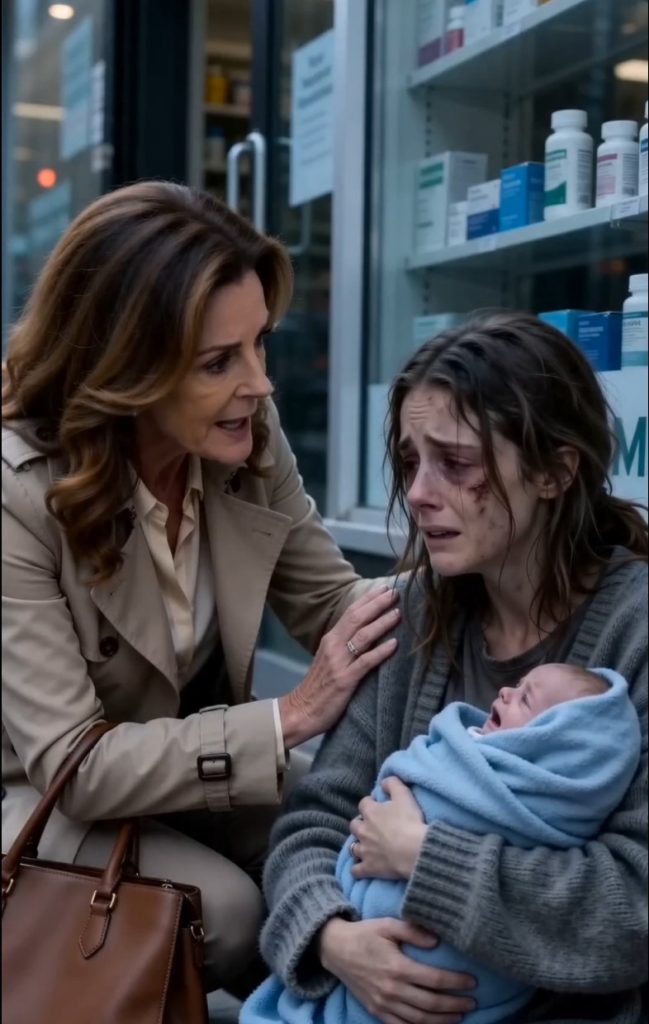
They walked past the pharmacy window with their collars raised and their eyes trained forward, stepping around the young woman sitting on the cold sidewalk as if she were a puddle. Her gray sweater hung off one shoulder. Her hair stuck to her damp cheeks. In her arms, wrapped in a faded blue blanket, the infant wailed against the city noise.
“Please,” she whispered.
No one stopped.
The young mother lifted her face again, and the effort seemed to cost her everything.
“Anything to eat. Please. I can’t take this.”
A man in a wool coat glanced down, then away.
A teenager slowed, embarrassed, and kept moving.
Then a pair of beige heels stopped in front of her.
The young mother looked up.
The woman standing there looked like she belonged behind glass, not on that hard gray sidewalk. She was in her late fifties, graceful and composed, wearing a tailored trench coat over a cream blouse. Her brown leather bag rested in the bend of her arm. Her hair was styled in loose waves that the wind barely touched.
But her eyes were not cold.
They moved from the baby’s flushed face to the mother’s trembling hands.
Then she knelt.
“What’s your name?” the woman asked.
The young mother blinked, as if she had forgotten people could ask that.
“Emma.”
The baby cried harder.
The woman opened her bag, pulled out a crisp hundred-dollar bill, and pressed it into Emma’s palm.
Emma stared at it.
“No,” she breathed. “I can’t—”
“Yes, you can,” the woman said firmly. “Use it for the baby.”
Emma’s fingers closed around the bill like she was afraid it might disappear.
The woman looked toward the pharmacy. “Does he need medicine?”
“Formula,” Emma said, ashamed. “And diapers. I was trying to get enough for both.”
The woman’s expression shifted. Not pity. Something deeper and angrier, as if the world had failed in front of her and dared her to ignore it.
She placed a careful hand near Emma’s shoulder, not touching until Emma gave a small nod.
“Do you have somewhere to stay tonight?”
Emma’s face collapsed.
“No.”
The woman looked down the sidewalk, at the passing strangers, the glowing pharmacy sign, the dirty snow packed along the curb. Then she made a decision with the calm certainty of someone who had spent her life being obeyed.
“I have a guest house.”
Emma stared at her. “What?”
“At my home. It’s warm. Private. There’s a bed, a bath, and a kitchen.” Her voice softened. “You and your baby can stay there tonight.”
Emma pulled the child closer.
“Why would you do that?”
The woman’s face changed.
For a second, she did not look wealthy. She looked wounded.
“Because years ago,” she said, “I prayed someone would do it for my daughter.”
Emma did not understand the meaning behind those words.
Not yet.
An hour later, the city was gone.
The cold sidewalk became a sunlit garden. The pharmacy window became clipped hedges and pale stone paths. The honking traffic became birdsong, wind in the trees, and the distant murmur of water from a fountain hidden beyond the roses.
Emma stood at the door of the guest house, holding her sleeping baby, unable to step inside.
The woman smiled gently.
“My name is Vivian,” she said. “Vivian Hartwell.”
Emma lowered her eyes.
“I don’t know how to thank you.”
“Rest,” Vivian said. “That will be thanks enough for now.”
But later, when Vivian returned carrying a silver tray with tea, warm soup, and fresh linen folded over one arm, she opened the guest house door and stopped dead.
Emma was asleep on the small sofa.
The baby lay beside her in a basket Vivian had brought from storage.
And around Emma’s neck, half-hidden beneath the stretched collar of her sweater, was a necklace Vivian had not seen in ten years.
A small gold locket.
Oval.
Cracked near the hinge.
Set with one tiny blue stone.
Vivian’s fingers went numb.
“That necklace,” she gasped.
The tray slipped.
Porcelain cups fell through the air, white and delicate and doomed.
They shattered across the floor like a scream.
Act II
Emma woke with a cry.
The baby startled and began fussing, his small fists pushing against the blanket. Emma sat up too fast, clutching the locket at her throat as if someone had already tried to take it.
Vivian stood in the doorway, pale as linen.
“I’m sorry,” Emma said quickly, looking at the broken cups. “I’m so sorry. I’ll clean it up. I didn’t mean to fall asleep.”
Vivian did not look at the porcelain.
She could not.
Her eyes were locked on the necklace.
“Where did you get that?”
Emma’s hand tightened around it.
The question changed her. The softness left her face. The fear returned, old and practiced.
“It’s mine.”
“I didn’t ask if it was yours.” Vivian’s voice trembled. “I asked where you got it.”
Emma rose slowly, barefoot on the rug, the baby now pressed against her chest.
“You brought me here because you wanted to help.”
“I did.”
“Then why are you looking at me like I stole something?”
The words struck Vivian hard.
She stepped back from the broken porcelain and gripped the doorframe.
“I had that necklace made for my daughter.”
Emma froze.
The garden outside seemed too bright, too peaceful, too cruel.
Vivian looked at the locket again, and memory came at her with such force she almost lost her balance.
Her daughter, Grace, had worn that necklace on her eighteenth birthday.
Vivian could still see her standing in the upstairs hallway of the main house, laughing because the clasp kept tangling in her hair. Grace had been all light and impatience then, a girl who hated formal dinners, hated her father’s rules, hated the careful coldness of the Hartwell name.
The blue stone had been sapphire, Grace’s birthstone.
Inside the locket were two initials.
G.H.
Grace Hartwell.
Vivian’s only child.
Her vanished child.
Ten years earlier, Grace had disappeared after a fight with her father, Richard. Vivian had been told she ran away with a boy from the wrong side of town. Then came rumors, then silence, then a police file that grew thinner every year until everyone but Vivian stopped pretending there was anything left to find.
But Vivian had never stopped.
Not really.
She had hired investigators. She had followed false sightings. She had called shelters in cities where Grace had never been. She had kept Grace’s room unchanged until Richard ordered the staff to pack it away while Vivian was in the hospital recovering from exhaustion.
And the necklace had been buried with Grace’s memory.
At least, that was what Vivian had believed.
Emma watched Vivian’s face and slowly lowered herself back onto the sofa.
“I didn’t steal it,” she said.
Vivian’s eyes filled.
“Then tell me.”
Emma looked down at the baby.
His name was Noah. He was four months old, with a soft round face and dark eyelashes that rested against his cheeks when he slept. He had been born in a county hospital under fluorescent lights while Emma held the hand of a nurse she had never met before.
No husband.
No mother.
No one waiting with balloons.
Just Emma and the baby, already fighting to stay in a world that had made no room for them.
“My mother gave it to me,” Emma said.
Vivian’s breath stopped.
Emma touched the locket with her thumb.
“She said if I was ever in real trouble, I should find the woman whose name was inside.”
Vivian whispered, “What name?”
Emma opened the locket.
The hinge gave a tiny, familiar click.
Inside, beneath the old initials, someone had scratched another word so small it looked like a secret trying not to be seen.
Vivian.
The room blurred.
Emma looked at her.
“My mother’s name was Grace.”
Act III
Vivian sat before her legs could fail her.
The guest house went quiet except for Noah’s small breathing and the distant birds beyond the open door. Emma stood across from her, uncertain whether she had just been saved or trapped.
Vivian’s voice barely worked.
“Grace had a child?”
Emma nodded slowly.
“Me.”
Vivian covered her mouth.
For ten years, Vivian had imagined every version of finding her daughter. Grace alive. Grace hurt. Grace angry. Grace older, harder, but still Grace. She had imagined apologies, arguments, embraces, doors slammed and opened again.
She had not imagined this.
A young woman in a torn sweater, holding a baby in a blue blanket, wearing the necklace Vivian had fastened around her daughter’s neck when they still had time.
“Where is she?” Vivian asked.
Emma’s face answered before her words did.
Vivian shook her head once, as if rejecting the room itself.
“No.”
Emma’s eyes filled, but she stayed standing.
“She died last winter.”
Vivian made a sound so small it seemed to frighten both of them.
Emma looked toward the window.
“She got sick. She kept working anyway. She said we only had to make it to spring.”
The sentence hung there.
They did not make it to spring.
Vivian stared down at her hands.
Her wedding ring was gone now. She had taken it off after Richard died two years earlier, but the mark remained, faint and pale, a ghost on her finger. She had spent so long blaming herself for not protecting Grace from him.
Now the punishment had grown larger.
She had not protected Grace.
She had not even known she had a granddaughter.
Emma shifted Noah in her arms.
“My mom didn’t talk about this place much,” she said. “She said it was beautiful. She said the garden had white roses and a stone path. She said there was a guest house with green shutters.”
Vivian looked up sharply.
The shutters were green.
No one outside the family knew that.
“She remembered?” Vivian whispered.
Emma gave a sad little smile.
“She remembered everything.”
The words hurt worse than silence.
Vivian had allowed herself one small mercy all these years: maybe Grace had forgotten them. Maybe the pain had faded. Maybe she had built a new life because she wanted to, not because she had been cut off from the old one.
But Grace had remembered the garden.
The house.
Her mother.
“She never came back,” Vivian said, almost to herself.
Emma’s expression changed.
“She tried.”
Vivian went still.
Emma lowered her voice.
“When I was little, we came to the front gate.”
Vivian’s body turned cold.
“I don’t remember much. I was maybe six. Mom had me in a yellow coat. She kept telling me to be polite, that I was going to meet my grandmother.”
Vivian’s fingers tightened around the edge of the sofa.
“What happened?”
Emma looked down.
“The guard told her Mrs. Hartwell did not accept visitors.”
Vivian closed her eyes.
“No.”
“He said if she came back, the police would be called.”
“No,” Vivian said again, louder this time.
Emma flinched.
Vivian stood, shaking.
“I never knew. Emma, I never knew.”
Emma wanted to believe her. That was the dangerous part. Hope had always been more frightening to her than disappointment because disappointment at least had the decency to arrive familiar.
“My mother said your husband came to see her after she left,” Emma continued. “He gave her cash and papers. He told her you had chosen your family name over her.”
Vivian’s face hardened through her tears.
“Richard.”
The name entered the guest house like smoke.
Richard Hartwell had been dead for two years, but Vivian still felt the old instinct to lower her voice when speaking against him. He had never shouted unless he had already won. His cruelty was tidy, polished, legal. He could destroy a person with documents and call it order.
Vivian had loved him once.
Then she had survived him.
“I searched for her,” Vivian said. “I swear to you, I searched.”
Emma studied her.
“My mother used to say you would have come if you knew.”
Vivian’s face crumpled.
“She said that?”
Emma nodded.
“She said you were softer than the house let you be.”
For the first time, Vivian reached toward Emma.
Not for the necklace.
For her hand.
Emma hesitated.
Then she let her take it.
And in that fragile contact, Vivian felt ten lost years, one dead daughter, one frightened granddaughter, and a baby who had carried the Hartwell blood back through the gate no guard could close now.
Act IV
Vivian took Emma to the main house before sunset.
Emma walked slowly through the garden with Noah tucked against her chest, staring at the hedges, the fountain, the white roses climbing the iron arch. She had grown up on her mother’s stories, but stories had made the place smaller.
The real estate was enormous.
Beautiful.
Intimidating.
A house built to impress people before they reached the door.
At the steps, Emma stopped.
Vivian noticed.
“You don’t have to go in.”
Emma looked up at the tall windows.
“My mother stood here once?”
Vivian swallowed.
“Yes.”
“Was she scared?”
Vivian thought of Grace at seventeen, storming barefoot across marble floors, fearless enough to frighten every adult who mistook obedience for love.
Then she thought of Grace years later, standing at the locked gate with a child in a yellow coat.
“Yes,” Vivian said softly. “But she came anyway.”
Emma nodded.
“Then I can go in.”
The front door opened before Vivian touched it.
A housekeeper named Marta stood there, her eyes widening when she saw Emma’s face. Not because Emma looked exactly like Grace. She did not. Grace had been brighter, sharper, all flame and motion.
Emma looked like what happened after flame had been forced to live in wind.
But the resemblance was there.
The mouth.
The chin.
The eyes when she was trying not to cry.
Marta whispered, “My God.”
Vivian steadied herself.
“Marta, this is Emma.”
Marta’s gaze dropped to the baby.
“And this is Noah,” Vivian said.
Marta covered her mouth and began to cry.
Emma looked overwhelmed. Noah woke and fussed. Vivian moved to take him, then stopped herself.
She had no right to assume.
Emma saw the restraint.
Something in her softened.
“Would you like to hold him?”
Vivian could not answer.
She simply nodded.
Emma placed Noah into her arms.
The baby was warm, solid, alive.
Vivian looked down at him and felt the final wall inside her break. This child had her daughter’s blood. Her daughter’s stubbornness, perhaps. Her daughter’s lost place at the table.
Noah blinked up at her.
Vivian smiled through tears.
“Hello, little one.”
That was when Charles entered the hall.
Vivian’s stepson.
Richard’s son from his first marriage.
He was forty-five, handsome in the way expensive men often are, with a watch that flashed under the chandelier and a smile that never reached his eyes. Since Richard’s death, Charles had managed most of the Hartwell estate, always with legal language and gentle reminders that Vivian was “not getting younger.”
His smile vanished when he saw Emma.
“Who is this?”
Vivian held Noah closer.
“My granddaughter.”
Charles stared.
Then he laughed once.
It was an ugly sound in the marble hall.
“That’s not funny.”
“No,” Vivian said. “It isn’t.”
Emma stepped forward. “My mother was Grace Hartwell.”
Charles looked at the locket around her neck.
For a fraction of a second, his face changed.
Vivian saw it.
So did Emma.
Charles recovered quickly. “Anyone can claim anything with a necklace.”
Vivian’s voice turned cold.
“Careful.”
He glanced at Marta, then back to Vivian.
“You bring a homeless girl into this house, and suddenly she’s family? Do you understand what people will do for money?”
Emma went pale.
Vivian handed Noah back to her gently, then turned on Charles with a calm that made Marta step aside.
“You knew.”
Charles blinked.
“What?”
“You knew Grace came to the gate.”
“I was in college.”
“You were twenty-five.”
His jaw tightened.
Vivian stepped closer.
“Your father was out of town that week. I was at the hospital with pneumonia. The guard worked for you.”
Charles’s expression hardened.
“You’re confused.”
“No,” Vivian said. “For the first time in years, I am not.”
Emma’s voice shook. “My mom said a man came out after the guard. Not Richard. Younger. He told her there was no place for us here.”
Charles looked at her with sudden hatred.
“You were six.”
“I remember his ring,” Emma said.
Her eyes dropped to his hand.
The Hartwell signet ring gleamed on Charles’s finger.
Marta gasped softly.
Charles closed his fist.
Vivian’s voice was nearly a whisper.
“You turned my daughter away.”
“She had already disgraced this family.”
The words were out before he could stop them.
Everything in the hall went still.
Emma took a step back as if struck.
Vivian stared at Charles, seeing not a stepson, not the polished executor of Richard’s wishes, but a gatekeeper who had chosen inheritance over mercy.
Charles straightened, abandoning the lie.
“Do you think Father wanted her back? Do you think he wanted some runaway girl and her child dragging scandal through this house? He protected you.”
“No,” Vivian said. “He controlled me. And you helped him.”
Charles’s face flushed.
“You owe me gratitude. I kept this estate intact.”
Vivian looked at Emma holding Noah beneath the chandelier, in the house where Grace should have been welcomed home.
Then she looked back at Charles.
“You kept a grandmother from her grandchild.”
Charles leaned in.
“You have no proof.”
Emma touched the locket.
Vivian smiled then, but it was not warm.
“Grace always kept proof.”
Act V
The proof was in the lining.
Vivian remembered it before she knew why. Grace had been sixteen when she started sewing secret pockets into her jackets, bags, even pillowcases. Richard called it childish. Vivian called it clever.
Emma removed the locket with trembling fingers and placed it in Vivian’s palm.
Vivian pressed the edge of the cracked hinge.
Nothing happened.
For one unbearable second, Charles smiled.
Then Emma said, “Try the stone.”
Vivian pressed the tiny sapphire.
A hidden compartment opened behind the photograph inside.
A folded strip of paper slid into her hand.
It was thin, worn, and creased almost to breaking.
Vivian opened it carefully.
Grace’s handwriting stared back at her.
Mom, if this ever reaches you, I tried to come home. They wouldn’t let me. Her name is Emma. She is yours too.
Vivian’s hand shook so hard Marta had to catch the paper before it fell.
Emma began to cry silently.
Vivian looked at Charles.
He no longer looked confident.
He looked cornered.
“There’s more,” Emma whispered.
From her sweater pocket, she pulled a small plastic envelope, cloudy with age. Inside were copies of documents Grace had hidden for years: the guard’s signed dismissal notice, a note in Richard’s handwriting, and a bank transfer made to Charles the week after Grace was turned away.
Vivian read enough.
Not all.
Enough.
By morning, Charles was gone from the estate.
Not politely. Not with a family statement. Vivian called her attorney before dinner, the police after that, and the board of the Hartwell Foundation before sunrise. Every door Richard and Charles had once used to control her began closing in their faces.
This time, she held the keys.
Emma stayed in the guest house that first night because the main house was too much.
Vivian did not argue.
She brought soup again, this time in plain bowls that could not shatter so dramatically. Marta brought blankets. Noah slept in a borrowed cradle that had once belonged to Grace, pulled from storage with tears and apologies.
Emma stood over it for a long time.
“My mom slept there?”
Vivian nodded.
“She hated it. She only wanted to sleep in my arms.”
Emma laughed through her tears.
“Noah too.”
The two women looked at each other, and for the first time, the space between them did not feel like suspicion.
It felt like grief learning how to become family.
Weeks passed.
There were DNA tests, legal papers, reporters outside the gate, and headlines Vivian refused to read. The world loved a lost-heiress story when it could dress it in scandal and money, but Vivian knew the truth was not glamorous.
A young mother had sat outside a pharmacy begging for formula.
A daughter had died believing she might never be welcomed home.
A baby had cried while strangers stepped around him.
That was the truth.
So Vivian changed the estate before it could swallow Emma whole.
The guest house became Emma’s first safe place, not a hiding place. Vivian hired no tutors, stylists, or consultants without asking. She did not replace Emma’s clothes without permission. She did not reach for Noah unless Emma offered him first.
She had already lost one daughter by letting powerful people decide what love should look like.
She would not repeat the mistake.
One afternoon, Vivian found Emma in Grace’s old room.
The boxes had been returned from storage. Photos lined the bed. A denim jacket lay across a chair. On the vanity sat a hairbrush with a faded ribbon tied around the handle.
Emma held a picture of Grace at eighteen.
“She looks happy here,” Emma said.
“She was,” Vivian replied. “That was before I became afraid of fighting for her.”
Emma looked at her.
Vivian did not hide from it.
“I should have fought harder.”
Emma’s eyes filled, but her voice was gentle.
“My mom said you loved her.”
“I did.”
“Then love me differently.”
Vivian nodded, tears slipping down her face.
“I will.”
A year later, the pharmacy window was gone from Emma’s nightmares.
Not entirely. Some memories leave fingerprints. But she no longer woke expecting concrete beneath her or strangers passing by.
Noah learned to walk in the garden.
His first steps happened on the stone path between the white roses, with Emma kneeling at one end and Vivian at the other, both women laughing and crying as he wobbled between them with furious determination.
When he reached Vivian, he grabbed her necklace.
Not the gold locket.
Emma wore that now, repaired but still carrying its crack near the hinge. Vivian wore a new silver chain with three small charms: a sapphire for Grace, an initial for Emma, and a tiny engraved N for Noah.
Emma lifted her son into the air.
“Careful,” she said. “Grandma’s jewelry is not for eating.”
Vivian froze.
Emma realized what she had said.
For a moment, neither woman moved.
Then Noah clapped his hands and laughed, completely unaware that one word had just healed something no court ruling ever could.
Vivian pressed her fingers to her mouth.
Emma smiled.
“Grandma,” she repeated softly.
Vivian reached for her hand.
From the garden, the great house looked less like a fortress now. The gates stood open during the day. The guest house hosted young mothers referred by shelters and hospitals, women who needed more than a hundred-dollar bill and a kind word on a freezing sidewalk.
Above its door, Vivian had placed a small brass plaque.
For Grace.
Inside, there was always formula. Always clean blankets. Always someone who answered the bell.
And in the main house, under the afternoon sun, Emma stood with her baby on her hip and the cracked gold locket resting against her heart.
The necklace had once been proof of everything Vivian lost.
Now it was proof that love, even buried under lies, could still find its way home.