Act I
Alina was on the ground before her father ever opened the door.
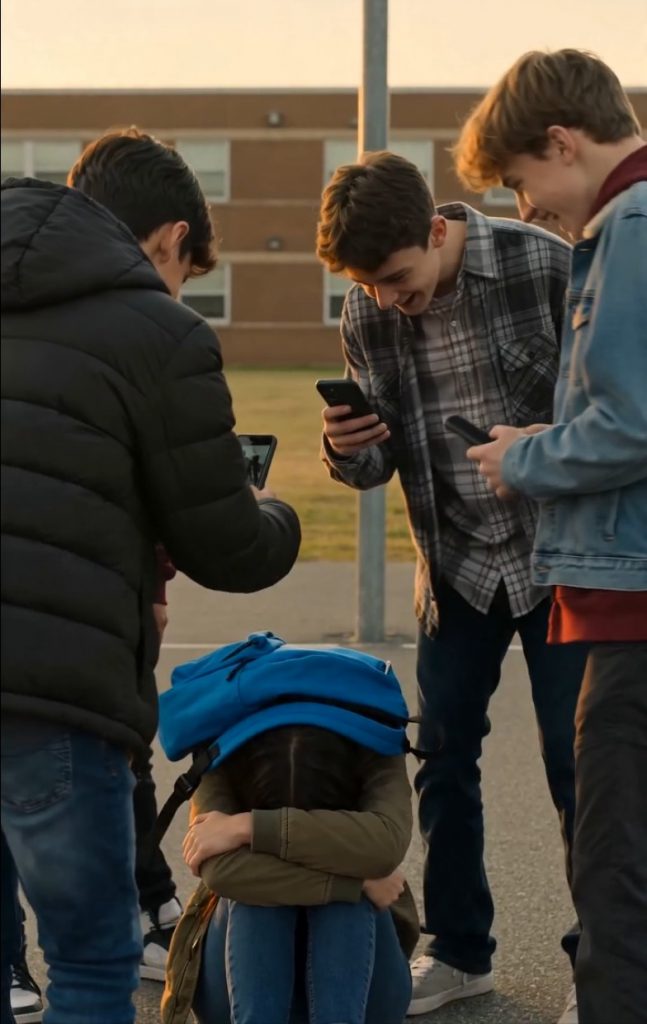
She sat curled beneath the basketball hoop, arms locked around her knees, face buried so deeply in her sleeves that only her shaking shoulders gave away the fact that she was crying. Around her, five teenagers moved in a loose circle, laughing as the sunset turned the schoolyard gold.
One boy in a black puffer jacket held her bright blue backpack above his head.
“Come get it, Alina!”
She did not move.
Another boy in a plaid shirt lifted his phone higher, grinning as he recorded. A girl in a denim jacket leaned toward the camera and laughed.
“She’s doing it again,” the girl said. “She’s crying again.”
The backpack flew over Alina’s head.
Someone caught it. Someone else cheered.
A red-hoodied boy crouched near her and snapped his fingers beside her ear.
“Hey. Charity case. Your stuff is in here, right?”
Alina made a small sound, but no words came out.
The boy in the puffer jacket unzipped the bag and began shaking it. Notebooks, pens, a lunch container, and a folded green sweater spilled onto the asphalt.
Then he pulled out a small metal case.
Alina’s head snapped up.
“No,” she choked. “Please don’t.”
That made them laugh harder.
Inside the dark green SUV parked near the chain-link fence, Colonel Marcus Vale stopped breathing.
His hands tightened around the steering wheel until his knuckles went pale. He had arrived early, still in uniform, hoping to surprise his daughter after six months away on assignment. He had imagined her running toward him. He had imagined her laughing. He had imagined dropping to one knee and letting her collide with him the way she used to when she was little.
Instead, he watched her fold herself into the ground while children circled her like wolves with phones.
The metal case flashed in the boy’s hand.
Marcus knew that case.
Alina’s mother had given it to her before she died.
The boy opened it.
Marcus’s jaw clenched so hard it hurt.
He switched off the engine.
The SUV door swung open.
The slam cracked across the court.
The laughter stopped all at once.
Marcus stepped onto the asphalt in full military uniform, black beret low over his brow, boots striking the pavement with slow, controlled force. He did not shout. He did not run. He did not touch anyone.
He only walked.
And somehow, that was worse.
The boy holding the backpack lowered it.
The girl in denim stopped recording.
One of the boys backed away so quickly his heel scraped the painted court line.
Marcus walked straight through the broken circle until his shadow fell across his daughter.
Alina slowly lifted her face.
Her hair was tangled and damp against her cheeks. Her eyes were red, wide, and terrified. For a heartbeat, she seemed unable to believe what she was seeing.
Then his expression softened.
All the anger in his body bent into something gentler.
“Alina,” he whispered.
Her chin trembled.
“Dad…”
The word broke him more than any battlefield ever had.
But when Marcus looked down and saw the open metal case in the bully’s hand, he understood this had not started today.
And he was going to find out who had let it go this far.
Act II
Alina Vale had spent most of her life learning how to wait.
She waited for video calls from places her father could not name. She waited through birthdays with a laptop propped beside the cake. She waited in school auditoriums, scanning the back row for a uniform that usually was not there.
She never complained about it.
Not to him.
Marcus knew that now, and the guilt had been sitting in his chest for years.
Her mother, Evelyn, used to say Alina was made of quiet courage. She was the child who comforted other children during thunderstorms. The girl who packed extra granola bars because someone in class always forgot lunch. The daughter who said, “It’s okay, Dad,” with a smile too mature for her age whenever he had to miss something important.
Then Evelyn got sick.
After the funeral, the quiet in Alina changed.
It became smaller. Tighter. A place to hide.
Marcus did everything wrong at first. He gave speeches about strength. He told her to be brave. He packed her schedule with tutors and activities because he thought routine could build a bridge over grief.
But grief does not obey a calendar.
When he transferred Alina to Stonebridge Academy, he thought he was giving her a fresh start. The school had a clean reputation, a strong scholarship program, polished brick buildings, and posters in every hallway promising respect, inclusion, and leadership.
He believed the posters.
That was his mistake.
At Stonebridge, Alina became “the military kid.” Then “the scholarship girl.” Then, after someone found an old article about her mother’s memorial fund, “the charity case.”
The cruelty started quietly.
A missing notebook.
A photo taken from behind.
Her lunch moved to another table.
Someone changing her name in a class group chat to “Sad Alina.”
When Marcus asked, she said everything was fine.
When he pushed, she said he worried too much.
But two months ago, his sister had called him while he was overseas.
“Marcus,” Aunt Claire said, voice tight, “Alina asked me how hard it is to transfer schools.”
That was when he knew.
He requested leave. It was denied twice. Then delayed. Then approved after an old friend in command noticed that Marcus had stopped sleeping more than three hours a night.
So he came home early.
He did not tell Alina because he wanted one moment of joy untouched by logistics, grief, or duty.
Instead, he found her on the ground.
Now he knelt before her on the basketball court and carefully removed his jacket.
“Can I put this around you?” he asked.
Alina nodded once.
He draped it over her shoulders. It swallowed her small frame, but she gripped the fabric like it was the only solid thing left in the world.
Behind him, the bullies stood frozen.
The boy in the black puffer jacket still held the metal case.
Marcus did not raise his voice.
“Put that down.”
The boy blinked.
“I didn’t—”
“Put it down.”
The case landed on the asphalt with a small metallic sound.
Marcus picked it up slowly.
Inside was Evelyn’s compass.
It was old, brass, scratched at the edges, with a tiny engraving on the lid.
For when you feel lost.
Evelyn had carried it during hiking trips before Alina was born. She had given it to their daughter during her final week in the hospital, when Alina was twelve and trying so hard not to cry that her whole body shook.
Now the compass sat in Marcus’s palm, touched by children who had no idea what they had just mocked.
Alina looked at it and fell apart.
Marcus pulled her close.
Not tightly. Not roughly. Just enough to let her hide against him.
The girl in denim whispered, “We were just joking.”
Marcus looked at her.
No one spoke after that.
Then a voice came from the school building.
“What is going on here?”
Principal Warren Blake crossed the court in a gray suit, followed by two teachers and a security guard. His expression was already annoyed, as if the problem was not a crying student on the ground, but the inconvenience of an adult witnessing it.
Marcus stood slowly.
Alina stayed behind him, wrapped in his jacket.
Principal Blake looked at the scattered backpack, the phones, the students, then at Marcus’s uniform.
“Colonel Vale,” he said with a strained smile. “There appears to have been a misunderstanding.”
Marcus’s eyes did not move.
“No,” he said. “There appears to have been an audience.”
And every phone in that circle was still recording.
Act III
Principal Blake wanted the conversation moved inside.
Marcus refused.
“Not yet.”
The principal’s smile faltered. “This is a school matter.”
“My daughter is shaking on the ground,” Marcus said. “This is a human matter first.”
A few students had gathered near the fence now, drawn by the sudden silence. The golden light had faded into a dull purple dusk. The basketball hoop stood above them like a witness too tired to look away.
Blake lowered his voice.
“Colonel, I understand you’re upset, but teenagers can be cruel without meaning real harm. We’ve spoken to Alina before about resilience.”
Alina flinched.
Marcus felt it through the sleeve of his uniform jacket.
He looked at the principal.
“You spoke to her?”
Blake hesitated.
“We encouraged her to stop isolating herself.”
Marcus turned fully toward him.
“My daughter reported this.”
The principal’s face tightened.
“She reported interpersonal conflict.”
The phrase was so polished it almost hid the rot underneath.
Almost.
Marcus reached down and picked up Alina’s backpack. A notebook had fallen open near his boot. On the first page, in Alina’s careful handwriting, were dates.
Names.
Times.
Screenshots printed and folded.
Marcus stared.
Alina had not been silent.
She had been documenting everything.
The puffer-jacket boy saw the notebook and muttered, “Oh, come on.”
Marcus looked at him.
“What’s your name?”
The boy glanced at the principal.
“Tyler Blake.”
The court went still.
Marcus understood.
So did everyone else.
The principal’s son.
Tyler lifted his chin with a weak imitation of confidence.
“She makes everything dramatic.”
The girl in denim nodded quickly. “Yeah, she’s always acting like everyone is attacking her.”
Alina whispered, “I’m not.”
The words were so small that Marcus almost missed them.
Then the boy in the plaid shirt made the worst mistake of his life.
He laughed nervously and said, “Maybe her dad can deploy her somewhere else.”
Marcus went silent.
Not angry in the loud way they expected.
Silent in the way that made the teachers stop breathing.
He turned to the boy.
“My uniform is not a costume for your punchline.”
The boy’s face drained.
Marcus continued, each word measured.
“And my daughter’s pain is not entertainment for your phone.”
Principal Blake stepped forward. “That’s enough. Everyone inside. We will handle this privately.”
“No,” Marcus said.
Blake blinked. “Excuse me?”
“You already handled it privately.”
The principal’s expression hardened.
Marcus took the notebook from the ground and held it up.
“She wrote dates. She wrote names. She printed messages. She gave you chances to protect her without humiliating anyone.”
Blake’s jaw moved, but no words came.
Marcus looked at the teachers.
“Did any of you read this?”
One teacher looked down.
The other closed her eyes.
That was answer enough.
Alina stepped forward, still wrapped in his jacket.
Her voice shook.
“I gave it to Mrs. Hall first. She said she would bring it to you.”
The older teacher covered her mouth.
“I did,” she whispered.
Principal Blake turned sharply. “Careful.”
Marcus caught the word.
So did Alina.
So did the students still recording.
The principal realized it too late.
For the first time since Marcus stepped onto the court, power shifted away from the man in charge of the school.
And it moved toward the girl everyone had tried to silence.
Act IV
Marcus did not threaten the principal.
He did something far more dangerous.
He asked for the truth calmly.
“Mrs. Hall,” he said, “what happened when you brought the complaint forward?”
The teacher looked at Tyler.
Then at Alina.
Her eyes filled with shame.
“I was told the matter was sensitive because of Tyler’s college applications,” she said.
Tyler muttered, “Shut up.”
Marcus’s gaze snapped to him.
Tyler stepped back.
Mrs. Hall kept going, her voice breaking now.
“I was told Alina had emotional difficulties after her mother’s death and that formal discipline would escalate her attention-seeking behavior.”
Alina made a sound like she had been struck.
Marcus closed his eyes for one second.
When he opened them, they were wet.
Principal Blake’s face flushed. “This is wildly inappropriate.”
“No,” Marcus said. “What was inappropriate was turning grief into a reason not to believe a child.”
Blake pointed toward the school. “My office. Now.”
“Your office has already done enough.”
The principal looked around and finally noticed the crowd. The phones. The students whispering. The security guard who had not moved. The teachers who no longer looked willing to rescue him.
Tyler tried to grab his phone from his pocket.
Marcus saw the movement.
“Do not delete anything.”
“You can’t tell me what to do,” Tyler snapped.
Marcus’s voice lowered.
“No. But the police can preserve evidence.”
The word police changed everything.
Blake stepped between them.
“That is unnecessary.”
“Your son and his friends stole my daughter’s property, cornered her, recorded her while she was crying, and scattered her belongings on school grounds after multiple ignored complaints.” Marcus looked at the phones. “Unnecessary ended before I arrived.”
Alina touched his sleeve.
“Dad,” she whispered.
The sound pulled him back.
He turned to her at once.
Her eyes were frightened again, not of him, but of what would happen after. The rumors. The hallway stares. The punishment that always found the person who spoke up before it found the person who caused harm.
Marcus softened.
“What do you want?” he asked.
Everyone looked at her.
Alina looked at the backpack. The compass. The court. The students who had laughed.
Then she looked at Principal Blake.
“I want them to stop saying I made it up.”
Her voice trembled, but it did not disappear.
“I want someone to say it happened.”
The court went quiet.
That was all she asked for.
Not revenge.
Not destruction.
Just reality.
Mrs. Hall began to cry.
“It happened,” she said.
The other teacher nodded. “It happened.”
One by one, students near the fence began lowering their phones. A younger boy in a soccer hoodie stepped forward.
“I saw them do it last week too,” he said.
A girl beside him added, “They took her lunch on Tuesday.”
Another voice: “Tyler posted stuff in the group chat.”
Then another.
The truth, once one person touched it, began passing from hand to hand.
Tyler looked at his father, panic replacing arrogance.
Principal Blake turned pale.
Marcus picked up the compass case and placed it gently in Alina’s hand.
“For when you feel lost,” he said.
She looked down at the engraving.
Then, slowly, she closed her fingers around it.
The next sound came from beyond the fence.
Two police cars rolled into the school parking lot, lights off but unmistakable.
Aunt Claire stepped out first.
She was a district attorney.
And she was holding a folder thick enough to end careers.
Act V
By Monday morning, Stonebridge Academy no longer controlled the story.
The videos spread first, but the documents mattered more.
Alina’s notebook. The ignored reports. The printed messages. The emails Mrs. Hall had saved after Principal Blake ordered her to “de-escalate without documentation.” The security footage from the court. The group chat Tyler thought he had deleted.
Nothing vanished quickly enough.
The school board placed Warren Blake on leave by noon.
Tyler and the others were suspended pending a formal hearing. Their parents arrived angry, then left quiet after seeing the footage. The clerk in the district office, who had spent years filing complaints into folders no one opened, cried when she handed over three more reports from other students.
Alina was not the only one.
That hurt her.
It also freed her.
For weeks, she stayed home with Marcus and Aunt Claire. She slept late. She avoided her phone. Some days she barely spoke. Marcus did not push. He cooked badly, folded laundry worse, and sat with her through long silences without trying to turn them into lessons.
One evening, Alina found him at the kitchen table polishing Evelyn’s brass compass.
“You’re going to wear the metal off,” she said.
He smiled faintly.
“Your mother said the same thing.”
Alina sat across from him.
For a while, they listened to the quiet hum of the refrigerator.
Then she said, “I didn’t tell you because I thought you’d be disappointed.”
Marcus looked up.
“In you?”
She nodded, eyes fixed on the table.
“I thought you’d tell me to be stronger.”
The compass stopped moving in his hands.
That sentence did what no enemy had ever done.
It wounded him cleanly.
He set the cloth down.
“I am sorry,” he said.
Alina blinked.
He did not dress it up. Did not explain duty or deployment or fear. He simply let the apology stand.
“I thought strength meant enduring,” he said. “Your mother understood better. She knew strength also means asking someone to stand beside you.”
Alina’s eyes filled.
“I tried.”
“I know,” he whispered. “I should have heard you sooner.”
She reached across the table and touched the compass.
“She would’ve been mad.”
Marcus laughed softly through the ache in his throat.
“At me?”
“At everyone.”
“Oh, absolutely.”
For the first time in months, Alina smiled.
Small.
Real.
Enough.
The hearing came in early winter.
Alina wore a navy sweater and kept the compass in her pocket. Marcus sat behind her in uniform, not as a threat, but as a promise. Aunt Claire sat beside him with her folder closed because the evidence had already spoken.
When the board asked Alina if she wanted to make a statement, she stood slowly.
Her hands shook.
She spoke anyway.
“I used to think being quiet made things easier,” she said. “It didn’t. It only made people comfortable while I was hurting.”
The room went still.
“I don’t want anyone to be scared to report something because the person hurting them has powerful parents. I don’t want teachers to be afraid of doing the right thing. And I don’t want posters about kindness if nobody means them.”
She looked at Tyler, who sat with his parents, staring at the floor.
“I don’t hate you,” she said.
He looked up, startled.
“But I don’t forgive you just because you got caught.”
His face reddened.
Alina turned back to the board.
“I just want school to be a place where kids are safer than they are silent.”
That line made the local paper the next day.
Marcus cut it out and placed it beside Evelyn’s photograph.
Months later, the basketball court was repainted.
Not because paint fixed what happened there, but because the school wanted a visible beginning. New policies came too. Anonymous reporting. Independent review. Required intervention training. Actual consequences for recording humiliation instead of helping.
Mrs. Hall became interim principal.
She asked Alina before changing anything about the court.
Alina requested one thing.
A bench under the fence.
For anyone who needed somewhere to sit without being surrounded.
On the first warm evening of spring, Marcus drove Alina back to the school. The court was empty except for the long shadows of the hoop and the soft orange light of sunset.
Alina stepped out of the SUV with the blue backpack over one shoulder.
The same backpack.
Washed. Repaired. Still hers.
Marcus walked beside her to the center of the court.
“This okay?” he asked.
She nodded.
Then she picked up a basketball someone had left near the fence.
“I used to like playing here,” she said.
“You still can.”
She bounced the ball once.
The sound echoed.
Then she shot.
The ball hit the backboard, circled the rim, and dropped through.
Alina stared at it, surprised.
Marcus smiled.
“Nice shot.”
She rolled her eyes, but she was smiling too.
For a while, they took turns missing and laughing and pretending Marcus was not far too proud of every basket she made. The sky turned lavender. The school windows glowed behind them. The court no longer felt like the place where she had been broken open in front of everyone.
It felt like a place she had returned to.
That mattered.
Before they left, Alina stood beneath the hoop and looked toward the spot where she had been curled on the ground months earlier.
Marcus waited.
She reached into her pocket and touched the compass.
Then she looked at her father.
“I don’t feel lost today.”
His eyes softened.
“No,” he said. “You don’t.”
They walked back to the SUV together, the blue backpack bouncing lightly against Alina’s shoulder.
And behind them, on the court where laughter had once been used like a weapon, the only sound left was a basketball rolling slowly through the golden light.