Act I
The boy was too small to be on that road.
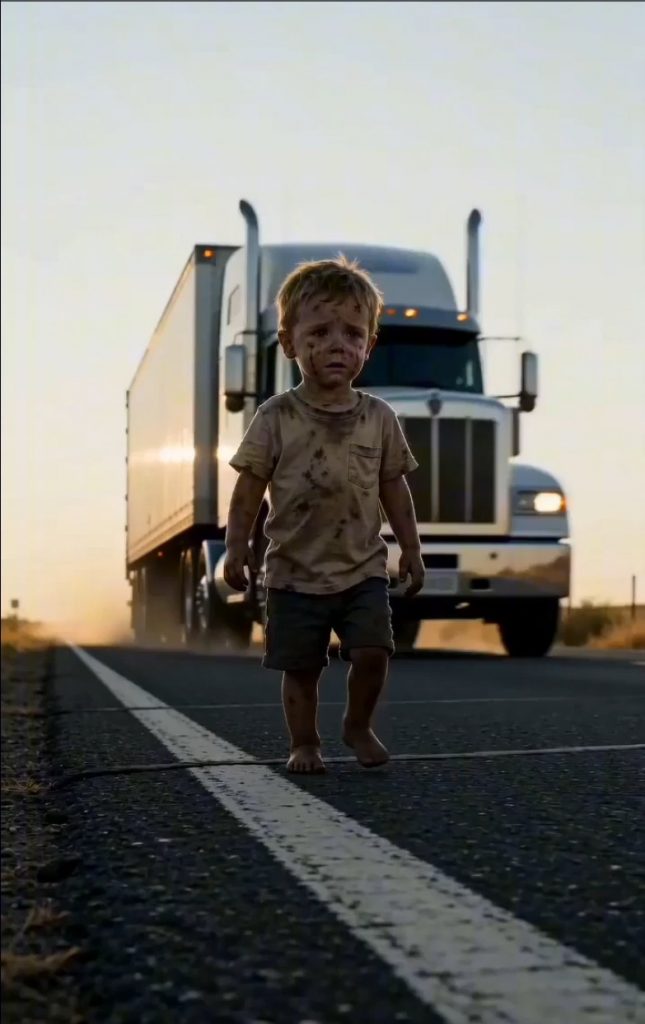
Semi-trucks thundered past him at seventy miles an hour, their wind pushing at his tiny body like invisible hands. Heat shimmered above the asphalt. Golden fields stretched on both sides of the highway, quiet and endless, as if the world beyond the white line had no idea a child was walking between life and death.
He could not have been more than three.
His beige T-shirt was stained with soot and dust. His light-brown hair stuck to his forehead. Dry tear tracks cut pale lines through the grime on his cheeks, but his eyes had gone strangely calm, the way children sometimes look after fear becomes too large for crying.
He walked along the shoulder without looking back.
A white truck blasted past.
The boy staggered.
Still, he kept walking.
Officer Daniel Miller saw him from half a mile away and thought, for one impossible second, that the heat was playing tricks on him.
Then the child lifted one little hand to shield his face from the wind of another passing truck.
Miller slammed the brakes.
His patrol car screamed to a stop ahead of the boy. He threw open the door and ran into the shoulder, one hand raised toward traffic, the other reaching for the child.
“Hey! Hey, little guy! Stop!”
The boy stopped.
Not suddenly.
Not fearfully.
Just as if his body had finally reached the end of the instruction it had been given.
Miller crouched in front of him, keeping himself between the child and the highway.
“Where is your mom?” he asked, trying to keep his voice steady. “Who were you with?”
The boy’s lip trembled.
For the first time, the calm cracked.
He raised one grimy finger and pointed past the wire fence, toward the tall grass bending in the hot wind.
“Mommy is sleeping in the grass,” he whispered. “She won’t wake up.”
Miller’s blood turned cold.
He followed the boy’s finger.
At first, he saw only weeds, sunburned earth, and the shallow ditch beyond the fence. Then something metallic flashed between the grass stalks.
A car.
Hidden deep off the road.
Miller reached for his radio.
Before he could speak, dispatch crackled through.
“Unit 42, be advised. We have an Amber Alert matching that toddler. Suspect is armed and believed to be in the vehicle.”
Miller froze.
The boy’s eyes suddenly moved past him.
His face changed.
Pure terror.
Behind Miller, somewhere on the shoulder, a car door shut with a heavy thud.
And the little boy began to shake.
Act II
His name was Noah Keller.
For the first two years of his life, Noah had known only three safe things: his mother’s arms, the blue blanket she tucked around him at night, and the song she hummed whenever thunder rolled over their small rental house outside Ashton County.
His mother, Rachel Keller, had once been a kindergarten teacher.
People remembered her as gentle, though gentle was not the same as weak. She was the kind of woman who knelt to speak to children at eye level, kept extra snacks in her desk for students who came to school hungry, and wrote birthday cards for kids whose parents forgot.
Then she met Lucas Grant.
Lucas was charming in public. That was the first thing everyone said later, as if charm were an excuse for blindness. He volunteered at charity barbecues. He shook hands with police officers. He wore clean shirts and called older women ma’am.
He also knew how to make Rachel doubt herself in private.
First, he criticized her friends.
Then her clothes.
Then her job.
Then the way she held Noah, fed Noah, comforted Noah.
By the time Rachel understood she was trapped, Lucas had already learned how to sound like the reasonable one.
“She’s emotional,” he told neighbors.
“She gets confused,” he told his sister.
“She panics over nothing,” he told a responding officer one winter night when Rachel called for help and then stood silent in the doorway because Lucas was holding Noah behind him.
That officer had been Daniel Miller.
He remembered Rachel.
Not clearly enough, and that would haunt him.
He remembered her standing barefoot on a porch in the cold, one hand gripping the doorframe, eyes swollen from crying. Lucas had smiled, calm and embarrassed.
“Sorry, officer,” he had said. “She’s been under stress.”
Miller had asked Rachel if she was safe.
She had looked past him at Noah.
Then she nodded.
Miller left that night with a bad feeling and no report strong enough to change anything.
Three months later, Rachel disappeared.
So did Noah.
The Amber Alert came from Rachel’s mother, who had received a voicemail in the middle of the night. No words at first. Only breathing. Then Rachel’s voice, small and shaking.
“Mom, if something happens, look in Noah’s bear. I’m sorry. I tried.”
The line went dead.
By morning, Rachel’s car was gone. Lucas’s truck was gone. Noah’s crib was empty. Lucas claimed Rachel had run off with the child and stolen money from him.
But Rachel’s mother knew better.
She brought the stuffed bear to the police station. Hidden inside the seam was a flash drive.
On it were recordings.
Lucas threatening Rachel. Lucas admitting he had access to a stolen handgun. Lucas saying no court would believe “a nervous little mother” over him. There were also photographs of forged documents and messages showing he had been planning to take Noah across state lines.
That was when the Amber Alert went out.
That was when Miller saw Rachel’s name again.
He had been searching the highways since dawn, guilt riding beside him in the passenger seat.
If he had pushed harder that winter night, maybe Rachel would not have had to hide proof inside a toy bear.
If he had recognized fear instead of waiting for permission to name it, maybe Noah would not be missing.
Then, near mile marker 118, he saw a tiny boy walking beside the white line.
Noah had not wandered there by accident.
Rachel had sent him.
Or pushed him.
Or begged him.
Somehow, in the wrecked silence beyond the fence, a mother had found the strength to send her child toward help.
Now help had arrived.
But so had the man Noah feared most.
Act III
Miller turned slowly.
A black pickup had pulled onto the shoulder twenty yards behind his patrol car.
Lucas Grant stood beside the open driver’s door.
Dust clung to his jeans. His face was scratched from the grass, and his right hand hung too close to his jacket pocket. He looked winded, angry, and far too calm for a man who had supposedly just found a missing child on a highway.
“Noah,” Lucas called gently.
The boy whimpered and grabbed Miller’s sleeve.
Miller shifted his body in front of him.
Lucas smiled.
It was the same smile from Rachel’s porch.
“Officer,” he said. “Thank God. That’s my son.”
Miller’s voice stayed even. “Keep your hands where I can see them.”
Lucas raised both hands halfway.
“He got scared after the crash. I was looking for him.”
“You were in the vehicle?”
Lucas glanced toward the field. “Rachel lost control. I tried to help.”
Noah pressed his face into Miller’s uniform.
“That’s not Daddy,” he whispered.
Lucas heard.
His smile thinned.
Miller’s radio crackled again.
“Unit 42, backup en route. Use caution. Suspect Lucas Grant considered dangerous.”
Lucas’s eyes hardened.
“There’s been a misunderstanding,” he said.
Miller opened the rear door of his patrol car and guided Noah inside without taking his eyes off Lucas. The boy climbed in, clutching the seat with both hands. Miller shut the door but did not lock him away from sight.
“Stay there, buddy,” he said softly. “You’re safe.”
Lucas took one step forward.
Miller’s hand moved to his weapon.
“Don’t.”
The highway roared beside them. Cars passed too fast to understand the scene. To them, it was only a patrol car, a man on the shoulder, a hot afternoon. They did not know a mother was somewhere in the grass. They did not know a child had walked through danger carrying the only message he knew how to say.
Mommy is sleeping.
She won’t wake up.
Miller needed backup.
He also needed to reach Rachel.
Every second mattered.
Lucas looked toward the field, then back at Miller. That glance told Miller something terrible.
Rachel might still be alive.
And Lucas was afraid she might speak.
Miller spoke into his radio without looking away.
“Dispatch, I have the child secured. I have the suspect on the shoulder. Possible victim in the ditch east of my position. Send medical now.”
Lucas’s face changed at the word victim.
“She’s gone,” he said too quickly.
Miller heard the mistake.
“You checked?”
Lucas said nothing.
From inside the patrol car, Noah suddenly began tapping the glass with one small hand.
“Mommy gave me the light,” he cried.
Miller looked back for only a second.
Noah was pointing to his own shoe.
A tiny red light blinked from inside the Velcro strap.
Not a toy.
A child GPS tag.
Rachel had hidden it in his shoe.
Miller understood then.
She had not only sent Noah walking.
She had made sure someone could find where he came from.
The signal had led dispatch to the highway. The child had led Miller to the field. And now the truth was hidden in the grass between them.
Lucas lunged.
Miller moved faster.
He took Lucas down against the side of the patrol car and pinned his arm before he could reach into his pocket. The struggle was brief, violent, and over almost as soon as it began. No shots. No hero speeches. Just training, fear, and the desperate knowledge that a child was watching through the glass.
Miller cuffed him as backup sirens wailed in the distance.
Then he ran for the fence.
Act IV
The ditch was deeper than it looked from the road.
Miller climbed over the wire fence and pushed through the tall grass, following the glint of metal. The car lay half-hidden below the slope, angled into brush, its front end crumpled against a cottonwood tree.
He kept his voice steady because Noah might still hear him from the shoulder.
“Rachel! Rachel Keller! Can you hear me?”
For one terrible moment, there was only wind.
Then a sound came from the grass beside the car.
Not a word.
A breath.
Miller dropped to his knees.
Rachel lay partly shielded by the tall weeds, one arm stretched toward the highway. Her face was pale, streaked with dust, but her eyes opened when he touched her shoulder.
“Where’s Noah?” she whispered.
“He’s safe,” Miller said. “He found me.”
Her eyes filled.
“He walked?”
“He walked.”
A tear slipped down her temple.
“My brave boy.”
Miller checked her carefully, afraid to move her too much before medics arrived. She was hurt, exhausted, fading in and out, but alive. Alive enough to speak. Alive enough to point weakly toward the wrecked car.
“My phone,” she whispered. “Under the seat. Recording.”
Miller looked toward the car.
Rachel’s fingers tightened around his sleeve.
“He ran us off the road,” she said. “He thought no one saw. But I recorded it.”
Miller swallowed.
The sirens grew louder.
“Save your strength.”
“No.” Her eyes sharpened with the last of her fear. “He always sounds innocent first.”
That sentence hit Miller like judgment.
He nodded.
“I know.”
The medics arrived within minutes, cutting through the fence and moving down the slope with stretchers and emergency bags. Miller stayed beside Rachel until they lifted her, until she heard again that Noah was alive, until her eyes finally closed from relief instead of fear.
At the patrol car, Noah screamed when he saw the stretcher.
Not because he was afraid of his mother.
Because he wanted her.
A paramedic wrapped him in a silver emergency blanket and carried him close enough for Rachel to hear his voice.
“Mommy!”
Rachel’s hand moved.
Barely.
Noah saw it and stopped crying all at once.
“She waked up,” he whispered.
Miller turned away for one second.
Only one.
Because he had a job to do, and because if he let himself feel the whole weight of that moment, his knees might not hold.
Lucas was already in the back of another police car, his face pressed to the window, shouting that Rachel was unstable, that she caused the crash, that he had tried to save them.
Then a deputy held up Rachel’s phone in an evidence bag.
Lucas stopped shouting.
The recording did exactly what Rachel said it would.
It caught his voice.
His threats.
The sound of her telling him Noah was in the car.
The impact was not shown to the public later, and it did not need to be. The audio was enough. The GPS records were enough. The hidden flash drive in the stuffed bear was enough. The marks through the field where Lucas had dragged himself away and left Rachel behind were enough.
But for Miller, the strongest evidence was still the smallest.
A toddler walking along a highway because his mother had told him to find help.
Act V
Noah spent that night in the pediatric wing with a nurse sitting by his bed and a stuffed bear tucked under his arm.
He had no serious injuries.
That was the miracle everyone repeated because it was easier than saying the rest aloud.
Rachel survived surgery.
Her recovery would be long. Her body needed time. Her mind needed more. But when she woke fully two days later, the first thing she asked for was Noah, and the second was Officer Miller.
Miller came into the room still in uniform, though he had not slept much since the highway.
Rachel looked smaller in the hospital bed, but her eyes were clear.
“I remember you,” she said.
He nodded.
“I remember you too.”
“You came to the house.”
“I did.”
Rachel looked toward the window.
“I wanted to tell you.”
“I know.”
“No,” she said softly. “You don’t. I wanted to. But Noah was inside. Lucas had him. I thought if I said the wrong thing…”
Her voice broke.
Miller stepped closer.
“I should have known.”
Rachel turned back to him.
“You know now.”
That did not absolve him.
But it gave him a place to begin.
The case against Lucas Grant became impossible to bury. The Amber Alert records, Rachel’s recordings, the phone from the crash, the GPS tag in Noah’s shoe, and Miller’s body camera on the shoulder all spoke louder than Lucas ever had.
The department reviewed the old porch call.
Miller requested it himself.
He did not hide behind procedure. He stood before the review board and said the words no officer likes to say.
“I missed it.”
Then he said something harder.
“I believed calm more than fear.”
That line became part of new training in the county.
Not because one sentence fixes a system.
Because someone finally admitted what had gone wrong.
Rachel and Noah moved in with Rachel’s mother after leaving the hospital. The house had yellow curtains, a fenced yard, and locks Lucas did not have keys to. Noah slept badly at first. He woke crying for the road, for trucks, for grass, for Mommy sleeping.
Rachel would hold him close and whisper, “I woke up. I’m here.”
Sometimes he believed her.
Sometimes he needed to hear it ten times.
Officer Miller visited once a week at first, officially to update Rachel on the case. Then less officially, to bring Noah toy cars, coloring books, and a little reflective vest because Noah had become obsessed with making sure people could see him.
The first time Noah laughed again, it was at Miller’s patrol car.
He pointed to the flashing lights and shouted, “Big blinkers!”
Rachel cried in the doorway.
Miller pretended not to see, because some moments deserve privacy even when they happen in plain sight.
Months later, the trial began.
Lucas wore a suit and tried to look like a man misunderstood by chaos. His lawyer suggested Rachel had been confused. Emotional. Unreliable after trauma.
Then the courtroom heard Noah’s tiny voice from Miller’s body camera.
Mommy is sleeping in the grass.
She won’t wake up.
No one moved.
The recording did not show fear in dramatic language. It showed something worse: a child too young to understand danger, carrying the truth because every adult system had failed before he did.
Rachel testified once.
Miller testified after her.
Lucas was convicted.
When the sentence was read, Rachel did not smile. Justice, she had learned, was not joy. It was a locked door between her child and the man who had taught him terror.
Afterward, outside the courthouse, Noah stood between Rachel and Miller wearing his small reflective vest over a dinosaur shirt.
A truck passed on the street.
He flinched.
Rachel knelt immediately.
Miller stepped back, giving them space.
Noah looked at his mother and touched her cheek as if checking she was real.
“You awake?” he asked.
Rachel’s eyes filled.
“Yes, baby,” she whispered. “I’m awake.”
He nodded seriously.
Then he turned to Miller.
“I walked good.”
Miller crouched to meet his eyes.
“You walked very good.”
Noah seemed satisfied with that.
Years from then, people in Ashton County would still talk about the toddler on Highway 16. Some would call it a miracle. Some would call it luck. Some would say a mother’s love guided him through the heat, the trucks, and the terror.
Rachel never argued.
She knew what had guided him.
A blinking light hidden in a shoe.
A stuffed bear full of proof.
A little boy brave enough to keep walking.
And a police officer who, when given a second chance to listen, finally did.
On the first anniversary of the rescue, Rachel took Noah to the field near mile marker 118. The fence had been repaired. The grass had grown back. Cars rushed by, indifferent as ever.
Rachel held Noah’s hand tightly.
“Is this where I found help?” he asked.
She looked at the white line, the shoulder, the golden fields, the place where her life had nearly ended and begun again.
“Yes,” she said. “This is where you found help.”
Noah looked up at her.
“And you waked up.”
Rachel lifted him into her arms.
“I did.”
Behind them, Officer Miller parked quietly on the shoulder, lights off this time. He did not interrupt. He simply stood watch, one hand resting on the hood of his patrol car, while mother and child faced the road that had tried to take them apart.
The wind moved through the grass.
The trucks roared past.
But Noah was not walking alone anymore.